
Results
-
 £82.28
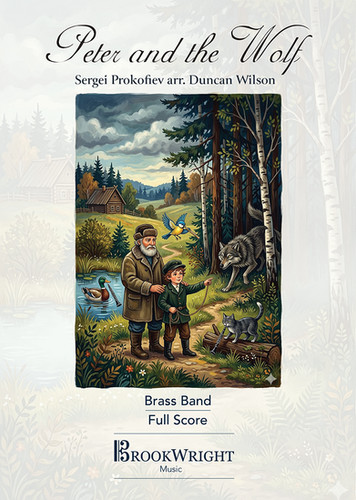
Peter and the Wolf (Brass Band, Narrator & Soloist) Prokofiev arr. Duncan Wilson
In 1936, Sergei Prokofiev was commissioned by Natalya Sats and the Central Children's Theatre in Moscow to write a musical symphony for children. Drawing from various sources, he created Peter and the Wolf, a work designed to introduce young audiences to the instruments of the orchestra. Prokofiev conducted both the Moscow premiere in May 1936 and the first English-language performance in Boston in 1938. In this adaptation for brass band, Duncan Wilson has abridged the original 25-minute score into a concert-friendly 18-minute version. All core material and principal themes remain intact. While the full band represents the character of Peter, the arrangement suggests seating the four other main characters (Bird, Duck, Cat, and Grandfather) slightly apart from the main ensemble. To enhance the performance, players may choose to develop their characters using costumes and accessories. To view a rolling score video please visit https://youtu.be/l8aXh-LiWb4 Duration: approx. 18 minutes Difficulty Level: 2nd Section + This PDF download includes the full score and parts. Sheet music available at www.brassband.co.uk (UK) or satradecentral.org (USA) Instrumentation Notes The Cat: Written for baritone, though bands may substitute a euphonium if preferred. If this substitution is made, the 1st baritone player should read the euphonium part. Instrumentation: Narrator The Bird (Soprano Cornet Eb) The Duck (Flugel Horn Bb) The Cat (Baritone Bb) Grandfather (Bass Eb) Solo Cornet 1&2 Bb Solo Cornet 3&4 Bb Repiano Cornet Bb 2nd Cornet Bb 3rd Cornet Bb Solo Horn Eb 1st Horn Eb 2nd Horn Eb 2nd Baritone Bb 1st Trombone Bb 2nd Trombone Bb Bass Trombone Euphonium Bb 2nd Bass Eb Bass Bb Timpani Percussion (2 players): Snare Drum, Bass Drum, Cymbals (clash and suspended), Woodblock, Triangle, Whip, Mark Tree, Glockenspiel, Xylophone & Tubular Bells
In Stock: Estimated dispatch 1-3 working days
-
£50.00
The Typewriter (Score & Parts) - Leroy Anderson
The Typewriter arranged for brass band by Andrew Duncan as a cornet or xylophone solo, is probably most recognised now as the theme tune to the long-running BBC Radio 4 show The News Quiz. Brass Band Grade 4: Advanced Youth and 3rd Section. Duration: 4 minutes.
In Stock: Estimated dispatch 1-3 working days
-
 £33.91
Gimme A Minute (or so) Eb Tenor Horn - Kevin Ackford
Score & Parts Best described as a Xylophone style solo written for Tenor Horn. Kevin wrote this as a finale to his guest soloist performance at his 50 Years A Bandsman concert and dedicated to the memory of John Holland his music teacher from his school days who passed away a few months before the concert took place. Also available with piano accompaniment.
Estimated dispatch 5-7 working days
-
 £50.00
Happy Go Lucky - Willy Hautvast
The public love the xylophone, so for all you xylophonists out there, here is a fresh and fun new composition for those of you who want a piece that doesn't require a top level of technique.
Estimated dispatch 10-14 working days
-
 £10.00
Kopanitsa
DescriptionKopanitsa was commissioned by Gavin Pritchard, who is also the work's dedicatee and gave the first performance with the Tongwynlais Temperance Band conducted by Gareth Pritchard at the Butlins Mineworkers Championship on 20 January 2008, winning the prize for best soloist as a result. He has recorded it on the CD "Enter the Galaxies" accompanied by the Cory Band conducted by Robert Childs.Gavin had requested a virtuoso showpiece featuring as many instruments as possible. The solo part is therefore written for vibraphone (bowed and struck), 10 x tuned tom toms, 5 x suspended cymbals plus hi-hat and a xylophone. The soloist's 'choreography' therefore forms an integral part of the performance. This can be seen to great effect in Gavin's performance of the work at the 2013 Brass in Concert Championship with Tredegar Band, available on the DVD of the event from World of Brass. A 'kopanitsa' is a Bulgarian folk dance that traditionally features two slow beats and two quick beats, reflected in the central 10/8 section. The music is deliberately Balkan in character, using the characteristic modes of Greek and Bulgarian folk music, and accelerates regularly to finish at breakneck speed. The tom-tom section marked 'ad lib.' after [D] can be improvised if the soloist wishes.You can follow the score in the preview video below!
Estimated dispatch 7-14 working days
-
 £34.95
Jack in a Box - Paul Lovatt-Cooper
A fun xylophone solo commissioned by the Bilton Silver (Rugby) band for talented up and coming percussionist Jack Fisher. Circa 2'30". Soloist: Grade 5 ABRSM.
Estimated dispatch 10-14 days
-
£34.95
Rondo Alla Turk - Paul Lovatt-Cooper
Mozart is one of my favourite composers and his Rondo Alla Turk has been a popular concert piece for many performers the world over. This is an arrangement I have done for solo xylophone that shows off the technical dexterity of both the piece and the instrument. Circa 3'10". Soloist: Grade 8 ABRSM.
Estimated dispatch 10-14 days
-
 £24.95
Skeletonality - Rodney Newton
Skeletonality was written for the virtuoso percussionist, Dave Danford and is a tribute to the late Teddy Brown, a popular variety artist of the 1920s and 30s. From 1917 to 1925, Teddy Brown was drummer and xylophone soloist with a...
Estimated dispatch 5-7 working days
-
 £30.00
Janacek's 'Taras Bulba' - Janacek
Comments from Tim Paton, the arranger of Janacek's 'Taras Bulba': "I will never forget the day in 1967 when I was introduced to the music of Leos Janacek, a Czech composer born in 1854, who died in 1928. Janacek was little known in Britain until the 1960's, when the conductor Charles Macherras introduced his unique music. I heard a recording of Macherras conducting the Pro Arte Orchestra in a performance of Janacek's "Sinfonietta".It was in 1969 that I first heard Janacek's Symphonic Rhapsody, "Taras Bulba".Janacek's music is exciting, powerful, emotive, impassioned and unpredictable.I have taken the first and third movements of this piece, and adapted them for Brass Band, which was at times extremely difficult, but rewarding. It sometimes took up to an hour to be satisfied that a mere several bars had been reproduced to convey the composer's intentions.The Death of AndriThe Cossaks, under the leadership of Taras Bulba, are fighting against the Poles in the 17th century. Taras's son Andri seeks to rescue his love, a Polish princess, from a city which is being besieged by the Cossaks. Having found her, he throws in his lot with the Poles, but is finally captured by his father, who executes him as a traitor before riding off again to battle.Prophesy and Death of Taras BulbaTaras himself is finally captured and condemned to be nailed to a tree and burned alive. As the flames creep around him, Taras has the satisfaction of seeing histroops escape, and as he dies, sees a vision of his country freed at last.This is incredibly descriptive music. The mood is constantly changing, creating feelings of love and anger, celebration and melancholy, despair and triumph.This Brass Band EditionThe duration of the original symphonic rhapsody, three movements, is approximately 23 minutes. I chose the first and third movements, so the Brass Band edition is approximately 14 minutes. The main reason is twofold: Being realistic about the demands this music would place on the stamina of the brass player; Keeping the piece less than 15 minutes, so that, if desired, it could be used on the contest platform.Two unique qualities of Janacek's music had to be taken into account when preparing this brass band version. His compositional technique was individual, at times not sticking to traditional expectations, in both form and orchestration. I imagined what the genius himself would have said looking at my work, and how to tackle a particular section to emulate his original intentions. This was particularly the case when dealing with high woodwind and violin parts, the use of tremolo in string parts, and the orchestral harp.Percussion: Janacek included timpani, side drum, cymbals, triangle and tubular bells. For reasons stated previously, I have also included xylophone and glockenspiel. I have also added the gong in a couple of places to enhance the dramatic effect of the music.
In Stock: Estimated dispatch 3-5 working days
-
 £62.00
Montage (Score only) - Peter Graham
Each of the movements of the symphony take as their starting point forms originating in music of the 16th and 17th centuries. The first, an intrada, introduces the main thematic material (based on the interval of a minor third) in its embryonic state. As the piece progresses, this material is developed and manipulated in a variety of ways. The interval of the third remains central to the overall scheme of the work, even unifying the three movements on a tonal plane (I: F (minor); II: A flat (major); III: C flat (minor). The internal structure of the intrada is an arch form: ABCBA, roughly modelled on the first movement of Concerto for Orchestra by Witold Lutoslawski, to whose memory the movement is dedicated. A chaconne follows - the basic material now transformed into expansive solo lines underpinned by a recurring sequence of five chords (again, a third apart). The movement's structure combines both ternary form and golden section principles and the chaconne's continuous cycle of chords may be visualised as circles. The final movement, a rondo, bears the dramatic weight of the entire work, as the underlying tonal tensions surface. A musical journey ensues, making diversions through lyrical territories as well as through more spiky, jazz-flavoured ones. The aural (and visual) montage is perhaps most apparent towards the climax of the piece, where three keys and polyrhythms sound simultaneously in the upper brass, xylophone, horns, and timpani. The climax itself combines the lyrical music heard earlier with the rondo theme, now presented by cornets and trombones in canon. The teleological thrust of the movement (if not the entire work) can be symbolized by the flight of an arrow, as it steers a predetermined course towards its target. Duration: 16:00
Estimated dispatch 7-9 working days
 View Music