Results
-
 £15.00
Visions of Gerontius (Brass Band - Study Score)
Visions of Gerontius is a set ofvariations on a hymn tune which is invariably associated with Cardinal John Henry Newman 's words taken from his visionary poem "The Dream of Gerontius", which deals with the journey of the soul from this world to the next. The stanzas of the hymn are taken from the poem which Elgar set to music in his great masterpiece of the same name, for soloists, chorus and orchestra, first performed in Birmingham in 1900. The dramatic setting of those words provides some of the most memorable moments in the music
Estimated dispatch 7-14 working days
-
£89.95
Visions of Gerontius (Brass Band -Score and Parts)
Visions of Gerontius is a set of variations on a hymn tune which is invariably associated with Cardinal John Henry Newman 's words taken from his visionary poem "The Dream of Gerontius", which deals with the journey of the soul from this world to the next. The stanzas of the hymn are taken from the poem which Elgar set to music in his great masterpiece of the same name, for soloists, chorus and orchestra, first performed in Birmingham in 1900. The dramatic setting of those words provides some of the most memorable moments in the music.
Estimated dispatch 7-14 working days
-
 £29.95
St. Andrew's Variations (Score Only)
This piece, written for the East Anglian Brass Band Festival in 1998, takes the form of eight variations and a finale, loosely based on the descending third motif heard in the initial theme. It was initially composed for junior band, and expanded and rescored for full band in 2006. There is no significance in the title, other than the fact it was written by a Scotsman to be played in the St Andrew's Hall, in Norwich!Alan Fernie was born and brought up in the Scots mining village of Newtongrange. From the age of 13 he learned to play the trombone both at school and with the local brass band, going on to study music in Glasgow and London. After a short period working as an orchestral musician, Alan moved into instrumental education, spending over 20 years teaching brass in schools all over the East of Scotland. It was during this time that he began to conduct and he has since directed bands at all levels, winning many awards. He first wrote for brass whilst still a student, and his music is now played, recorded and published throughout the world.In 2009, Alan was honoured with the "President's Award" from the Scottish Brass Band Association for services to banding. He is also proud to be associated as composer in residence with the acclaimed charity "Brass for Africa", with whom he spent two months recently teaching in Kampala, Uganda. Living in the Scottish Borders, Alan now works as a freelance musician, finding time to write, teach, conduct, judge, perform and act as compere throughout the UK and beyond.
Estimated dispatch 7-14 working days
-
 £34.95
Song of the Night Sky - Christopher Bond
Orpheus is known as the most talented music player of the ancient times. It is said that god Apollo was his father, from whom took his extreme talent in music, and the Muse Calliope was his mother. Tragedy struck when his wife, Eurydice stepped on a viper which in turn bit her, injecting its fatal venom. Nothing could stop his cries of anguish and sheer pain and sorrow upon realizing his beautiful Eurydice was dead. Orpheus decided to go into the Underworld to get his wife back. Apollo, his father, would talk to Hades, the god of the Underworld to accept him and hear his plea. And so Orpheus set off into the Underworld and was warned that for no reason must he look back while his wife was still in the dark, for that would undo everything he hoped for. As Orpheus was reaching the exit of the Underworld, he could hear the footfalls of his wife approaching him. As his was approaching the exit, his heart was beating faster and faster. The moment he stepped on the world of the living, he turned his head to hug his wife. Unfortunately, he got only a glimpse of Eurydice before she was once again drawn back into the underworld. When Orpheus turned his head, Eurydice was still in the dark, she hadn't seen the sun and, was drowned back to the dark world of the dead. Waves of anguish and despair swept over him and shuddering with grief he approached the Underworld again but this time, he was denied entry, the gates were standing shut and god Hermes, sent by Zeus, wouldn't let him in. His songs were no more joyful but extremely sad. His only comfort was to lay on a huge rock and feel the caress of the breeze, his only vision were the open skies. Song of the Night Sky was recorded by Tom Hutchinson and the Cory Band in June 2015, featuring on his debut solo album.
Estimated dispatch 10-14 working days
-
£90.00
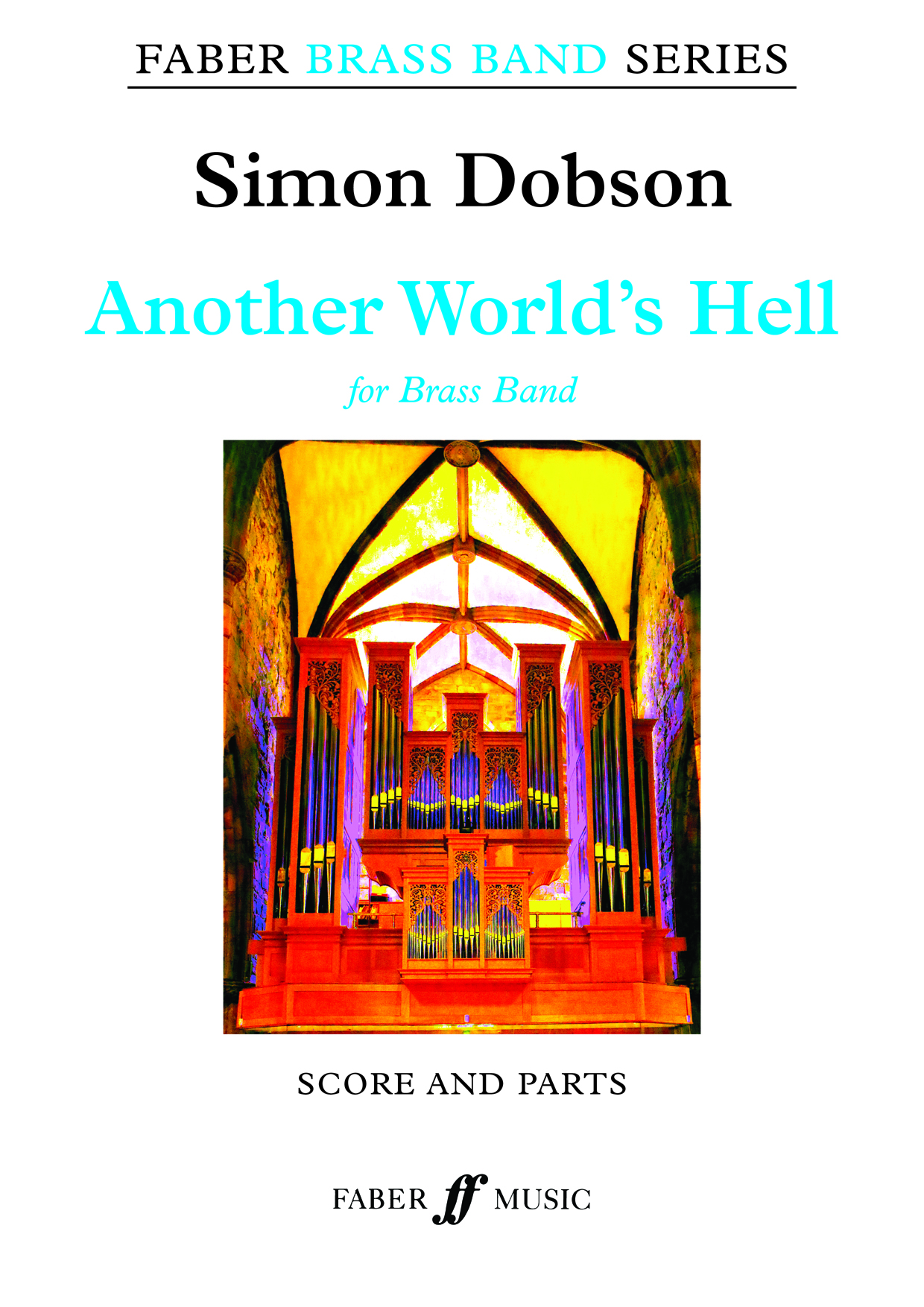
Another World's Hell - Simon Dobson
Another World's Hell was commissioned in versions for brass, wind and fanfare bands by the Socit Cantonale des Musiques Vaudoises and the Association Cantonale des Musiques Neuchteloises for the 2013 Swiss Cantonales festivals. It is inspired by a passage in Aldous Huxley's classic 1932 science-fiction novel Brave New World, which describes in unusually close detail the music that is being played at a dance. This is Dobson's interpretation of the imagined 'future music' that Huxley dreamed of.Brass Band Grade 5Duration: 13 minutes, Score & Parts
In Stock: Estimated dispatch 1-3 working days
-
 £34.99
Submerged... (Cornet Concerto No.2) - Jonathan Bates
'Submerged..' is a virtuoso concerto for Cornet composed as a response to the 'lost' Derbyshire villages of Ashopton & Derwent,. both of which were drowned in the early 1940's to make way for a new reservoir to aid the ever-increasing water demand from nearby. Sheffield and it's steel industry during World War 2. The work is through-composed but is defined by 3 clear main sections, 'The . Packhorse Bridge, Derwent', 'Ashopton Chapel' and 'Operation Chastise'. Much of the melodic and harmonic material throughout the. concerto is inspired by 3 contrasting sources; an original motif of towering block chords which opens the concerto, the famous opening. fragment of Eric Ball's 'High Peak' (1969) which was composed as a tribute to the district of Derbyshire where Ashopton & Derwent lie, . and finally Claude Debussy's haunting 'La Cath drale Engloutie' or 'The Sunken Cathedral', which was composed in 1910 around the legend of. the submerged cathedral of Ys. . I. Packhorse Bridge, Derwent (1925). One of the most striking features of the former village of Derwent was it's Packhorse Bridge, which spanned the River Derwent. adjacent to the Derwent Hall - a grand, picturesque Jacobean country house. In 1925, the renowned impressionist artist Stanley. Royle painted a striking image of the two in midwinter, with the partially frozen river sat quietly underneath the snow-topped. bridge in the foreground, while the old hall sits peacefully and dark in the background. The opening setion of this concerto paints. this picture in a quite schizophrenic manner; with frosty, shrill march-like material picturing the villagers crossing the narrow icy. bridge, combined with wild and frenzied waltz music of the grand hall and it's masquerade balls laying, for now, quietly mysterious. across the river. . II. Ashopton Chapel (1939). Ashopton was much the smaller and less-populated of the 2 'lost' villages, but still bore home to a Roman Catholic Chapel which was. the focal point of the village. The chapel - along with the rest of Ashopton - was drowned in 1943, but the final service to take place there. was held in 1939, with the final hymn being 'Day's Dying in the West'. This hymn forms a haunting coda to the 2nd section, with firstly the . piano leading the melody before an audio track containing an old recording of the hymn is accompanied by the sound of flowing water and . the rumble of storms as the village hypothetically disappears from existence with the hymn tune still echoing around the valley, before . subsiding into the growing roar of the engine of a Lancaster Bomber as it soars overhead towards Derwent to practise it's 'Dam-Buster' raid. . III. Operation Chastise (1943). The Derwent Reservoir lies adjacent to Ladybower Reservoir (of which Ashopton & Derwent were flooded to make way for) in the . Derbyshire High Peak, and during the 2nd World War was used as one of the central low-atitude practise areas of the 617 Squadron - more . commonly known affectionately as the 'Dambusters'. Before the destruction of Derwent, it's 'Packhorse Bridge' was dismantled stone by stone . and re-assembled upstream at Howden Dam to the north end of Derwent Reservoir. This is where the music begins, with a reconstruction of . the opening material before taking flight into a whirlwind tour of virtuosity from the soloist. .
In Stock: Estimated dispatch 1-3 working days
-
 £15.00
Anvil Chorus from Il Trovatore - Verdi
Programme Notes from Andrew Duncan:Like many of the arrangements in the Flexi-Collection - Popular Classics Series I have simplified the rhythms and time signature, etc. I have also omitted trills for ease of playing.Dynamics form a very important aspect of this arrangement and it is important to observe these, especially the p markings. Every dynamic from p through to ff is used as well as some crescendos.The 1st Cornet/Trumpet part is perhaps more difficult than in some of the other arrangements in the series, but the other parts are fairly simple in comparison.The Percussion part (which is optional) is unusual in that it calls for two 'Anvils' to be played. However if these are not available then a good effect can be obtained by hitting two pieces of metal with metal hammers.The Flexi-Collection ApproachFlexible scoring tailored to your needs - A perfect solution for expanding the repertoire of training and junior brass bands. The Flexi-Collection currently offers two series - Popular Classics and World Tour. Based on four-part harmony, these collections provide groups with the advantage of complete flexibility when they may not be balanced. If players or instruments are missing, the show can still go on!The Flexi-Collection - Popular Classics Series, encapsulates all that is great about the wonderful range of musical styles produced by Holst, Elgar, Handel, Verdi, Tchaikovsky, Grieg, Bizet and Parry.The thoughtful scoring and arranging by Andrew Duncan now means that groups of all abilities have access to a truly flexible set of music for their needs. With world parts, rudimentary theory, terminology translations and large format typesetting, The Flexi-Collection ticks all the boxes when it comes to bringing interesting music to the training and junior band/brass group environment.Available for Brass Band - The Flexi-Collection offers flexibility in every sense of the word.(Available individually or as part of the money-saving Flexi-Collection Popular Classics Album)
In Stock: Estimated dispatch 3-5 working days
-
 £75.00
De Profundis - john wallace, Tony George
An original composition for massed brass bands and brass quintet devised by John Wallace, Tony George and Svend McEwan-Brown. A cross-genre production work, including scene setting, lighting and the spoken word reciting associated poems, De Profundis was given its world premiere at the East Neuk Festival on 1 July 2017 at The Bowhouse, performed by The Wallace Collection, Tullis Russell Mills Band and friends.If you would like to perform this work, The Wallace Collection are able to provide production consultancy and supply the brass quintet elements of the production - if you would like to discuss potential performances, please contact them direct on [email protected] NotesDe Profundis is a large scale brass band performance piece created by John Wallace and Tony George, based upon an original idea by Svend McEwan-Brown. It was developed in sessions with members of the Tullis Russell Mills Band, commissioned and premiered at East Neuk Festival 2017 at The Bowhouse, St Monans, on 1st July 2017.It was supported by Creative Scotland, Fife Council, Toby and Kate Anstruther, Shields and Carol Henderson, Donald and Louise MacDonald.This project remembers and celebrates the lives and music of miners. It is designed to give brass bands a performance piece that uses elements of improvisation and participation, to offer the players a stimulating and inspiring experience beyondthe normal run of brass band repertoire.All the music is drawn from two settings of the psalm 'Out of the Deep" (De Profundis).Look and Listen (courtesy of Tullis Russell Mills Band and The Wallace Collection at 2017 East Neuk Festival):More InformationMore details about the De Profundis project is available on a dedicated web-page on The Wallace Collection website.
In Stock: Estimated dispatch 3-5 working days
-
 £55.00
Triumph Series Brass Band Journal, Numbers 1359 - 1362, March 2024
1359: Festival March - Coastal Celebration (Sam Creamer)Coastal Celebration was commissioned in 2019 by Nambour Salvation Army Band for the Corps' 125th anniversary celebrations. Nambour was the birthplace of The Salvation Army's work on the Beautiful Sunshine Coast in Queensland, Australia. Firring with this theme are subtle tributes to iconic Sunshine Coast landmarks, referenced with small phrases of popular secular melodies intertwined with the main tunes What a faithful God (S.A.S.B. 378) and All through the years (S.A.S.B. 826).1360: He's always been faithful (Craig Woodland)This meditative selection is an arrangement of the song by American singer and record producer Sara, Groves, He's always been faithful. The words express the joy and thankfulness in having a relationship with Jesus and knowing his presence in life. The melody and motifs of the traditional hymn, Great is thy faithfulness (S.A.S.B. 26), are heard throughout.1361: Christ's living water (Dean Jones)Christ's sacrificial love has been beautifully portrayed through the imagery of water in many songs, none more so that the skilfully crafted words we find in the chorus of I know a fount (S.A.S.B. 197), written by Oliver Cooke. To enhance the sentiments expressed, the pure sounds derived from Handel's Water Music fit perfectly in terms of music and imagery.1362: March - Fear Not! (Avelan Ntsiete)The Salvation Army continues to proclaim its music ministry in all corners of the world and, with this item under review, we introduce a new composer, originally from Congo Brazzaville, Central Africa. Avelan Ntsiete is currently a Bandsman at the Lilas Corps in Paris but has previously served in the Congo Brazzaville Territorial Band. This march, in traditional format, was written for an evangelistic campaign in Kindamba, where civil war has brought upheaval to the area and uncertainty for the local Salvationists. The composer was part of a small brass group which travelled for over 24 hours by truck and on foot to reach Kindamba and bring encouragement to the Salvationists within that community.
Estimated dispatch 7-14 working days
-
 £59.95
Judd: Quest
'Quest' was originally written for the Territorial Youth Band (UK) in 2012. It is a major work in three movements, Movement 1: Making a difference, Movement 2: Making time and Movement 3: Making progress. The music essentially charts the journey of the Christians life. The music commences with Ray Steadman-Allen's choral work and testimony 'So this is it! My day for living!' and has references and then a presentation to the tune 'Southport' associated with the words 'To serve the present age my calling to fufil'. The music displays the struggle of the Christian in maintaining a witness within this world. The second movement is a reflective and prayerful setting of the song 'This day' found in the Sing to the Lord journal. The imposing third movement features the tune 'Trust in God' with the associated words 'As the weary way of life we journey'. The piece has been recorded by the International Staff Band under the same title (SPS330)
Estimated dispatch 7-14 working days