
Results
-
 £77.00
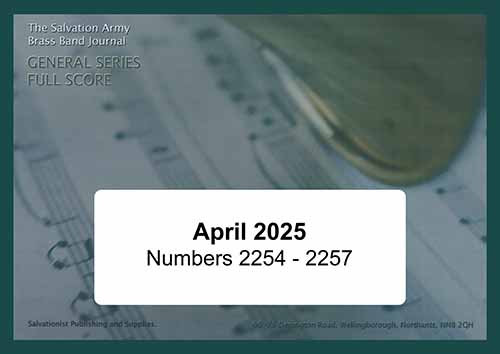
General Series Brass Band Journal, Numbers 2254 - 2257, April 2025
2254: Be glorified today (Martin Cordner)Built around Bob Kilpatrick's song In my life, Lord, be glorified today (S.A.S.B. 593), this concert opener was composed for Cambridge Citadel Band (UK and Ireland Territory) at the request of Bandmaster Simon Fisher. The piece pays homage to the city.2255: Driven by mission (Stephen Bulla)Stephen Bulla wrote this piece to commemorate Willis Howell and his wife's retirement from active officership. Bulla references St. Denio (S.A.S.B. 37), Melita (T.B. 442), For your mission and Men of Harlech (T.B. 756), and the assembling of the tunes and all they represent reflects the masterful artistry that always marks Bulla's works.2256: The Lord's my shepherd (Paul Sharman)This arrangement brings together two settings of Psalm 23; the familiar hymn tune Crimond (T.B. 68) and the more recent melody by Stuart Townend (T.B. 863).2257: Cornet Solo - I love you, Lord (Ian Robinson)Laurie Klein's chorus I love you, Lord (S.A.S.B. 369) has been popular for many years with Salvation Army congregations around the world and this work combines unconventional harmonies with sparse scoring to feature the soloist.
Estimated dispatch 7-14 working days
-
 £15.00
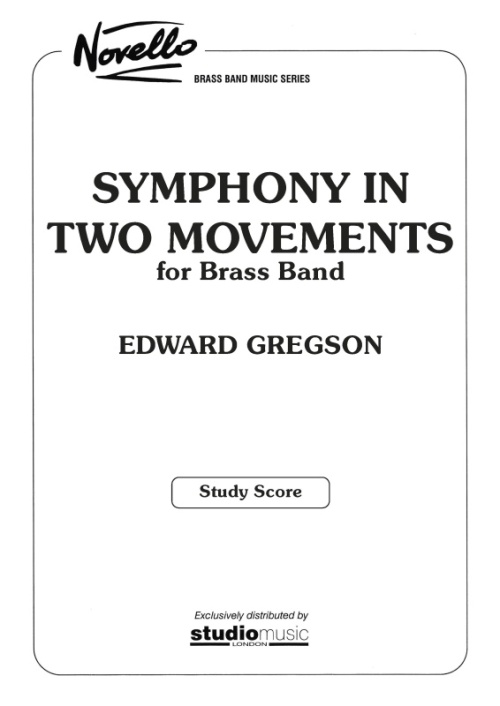
Symphony in Two Movements (Study Score Only)
Selected as the Championship Section test piece for the National Brass Band Championships of Great Britain 2025This work was jointly commissioned by the National Youth Brass Band of Great Britain (NYBBGB) and the National Youth Brass Band of Wales (NYBBW), the latter with funding from T Cerdd (Music Centre Wales), to celebrate their 60th and 30th anniversaries respectively. The first performances were given at Cadogan Hall, London, in April 2012, by the NYBBGB, conducted by Bramwell Tovey; and at the Great Hall, Aberystwyth University, in July 2012, by the NYBBW, conducted by Nicholas Childs.When I was approached about a joint commission to write a new work to celebrate the anniversaries of these two outstanding youth bands I was delighted to accept, and decided to respond by writing a work apposite for the magnitude of these special occasions, namely a 'symphony for brass'.Through a long journey of writing music for brass band, which commenced with Connotations (1977), and continued with Dances and Arias (1984), Of Men and Mountains (1991), The Trumpets of the Angels (2000) and Rococo Variations (2008), I arrived at what I regard as the most important work of the cycle to date, combining as it does serious musical intent with considerable technical demands. It is perhaps my most abstract work for brass band, avoiding any programmatic content.The symphony lasts for some 19 minutes and is structured in two linked movements. The form is based on that used by Beethoven in his final piano sonata (Op.111), which is in two movements only: a compact sonata-form allegro, followed by a more expansive theme and four variations. Prokofiev also adopted this model in his 2nd Symphony of 1925.The opening Toccata of this Symphony is highly dramatic but compact, whilst still retaining the 'traditional' structural elements of exposition, development and recapitulation; indeed, it also has the 'traditional' element of a contrasting second subject - a gentle, lyrical modal melody first heard on solo cornets.In contrast, the longer and more substantial second movement Variations is built around a theme and four variations. The slowly unfolding chorale-like theme accumulates both added note harmony and increasing instrumentation, whilst the four variations which follow are by turn mercurial (fast, starting with all the instruments muted), march-like (menacing, with short rhythmic articulations underpinning an extended atonal melody), serene (a series of 'romances' for solo instruments alongside echoes of the chorale) with an emerging theme eventually bursting into a climax of passionate intent; whilst the final variation is a dynamic scherzo (concertante-like in its series of rapid-fire solos, duets, trios and quartets) with the music gradually incorporating elements of the main ideas from the first movement, thus acting as a recapitulation for the whole work. It reaches its peroration with a return to the very opening of the symphony, now in the 'home' tonality of F, and thus creating a truly symphonic dimension to the music.Most of the melodic material of the symphony is derived from the opening eleven-note 'row', which contains various intervallic sets, and although the work is not serially conceived it does use some typical quasi-serial procedures, such as canons, inversions, and retrogrades. The symphony uses somewhat limited percussion, in line with a 'classical' approach to the sound world of the brass band, alongside a use of multi-divisi instrumentation, whereby each player has an individual part rather than the traditional doubling within certain sections of the band.- Edward GregsonDuration: 19.00
Estimated dispatch 7-14 working days
-
£44.00
Don't Sit Under the Apple Tree - Stept-Brown-Tobias - Bjorn Morten Kjaernes
"Don't Sit Under the Apple Tree (With Anyone Else but Me)" is a popular song that was made famous by Glenn Miller and by the Andrews Sisters during World War II. Its lyrics are the words of two young lovers who pledge their fidelity while one of them is away serving in the war. Originally titled "Anywhere the Bluebird Goes", the melody was written by Sam H. Stept as an updated version of the nineteenth-century English folk song "Long, Long Ago". Lew Brown and Charles Tobias wrote the lyrics and the song debuted in the 1939 Broadway musical Yokel Boy. After the United States entered the war in December 1941, Brown and Tobias modified the lyrics to their current form, with the chorus ending with "...'till I come marching home".In 1942 the song was featured in the film Private Buckaroo as a performance by the Andrews Sisters with the Harry James orchestra and featuring a tap dancing routine by The Jivin' Jacks and Jills. It was featured in the films Twelve O'Clock High (1949), With a Song in My Heart (1952), Kiss Them for Me (1957), A Carol for Another Christmas (1964), In Dreams (1999) and The Master (2012). It also featured in the mini-series The Pacific. You can use the song both on musical concerts, movie concerts or just as a happy jazz tune on your next concert. On the sections (like from bar 25), please work carefully to make a good balance with all parts, and that each chord is balanced. With 4-part harmonies sometimes you need to hold back certain notes to make the accord sound good. If you want to open up for a longer improvisation, you can repeat 65 to 81, but then change the part 2 in bar 80 from Eb to a D on the repeat. The accord will be an F6 instead of F7 (on beat 3 and 4 in bar 80) Have fun and enjoy!
Estimated dispatch 7-14 working days
-
 £55.00
Tell me its not true
ABOUT THIS PIECE: Bring the poignant emotion of Tell Me It's Not True from Blood Brothers to your next concert with this heartfelt arrangement. Composed by Willy Russell, this powerful ballad serves as the moving finale to the acclaimed musical, encapsulating its themes of love, loss, and heartbreak. Blood Brothers has captivated audiences worldwide with its gripping story and unforgettable music, making this piece a timeless favourite. This arrangement captures the song's emotional intensity and dramatic impact, making it an ideal choice for concerts or occasions where a deeply expressive performance is required. With its soaring melodies and poignant harmonies, Tell Me It's Not True offers players the opportunity to showcase both musicality and depth. This arrangement was produced with the kind permission of Willy Russell himself. Willy made the following comment on this arrangement: "Please pass on my warmest congratulations to Adam, I think he has done a superb job with this arrangement". ENSEMBLE: Standard British Brass Band WHEN YOU BUY THIS PRODUCT, YOU GET: High-quality printed score and parts LEVEL: 1 LISTEN: Click here DURATION: 4-minutes, 10 secondsEXAMPLE SCORE: Click here LEVEL GUIDE: Level 1- Accessible to all Level 2 - c. UK third section and higher Level 3 - c. UK second section and higher Level 4 - c. UK first section and higher Level 5 - c. UK championship section level
Estimated dispatch 5-7 working days
-
 £15.00
Perseverance
DescriptionPerseverance was commissioned by Middleton Band to mark their 140th anniversary in 2016, supported using public funding by the National Lottery through Arts Council England, and featured on Middleton Band's CD of the same name.The title is taken from the original name of the 1876 band, the Middleton Perseverance Drum and Fife Band. According to the band's historical records, the Drum and Fife band was formed by six Middleton youngsters eager to learn music but short of funds. Following a whip round, they visited a music shop in Oldham where they purchased a 'one key flute' for six shillings and sixpence, and ('later on') a drum.This determination to make music despite the odds has been a characteristic of the band ever since; at the end of the second world war the band was again down to six players, who rebuilt the 'Middleton Borough Band' back to twenty-six players. After a period of some considerable success throughout the sixties and seventies culminating in winning the National Third Section title in 1983 the band hit hard times again in the late eighties and was down to only four members in 1987 before again being brought back to life. In recent decades the band has built a strong relationship with the East Lancashire Railway, another organisation which has battled sometimes mighty obstacles in its struggle to survive, and has maintained a thriving and successful youth band.The band's will to survive through adversity is reflected in the music, which builds from a sextet of four brass and two percussion players three times, only to fall back to the sextet twice. In the central slow movement the bass drum plays a 'heartbeat' rhythm as the remaining players remember those lost in the war. The relentless pace of the final section culminates in the band triumphing over the adversity which has curtailed the previous two sections. As a former member of Middleton Band (and one of the team that regained the National Third Section title in 2007) it is my pleasure to dedicate this work to the 'Pop and Ale Boys', Middleton Band.You can read more about the piece here.To view the accompanying video by Andy Marshall, designed to precede the piece, clickhereand find out more about the link between the video and the music here.Recording with Score VideoPerformance NotesIn performance the four brass members of the sextet (soprano, solo horn, solo trombone and solo euphonium) should stand at the sides of the band - soprano and horn behind the cornets, trombone and euphonium behind the trombones. Percussion may stand with them at the conductor's discretion, but only if the band has TWO snare drums and TWO concert bass drums available, as these are also needed at the back of the band in the tutti sections. In the second sextet snare drum should be muffled with a heavy cloth OR have the snares turned off (not both).Percussion and mutesPercussion required:snare drum (muffled with a heavy cloth at one point)concert bass drum, kit bass drum, hi-hat, suspended (crash) cymbal2 x tom-tomswood blockclash cymbals3 x timpanitam-tamglockenspielSoprano cornet, repiano and 2nd cornets, flugel and all trombones require metal straight mutes. Soprano, Solo Cornet 3/4, Repiano 2nd and 3rd cornets require cup mutes. Solo Cornet 1/2, Repiano, 2nd and 3rd cornets require harmon mutes.
Estimated dispatch 7-14 working days
-
 £30.00
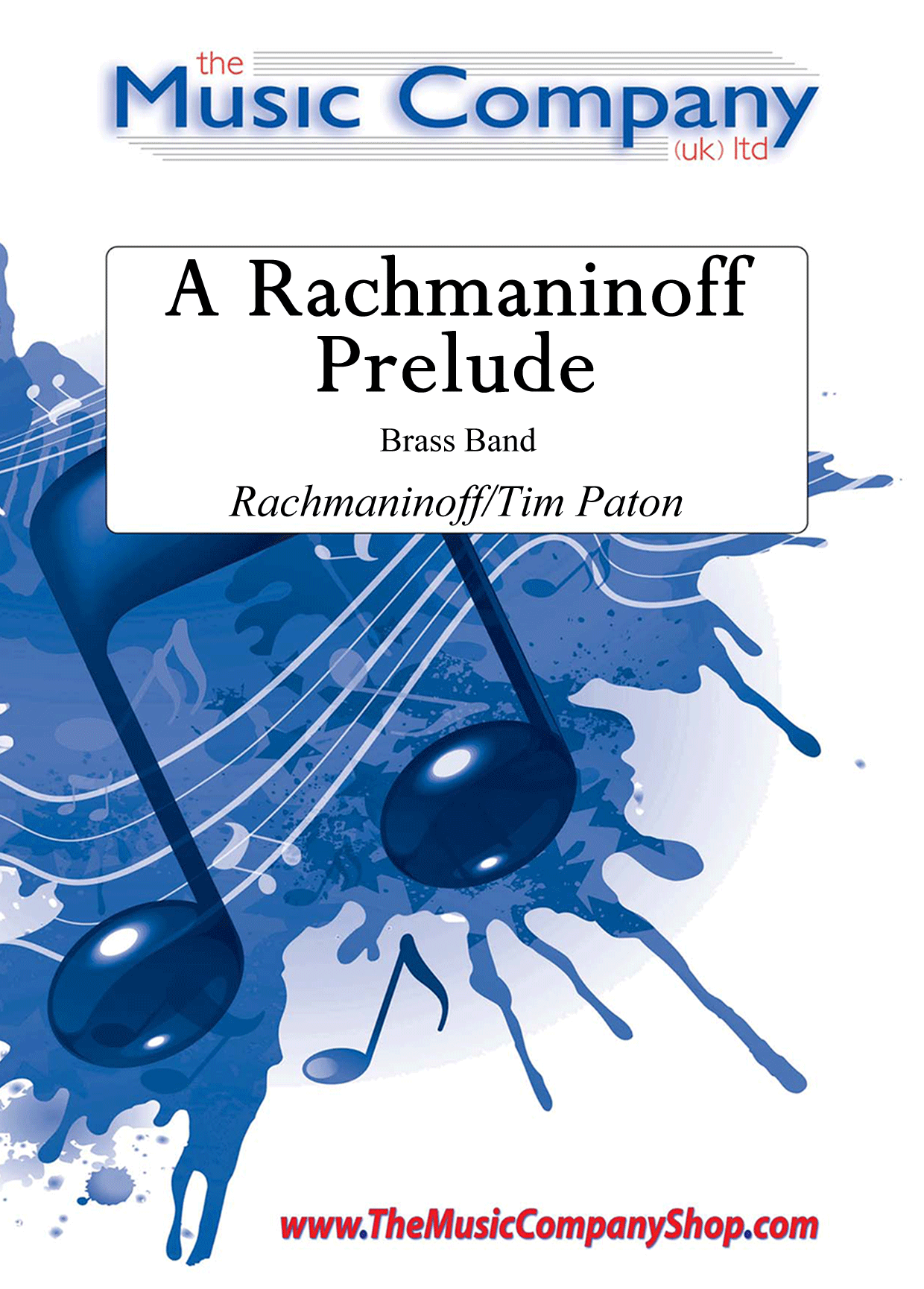
A Rachmaninoff Prelude - Rachmaninoff
An arrangement by Tim Paton of this Rachmaninoff favourite for brass band.Comments from Tim:I first heard the Rachmaninoff Prelude in G minor when my brother, (Dr) Rod Paton, used to play it on the piano. The martial sound of the opening theme caught my imagination, and I knew then that this piece would sound magnificent if played by a brass band - if you like the music of Rachmaninoff, then you will love this piece! That spectacular sound that we all know, with busy, melodic bass lines, and a middle section in his well known 'romantic' style - I could already hear the euphonium playing those rippling arpeggios. In response to the enthusiasm for this magnificent piece, I have lightheartedly commented that maybe he wrote it for brass band, but there wasn't one available, so he did it for piano instead!Look and Listen (Score-reading digital sound sample):
In Stock: Estimated dispatch 3-5 working days
-
 £39.95
A Little Prayer (Score and Parts) - Evelyn Glennie
Composer Evelyn Glennie writes... "When I wrote the chorale for marimba, A Little Prayer, it expressed my spiritual feelings and displayed a pleasantly relaxed dimension of the instrument. Over the years my exposure to brass bands has filled me with wonder; their musical diversity is considerable. From performing a simple melody to the most complex of test-pieces, they bring brilliance to the music. I had no hesitation in giving A Little Prayer to Robert Childs to bring this little melody to life through brass." A perfect reflective interlude for concert or devotional use by bands of all abilities. This is the only version of this arrangement available for sale to the public.
Estimated dispatch 7-9 working days
-
 £14.94
Jingle Boogie-Woogie Bells (Brass Band - Ukraine Charity Release) Ovcharenko
This piece was arranged by Halyna Ovcharenko, a Ukrainian composer who was born in Lugansk, a Ukrainian city that is currently under occupation by the Russian Federation. All the proceeds from this sale will go towards the 'A family for every orphan' appeal, which is providing emergency relief services to thousands of children and families in Ukraine. For more information about the charity please visit https://afamilyforeveryorphan.org/ukraine/ Halyna Ovcharenko has been composing music since she was 11. Many of her compositions of various genres have received international awards, but she discovered the world of brass band music with its specific timbre and huge range of musical colors only recently, in 2022, while composing her Vyshyvanka for Grimethorpe Colliery Band. Halyna comments: "I enjoyed my experience. Since then I have had an appetite to write more for brass bands, and here we are - an arrangement of a traditional English Christmas song which I have done especially to raise money for Ukrainian orphans. Their heroic parents stood for my Lugansk, for our Ukraine and for the whole World. I hope that the World will make these children feel that they are not left alone, giving them love, care and joy." The picture on the front cover was drawn by Victoria Lebed, a Ukrainian girl. This PDF download includes parts and score. Sheet music available from www.brassband.co.uk Instrumentation: Soprano Cornet Eb Solo Cornet Bb Repiano Cornet Bb 2nd Cornet Bb 3rd Cornet Bb Flugel Horn Bb Solo Horn Eb 1st Horn Eb 2nd Horn Eb 1st Baritone Bb 2nd Baritone Bb 1st Trombone Bb 2nd Trombone Bb Bass Trombone Euphonium Bb Bass Eb Bass Bb Percussion 1-2
In Stock: Estimated dispatch 1-3 working days
-
 £9.00
£9.00120 Hymns - A4 Parts
INDEX OF HYMNS :AberystwythAbridgeAngelusAureliaAustrian HymnBelmontBlaenwernCarlisleChrist the KingComeCorJesuCorpus ChristiCrimondCross of JesusDarwalls 148thDay of RestDennisDiademDiademataDivine MysteriesDixDominus Regit MeDresden (Wir pflugen)Duke StreetDundee (French)Easter HymnEm' Feste BurgEllacombeEllersEventideFranconiaFrench (Dundee)GeibelGerontiusGopsalHanoverHollingsideHorsleyHursleyHyfrydolInnocentsKocherLaudate DominumLaudes DominiLloydLobe den HerrenLove DivineLux BenignaMaidstoneMannheimMartyrdomMarytonMelcombeMelitaMiles LaneMisericordiaMissionaryMonldandMonks GateMorning HymnMorning LightMoscowMozart (Nottingham)National AnthemNearer, My God, To TheeNicaNottingham (Mozart)Nun DanketOld HundredthPassion ChoralePenlanPentecostPilgrimsPraise, my SoulRedheadRegent SquareRichmondRimmingtonRockinghamSt. AgnesSt. AlbinusSt. AnnSt. BeesSt. CeciliaSt. ClementSt. ColumbaSt. CuthbertSt. DenioSt. EtheiwaldSt. FrancisSt. George,St. GertrudeSt. MagnusSt. MichaelSt. OswaldSt. PeterSt. TheodulphSt. TheresaSamuelSandonSawstonSine NomineStellaStracathroStuttgartTallis' CanonTurns DavidicaVictoryVox DilectiWarehamWarringtonWestminsterWhen He ComethWhitburnWiltshireWir pflugen (Dresden)INDEX OF CAROLS :Angels from the Realms of GloryAs with GladnessAway in a MangerChristians AwakeCoventry Carol, TheDing Dong Merrily on HighDeck the HallsGod Rest ye Merry GentlemenGood King WenceslasGood Christian Men RejoiceHark! The Herald Angels SingHolly and The Ivy, TheI Saw Three ShipsIt Came upon the Midnight ClearJingle BellsNowellO Come All Ye FaithfulO Little Town of BethlehemOnce in Royal David's CityRocking Carol, TheSee Amid the Winter SnowSilent NightUnto us a Child is BornWassailWe Three KingsWe Wish you a Merry ChristmasWhile Shepherds Watched
Estimated dispatch 7-14 working days
-
£7.50
120 Hymns - A5 Parts
INDEX OF HYMNS :AberystwythAbridgeAngelusAureliaAustrian HymnBelmontBlaenwernCarlisleChrist the KingComeCorJesuCorpus ChristiCrimondCross of JesusDarwalls 148thDay of RestDennisDiademDiademataDivine MysteriesDixDominus Regit MeDresden (Wir pflugen)Duke StreetDundee (French)Easter HymnEm' Feste BurgEllacombeEllersEventideFranconiaFrench (Dundee)GeibelGerontiusGopsalHanoverHollingsideHorsleyHursleyHyfrydolInnocentsKocherLaudate DominumLaudes DominiLloydLobe den HerrenLove DivineLux BenignaMaidstoneMannheimMartyrdomMarytonMelcombeMelitaMiles LaneMisericordiaMissionaryMonldandMonks GateMorning HymnMorning LightMoscowMozart (Nottingham)National AnthemNearer, My God, To TheeNicaNottingham (Mozart)Nun DanketOld HundredthPassion ChoralePenlanPentecostPilgrimsPraise, my SoulRedheadRegent SquareRichmondRimmingtonRockinghamSt. AgnesSt. AlbinusSt. AnnSt. BeesSt. CeciliaSt. ClementSt. ColumbaSt. CuthbertSt. DenioSt. EtheiwaldSt. FrancisSt. George,St. GertrudeSt. MagnusSt. MichaelSt. OswaldSt. PeterSt. TheodulphSt. TheresaSamuelSandonSawstonSine NomineStellaStracathroStuttgartTallis' CanonTurns DavidicaVictoryVox DilectiWarehamWarringtonWestminsterWhen He ComethWhitburnWiltshireWir pflugen (Dresden)INDEX OF CAROLS :Angels from the Realms of GloryAs with GladnessAway in a MangerChristians AwakeCoventry Carol, TheDing Dong Merrily on HighDeck the HallsGod Rest ye Merry GentlemenGood King WenceslasGood Christian Men RejoiceHark! The Herald Angels SingHolly and The Ivy, TheI Saw Three ShipsIt Came upon the Midnight ClearJingle BellsNowellO Come All Ye FaithfulO Little Town of BethlehemOnce in Royal David's CityRocking Carol, TheSee Amid the Winter SnowSilent NightUnto us a Child is BornWassailWe Three KingsWe Wish you a Merry ChristmasWhile Shepherds Watched
Estimated dispatch 7-14 working days