
Results
-
 £38.95
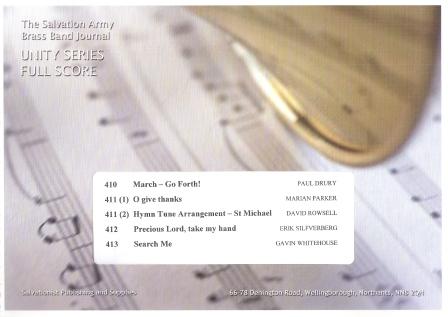
Unity Series Band Journal October 2013 Numbers 410 - 413
No. 410 March - Go Forth! (Paul Drury)This march was written as a tribute to Bandmaster Jack Spowart and the Bo'ness Salvation Army Band. The composer lives in the twon of Bo'ness and has had numerous opportunities to share with the band and the wider corps at various events. This march serves as recognition of the faithful service given in the Lord's name in the town by The Salvation Army for over 100 years. Two tunes are featured, both well-known and instantly recognisable, namely, Forward! be our watchword and We're marching on.No.411 (1) O give thanks (Marian Parker)The composer, Marian Parker, is a new contributor and is the Recruiting Sergeant at Leicester South Corps. This simple, yet rhythmic piece should not pose any technical problems for most bands and features the attractive arrangement of Joanne Pond's contemporary song, 'O give thanks'.No.411 (2) Hymn Tune Arrangement - St Michael (David Rowsell)The hymn tune 'St Michael' was composed in 1551 by French composer Louis Bourgeois and the composer provides a very useful arrangement of this historic hymn.No. 412 Precious Lord, take my hand (Erik Silfverberg O.F.)This well-known Gospel Song is a favourite of many. It has been recorded by many great artists, including Rosetta Tharpe, Elvis Presley and Aretha Franklin. The words were written by Reverend Thomas A. Dorsey, who is often known as the 'Father of Gospel song'.No. 413 Search Me (Gavin Whitehouse)The second new contributor to this journal is Gavin Whitehouse. gavin is the Assistant Music Director for the Greater New York Division and is also the USA Eastern Territorial Songster Leader. This piece combines two songs - one old and one new - which speak of a God who knows us intimately. 'Search me, O God and know my heart today' (associated with the beautiful Maori melody, 'Now is the hour') is woven with a contemporary setting of Psalm 139 by Rebecca St James, the first line of which says, 'You searchme, you know me'.
Estimated dispatch 7-14 working days
-
 £59.99
A Forest Symphony (Brass Band - Score and Parts)
A Forest Symphony was commissioned for the 2007 Voices in the Forest Festival, with the support of Creative Partnerships, the Forest of Dean. The first performance was given the Lydbrook Band. A Forest Symphony explores the hidden and magical world of the forest; secrets that may only be seen the animals who live there, or by fortunate ramblers who stray from the beaten path. Suitable for 1st Section Bands and above. Duration: 12.00
Estimated dispatch 7-14 working days
-
 £44.95
Joy Through the Ages (Brass Band - Score and Parts)
This work was written for the 125th anniversary of Boscombe Band, celebrated in November 2011, and is the title track of the band' album released in the same year. The music is celebratory in nature and is dedicated to all those who have served in the band during its 125 year history. The theme of the work is a song by Charles Hutchison Gabriel which was the favourite of the band's librarian, Gerald Whittingham, who was 'promoted to Glory' after a long battle with a brain tumour. The title comes from the last verse, 'When with the ransomed in Glory, his face I at last shall see, 'twill be my joy through the ages, to sing of his love for me'.
Estimated dispatch 7-14 working days
-
 £44.95
Judd: Excerpts from Polovtsian Dances
Alexander Borodin (1883 - 1887) was a Russian composer who made his living as a chemist. He was a member of the group of composers called "The Five" (or "The Mighty Handful") who were dedicated to producing a specifically Russian kind of art music. He is best known for his symphonies, his two string quartets, and his opera "Prince Igor". The opera contains "The Polovtsian Dances" which is often performed as a stand-alone concert work.
Estimated dispatch 7-14 working days
-
 £34.95
Judd: The Covenanters
In 1638, many members of the Presbyterian Church of Scotland signed a document called the National Covenant. By doing so, they were declaring that they acknowledged only Jesus Christ as the spiritual head of their church, and not any king or queen. This had become necessary because the Stuart kings believed in the Divine Right of Monarchs and saw themselves as head of the church. In the previous year, Charles I had forcibly introduced the Book of Common Prayer, invoking the wrath of the common people who faced the threat of torture, transportation or execution if they did not use the new liturgy and worship at their local church. The net result of this was that many met illegally in the countryside or in barns and large houses. These meetings became known as 'conventides' and many took place in the south-west of the country. Anyone caught attending was at risk of execution by the muskets of the dragoons who were employed in the area for that specific purpose. This music was written to honour the bravery and loyalty of these Christians to their faith, in the face of extreme danger, in the hope that it will inspire us also to be faithful. There are overtones of military threat, secrecy and solidarity. An old pentatonic tune is used, which the composer heard as a boy being sung to the words The Lord's My Shepherd.
Estimated dispatch 7-14 working days
-
 £59.95
Judd: The Long Cloud of Witnesses
This music was written for the Amsterdam Staff Band's 50th Anniversary. The idea for using this theme in appreciation of the pioneers of the band who had gone before came to me during the thanksgiving service for my own mother's life. She was a life-long Salvationist, and the large crowd that gathered for her thanksgiving in Winchester gave such an inspiring rendition of this hymn at the end of the service that it moved me to write the music. In the closing pages of the score I have tried to suggest that final parade when those who loved the Lord join the 'long cloud of witnesses' in procession to their eternal home. - Kenneth Downie
Estimated dispatch 7-14 working days
-
 £95.00
Variations on a Theme of Michael Tippett (Brass Band - Score and Parts)
A Centenary Tribute by Michael Ball, Edward Gregson, Elgar Howarth, Bramwell Tovey and Philip WilbyThis unique 'pice d'occasion' arose out of a telephone conversation in 2004 with Alan Wycherley, who was the soprano cornet player of the Foden's Richardson Band at the time. He indicated that the band would like to include an original birthday tribute for Edward Gregson (60) and Elgar Howarth (70) in its concert at the 2005 RNCM Festival of Brass in Manchester. I have been Artistic Director of Manchester's Festival of Brass since it was established in 1990 as a BBC Radio 3 series, As the centenary of the birth of Sir Michael Tippett fell on 5 January 2005, I devised this collective work as a way of embracing all three anniversaries in a novel way.The idea of joint compositions is not a new one in the classical music world. In the 1860s, Verdi was joined by a number of his contemporaries in a Requiem Mass for Rossini. In this country there have been a number of orchestral examples over the past fifty years, but never before for the brass band. Although Tippett composed only one work for brass band, Festal Brass with Blues, his orchestral works and operas are full of idiomatic brass writing. The theme I chose for this celebration is one of Tippet's most memorable miniatures featuring wind and brass. In the opera Midsummer Marriage it marks the entry of the Ancients. It is also included in the orchestral Suite in D (1948), for the Birthday of Prince Charles.I invited five of the leading contemporary voices in brass band music to add their own creative perspectives to the little Tippett theme, with it's characteristic rhythms, embellishments and modality - the Lydian mode. Each contribution was designed to fit into a tonal and formal template to give the whole work a flow and continuity. In Danse des Amis, Bramwell Tovey has composed a jazzy, humorous variation. Inspiration came from Tippett's love of jazz and, more personally, from the characteristically syncopated gait of the distinguished music critic John Amis, who Tovey once observed leaving a performance of Tippett's opera King Priam before the end. Incidentally, that performance was conducted by Elgar Howarth.We hear Edward Gregson in lyrical mode. His Midsummer Song is redolent of the sound world of Tippett's opera A Midsummer Marriage and it ends with a brief reference to a favourite of Gregson's, Tippett's Concerto for Orchestra. Michael Ball provides a brief moment of light, airy activity bringing to mind perhaps Tippett's love of Shakespearian fantasy, especially The Tempest. Elgar Howarth juxtaposes a slowed down version of the processional theme with distant recollections of fanfares from King Priam. Philip Wilby has rounded the tribute off with a spectacular fugue. During its inexorable progress Wilby ingeniously introduces the two other birthday references - the three-note musical signature that Elgar Howarth includes in much of his music and the characteristic theme which begins Edward Gregson's substantial work for brass an organ The Trumpets of the Angels. An elaborated reprise of Tippett's little theme is followed by a dynamic coda.- Paul HindmarshDuration: 13.00
Estimated dispatch 7-14 working days
-
£40.00
Variations on a Theme of Michael Tippett (Brass Band - Score only)
A Centenary Tribute by Michael Ball, Edward Gregson, Elgar Howarth, Bramwell Tovey and Philip WilbyThis unique 'pice d'occasion' arose out of a telephone conversation in 2004 with Alan Wycherley, who was the soprano cornet player of the Foden's Richardson Band at the time. He indicated that the band would like to include an original birthday tribute for Edward Gregson (60) and Elgar Howarth (70) in its concert at the 2005 RNCM Festival of Brass in Manchester. I have been Artistic Director of Manchester's Festival of Brass since it was established in 1990 as a BBC Radio 3 series, As the centenary of the birth of Sir Michael Tippett fell on 5 January 2005, I devised this collective work as a way of embracing all three anniversaries in a novel way.The idea of joint compositions is not a new one in the classical music world. In the 1860s, Verdi was joined by a number of his contemporaries in a Requiem Mass for Rossini. In this country there have been a number of orchestral examples over the past fifty years, but never before for the brass band. Although Tippett composed only one work for brass band, Festal Brass with Blues, his orchestral works and operas are full of idiomatic brass writing. The theme I chose for this celebration is one of Tippet's most memorable miniatures featuring wind and brass. In the opera Midsummer Marriage it marks the entry of the Ancients. It is also included in the orchestral Suite in D (1948), for the Birthday of Prince Charles.I invited five of the leading contemporary voices in brass band music to add their own creative perspectives to the little Tippett theme, with it's characteristic rhythms, embellishments and modality - the Lydian mode. Each contribution was designed to fit into a tonal and formal template to give the whole work a flow and continuity. In Danse des Amis, Bramwell Tovey has composed a jazzy, humorous variation. Inspiration came from Tippett's love of jazz and, more personally, from the characteristically syncopated gait of the distinguished music critic John Amis, who Tovey once observed leaving a performance of Tippett's opera King Priam before the end. Incidentally, that performance was conducted by Elgar Howarth.We hear Edward Gregson in lyrical mode. His Midsummer Song is redolent of the sound world of Tippett's opera A Midsummer Marriage and it ends with a brief reference to a favourite of Gregson's, Tippett's Concerto for Orchestra. Michael Ball provides a brief moment of light, airy activity bringing to mind perhaps Tippett's love of Shakespearian fantasy, especially The Tempest. Elgar Howarth juxtaposes a slowed down version of the processional theme with distant recollections of fanfares from King Priam. Philip Wilby has rounded the tribute off with a spectacular fugue. During its inexorable progress Wilby ingeniously introduces the two other birthday references - the three-note musical signature that Elgar Howarth includes in much of his music and the characteristic theme which begins Edward Gregson's substantial work for brass an organ The Trumpets of the Angels. An elaborated reprise of Tippett's little theme is followed by a dynamic coda.- Paul HindmarshDuration: 13.00
Estimated dispatch 7-14 working days
-
 £34.95
Island Whirl (Brass Band - Score and Parts)
Island Whirl was commissioned by Margaret Milligan who wanted a brand new piece of music composed as a present for Ian, her husband for his 70th birthday. Ian Milligan is a keen and dedicated musician and he is the musical director of Callendar Brass, based in Callendar near Stirling in Scotland.Margaret contacted me about the possibility of composing a short lively piece which had a Scottish theme that would be ideal for Callendar Brass Band and any other ensemble to get their teeth into. This piece takes its inspiration from the traditional Scottish folk song 'An Eriskay Love Lilt' which is a particular favourite of both Margaret and Ian.With thunderous Celtic drums the piece opens in a whirlwind of sound with fanfare brass and an off-stage soloist that can perform using either the cornet or trumpet. After the exciting opening, the brass and drums die away to allow the off-stage soloist to air the traditional tune 'An Eriskay Love Lilt'.The beautiful haunting melody, keeping its originality throughout undergoes a series of changes in the accompanying harmonic material before dying away to allow the Celtic drums to return. The percussion whip the band into a frenzy as the piece gets faster and faster. Just prior to the final notes the band diminuendo to allow one last closing statement from the Eriskay Love Lilt lead by the off-stage soloist before the ensemble charge to a dramatic close.When performing this piece I would recommend the off-stage soloist taking a position somewhere in the audience, so they can almost feel part of the performance. In addition, with the two tom-tom parts that represent the Celtic drums, bands should make the most of showcasing them by getting the two drummers out to the front of the band to perform. The ideal stage position would be with the players set up in stereo with one player in front of the soprano cornet and the other in front of the solo trombone.With the various choreographed movements from both the off-stage soloist and the percussionists. This piece is a great addition to any concert repertoire and is an ideal showcase for bands who want to try something a little different.I wish Ian at 70 years young, all the very best with his music making in the many years to come and I hope this piece, composed especially for him and Callender Brass brings them many years of musical enjoyment.Paul Lovatt-Cooper
Estimated dispatch 7-14 working days
-
 £24.95
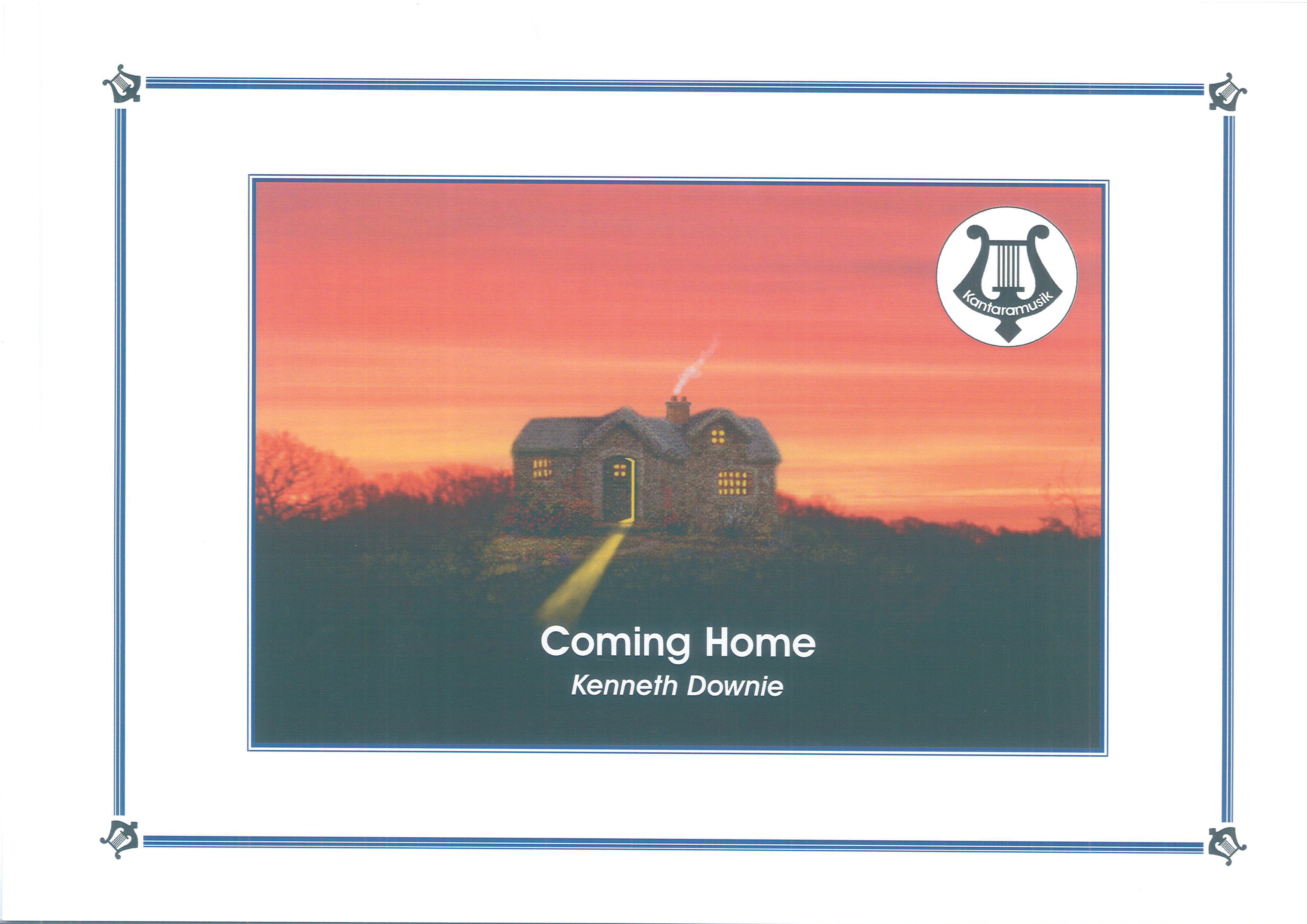
Coming Home (Brass Band - Score and Parts)
The arranger has described Coming Home! as music of reconciliation. In a world of conflict, at both national and personal level, it would be good to think that this music could bring a message of hope and resolution of problems for people who are hurting. It is a setting of Will Lamartine Thompson's melody to his own words beginning 'Softly and tenderly Jesus is calling'. The chorus starts 'Come home, come home! Ye who are weary,come home!'. The rising interval of a fifth is always associated with the words 'Come home'. It is the arrangers hope that the gentle and moving nature of this music will create for all listeners, whether or not they possess religious faith, a spirit of harmony and reconciliation.
Estimated dispatch 7-14 working days