
Results
-
 £105.20
Daniels Joik - Jon-Henrik Fjâllgren - Idar Torskangerpoll
Jon Henrik Mario Fjallgren became instantly well-known after his appearance in Sweden's "Got Talent" where he performed "Daniels Joik" written for his recently passed best friend.Fjallgren was born in Cali, Columbia in 1987 but adopted by a Swedish Sami family and lives now as a reindeer herder, singer and composer. He debuted on stage in 2003, 14 years old and on record two years later.After the success with "Got Talent", he has also participated twice in the Swedish Eurovision Song Contest.This arrangement can be performed in a long or shorter version, for short version cut bars 58-78.
Estimated dispatch 5-14 working days
-
 £115.60
Let's Meet the Band - Haakon Esplo
Let your youngest musicians present their instruments and be soloists in this simple piece!Let's meet the band has a tutti part as starts and finish and a flexible part in the middle (A and B) where the soloist plays B-part and the rest plays A-part as accompaniment.Repeat the middle part as many times as you want and let all who wants to be soloists stand up and play. One by one or together in small groups.
Estimated dispatch 5-14 working days
-
 £115.60
Stjernen og Rosa - John Philip Haqnnevik
The Star and a Rose is a big-scale Christmas piece for band, featuring four seasonal chorales.The first is a Gregorian-like chant Hodie Christus natus est.In this section of the piece, a soloist can be placed away from the band, maybe on a gallery. The soloist can be a tenor instrument, maybe trombone, or you can feature a vocal soloist.After this, the music leads us on to the old German Christmas chorale Lo, how a rose e'er blooming. This song is given a fairly rhythmical treatment, but make sure that the melody is presented in a cantabile style.An interlude follows, before the piece presents one of the most used and loved Scandinavian Christmas chorales, Mitt hjerte alltid vanker (My Heart will always wander), composed by the Danish bishop Hans Adolph Brorson around 1732. This song is building towards a climax, before the solo horn brings it all down to the Stable view described in the lyrics.Then comes a transition that brings us in to the final section of the piece, which presents the international Christmas Carol Adeste Fideles. As many will notice, I have borrowed a section from David Wilcocks majestic harmonization towards the end.The title of the piece has its background form the lyrics in My heart will always wander, where the text speaks about the stars in the sky. But also in the latin text for Adeste Fideles:Stella duce, Magi, Christum adorantesThe Rose is of course from the lyrics in the chorale Lo, how a Rose.
Estimated dispatch 5-14 working days
-
 £115.60
Deck the Halls - John Philip Hannevik
The original Welsh song Nos galan dating back to the sixteenth century, has become an international Christmas carol with the English lyric Deck the hall with boughs of holly.The song does not offer much in terms of variation, but I have tried to construct a short piece where one can see that the song still offers itself to a wide array of stylistical treatments.The opening is almost like a Christmas Overture, before it wanders in to a renaissance-like style.The middle section offers a much more lush and lyrical rubato treatment, with lots of color and thick harmonization.The end then turns the tempo even more up than at the start of the piece, and brings us through a big band ending with long soaring lines.- John Philip Hannevik -
Estimated dispatch 5-14 working days
-
 £228.70
Echoes From..... - Kjetil Djønne
The essence of what a school band is, has inspired me in this composition. A hub between musicians of all ages and a place where young people can feel belonging. Several of the values in a school band have a positive impact on how musicians grow and mature. They learn about culture and discipline, as well as experiencing unity and mastery. A school band always has a goal, and achieving goals together, without reserves, is priceless. High ambitions and a common will to improve are recognizable in many school bands. In my opinion Skodvin Skulemusikk got these values: unity, affiliation, effort and ambition.The piece portrays the echo that rings in the hall before the applause after a concert. The echo in the hallways during breaks, or in the rehearsal room during rehearsal. The echo, or consequence, of all the work that is done by both musicians and parents. The echo of a unity and belonging that can last a lifetime.
Estimated dispatch 5-14 working days
-
 £127.30
Model T - Sammy Nestico - Idar Torskangerpoll
Sammy Nestico's legendary car ride in an old T-Ford has long been a classic in the wind band repertoire. Now, the brass bands also can enjoy this car ride.In the piece Nestico uses percussion and wind players to make a sonic landscape where the listener easily hears how an old veteran car is started, with some problems, and then is accelerated into narrow country lanes.This is a piece for bands looking for programmatic music of a certain character. It's a big crowd-pleaser which appeals to most listeners, especially those who are into nice, old cars.
Estimated dispatch 5-14 working days
-
 £127.30
Summer Play Samba - Øystein Olsen Vadsten
"Summer Play Samba" is, as the title suggests, a light summer samba, which flows like a fresh summer breeze into the ear canals and stays there.The piece was written in connection with an assignment the composer was to have as a guest conductor at a so-called Summer Play in the Eastern Norway area. Hence the title Summer Play Samba. Here, musicians from far and near meet and participate in a kind of prima vista bonanza, where the main point is to be able to practice music during the summer break. Due to the lack of a piece in the entertainment genre, "Summer Play Samba" was written for this specific evening.After a bit of cleanup and polishing, this great samba is now ready for release."Summer Play Samba" should be a welcome contribution to any entertainment repertoire and is guaranteed to please the ears of many musicians and concertgoers.
Estimated dispatch 5-14 working days
-
 £115.60
Minnen fran Holmen - Jerker Johansson
The first theme was written the summer 1997 when Jerker Johansson was composing in Swedish folk music style for an intended radio programme in which his father should participate reading poems in local dialect. Unfortunately, the project was discontinued. In the spring 2015 Mr. Johansson however started to work on the theme again, this time adding a song theme of broader character. Holmen is the name of the homestead where Mr. Johansson's father Arne grew up. It is beautifully located in the parish of Skarv, situated east of Skara, one of the oldest towns in Sweden. At Holmen, the composer spent his childhood summers and his recollections are filled with many bright moments andhappy memories. The piece was premiered May 22, 2015 by the Goteborg Wind Orchestra conducted by the composer.
Estimated dispatch 5-14 working days
-
£76.99
The Haunter of the Dark - Franco Cesarini
The Haunter of the Dark is based on a tale by the author Howard Phillips Lovecraft (1890-1937) about a deserted church, where according to an old legend a monster had been lying low for years.A scientist who studies ancient religions visits this church. Besides some ancient writings he discovers a box, which contains a luminous stone. Every time the stone sheds its light, the scientist experiences all sorts of weird visions.The church in the tale actually exists, and can be found in Providence (USA). Franco Cesarini has visited it and sketches the mysterious and occult atmosphere in "The Haunter of the Dark".
Estimated dispatch 5-14 working days
-
 £60.99
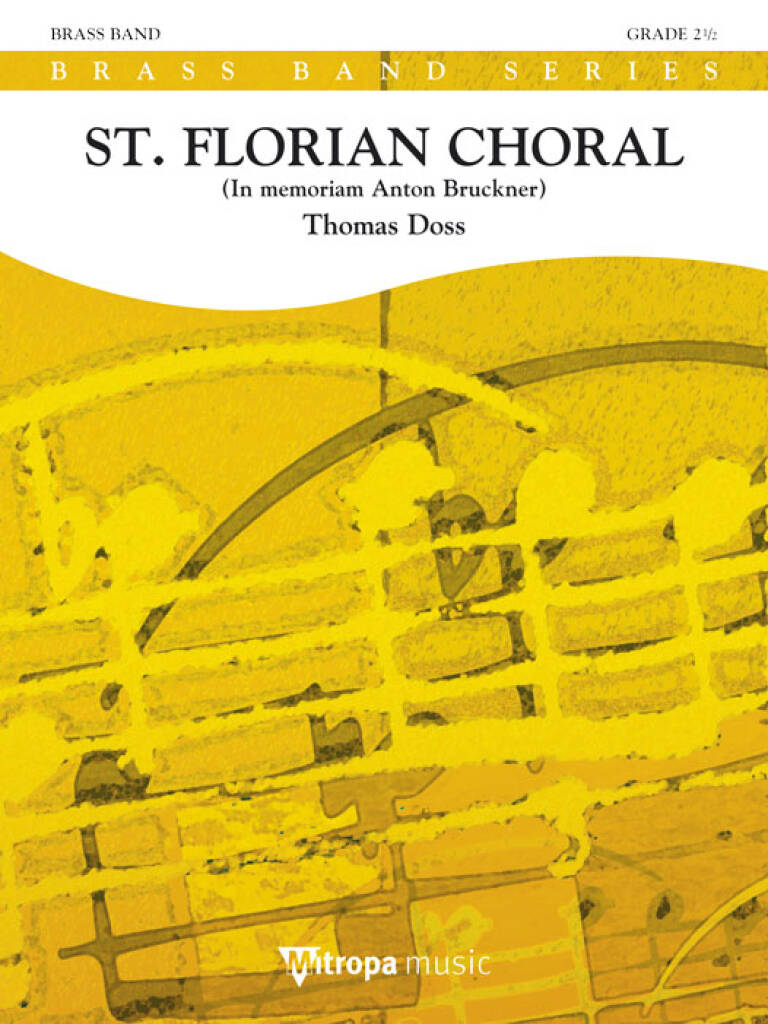
St. Florian Choral - Thomas Doss
The convent of St. Florian was the place of work of the upper Austrian composer Anton Bruckner. This convent with its marvellous church, where many of his great symphonies were composed, is situated in the middle of a rural idyll. St. Florian Choral is Thomas Doss' modest and deep bow to this great master, whose music has been very formative for the composer's musical life.
Estimated dispatch 5-14 working days
 View Music