
Results
-
 £15.00
In the Hall of the Mountain King - Grieg
Performance Notes from Andrew Duncan:This arrangement is fairly difficult for inexperienced players and is without doubt one of the most difficult in the Flexi-Collection Popular Classics Series. But, as it is such a popular piece there is normally a great incentive from the players to learn the piece, despite the difficulties.The accelerando and gradual increases in tempo which are integral to this piece are in themselves very important musical ideas for new players to grasp, and these will be better understood as a result of playing and learning this arrangement.Other features found in this arrangement which may be new to some inexperienced players are the use of tin mutes in the 1st Cornet/Trumpet part, and the falling chromatic notes (accidentals) found in the melody line. Also, the wide range of dynamics, pp - ff , may be new to some players.I have deliberately not suggested any specific metronome markings as this is very much up to the conductor and is dependant on the players' abilities. However, as the arrangement becomes more familiar, the tempo could no doubt be speeded up adding to the excitement of future performances.The Flexi-Collection ApproachFlexible scoring tailored to your needs - A perfect solution for expanding the repertoire of training and junior brass bands. The Flexi-Collection currently offers two series - Popular Classics and World Tour. Based on four-part harmony, these collections provide groups with the advantage of complete flexibility when they may not be balanced. If players or instruments are missing, the show can still go on!The Flexi-Collection - Popular Classics Series, encapsulates all that is great about the wonderful range of musical styles produced by Holst, Elgar, Handel, Verdi, Tchaikovsky, Grieg, Bizet and Parry.The thoughtful scoring and arranging by Andrew Duncan now means that groups of all abilities have access to a truly flexible set of music for their needs. With world parts, rudimentary theory, terminology translations and large format typesetting, The Flexi-Collection ticks all the boxes when it comes to bringing interesting music to the training and junior band/brass group environment.Available individually or as part of the money-saving Flexi-Collection Popular ClassicsAlbum.Scored for Brass Band and supplied with additional Easy Bb, Easy Eb and world parts - The Flexi-Collection offers flexibility in every sense of the word.
In Stock: Estimated dispatch 3-5 working days
-
 £15.00
Jupiter from the Planet Suite - Holst
Programme notes:The hauntingly beautiful theme from Jupiter, from The Planets Suite has a rare qualityexpressing both optimism and dignity which makes it a popular choice for many formalpublic events such as opening and award ceremonies.The tune is originally found in the Jupiter movement from the large-scale work fororchestra called 'The Planets Suite'. Written by the English composer Gustav Holt ThePlanets Suite is thought to be his finest work.The theme has a steady 3/4 rhythm which provides a contrast in terms of tempo andmeter to the rest of the movement, and has been made popular as a patriotic song called'I vow to Thee My Country'.Performance notes:This arrangement makes use of a gradual increase in dynamics, beginning p and ending ff.With this gradual increase in dynamics is a gradual increase in the scoring starting offwith only the lower instruments playing p and ending up with everyone playing ff.The percussion part is very minimal in this arrangement (only 2 notes for the suspendedcymbal) and is an optional part.Just before the final chord there is a cut off marked in the parts. This may be a newconcept for some inexperienced players so it should be fully explained by the conductor.The Flexi-Collection ApproachFlexible scoring tailored to your needs - A perfect solution for expanding the repertoire of training and junior brass bands. The Flexi-Collection currently offers two series - Popular Classics and World Tour. Based on four-part harmony, these collections provide groups with the advantage of complete flexibility when they may not be balanced. If players or instruments are missing, the show can still go on!The Flexi-Collection - Popular Classics Series, encapsulates all that is great about the wonderful range of musical styles produced by Holst, Elgar, Handel, Verdi, Tchaikovsky, Grieg, Bizet and Parry.The thoughtful scoring and arranging by Andrew Duncan now means that groups of all abilities have access to a truly flexible set of music for their needs. With world parts, rudimentary theory, terminology translations and large format typesetting, The Flexi-Collection ticks all the boxes when it comes to bringing interesting music to the training and junior band/brass group environment.Available individually or as part of the money-saving Flexi-Collection Popular ClassicsAlbum.Scored for Brass Band and supplied with additional Easy Bb, Easy Eb and world parts - The Flexi-Collection offers flexibility in every sense of the word.
In Stock: Estimated dispatch 3-5 working days
-
 £6.99
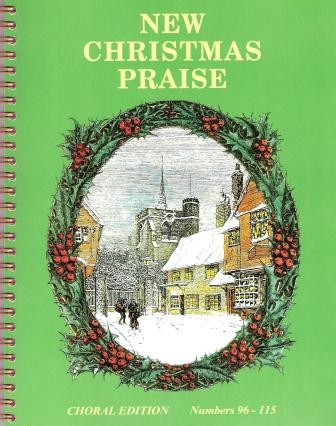
£6.99New Christmas Praise 96 - 115 Choral Edition
A full vocal music/accompaniment edition,this supplementary album contains 20 Christmas songs which will enhance the choral repertoire.Contents :96. Deck the hall 97. Frosty the snowman 98. Have yourself a merry little Christmas 99. Here we come a-wassailing 100.Jingle Bells 101.I saw Mommy kissing Santa Claus 102.O Christmas tree 103.Patapan 104.Rudolph, the red-nosed reindeer 105.Santa Claus is comin to town 106.Sleigh ride 107.The Boars Head carol 108.The twelve days of Christmas 109.The Christmas Song 110.We wish you a merry Christmas 111.When Santa got stuck up the chimney 112.Winter Wonderland 113.When a child is born 114.Worldwide Christmas message 115.Auld Lang Syne
Estimated dispatch 7-14 working days
-
 £0.49
£0.49New Christmas Praise Song Book 96 - 115
These books are now an archive publication and, although are still available, have been superseded by Christmas Collection (available in marchcard size: https://www.sps-shop.com/cc-marchcard or A4 size https://www.sps-shop.com/cc-largeprint). Christmas Collection includes 46 new carols and songs as well as 10 extended carols (originally seen in the Sounds of Christmas books).Ideal for congregational singingContents :96. Deck the hall 97. Frosty the snowman 98. Have yourself a merry little Christmas 99. Here we come a-wassailing 100.Jingle Bells 101.I saw Mommy kissing Santa Claus 102.O Christmas tree 103.Patapan 104.Rudolph, the red-nosed reindeer 105.Santa Claus is comin to town 106.Sleigh ride 107.The Boars Head carol 108.The twelve days of Christmas 109.The Christmas Song 110.We wish you a merry Christmas 111.When Santa got stuck up the chimney 112.Winter Wonderland 113.When a child is born 114.Worldwide Christmas message 115.Auld Lang Syne
Estimated dispatch 7-14 working days
-
 £19.95
Mythical Tales (Brass Quintet)
Mythical Tales (2012) is a ten minute work in three movements which represents three of the most popular folk stories or indeed in the case of the first movement, true stories, in Welsh culture.I. Owain GlyndwrOwain Glyn Dwr was born around the 1350s into an Anglo-Welsh gentry family. His estates provided him with a modest power base in north-east Wales. After a number of disputes, he proclaimed himself prince of Wales in September 1400.Glyn Dwr led several battles with the English, although he was never captured. Over the next few years punitive measures were enacted to keep control of Wales, but these were matched by many acts of Welsh rebellion - among them the capture of Conwy Castle in April 1401. In June 1402, at the Battle of Pilleth on Bryn Glas Hill, Glyn Dwr led his troops to victory over an English army. By now Glyn Dwr was leading a national revolt. In 1404, he led a march towards Wocester, but failed, with the English capturing parts of Wales. He died defending his country.II. MyfanwyMyfanwy was the most beautiful woman in Powys, but she was vain and liked nothing better than to be told how beautiful she was. Many handsome men would court her, but she would not show interest because they couldn't sing and play to her, reflecting her true beauty.Luckily, a penniless bard, Hywel ap Einion was in love with Myfanwy, and one day plucked up the courage to climb up the hill to the castle with his harp, to sing and play to her. He's allowed in to play for her, and while he's playing and complimenting her on her beauty she can neither listen nor look at any other man. Because of this Hywel believes that she has fallen in love with him. But his hopes are dashed when a richer, more handsome and more eloquent lover comes along. The music of the second movement portrays the despair and upset that Hywel must have felt.III. Battle of the DragonsMany centuries ago when dragons roamed the land, a white ice dragon descended on a small village and decided to live there, not knowing that a red fire dragon was already living nearby.Six months later the red dragon awoke to find a huge white dragon wrapped around his village that he cared for. He could tell that his people were ill from the cold. The Land was bare; nothing was able to grow not even the pesky dandelions. The people were starving. The people longed for the red dragon to free them from the icy misery, so that their life and land could return to the sunny and warm climate that it was once before.The red fire dragon challenged the white ice dragon to a single combat fight at the top of the cliff the next day. The people of the village watched in terror awaiting their fate. The red dragon beat the white dragon, and the crowd cheered with joy as the red dragon roared with triumph. The mayor of the village declared that the land should always fly a flag with the symbol of a Red dragon on it. The flag's background should be half green and half white; the green to represent the lush green grass of the land and the white to represent the ice. This way no one would ever forget what happened.
Estimated dispatch 7-14 working days
-
 £31.50
Edward Gregson: Postcard to Grimethorpe
DescriptionComposer's NoteI composed the original version of Postcard to Grimethorpe in 1993 at the request of Elgar Howarth, for a concert at the Queen Elizabeth Hall, London, given by the Grimethorpe Colliery Band. This was at a time when after the Grimethorpe Colliery pit closed the future of the band was in severe jeopardy. The concert was given in aid of the band, both through publicity and funding.Then in late 2022 Jack Stamp, the American composer, conductor and educator, and at that time international composer-in-association with Grimethorpe, contacted me to say that he had discovered my short piece in the band library, and asked if I might extend it for a recording he was sponsoring for the band - the repertoire to consist entirely of music specially composed for Grimethorpe.I agreed and decided to extend the piece by using the miner's hymn Gresford, as a symbolic gesture of protest at the many thousands of miners in the UK who were made redundant from their jobs. After an angular (atonal) first section, the hymn enters, softly at first, but with each phrase it becomes more powerful and insistent, ending with the final phrase triumphantly accompanied by melodic percussion (replacing the drums and cymbals of the earlier phrases, as if the band were then on the march). However, this short work ends softly and gently, as if anger has been replaced by quiet resolution and determination, looking to the future with confidence.For more information on Edward Gregson's music please visit the composer's website: www.edwardgregson.com
Estimated dispatch 7-14 working days
-
 £30.00
Black Bottom Stomp - Jelly Roll Morton
Ferdinand Joseph LaMothe, professionally known as Jelly Roll Morton, was an American ragtime and early jazz pianist, bandleader and composer who started his career in New Orleans, Louisiana. Widely recognised as a pivotal figure in early jazz, Morton is perhaps most notable as jazz's first arranger, proving that a genre rooted in improvisation could retain its essential spirit and characteristics when notated. His composition "Jelly Roll Blues" was the first published jazz composition in 1915. Morton is also notable for writing such standards as "King Porter Stomp", "Wolverine Blues", "Black Bottom Stomp", and "I Thought I Heard Buddy Bolden Say". Notorious for his arrogance and self-promotion, Morton claimed to have invented jazz outright in 1902, much to the derision of fellow musicians and the critics. At the age of fourteen, Morton began working as a piano player in a brothel (or, as it was referred to back then, a sporting house). In that atmosphere, he often sang smutty lyrics and took the nickname "Jelly Roll". While working there, he was living with his religious, church-going great-grandmother; who he convinced that he worked as a night watchman in a barrel factory. After Morton's grandmother found out that he was playing jazz in a local brothel, she kicked him out of her house and told him that "devil music" would surely bring about his downfall. Born in downtown New Orleans, Louisiana, his exact birth date differs depending to whichever source you want to believe; his half-sisters claimed he was born in September 1885, but his World War 1 draft card showed September 1884 and his California death certificate listed his birth as September 1889. He died in 1941 in Los Angeles.
-
 £30.00
Fugatango - Steve Waterman
"When Roger Argente approached me to write a composition for his Spanish flavoured brass project, he made the suggestion that a Tango, althoughmore Argentinian than Spanish, would fit in well with the overall concept. I have always been a very big fan of the music of Argentinian composerAstor Piazzolla and particularly the way that the Tango could be combined with jazz. A favourite recording of mine is of Piazzolla himselfperforming (on the bandoneon) with the jazz saxophonist Gerry Mulligan. Roger and I both thought it would be a good idea to let some of themusicians in the ensemble take improvised solos. As the composing progressed, a fugato also emerged hence the title Fugatango."
-
 £30.00
Reach - S Club 7
When the group S Club 7, (an able bunch with a wide appeal to all ages), released the song Reach in the year 20, it soon became a hit with many people, and still is. My wife Julie and myself were at a large event recently, and saw the effect of this song on a mixed audience - it brought the house down! Besides more serious projects, I am a great believer in entertaining the brass band's largest audience, the general public, which is why I have been very happy to produce this arrangement of a song which is full of fun.
In Stock: Estimated dispatch 3-5 working days
-
 £85.92
Chorale Tangents (Brass Band) Kenneth Downie
VIEW SCORE PDF This magnificent work by Kenneth Downie was commissioned by Festival Brass Band of Belgium, and its conductor Manu Mellaerts. It was first performed by the band on 10th October 2010, in Mechelen, a beautiful old city in the province of Antwerp. The composer writes: 'The chorale in the title is the famous one associated with the words 'Now thank we all our God', dating from 17th century Germany. The words were written by Martin Rinkart and the music by Johann Cruger. The use of the word 'tangents' in the title can best be understood as variations. This is another set of variations, in the line of St. Magnus, Princethorpe and Purcell Variations. I still cannot resist the urge to present familiar material in an unfamiliar way! Hopefully, the listener can relate to these tangents, and experience some of the joy that I receive when writing them.' To view a video of Festival Brass Band performing the work please visit: https://www.youtube.com/watch?v=Kc83_BYkZSc Sheet music available from: UK - www.brassband.co.uk USA - www.solidbrassmusic.com Instrumentation: Soprano Cornet Eb Solo Cornet Bb Repiano Cornet Bb 2nd Cornet Bb 3rd Cornet Bb Flugel Horn Bb Solo Horn Eb 1st Horn Eb 2nd Horn Eb 1st Baritone Bb 2nd Baritone Bb 1st Trombone Bb 2nd Trombone Bb Bass Trombone Euphonium Bb Bass Eb Bass Bb Timpani Percussion 1-3
In Stock: Estimated dispatch 1-3 working days
 Watch video