
Results
-
 £29.95
Dalaro (Brass Band - Score and Parts) - Gregson, Edward
The name of Edward Gregson is well known in Salvationist circles as well as in the wider music world, his music receiving performances and being recorded and published regularly. This music is individual and of high worth with an assured technique. It is always a pleasurable task for the musician to handle music with these qualities, whether one is editor, conductor or player.Written in connection with the International Salvation Army Students' Fellowship Conference held in Dalaro, Sweden in 1964, this is a 'festival' rather than processional march. Section C is a tune from the Swedish Tune Book (No. 303 in the 1945 edition), Jag gar till det land dar ovan (I go to that Land above). There is a slight divergence from the tune book version (labelled, by the way, as an English tune); this could well be the manner in which the tune is sung - we are all aware of the way in which congregations modify tunes.
Estimated dispatch 7-14 working days
-
 £54.99
On My Way (Brass Band - Score and Parts)
The English musician Phil Collins has written six new songs for the animated Walt Disney film Brother Bear. His catchy pop rock is well known and popular with a worldwide audience. In Brother Bear, the young Kenai kills a grizzly bear to avenge his brother's death. Then he is magically transformed into a bear himself and he makes friends with the bear cub Koda. Together, they undertake a long, exciting journey in search of the mountain where Kenai can become human again. Meanwhile Kenai's remaining brother hunts them in order to avenge his family. Thus, the main themes of Brother Bear are brotherhood and friendship. On My Way gives voice to the courage and the determination that characterise Brother Bear. Peter Kleine Schaars has produced an excellent arrangement for band, which reflects the original film music very well. 03:45
Estimated dispatch 7-14 working days
-
£19.99
On My Way (Brass Band - Score only)
The English musician Phil Collins has written six new songs for the animated Walt Disney film Brother Bear. His catchy pop rock is well known and popular with a worldwide audience. In Brother Bear, the young Kenai kills a grizzly bear to avenge his brother's death. Then he is magically transformed into a bear himself and he makes friends with the bear cub Koda. Together, they undertake a long, exciting journey in search of the mountain where Kenai can become human again. Meanwhile Kenai's remaining brother hunts them in order to avenge his family. Thus, the main themes of Brother Bear are brotherhood and friendship. On My Way gives voice to the courage and the determination that characterise Brother Bear. Peter Kleine Schaars has produced an excellent arrangement for band, which reflects the original film music very well. 03:45
Estimated dispatch 7-14 working days
-
 £60.99
Es ist ein Ros Entsprungen (Brass Band - Score and Parts) - Praetorius, Michael - Schwarz, Otto M.
The many sided and productive Michael Praetorius (1571-1621) is known as a composer of dance music, sacred music and music for the advent and Christmas time. He worked as Kapelmeister to the court at Wolffenbuttel, but he was also asked to serve in other places, including Dresden. Praetorius was valued for the new impulses he gave to music by means of his use of instrumental accompaniment. His main contribution is his theoretical work "Syntagma Musicum", one of the most important musical reference books, in connection with instruments and instrumentation in the early 17th Century. "Es ist ein ros entsprungen" is a well known ancient melody which has inspired numerous composers and arrangers throughout the Centuries. Otto M. Schwarz has made a choral arrangement.Duration: 3:00
Estimated dispatch 7-14 working days
-
 £73.00
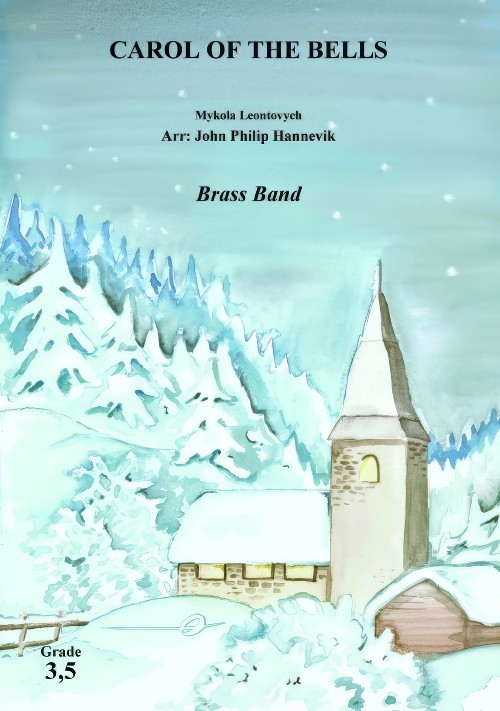
Carol of the Bells (Brass Band - Score and Parts) - Leontovych, Mykola Dmytrovich - Hannevik, John Philip
Ukrainian composer Mykola Leontyovich composed this famous Christmas Carol in 1914. The carol is based on a folk chant called Shchedryk. The composer was a supporter of the independence movement in Ukraina, and was assassinated by a Soviet agent in 1921.The carol was made famous after the adaption by Peter J. Wilhousky in 1936. Wilhousky worked as an arranger for the NBC symphony orchestra. It is also well known from popular culture, like the film Home Alone (1990), and a version by the vocal group Pentatonix.Duration: 2.30
Estimated dispatch 7-14 working days
-
 £94.99
Dublin Pictures (Brass Band - Score and Parts) - Jeanbourquin, Marc
Ireland is a multi-faceted country that has developed a popular and distinctive musical culture. The first movement of Dublin Pictures reflects Irish festivals where there is dancing and traditional beer flowing. More tranquil in its feel, the second movement illustrates the landscape that can be seen from the Ha'penny Bridge, a bridge that crosses the River Liffey in Dublin. This movement highlights the wide range of the orchestra's sound colours as the musicians' voices combine with the wind and percussion to accompany the soloist. The lively and joyful rhythms of the last movement take the listener to Temple Bar, the famous tourist quarter of the city, well known for its vibrant nightlife. The music's energy and virtuosic motifs are in contrast to the previous movement and provide a spirited and festive finale.Marc Jeanbourquin wrote this piece in three movements for Azimuts Brass in 2011.Duration: 7:45
Estimated dispatch 7-14 working days
-
 £54.99
A Spanish Christmas Carol (Brass Band - Score and Parts) - Millstone, Patrick
Rondeau of the Shepherds is the historical title associated with the well'known Dutch Christmas carol "Midden in de winternacht." The modern Dutch text was written in 1948 by the poet and writer Harry Prenen. The melody, however, has a much older heritage. It appears in the works of 17th' and 18th'century French organ composers such as Louis-Claude Daquin, Claude Balbastre, and Jean-Franois Dandrieu, who often included it in their Christmas suites and nols.The tune itself is believed to originate from a late'medieval Spanish (likely Catalan) Christmas song, traditionally identified as "El Desembre Congelat." Its imagery--shepherds, flutes, and drums--reflects a deep familiarity with biblical narratives while offering a vivid glimpse into the festive, folk-influenced Christmas celebrations of the Middle Ages.Energetic and joyful, this carol works beautifully as an uplifting, up-tempo intermezzo within a church service or seasonal concert program.Duration: 3.00
Estimated dispatch 7-14 working days
-
 £125.00
The World Rejoicing (Brass Band - Score and Parts) - Gregson, Edward
The World Rejoicing was commissioned by the National Brass Band Associations of Belgium, Netherlands, Norway, Switzerland, and the British Open, as the test piece for their competitions in 2020/21. Although the work was completed in 2019, the pandemic of 2020 meant that these competitions were postponed until 2021/22. The premiere took place in September 2021 at Symphony Hall, Birmingham, UK.In searching for a common link between the brass band traditions of the various European countries that commissioned this work, I considered the fact that hymns have always played an important role in the relationship that brass bands have with their particular communities; and thus I turned to a well- known Lutheran chorale, Nun danket alle Gott (Now thank we all our God), written around 1636 by Martin Rinkart, with the melody attributed to Johann Cruger. A number of composers have incorporated this chorale into their music, most famously J.S. Bach in his Cantatas no. 79 and 192, and Mendelssohn in the Lobsegang movement of his 2nd Symphony (the harmonisation of which is usually used when this hymn is sung).It seemed fitting therefore for me to return to a compositional form I have used many times before (Variations) and to write a work based on this hymn. I have used it in a similar way to that which I employed in my Variations on Laudate Dominum of 1976 - that is, rather than writing a set of variations using elaborations of the complete tune, I have taken various phrases from the chorale and used them within the context of other musical material, applying an overall symphonic process of continuous variation and development. The structure, or sub-divisions of the work, which is through composed and plays without a break, is as follows:Prelude, Capriccio, La Danza 1, Processional, La Danza 2, Arias and Duets, Fuga Burlesca, Chorale, and Postlude.The work, which is around 16 minutes in length, is also partly autobiographical - in the manner say of Strauss's Ein Heldenleben - in that I have incorporated into the score brief quotations from many of my other major works for brass band. In that respect, The World Rejoicing sums up a particular facet of my life as a composer, and reflects the admiration I have always had for what is surely one of the great amateur music-making traditions in the world.Duration: 16.00
Estimated dispatch 7-14 working days
-
£40.00
The World Rejoicing (Brass Band - Score only) - Gregson, Edward
The World Rejoicing was commissioned by the National Brass Band Associations of Belgium, Netherlands, Norway, Switzerland, and the British Open, as the test piece for their competitions in 2020/21. Although the work was completed in 2019, the pandemic of 2020 meant that these competitions were postponed until 2021/22. The premiere took place in September 2021 at Symphony Hall, Birmingham, UK.In searching for a common link between the brass band traditions of the various European countries that commissioned this work, I considered the fact that hymns have always played an important role in the relationship that brass bands have with their particular communities; and thus I turned to a well- known Lutheran chorale, Nun danket alle Gott (Now thank we all our God), written around 1636 by Martin Rinkart, with the melody attributed to Johann Cruger. A number of composers have incorporated this chorale into their music, most famously J.S. Bach in his Cantatas no. 79 and 192, and Mendelssohn in the Lobsegang movement of his 2nd Symphony (the harmonisation of which is usually used when this hymn is sung).It seemed fitting therefore for me to return to a compositional form I have used many times before (Variations) and to write a work based on this hymn. I have used it in a similar way to that which I employed in my Variations on Laudate Dominum of 1976 - that is, rather than writing a set of variations using elaborations of the complete tune, I have taken various phrases from the chorale and used them within the context of other musical material, applying an overall symphonic process of continuous variation and development. The structure, or sub-divisions of the work, which is through composed and plays without a break, is as follows:Prelude, Capriccio, La Danza 1, Processional, La Danza 2, Arias and Duets, Fuga Burlesca, Chorale, and Postlude.The work, which is around 16 minutes in length, is also partly autobiographical - in the manner say of Strauss's Ein Heldenleben - in that I have incorporated into the score brief quotations from many of my other major works for brass band. In that respect, The World Rejoicing sums up a particular facet of my life as a composer, and reflects the admiration I have always had for what is surely one of the great amateur music-making traditions in the world.Duration: 16.00
Estimated dispatch 7-14 working days
-
£15.00
The World Rejoicing (Brass Band - Study Score) - Gregson, Edward
The World Rejoicing was commissioned by the National Brass Band Associations of Belgium, Netherlands, Norway, Switzerland, and the British Open, as the test piece for their competitions in 2020/21. Although the work was completed in 2019, the pandemic of 2020 meant that these competitions were postponed until 2021/22. The premiere took place in September 2021 at Symphony Hall, Birmingham, UK.In searching for a common link between the brass band traditions of the various European countries that commissioned this work, I considered the fact that hymns have always played an important role in the relationship that brass bands have with their particular communities; and thus I turned to a well- known Lutheran chorale, Nun danket alle Gott (Now thank we all our God), written around 1636 by Martin Rinkart, with the melody attributed to Johann Cruger. A number of composers have incorporated this chorale into their music, most famously J.S. Bach in his Cantatas no. 79 and 192, and Mendelssohn in the Lobsegang movement of his 2nd Symphony (the harmonisation of which is usually used when this hymn is sung).It seemed fitting therefore for me to return to a compositional form I have used many times before (Variations) and to write a work based on this hymn. I have used it in a similar way to that which I employed in my Variations on Laudate Dominum of 1976 - that is, rather than writing a set of variations using elaborations of the complete tune, I have taken various phrases from the chorale and used them within the context of other musical material, applying an overall symphonic process of continuous variation and development. The structure, or sub-divisions of the work, which is through composed and plays without a break, is as follows:Prelude, Capriccio, La Danza 1, Processional, La Danza 2, Arias and Duets, Fuga Burlesca, Chorale, and Postlude.The work, which is around 16 minutes in length, is also partly autobiographical - in the manner say of Strauss's Ein Heldenleben - in that I have incorporated into the score brief quotations from many of my other major works for brass band. In that respect, The World Rejoicing sums up a particular facet of my life as a composer, and reflects the admiration I have always had for what is surely one of the great amateur music-making traditions in the world.Duration: 16.00
Estimated dispatch 7-14 working days
 View Music