
Results
-
 £45.00
The Pilgrim - Josiah Walters
Josiah describes his composition'The Pilgrim' as a journey of development and emotion, encompassing three key stages of emotional state: from the opening sounds which are full of anticipation and uncertainty, through to a passage of disillusionment and frustration, then moving on to a concluding stage which reintroduces the positive elements of the opening optimism, yet closing quietly, symbolizing an inner peace and contentment at the end of the musical journey.The composer's emotive approach to the creation of the work embraces a wealth of passion, anguish and enlightenment. Through his use of imaginative melody, themes and harmonic texture, Josiah has represented a collection of powerful emotions. Essentially non-programmatic, the piece opens in a contemplative manner, building with enthusiasm, and first introducing the use of bells and bell effects as a musical metaphor which is used throughout the piece to signify the journey's destination.As the sentiment continues, the music evolves in to an Allegro Furioso section, opening up a strong sense of frustration. At this section's climax, the symbolic use of the bells is reintroduced to create an over-tone of hope and purpose, although this does not last long as they fade into the Misterioso Molto Rubato section.As the melodies and harmonies develop onwards, 'The Pilgrim' evolves into a more reflective phase, reintroducing the sounds and motifs of the more strident opening.This closing section symbolizes the realisation that everything needed was already available to The Pilgrim, but travelling the journey, confronting and overcoming all of the challenges was the only route of discovery - peacefulness prevails, bringing the work to a close with a sense of contentment and enlightenment.'The Pilgrim', highly emotive in its creation, offers a wealth of musical imagery.Even to the uninformed listener, this fascinating, powerful and beautiful work stirs and stimulates a variety of emotional reactions - offering each listener an opportunity to apply the music to their own journey, their own personal pilgrimage.
In Stock: Estimated dispatch 3-5 working days
-
Walking in Greendale - Bryan Daly - Len Jenkins
The composer Bryan Daly was responsible for the music in the original Postman Pat series, including its well-known signature tune. Tucked away in only one episode, (not the one about Pat learning to play a tuba), is the delightful piece "Walking in Greendale", which features a jolly tuba part. Bryan kindly gave permission for its arrangement for Tuba and Brass Band, and this was originally played by Graham Cooper in The Woburn Sands 'B' Band at Whaddon Church Fete (one branch of Graham's family comes from Whaddon, in Buckinghamshire). The piece is ideal for fetes, concerts and similar engagements. Sadly, Bryan Daly died in January 2012, but with the agreement of his son, Robert, this revised arrangement is dedicated to his memory.
-
Scotch Missed - Len Jenkins - Len Jenkins
Back in the late 1980's a crowd of us went to Scotland to see in the New Year. We were dismayed to find that the pubs were shut early on New Year's Eve, and the only drink and merriment would be in an hotel (if resident or invited), or by 'first footing'. This involved taking a bottle of Scotch and presenting oneself at the door of a complete stranger, whereupon we were relieved of the bottle and welcomed into the general hubbub. The bottle was passed around those gathered there, so that by the time it got back to us it was empty. Just like its homonym, when it got around to us, it simply did not exist.
-
 £39.95
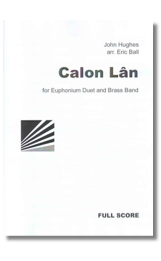
Calon Lan - Eric Ball
Eric Ball originally made this duet arrangement with piano accompaniment for inclusion in our album Czardas (order code 0078) and it was later transcribed for brass band by Eric Wilson (who was named after the composer!). The Welsh tune is handled in turn by the duettists, one embellishing while the other carries the melody. The accompaniment parts are not difficult making this delightful, somewhat nostalgic, piece ideal for bands of all abilities.
Estimated dispatch 7-9 working days
-
 £41.09
Christmas Day (Brass Band) Gustav Holst arr. Philip Rayment
VIEW SCORE PDF Well-known English composer, Gustav Holst (1874-1934) wrote this choral fantasy in 1910, about five years before his renowned orchestral suite, The Planets. The piece was originally composed for SATB choir and orchestra and dedicated to the students of Morley College, where Holst taught music. In the years since, it has been arranged for various combinations of voice and/or instruments. This arrangement is in the original key and could be adapted for use with choir and/or organ. Christmas Day features three carols in their entirety: Good Christian Men, Rejoice; God Rest Ye Merry, Gentlemen and Come, Ye Lofty, Come, Ye Lowly (an old Breton melody). There are also references to The First Nowell. Although well-received initially, this work (like many of Holst's) was neglected for many years and has not been widely recorded. It is hoped that it will be useful for brass bands during the festive season, particularly in a large acoustic. To listen to the Canadian Staff Band performing the work please visit www.youtube.com/watch?v=ccXkbWi_iWE Sheet music available from: UK - www.brassband.co.uk USA - www.solidbrassmusic.com Difficulty Level: 3rd Section + Instrumentation: Soprano Cornet Eb Solo Cornet Bb Repiano Cornet Bb 2nd Cornet Bb 3rd Cornet Bb Flugel Horn Bb Solo Horn Eb 1st Horn Eb 2nd Horn Eb 1st Baritone Bb 2nd Baritone Bb 1st Trombone Bb 2nd Trombone Bb Bass Trombone Euphonium Bb Bass Eb Bass Bb Percussion 1-3
In Stock: Estimated dispatch 1-3 working days
-
 £33.62
Coronation March from 'Le Prophete' (Brass Band) Meyerbeer arr. Rob Bushnell
The Coronation March by the German composer Giacomo Meyerbeer comes from Act 4, Scene 2 of his grand opera, Le Prophete (The Prophet). Set in the 16th century, it is based on the life of John of Leiden, Anabaptist leader and "King of Munster", with the libretto influenced by the works of Voltaire. The 5-act opera deals with love, revenge and tragedy. It was premiered by the Paris Opera at the Salle Le Peletier on 16 April 1849, with audience members including Chopin, Verdi, Delacroix, Charles Dickens and Berlioz.During his life, Meyerbeer was a dominant figure in the world of opera, with Hector Berlioz saying of him 'he has not only the luck to be talented, but the talent to be lucky.' To view a rolling score video of the work please visit www.youtube.com/watch?v=_M4DtUdQzhA Duration: Approx. 3.40 minutes Difficulty Level: 3rd Section + PDF download includes parts and score. Also includes alternative parts for horns in F and lower brass in bass clef. Sheet music available from www.brassband.co.uk Instrumentation: Soprano Cornet Eb Solo Cornet Bb Repiano Cornet Bb 2nd Cornet Bb 3rd Cornet Bb Flugel Horn Bb Solo Horn Eb 1st Horn Eb 2nd Horn Eb 1st Baritone Bb 2nd Baritone Bb 1st Trombone Bb 2nd Trombone Bb Bass Trombone Euphonium Bb Bass Eb Bass BbTimpani Percussion
In Stock: Estimated dispatch 1-3 working days
-
 £59.77
Horizon: The Promise of the Lord (Brass Band) Andrew Wainwright
Horizon: The Promise of the Lord was written at the request of Bandmaster Stephen Cobb for The International Staff Band. It is based on the much loved hymn of the church, Cwm Rhondda (Guide me O thou great Jehovah). The work was recorded on the ISB's CD Manuscripts II (released 2023). This highly descriptive piece will be an excellent addition to concert programs, as well as being appropriate as a test piece. The inspiration for the work comes from the book of Exodus. Whilst the music is not intended to be directly programmatic, like the hymn Cwm Rhondda, the work takes the listener through the Exodus from Egypt to the promised land of Israel as a metaphor of the spiritual pilgrimage of the individual Christian through his or her earthly life. The music aims to evoke a sense of God's guidance through strife and affirm the reality that God provides for us and redeems all the wrong in the world. This God who provided for the Hebrew people wandering amidst 'barren lands' with 'bread of heaven' is still and ever will be a God of provisional grace. Through listening to the music, it is the composer's intention that we are reminded of God's promise of Deliverance as set out in Exodus 6 v7-8: 'I will take you as my own people, and I will be your God. Then you will know that I am the Lord your God, who brought you out from under the yoke of the Egyptians. And I will bring you to the land I swore with uplifted hand to give to Abraham, to Isaac and to Jacob. I will give it to you as a possession. I am the Lord.' Like the hymn, Horizon: The Promise of the Lord is intended as a prayer for guidance. The Christian is a pilgrim through 'this barren land'. The music is often chromatic and in large parts verging on atonality, as a reflection of the strife that the Israelites endured in their 40 years in the wilderness. However, it ends in climactic fashion with the Hebrew people finally reaching their destination after many years of wandering in the desert - as they approach the 'Horizon' promised by the Lord. To view a performance of the work by the National Youth Brass Band of Great Britain please visit www.youtube.com/watch?v=LjOHf7QEw1g PDF download includes score and parts. Sheet music available from: UK - www.brassband.co.uk USA - https://satradecentral.org Difficulty Level: 1st Section + Length: c11.00 minutes Instrumentation: Soprano Cornet Eb Solo Cornet Bb Repiano Cornet Bb 2nd Cornet Bb 3rd Cornet Bb Flugel Horn Bb Solo Horn Eb 1st Horn Eb 2nd Horn Eb 1st Baritone Bb 2nd Baritone Bb 1st Trombone Bb 2nd Trombone Bb Bass Trombone Euphonium Bb Bass Eb Bass Bb Percussion 1-4
In Stock: Estimated dispatch 1-3 working days
-
 £33.62
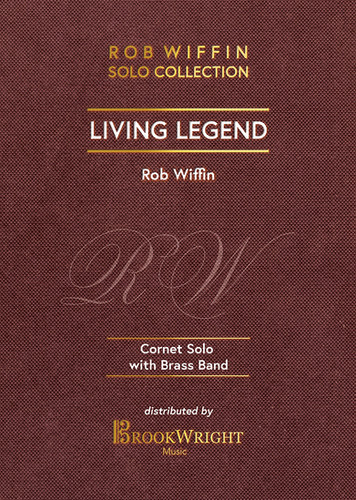
Living Legend (Cornet Solo with Brass Band) Rob Wiffin
This short, lyrical solo was named for a musician friend who was proud of having been described as a living legend. Although not obviously technically demanding, it requires good control and careful phrasing, as well as sensitive accompaniment from the band. Audio demo: https://soundcloud.com/user-565396545/living-legend-cornet-solo-with Duration: Approx. 3.30 minutes Difficulty Level (Band): Easy Soloist: Medium This PDF download includes the full score and parts. Sheet music available at www.brassband.co.uk (UK) or https://satradecentral.org (USA)
In Stock: Estimated dispatch 1-3 working days
-
 £59.77
Sleigh Ride Suite (Brass Band) Leopold Mozart arr. Alex McGee
Today Leopold Mozart (1719-1787) is known almost exclusively as the stern father of Wolfgang, but he was a prominent and successful musician in his own time. The Sleigh Ride, composed just before Wolfgang was born, certainly shows that Mozart the elder had as good a sense of humour as his more famous son. Wolfgang must, in fact, have known and enjoyed his father's piece - he included a short Sleigh Ride in his German Dances, K.605, in 1791. Leopold's more complicated piece is a programmatic serenade, with short titles for each section: a musical picture of a cold evening's ride to a party. The score calls for sleigh bells, rattle, a whip, and triangle. The action begins with a short overture (Intrada), followed by the Sleigh Ride itself, a lively duple-meter dance accompanied by jangling sleigh bells and punctuated by the cracking of a whip. There is then a nice bit of musical pantomime - The Young Lady Shivers With Cold. The sleigh finally arrives at the party, a ball with a small dance orchestra. The Ball Begins, not surprisingly, with a courtly menuet, and the End of the Ball is a spirited Kehraus, a lively rondo-form dance. This transcription faithfully seeks to convey the light touch of the Age of Enlightenment to the modern brass band and provides ensembles with new material for their annual Christmas concerts. To view a rolling score video of the work please visit https://www.youtube.com/watch?v=tgrBe1u8Xag Duration: Approx. 11.45 minutes Difficulty Level: 3rd Section + PDF download includes parts and score. Sheet music available from www.brassband.co.uk Instrumentation: Soprano Cornet Eb Solo Cornet Bb Repiano Cornet Bb 2nd Cornet Bb 3rd Cornet Bb Flugel Horn Bb Solo Horn Eb 1st Horn Eb 2nd Horn Eb 1st Baritone Bb 2nd Baritone Bb 1st Trombone Bb 2nd Trombone Bb Bass Trombone Euphonium Bb Bass Eb Bass BbTimpani Percussion 1-2
In Stock: Estimated dispatch 1-3 working days
-
 £38.95
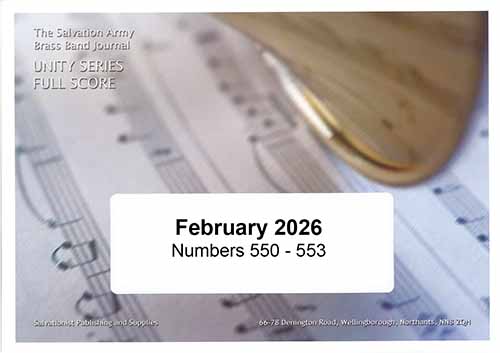
Unity Series Band Journal - Numbers 550 - 553, February 2026
550: March - Century of celebration (Stephen Smith)This march follows a traditional pattern and should be accessible for most bands. It was written for the 100th anniversary of Camp Gifford in Loon Lake, Washington, therefore included are well-known songs with references to water as the camp is located on the shores of Deer Lake.551: Going Home (Alan Williams)Richard Jukes' song I'm a soldier bound for Glory (S.A.S.B. 856) displays the confidence of someone with a steadfast faith who is certain that by loving and serving their God they will be accepted into his Kingdom. This assurance results in a joyful song of testimony. Whilst not a direct setting of the five verses, the dance-like rhythm of this cha-cha should reflect the positive and encouraging nature of the lyrics and be full of joy and spirit.552: Whosoever will may come (Noel Jones)This is a two-verse arrangement of the song Whosoever will may come (S.A.S.B. 405), with words written by William John McAlonan and music composed by Alfred Braine. This song is included in the Invitation and Challenge section of the song book. The arrangement should be played in a spirited style.553: March - Sing a praise of celebration (Marcus Venables)This music was written at the request of the Singapore Central Corps Band, who asked that the work be based on two specific meaningful melodies. The first is To the Glory and Praise of God by Robert Redhead, a tune rooted in corporate worship and joyful proclamation, calling God's people to lift their voices in thanksgiving. The other is Home, a beloved Singaporean song that speaks of belonging.
Estimated dispatch 7-14 working days
 View Music
 Watch video