
Results
-
 £80.00
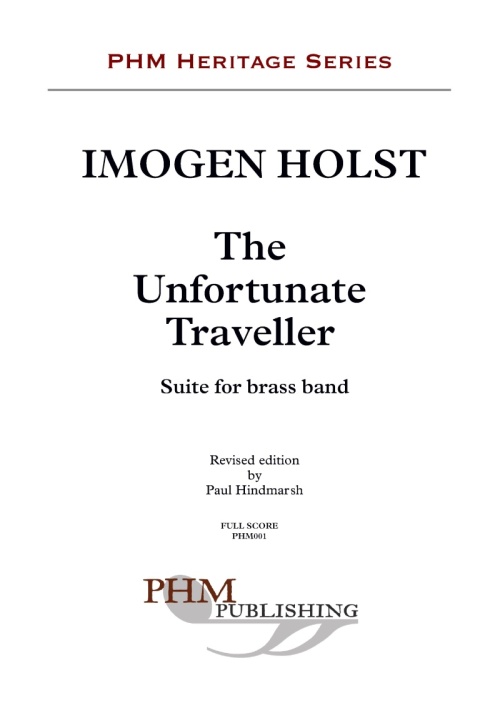
The Unfortunate Traveller (Brass Band - Score and Parts)
Imogen Holst (1907-1984) submitted The Unfortunate Traveller (1929) as her final work as a student portfolio at the Royal College of Music, where her composition teacher was Gordon Jacob. The title was taken from Thomas Nashe's famous 1594 picaresque novel of the same title. The Suite was first performed on 12 February 1933 at her Majesty's Theatre, Carlisle, by the St. Stephen's Band, with the composer conducting. Te concert was given in memory of Holst's uncle, Dr. H.A. Lediard. Holst had been impressed with the band's performance of his A Moorside Suite at the 1928 National Brass Band Championships (The Crystal Palace, South London) and was keen to work with them. Writing in Imogen Holst, a life in music, Christopher Grogan indicates that it was Gustav Holst's suggestion to include his daughter's work in the programme, quoting Imogen Holst's remarks made in interview to The Daily Mail as follows: "....it is the first time, so far as I know, that a woman has conducted a brass band at a public concert....It has been a delight to rehearse the St. Stephen's Band. It was their performance at the Crystal Palace Festival that inspired me to write this Suite, which I have dedicated to them."Imogen Holst accompanied her father to the Crystal Palace in 1928 to hear the performances of A Moorside Suite, and was so excited by the played and, audibly, by her father's music that she decided to write a brass band piece for her final examination. Te result was The Unfortunate Traveller (1929). However, it was not possible for her to present a brass band work for examination. She arranged it for string orchestra so that it could be played before she left the RCM in July 1930. Following the premiere of the original in 1933, the manuscripts did not resurface until 1969 Imogen found them among her late mother's effects. Although she requested score and parts be destroyed, they ended up in the possession of Manchester composer John Golland, who marked up the score presumably with the intention of creating a new performing edition. The original scoring reveals a lack of experience with what can be a tricky medium.With the agreement of the Holst Foundation, a revised edition, with additional percussion, was prepared in 2011 since when the work has been fortunate to travel round the world as a concert and contest piece. The original includes drums in the March only. The title was taken from Tomas Nashe's famous 1594 picaresque novel of the same title. Several Morris Dance tunes are introduced during the course of the four short movements, including Bonnie Green Garters, Shepherd's Hey, The Rose and The Wind Blaws Cauld. Quirky twists and turns of harmony and spirited rhythms that remind us how much Imogen Holst loved tradition English dance music.In September 2025, I made a performing edition of the composer's arrangement for string orchestra. The manuscript lacks the final movement, which I arranged in a similar style, ie. without extending the upper ranges. Making this edition raised some issues regarding the accuracy of my band version and some of the solutions I used to smooth out the voicing. I have used the composer's second thoughts to refine my performing edition and to correct a textual errors.- Paul HindmarshDuration: 10.00
Estimated dispatch 7-14 working days
-
£40.00
The Unfortunate Traveller (Brass Band - Score only)
Imogen Holst (1907-1984) submitted The Unfortunate Traveller (1929) as her final work as a student portfolio at the Royal College of Music, where her composition teacher was Gordon Jacob. The title was taken from Thomas Nashe's famous 1594 picaresque novel of the same title. The Suite was first performed on 12 February 1933 at her Majesty's Theatre, Carlisle, by the St. Stephen's Band, with the composer conducting. Te concert was given in memory of Holst's uncle, Dr. H.A. Lediard. Holst had been impressed with the band's performance of his A Moorside Suite at the 1928 National Brass Band Championships (The Crystal Palace, South London) and was keen to work with them. Writing in Imogen Holst, a life in music, Christopher Grogan indicates that it was Gustav Holst's suggestion to include his daughter's work in the programme, quoting Imogen Holst's remarks made in interview to The Daily Mail as follows: "....it is the first time, so far as I know, that a woman has conducted a brass band at a public concert....It has been a delight to rehearse the St. Stephen's Band. It was their performance at the Crystal Palace Festival that inspired me to write this Suite, which I have dedicated to them."Imogen Holst accompanied her father to the Crystal Palace in 1928 to hear the performances of A Moorside Suite, and was so excited by the played and, audibly, by her father's music that she decided to write a brass band piece for her final examination. Te result was The Unfortunate Traveller (1929). However, it was not possible for her to present a brass band work for examination. She arranged it for string orchestra so that it could be played before she left the RCM in July 1930. Following the premiere of the original in 1933, the manuscripts did not resurface until 1969 Imogen found them among her late mother's effects. Although she requested score and parts be destroyed, they ended up in the possession of Manchester composer John Golland, who marked up the score presumably with the intention of creating a new performing edition. The original scoring reveals a lack of experience with what can be a tricky medium.With the agreement of the Holst Foundation, a revised edition, with additional percussion, was prepared in 2011 since when the work has been fortunate to travel round the world as a concert and contest piece. The original includes drums in the March only. The title was taken from Tomas Nashe's famous 1594 picaresque novel of the same title. Several Morris Dance tunes are introduced during the course of the four short movements, including Bonnie Green Garters, Shepherd's Hey, The Rose and The Wind Blaws Cauld. Quirky twists and turns of harmony and spirited rhythms that remind us how much Imogen Holst loved tradition English dance music.In September 2025, I made a performing edition of the composer's arrangement for string orchestra. The manuscript lacks the final movement, which I arranged in a similar style, ie. without extending the upper ranges. Making this edition raised some issues regarding the accuracy of my band version and some of the solutions I used to smooth out the voicing. I have used the composer's second thoughts to refine my performing edition and to correct a textual errors.- Paul HindmarshDuration: 10.00
Estimated dispatch 7-14 working days
-
 £59.45
Avifauna (Brass Band) Joshua Tyler Jameson
This highly descriptive work was commissioned by the National Youth Brass Band of America and will be a terrific concert or entertainment contest item. The music paints the picture of the lives of a variety of different birds.The composer writes:'When I began thinking about this project I was sitting in my office in the early morning, the sun having just risen. There was a gentle breeze and the only thing that I could hear (aside from my hungry whining cats) was the gentle song of the birds outside my open window. As much of my work is programmatic, almost like symphonic poems, this immediately gave me the image of a majestic sunrise with all types of birds fluttering about, almost as if out of an episode of Planet Earth. When I was commissioned by the National Youth Brass Band of America, I knew the project had to be something the ensemble could grab onto. Something they could see. Something they could relate to. There being so many types of birds in North America, I selected a handful to help tell my story...The scene where I came up with this idea seemed to be the perfect starting point. Sunrise, tiny chirps of Morning Birds floating around the twilight of dawn, swiftly moving towards the majesty of the sun cresting the horizon. A new day, the beginning of a story.As the sun rises higher in the sky, animal activity stirs, becoming lively and wild. The flowers have opened up to drink in the sun's rays, leaving them open to nectar-seeking Hummingbirds. Whizzing by at lightning speed, the hummingbirds journey from flower to flower, drinking their fill until the sun begins to set back over the horizon.When daylight fades, the enigmatic Owl floats silently through the sky. The wonder of these creatures comes not just from their beauty, but also from their mystery and their ferocity. We see images in pop culture of majestic white owls and marvel in their beauty... but to a mouse roaming the forest floor in the dark of the night, the terror of suddenly being dropped upon by a silent predator is anything but peaceful.In the dead of night, soft rolling clouds thicken as a storm begins to brew. With the ensuing rain also emerges the grotesque scavenging Vulture; marching along from carcass to carcass, tearing into the rotting leftovers of another predator's kill, gorging themselves until over-full. However, from this nightmare fuel of a bird, a new day awaits...As the dawn of another day approaches, you begin to hear the same morning birds you heard the previous day. When the light finally breaks the horizon, the soaring majesty of the Eagle drives us to the end of our story; an exciting journey told through the eyes of the winged creatures that paint the skies of North America.This is Avifauna.'To view a follow-the-score video please visit: www.youtube.com/watch?v=J2bhBpx9KvMSheet music available from:UK - www.brassband.co.ukUSA - www.solidbrassmusic.comDifficulty Level: 2nd Section +Instrumentation:Soprano Cornet EbSolo Cornet BbRepiano Cornet Bb2nd Cornet Bb3rd Cornet BbFlugel Horn BbSolo Horn Eb1st Horn Eb2nd Horn Eb1st Baritone Bb2nd Baritone Bb1st Trombone Bb2nd Trombone BbBass TromboneEuphonium BbBass EbBass BbPercussion 1-4
In Stock: Estimated dispatch 1-3 working days
-
 £29.95
Prayer to St Michael - Jonathan Bates
DURATION: 4'00". DIFFICULTY: Moderate. 'Prayer to Saint Michael' is a solo for Euphonium, composed for the Wantage Band and inspired by the life of a young Johann Sebastian Bach, who following the death of both parents by the age of only 10 moved to live with his older brother - Johann Christoph Bach - who was the church organist at St Michael's Church in Ohrdruf. It was in this church where Bach spent many hours studying and performing, being instructed by Johann Christoff on the clavichord. Within 6 years, the young Bach had been enrolled in the prestigious St Michael's School in Luneberg. . "St. Michael the Archangel, illustrious leader of the heavenly army, . defend us in the battle against principalities and powers, . against the rulers of the world of darkness and the spirit of wickedness in high places. Come to the rescue of mankind, . whom God has made in His own image and likeness, . and purchased from Satan's tyranny at so great a price. The Holy Church venerates you as her patron and guardian. The Lord has entrusted to you the task of leading the souls of the redeemed to heavenly blessedness. Entreat the Lord of peace to cast Satan down under our feet, . so as to keep him from further holding man captive and doing harm to the Church. Carry our prayers up to God's throne, . that the mercy of the Lord may quickly come and lay hold of the beast, . the serpent of old, Satan . and his demons, casting him in chains into the abyss, . so that he can no longer seduce the nations. Amen.". .
In Stock: Estimated dispatch 1-3 working days
-
£86.00
Minnen fran Holmen - Jerker Johansson
The first theme played by the solo clarinet was written by Jerker Johansson the summer 1997, when he was composing in Swedish folk music style for an intended radio programme in which his father should participate reading poems in local dialect. Unfortunately, the project was discontinued. In the spring 2015 Mr. Johansson however started to work on the theme again, this time adding a song theme of broader character. Holmen is the name of the homestead where Mr. Johansson's father Arne grew up. It is beautifully located in the parish of Skarv, situated east of Skara, one of the oldest towns in Sweden. At Holmen, the composer spent his childhood summers and his recollections are filled with many bright moments and happy memories. The piece was premiered May 22, 2015 by the Goteborg Wind Orchestra conducted by the composer.
Estimated dispatch 7-14 working days
-
£250.00
Continental Divide - Stig Nordhagen
The title is "Continental Divide" and it has nothing to do with tectonic plates, but is another word for "Watershed".It is the place where the the water flows in opposite directions. For example, when you drive up a mountain, the water flows downwards, the same does it when you drive down the other side. On top there is usually a water, and it is in this water, or musical idea if you like,that it is a continental divide. What I intend is that in this piece there are some musical motifs that change character and direction. They can be in the foreground and carry the play, or they may be in the background as a countermeasure. It can also be from horizontal lines to vertical.Or rhythmical patterns that dont find their match until far into the piece.
Estimated dispatch 7-14 working days
-
 £20.00
African Dawn - Steve Robson
This piece embraces the sounds and imagery of a tribal group out singing on a remote hill top, where individuals sing out a 2 bar phrase and the remainder of their group sing a response. African Dawn brings this vision to life by giving the opportunity for the musicians playing the original "Chant" or "Call" to be positioned as soloists, or just stand up within the main group.There is also the opportunity for lots of percussion to be spread throughout the band and divided into groups, or even groups of people clapping the separate rhythms to bring forth the African atmosphere.African Dawn is part of the Flexi-Collection - World Tour Series.Our Flexi-Collection Series:Flexible scoring tailored to your needs - a perfect solution for expanding the repertoire of Junior/Youth brass bands and ensembles. The Flexi-Collection currently offers two series and these will be regularly expanded to offer groups an even wider variation of music. Based on four-part harmony, these collections provide brass groups with the advantage of complete flexibility when may not be balanced.Added Extras:Each part of The World Tour Series also includes rudimentary theory reference sheet andLearn Together Moments(warm-up passages which relate to each of the styles of pieces included in the whole series). The score also includes background/programme notes andCheck It Outideas to encourage the players to find out more about the music style and/or inspiration behind the piece.If players or instruments are missing, the show can still go on! The thoughtful scoring and arranging by Steve Robson now means that groups of all abilities have access to a truly flexible set of music for their needs.Available for Brass Band (with world parts included), pieces included in our World Tour Series offer flexibility in every sense of the word.(Available individually or as part of the completeFlexi-Collection World Tour Series Album).
In Stock: Estimated dispatch 3-5 working days
-
 £30.00
Exegesis - Tim Paton
An exciting, original composition for brass band by Tim Paton. A complex work which entwines melodic lyricism amidst contemporary harmonies and scoring. A tour de force of Tim's creativity and a rewarding challenge for the performers and audience.Tim comments: The term exegesis is applied to a study which works out the meaning of something, an interpretation of a series of events, a comparison of ideas within a given medium, for example, "Biblical exegesis". This brass band piece is a musical exegesis.Section one is made up of three main themes, and although these themes are tonal within themselves, there is a sense that they are trying to understand one another. From the very beginning of this section, there is an element of bi-tonality and dissonance.The middle section is ponderous, where we hear elements of these three themes. It could be called the 'thinking section'.Section three almost interrupts this middle section, with fanfares displaying a realisation, still containing bi-tonality, but in harmony! We are soon led in to a hymn like celebration, followed by a determined, militaristic section for the percussion. Finally, the fanfares which opened this third section, reappear, taking us to a final conclusion.
In Stock: Estimated dispatch 3-5 working days
-
 £30.00
Pioneers (Brass Band) - Steve Robson
The 19th Century was a time of great pioneering spirit, where developments in industry, and transport were to begin a process, which was to transform societies around the world beyond recognition.In the vast, so-called "New World" of America these changes were exemplified as the railways spread out to reach hitherto remote and largely unexplored expanses.Steve Robson has composed Pioneers as a three movement piece for brass band, written in the spirit of John Philip Sousa (1854 - 1932), Stephen Foster (1826 - 1864) and Scott Joplin (1868 - 1917).The three movements consist of:March - The US Marine Band (1880)Spiritual - I'm Lookin' Up To HeavenRagtime - Canonball RagAlso available for brass and percussion ensemble.
In Stock: Estimated dispatch 3-5 working days
-
 £20.00
Pioneers (Ensemble) - Steve Robson
The 19th Century was a time of great pioneering spirit, where developments in industry, and transport were to begin a process, which was to transform societies around the world beyond recognition.In the vast, so-called "New World" of America these changes were exemplified as the railways spread out to reach hitherto remote and largely unexplored expanses.Steve Robson has written Pioneers as a three movement piece for brass and percussion ensemble (and also now available as a full brass band version), written in the spirit of John Philip Sousa (1854 - 1932), Stephen Foster (1826 - 1864) and Scott Joplin (1868 - 1917).The three movements have been written for the following instrumentation:2 x Bb cornet1 x flugelhorn1 x Eb Tenor Horn1 x tenor trombone1 x euphonium1 x Eb Bassdrumkit and percussionand consist of:March - The US Marine Band (1880)Spiritual - I'm Lookin' Up To HeavenRagtime - Canonball RagAlso available for brass band.
In Stock: Estimated dispatch 3-5 working days