
Results
-
 £30.00
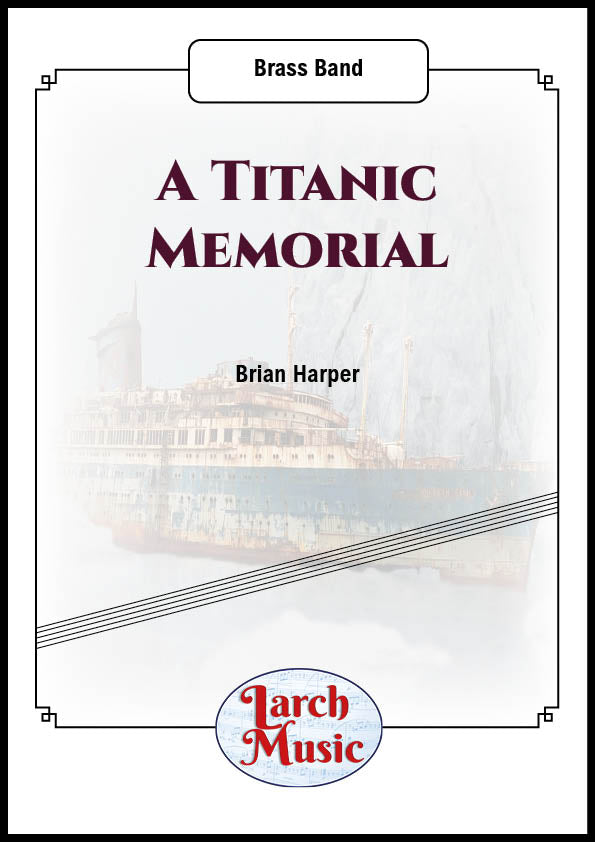
A Titanic Memorial - Brass Band Sheet Music Full Score & Parts - LM393
COMPOSER: Brian HarperRMSTitanicwas a British passengerliner, operated by theWhite Star Line, thatsank in the North Atlantic Oceanon 15 April 1912 after striking anicebergduring her maiden voyage fromSouthampton, England toNew York City, United States.Of theestimated 2,224 passengers and crewaboard, more than 1,500 died, making itthe deadliest sinking of a single shipup to that time.It remains the deadliest peacetime sinking of anocean linerorcruise ship.The disaster drew public attention, provided foundational material for thedisaster filmgenre, and has inspired many artistic works.LM393 - ISMN : 9790570003938
In Stock: Estimated dispatch 3-5 working days
-
 £30.00
Be Thou My Vision (Traditional arr. by David Grace) - Brass Band Sheet Music Full Score & Parts - LM656 - Traditional - David Grace
COMPOSER: TraditionalARRANGER: David Grace"Be Thou My Vision" (Old Irish: Rop tu mo baile or Rob tu mo bhoile) is a traditional Christian hymn of Irish origin.The words are based on a Middle Irish poem that has traditionally been attributed to Dallan Forgaill in the 6th century.However, scholars believe it was written later than that.Some date it to the 8th century; others put it as late as the 10th or 11th century.That it sat untranslated for perhaps 14 centuries is astounding.The best-known English version, with some minor variations, was translated in 1905 by Mary Elizabeth Byrne, then made into verse by Eleanor Hull and published in 1912.Since 1919 it has been commonly sung to an Irish folk tune, noted as "Slane" in church hymnals, and is one of the most popular hymns in the United Kingdom.LM656 - ISMN : 9790570006564
In Stock: Estimated dispatch 3-5 working days
-
 £59.95
Bonnie Northumbria - Brass Band - LM786
COMPOSER: Laurie JohnstonProgramme NotesNorthumberland, or Northumbria as it is also known, is the most northern county in England and has magnificent and stunning landscapes just waiting to be explored. Filled with mystical castles, atmospheric ruins and historical sites and edged by spectacular coastal scenery, there is something wonderful to see at every turn. The Devils Causeway passes through Northumbria and reaches Berwick upon Tweed at the coast. Walkers and cyclists can also take the Coast and Castles Cycle Route or the North Sea Trail which journey through some of the most beautiful scenery along the way.The Blaydon Races is aGeordiefolk songwritten in the 19th century byGeordie Ridley, in a style deriving frommusic hall. It is regarded by many as the unofficialanthemofTynesideand is frequentlysungby supporters ofNewcastle United Football ClubandNewcastle Falconsrugby club.Blaydonis a small town inGateshead, situated about 4 miles (6.4km) fromNewcastle upon Tyne, inNorth East England. The race used to take place on the Stella Haugh 1 mile (1.6km) west of Blaydon.Stella South Power Station(demolished in 1995) was built on the site of the track in the early 1950s, after the races had stopped taking place in 1916.Water of Tyne (sometimes rendered as The Waters of Tyne) is a folk song (Roud number1364) from the north-east of England. The song is sung by a girl or woman lamenting the fact that her paramour is on the opposite bank of theRiver Tyne. Sleeve notes to Michael Hunt's recording of Tyneside songs states that "the ferry is believed to be that atHaughton Castleon theNorth Tyne". Alternatively the "rough river" in the last line may indicate a point further downstream, possiblyTynemouth.The song was collected byJohn Bellin 1810 and published two years later inRhymes of Northern Bards.The Keel Row is a traditional Tyneside folk song evoking the life and work of thekeelmenofNewcastle upon Tyne. A closely related song was first published in aScottishcollection of the 1770s, but may be considerably older, and it is unclear whether the tune is Scottish or English in origin.The opening lines of the song set it inSandgate, that part of the quayside overlooking the River Tyne to the east of the city centre where the keelmen lived and which is still overlooked by theKeelmen's Hospital.Versions of the song appear in both England and Scotland, with Scottish versions referring tothe Canongaterather than Sandgate. The earliest printing was in the 1770s inEdinburghin A Collection of Favourite Scots Tunes, edited by Charles Maclean, though the tune was also found in several late eighteenth-century English manuscript collections. As the term "keel" was used both sides of the border, it has not been determined which version was the original, althoughFrank Kidsonsurmised that like many other songs collected by Maclean it may originally have been aJacobiteair from the time of the1745 rebellion. Some versions of the song make reference to a "blue bonnet[...] with a snowy rose upon it", a clear attempt to evoke Jacobite symbolism, whether dating from 1745 or not.Kidson, however, also noted that he had found the tune of The Keel Row associated with an early dance called "The Yorkshire Lad" as early as 1748.By the 19th century the tune was well associated with the River Tyne; a few years before the 1850s the keelmen had met yearly to celebrate the founding of the Keelmen's Hospital, perambulating the town to the accompaniment of bands playing The Keel Row.Dance To Thy Daddyis a traditional Englishfolksong, originating inNorth East England. An early source for the lyrics, Joseph Robson's "Songs of the bards of the Tyne", published 1849, can be found on the Farne archive. In Farne's notes to the song, it is stated that these lyrics were written by William Watson around 1826.
In Stock: Estimated dispatch 3-5 working days
-
£44.00
Don't Sit Under the Apple Tree - Stept-Brown-Tobias - Bjorn Morten Kjaernes
"Don't Sit Under the Apple Tree (With Anyone Else but Me)" is a popular song that was made famous by Glenn Miller and by the Andrews Sisters during World War II. Its lyrics are the words of two young lovers who pledge their fidelity while one of them is away serving in the war. Originally titled "Anywhere the Bluebird Goes", the melody was written by Sam H. Stept as an updated version of the nineteenth-century English folk song "Long, Long Ago". Lew Brown and Charles Tobias wrote the lyrics and the song debuted in the 1939 Broadway musical Yokel Boy. After the United States entered the war in December 1941, Brown and Tobias modified the lyrics to their current form, with the chorus ending with "...'till I come marching home".In 1942 the song was featured in the film Private Buckaroo as a performance by the Andrews Sisters with the Harry James orchestra and featuring a tap dancing routine by The Jivin' Jacks and Jills. It was featured in the films Twelve O'Clock High (1949), With a Song in My Heart (1952), Kiss Them for Me (1957), A Carol for Another Christmas (1964), In Dreams (1999) and The Master (2012). It also featured in the mini-series The Pacific. You can use the song both on musical concerts, movie concerts or just as a happy jazz tune on your next concert. On the sections (like from bar 25), please work carefully to make a good balance with all parts, and that each chord is balanced. With 4-part harmonies sometimes you need to hold back certain notes to make the accord sound good. If you want to open up for a longer improvisation, you can repeat 65 to 81, but then change the part 2 in bar 80 from Eb to a D on the repeat. The accord will be an F6 instead of F7 (on beat 3 and 4 in bar 80) Have fun and enjoy!
Estimated dispatch 7-14 working days
-
£35.00
B of the Bang - Peter Meechan
B of the Bang has a double reference point for its title, both of which are very closely related.A quotation from the legendary British Sprinter, Linford Christie, was the initial starting point for the piece. Christie used to say that he started his races not merely at the 'bang' of the starting pistol, but at 'The B of the Bang'.B of the Bang (Again named after the Christie quote) is also the name of a prominent sculpture in the composers' home city, Manchester. Designed by Thomas Heatherwick, it is the tallest self-supporting sculpture in the United Kingdom and was constructed close to the City of Manchester Stadium in order to commemorate the success of the 2002 Commonwealth Games.B of the Bang was commissioned by Luc Vertommen and Brass Band Buizingen, Belgium, for the Kerkrade World Brass Band Championships.First performance:Brass Band BuizingenLuc Vertommen - ConductorKerkrade, Holland.
Estimated dispatch 12-14 working days
-
 £64.95
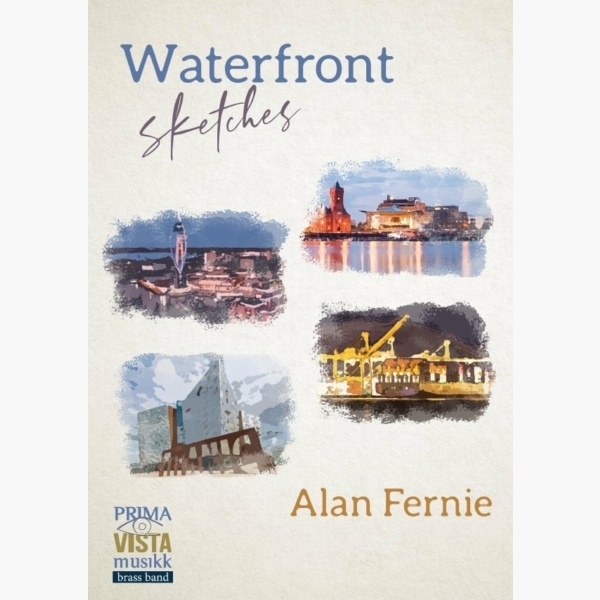
Waterfront Sketches - Alan Fernie
Waterfront Sketches was commissioned by the National Children's Band of Great Britain and premiered by them at Repton School in July 2016. The composer was asked to write a work reflecting the four nations that make up the United Kingdom...
Estimated dispatch 5-7 working days
-
£39.95
PURPOSE (Brass Band Set) - Paul Sharman
Written for The Salvation Army United Kingdom Territorial Youth Band course 2009, the songs included all speak about having a purpose in our lives; 'Dare to be a Daniel' ('Standing by a purpose true'), 'Without you, I'll be nothing' and 'King of kings, Majesty' ('I live to serve your majesty').
Estimated dispatch 7-14 working days
-
£44.95
TURRIS FORTISSIMA (Brass Band Set) - Steven Ponsford
The geographical position of Plymouth (the composer's home city) means that, at various times in history, the city has been the United Kingdom's first line of defence. A series of forts around the coast bears testimony to this and forts have featured on the city's coat of arms ever since. However, the city's forefathers believed that physical security was worthless without a faith in God's protection and this is reflected in the city motto; Turris fortissima est nomen Jehovah (The name of Jehovah is our strongest tower) (Proverbs 18:10). Written for Enfield Citadel Band's tour of the USA in 2007, the music attempts to portray this assurance with the use of the tune Ein' Fest Burg (A mighty fortress is our God) along with the more contemporary Blessed be the Name of the Lord and Shout to the Lord. There is also an apt reference to Dean Goffin's My Strength, My Tower as the music builds to its dramatic final bars.
Estimated dispatch 7-14 working days
-
Galloping Home (The theme from TV's Black Beauty) - Dennis King - Len Jenkins
"The Adventures of Black Beauty" was a British children's television drama series produced by London Weekend Television and shown by ITV in the United Kingdom between 1972 and 1974. The theme tune, "Galloping Home", written by Denis King and performed by the London String Chorale, was released as a single and peaked at number 31 in the UK charts in the week of 2 February 1974. It was later used at the climax of the first series of Absolutely Fabulous, with Edina Monsoon dreaming of running through a field as Black Beauty does in the series' title sequence. The piece has been arranged for both Full Brass Band and Brass Ensemble, in this case a Quintet with optional percussion. Both arrangements are well within the capabilities of most bands.
-
Peterborough Mass - Jeremy Cladd - Len Jenkins
Peterborough Mass comprises 5 Movements, Kyrie, Gloria, Sanctus, Benedictus and Agnus Dei. It was composed by Jeremy Cladd who became Head Chorister during his teenage yearsat Peterborough Cathedral. Total immersion in the music within such an inspiring building caused Jeremy to look deeper into the liturgical aspects of the Mass in order to understand the origins of the literary text being sung, so that he could paint a musical landscape based upon his interpretation of the text. From a musical perspective, Jeremy's Kyrie takes its inspiration from Philippians 2 vv1-11 (NIV) "Imitating Christ's Humility", and is structured AB where A refers to humility and submission "lord have mercy" and B relates to "united with Christ", with the latter evoking feelings of salvation and joy. In sympathy with the literary text, the Kyrie has a short introduction, and then a ternary form ABA structure where A is influenced by polyphonic choral writing and B by homophonic choral writing. This is the first of the five Movements to be arranged for Brass Band with Choir and comprises a full brass band score, parts for all instruments and a choral practice score.
 View Music