Results
-
£24.50
Codebreakers - Len Jenkins
A great march, dedicated to the memory of those who worked at Bletchley Park, Milton Keynes, England, in World War 2. They were under the brilliant leadership of Alan Turing and were responsible for breaking the secret military codes used by the Enemy Forces (German in particular). The composer, Len Jenkins, lives close to Bletchley Park, went to school even closer, and attended Training Courses actually in 'The Park'. The march has memorable themes and is toe tapping for the audience.
In Stock: Estimated dispatch 1-3 working days
-
 £37.50
A Coventry Rhapsody - Karl Whelan
For bands searching for an 'Overture' kind of work to programme into their Christmas concerts, look no further. "The Coventry Carol" dates back to the 16th century and is one of three songs from a nativity play entitled "Pageant of the Shearman and Tailors" which was traditionally performed in Coventry. The carol itself depicts the "Massacre of the Innocents" in the nativity narrative from the "Gospel of Matthew", in which King Herod, orders the execution of all baby boys under the age of two in the vicinity of Bethlehem. In this Rhapsody, Karl Whelan takes the familiar tune and turns it into an impressive showcase for bands looking to give the audience something different and very enjoyable for their festive concerts.
In Stock: Estimated dispatch 1-3 working days
-
£24.50
Hut Six - Len Jenkins
A great march (perfect for contests such as whit Fridays) dedicated to the memory of those who worked at Bletchley Park, Milton Keynes, England, in World War 2. They were under the brilliant leadership of Alan Turing and were responsible for breaking the secret military codes used by the Enemy Forces (German in particular). The composer, Len Jenkins, lives close to Bletchley Park, went to school even closer, and attended Training Courses actually in 'The Park'. The march has memorable themes and is toe tapping for the audience.
In Stock: Estimated dispatch 1-3 working days
-
 £10.00
Land Under Wave
DescriptionLand Under Wavewas inspired by the character Tiffany Aching, in the "Wee Free Men" series of books by Terry Pratchett. In the books, Tiffany discovers not only that she is a witch, but that her name in the language of the Wee Free Men means "land under wave". This name signifies her ties to the land of her birth, the chalk downlands of Pratchett's Discworld, because chalk is formed from the beds of prehistoric seas.Listen to an audio preview while following the music below:
Estimated dispatch 7-14 working days
-
 £54.95
Fire in the Blood (Brass Band - Score and Parts)
Fire in the Blood was commissioned by Dr Stephen Cobb for the 120th anniversary of the International Staff Band of the Salvation Army. The piece was composed for the celebration concert where the ISB were joined by several other staff bands from around the world to perform independently to a sell-out capacity crowd at Britain's most famous concert hall The Royal Albert Hall. Fire in the Blood received its world premier at the 'ISB 120' concert at the Royal Albert Hall on June 4th 2011.With this piece I wanted to acknowledge music that had an impact on me through my Salvation Army upbringing. When thinking of a title for this piece I had no hesitation than to reflect and re-word the Salvation Army's motto under their famous crest 'Blood and Fire'.When composing Fire in the Blood I wanted to use three songs of worship that have been prevalent in the Salvation Army's services over a number of years. Opening with Richard Phillips' setting of Psalm 95, 'Sing for Joy', the music is vibrant and full of energy, I wanted to capture the spirit of the well known words of Scripture. The music then moves into a more reflective section that includes Howard Davies' emotive song melody 'Lord, you know that we love you' and Laurie Klein's worship song 'I love you Lord'.A re-statement of the opening Psalm setting follows and this, in turn, leads into a dramatic and powerful finale that combines two pivotal statements drawn from the slower, reflective section: I love you lord, and I lift my voice to worship you, O my soul rejoice and Lord, you know that we love you with a final flourish from Psalm 95: Come let us sing joy to the Lord!Paul Lovatt-Cooper
Estimated dispatch 7-14 working days
-
 £24.95
Fire in the Blood (Brass Band - Score only)
Fire in the Blood was commissioned by Dr Stephen Cobb for the 120th anniversary of the International Staff Band of the Salvation Army. The piece was composed for the celebration concert where the ISB were joined by several other staff bands from around the world to perform independently to a sell-out capacity crowd at Britain's most famous concert hall The Royal Albert Hall. Fire in the Blood received its world premier at the 'ISB 120' concert at the Royal Albert Hall on June 4th 2011.With this piece I wanted to acknowledge music that had an impact on me through my Salvation Army upbringing. When thinking of a title for this piece I had no hesitation than to reflect and re-word the Salvation Army's motto under their famous crest 'Blood and Fire'.When composing Fire in the Blood I wanted to use three songs of worship that have been prevalent in the Salvation Army's services over a number of years. Opening with Richard Phillips' setting of Psalm 95, 'Sing for Joy', the music is vibrant and full of energy, I wanted to capture the spirit of the well known words of Scripture. The music then moves into a more reflective section that includes Howard Davies' emotive song melody 'Lord, you know that we love you' and Laurie Klein's worship song 'I love you Lord'.A re-statement of the opening Psalm setting follows and this, in turn, leads into a dramatic and powerful finale that combines two pivotal statements drawn from the slower, reflective section: I love you lord, and I lift my voice to worship you, O my soul rejoice and Lord, you know that we love you with a final flourish from Psalm 95: Come let us sing joy to the Lord!Paul Lovatt-Cooper
Estimated dispatch 7-14 working days
-
£85.00
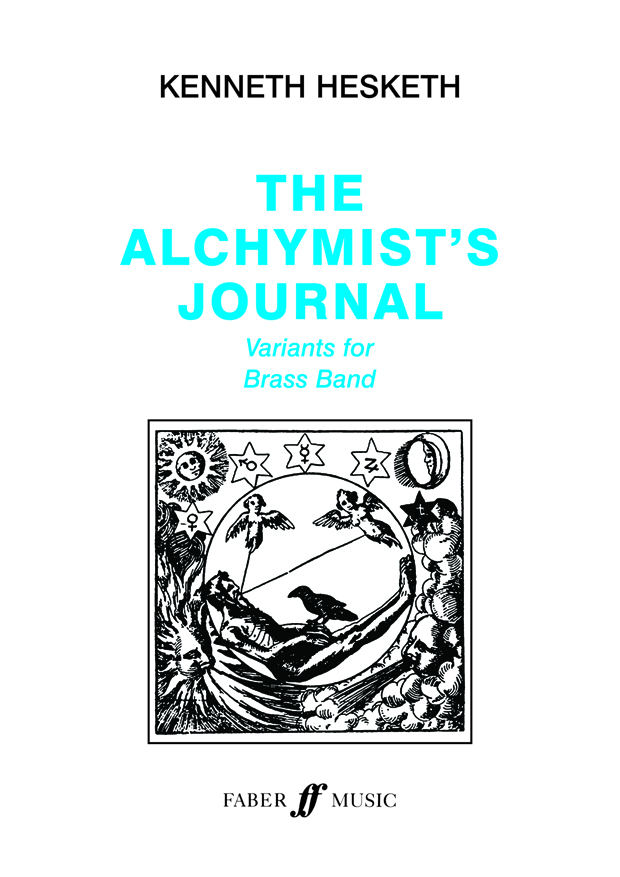
The Alchymist's Journal - Kenneth Hesketh
The Alchymist's Journal (Variants for Brass Band) was commissioned by Faber Music Band Consultant Paul Hindmarsh in 2001, with the support of the Brass Band Heritage Trust, as a substantial concert/contest challenge that would be within the compass of the country's most able youth and first section bands. It received its first performance in January 2002, by Black Dyke Band under Nicholas Childs, as part of the Royal Northern College of Music Festival of Brass.Since its original publication, composer Kenneth Hesketh has made a number of revisions to the work. Most of these were included in the recording made by Foden's Band (Bramwell Tovey) for NMC Recordings (NMC D142). This definitive new edition, including all the composer's revisions, has been specially prepared for the 2015 National Brass Band Championships of Great Britain and is the text that all bands performing will be required to use.Brass Band Grade 5: 1st SectionDuration: 12 minutes.
In Stock: Estimated dispatch 1-3 working days
-
 £34.95
By Water and the Word - Jonathan Bates
DURATION: 4'00". DIFFICULTY: 4th+. 'By Water and the Word' was composed for 2020 Brass Band Summer School in memory of it's long-standing course administrator Philip Biggs, who passed away in 2019. Aside from his work with BBSS, Philip was also the renowned administrator for the National Youth Brass Band of Great Britain where my first opportunities as a writer of brass music were presented. It's a certainty to say that without Philip's work at the head of this organisation, there's zero chance I would be able to do what I do today as a musician, and for that it was a huge honour to write this short work in his memory. Under Maestro Bramwell Tovey, each course would conclude with an encore of The Day Thou Gavest (St. Clements) and one of the most used hymn tunes throughout the week was The Church's One Foundation (Aurelia). Since then, these two tunes have become synonymous with the NYBBGB and in turn Philip's life & work, so I felt it fitting to combine these two wonderful sacred melodies into a new work paying homage to those memories. .
In Stock: Estimated dispatch 1-3 working days
-
Laughter In The Rain - Sedaka & Cody - Len Jenkins
In America, this was Neil Sedaka's comeback single. Whilst he had 11 Top-40 hits from 1960-1963, he could not score a hit after the British Invasion of the 60's. His fortunes were such in America that this song was at first released only in England, where it went to No. 15. However, whilst recording with 10cc in London, Sedaka reconnected with his friend Elton John who offered to put out a Sedaka single in America under his own record label, Rocket Records. Since "Laughter In The Rain" was already a hit in the UK, that was the choice, and anything with Elton John's name on it was sure to get some spins. So, later in 1974, "Laughter" was released on Rocket Records with liner notes and endorsements by Elton, and the song took off, becoming his second million-seller 12 years after his first, which was "Breaking Up Is Hard To Do."
-
The Giddy Goat - Traditional Swiss - Daniel von Siebenthal
The Giddy Goat is a silly folk song that everyone knows in Switzerland. It is about a white goat that does not want to get milked, so she kicks the milker. Thinking that this is because the goat is white, the owner decides that he will buy a brown one instead. From there on, people make up their own verses in which the goat is often replaced with past loves, enemies, and anyone or anything worthy of ridicule. Daniel, the arranger, lives in Gstaad in the Saanen district and the "Saanen goat" is a breed of white goat known throughout the world. As a farm boy, he did his share of goat milking and received the occasional hoof under his chin for his trouble. So, this piece is a tribute to a local breed that became world-famous, especially in America where the tune also meets its counterpart Billy Grogan's Goat (a similar silly song). The Giddy Goat should always be played as a "silly song" reflecting the goat's nature; capricious and cantankerous. The low bass line is important in Swiss folk music and should approximate to a plucked string-bass whose strings are dampened, to give it a pulsating feel. For those who would like to yodel we include the following Swiss tongue twister:- Holeduli duliduli, holeduli duli duli duuli, Holeduli duliduli, holeduli duli duli duu
 View Music