
Results
-
 £29.88
Still, Still, Still (Horn Section Feature with Brass Band) arr. Stephen Tighe
Still, still, still is an Austrian Christmas carol and lullaby. The melody is a folk tune from the Salzburg area and the tune appeared for the first time in 1865 in a folksong collection. The words describe the peace of the infant Jesus and his mother as the baby is sung to sleep. They have changed slightly over the years, but the modern standard German version was established in the mid-19th century. This arrangement by Stephen Tighe features the flugelhorn and horn section with brass band. PDF download includes score and parts. Sheet music available from: UK - www.brassband.co.uk USA - www.solidbrassmusic.com Difficulty Level: 4th Section + Instrumentation: Soprano Cornet Eb Solo Cornet Bb Repiano Cornet Bb 2nd Cornet Bb 3rd Cornet Bb Flugel Horn Bb Solo Horn Eb 1st Horn Eb 2nd Horn Eb 1st Baritone Bb 2nd Baritone Bb 1st Trombone Bb 2nd Trombone Bb Bass Trombone Euphonium Bb Bass Eb Bass Bb Timpani Sleigh Bells Drum Kit Glockenspiel
In Stock: Estimated dispatch 1-3 working days
-
 £37.35
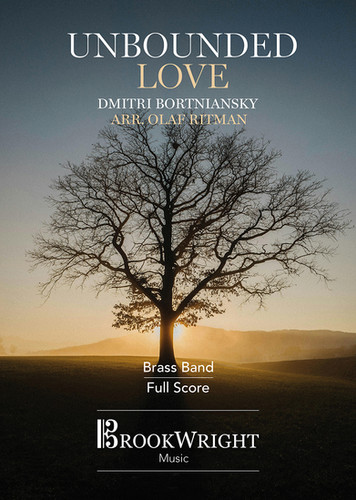
Unbounded Love (Brass Band) Bortniansky arr. Olaf Ritman
Unbounded Love is a deeply moving work that bridges the gap between sacred tradition and personal tribute. Drawing inspiration from the beloved 18th-century hymn Ich bete an die Macht der Liebe (I Pray to the Power of Love), this arrangement transforms a timeless spiritual message into a profound musical experience. The foundation of this work lies in the 1822 melody by Dmitri Bortniansky. Originally set to the poetry of Gerhard Tersteegen, this dignified and contemplative theme has served as a cornerstone of ceremonial music for centuries, symbolising solace, reverence, and the liberating power of divine love. Unbounded Love is an intimate memorial dedicated to Hein Voskamp, a cherished soprano player and close friend of the composer. Born from a simple final request - to hear this hymn one last time - the piece became the composer's way of navigating grief and expressing gratitude when words were no longer enough. To view a video of the Amsterdam Staff Band performing the work please visit https://youtu.be/Ug6tZwX7MiQ Duration: Approx. 5.45 minutes Difficulty Level: 4th Section + This PDF download includes the full score and parts. Sheet music available at www.brassband.co.uk (UK) or https://satradecentral.org (USA) Instrumentation: Soprano Cornet Eb Solo Cornet Bb Repiano Cornet Bb 2nd Cornet Bb 3rd Cornet Bb Flugel Horn Bb Solo Horn Eb 1st Horn Eb 2nd Horn Eb 1st Baritone Bb 2nd Baritone Bb 1st Trombone Bb 2nd Trombone Bb Bass Trombone Euphonium Bb Bass Eb Bass Bb Timpani Glockenspiel Percussion
In Stock: Estimated dispatch 1-3 working days
-
 £37.35
Whodunnit? Murder Mystery for Brass & Percussion (Brass Band) Karl Whelan
The composer writes: 'One of my all time favourite films is Clue (1985) based on the board game of the same name (Cluedo, if you're from the UK). Clue follows the night of six guests who are invited to a mansion for dinner. The host, Mr. Boddy is murdered, and the guests must work together to find the killer before any more lives are lost. I implore you to give it a watch if you haven't already, even if it's just for Tim Curry's magical performance as The Butler. Running at 82 minutes, the film is over before you know it. I wanted to create a similar story here with Whodunnit?, which like it's inspiration, Clue, moves at an incredible pace as it follows a dinner party, to which our guests have been invited. This work is rather dark throughout and full of intentional cliches, for which, I make no apology!' To view a rolling score video please visit www.youtube.com/watch?v=hdviJUrCvOE Sheet music available from: UK - www.brassband.co.uk USA - https://satradecentral.org Difficulty Level: 2nd Section + Length: 6.00 minutes Instrumentation: Soprano Cornet Eb Solo Cornet Bb Repiano Cornet Bb 2nd Cornet Bb 3rd Cornet Bb Flugel Horn Bb Solo Horn Eb 1st Horn Eb 2nd Horn Eb 1st Baritone Bb 2nd Baritone Bb 1st Trombone Bb 2nd Trombone Bb Bass Trombone Euphonium Bb Bass Eb Bass Bb Timpani Percussion 1 (Suspended Cymbal**, Shaker, Drum Kit, Vibraslap) Percussion 2 (Bass Drum, Suspended Cymbal**, Wood Blocks, Tam-tam) Percussion 3 (Glockenspiel, Xylophone, Tubular Bells, Vibraphone) * Doubling on Trumpet (if possible) ** Shared
In Stock: Estimated dispatch 1-3 working days
-
 £42.00
Hymn at Sunrise (Score only) - Ray Steadman-Allen
The idea for this work was prompted by a poem - Hymn Before Sunrise - which describes the majesty of a mountain in darkness, the sounds of a nearby waterfall and so on. Nothing came of the exposure to these pictures except for general thoughts about the dawn of day and a series of movements expressing a personal response to the wonder of creation in an imaginary moment in time. The movement titles, which were added later, are intended to underline a prevailing sense of worship, wonder and exaltation. The music is pure, not pictoral, though listeners may conjure their own images. An actual hymn - Tallis' Cannon - is incorporated. There are five movements: 1. Thanksgiving: A short prelude in two parts. First a brief passage of 'dawn music' before things become more vigorous: fanfare-like music ushers in the trombone section's presentation of the Tallis tune. A broad band version concludes the movement. 2. De Profundis: A slow movement shot through with anxious questionings featuring flugel and trombone. The mood lightens a little in the centre where the soprano cornet is featured and the movement ends serenely. 3. Celebration is characterised by rhythmic drive, this is buoyant with plenty of incident pointed up by the percussion. 4. Invocation: Melodic in nature and sober in mood, the first section is a series of short solos mingled with chorale-like statements. Central to the movement is a chorale-prelude style presentation of the Tallis tune. The third section reintroduces the earlier solo music by the full ensemble. Dissolving, the music enters the last movement without a break. 5. Paean: Marked allegro con spirito there is, quite rightly, a fair amount of fun in the rejoicing. Snatches of Tallis are heard, then comes a gentle passage with a cornet solo leading to fanfare music and recapitulation. Two recitatives are succeeded by a coda which brings the work to a sonorous and exultant conclusion.
Estimated dispatch 7-9 working days
-
 £52.00
Hymn at Sunrise (Parts only) - Ray Steadman-Allen
The idea for this work was prompted by a poem - Hymn Before Sunrise - which describes the majesty of a mountain in darkness, the sounds of a nearby waterfall and so on. Nothing came of the exposure to these pictures except for general thoughts about the dawn of day and a series of movements expressing a personal response to the wonder of creation in an imaginary moment in time. The movement titles, which were added later, are intended to underline a prevailing sense of worship, wonder and exaltation. The music is pure, not pictoral, though listeners may conjure their own images. An actual hymn - Tallis' Cannon - is incorporated. There are five movements: 1. Thanksgiving: A short prelude in two parts. First a brief passage of 'dawn music' before things become more vigorous: fanfare-like music ushers in the trombone section's presentation of the Tallis tune. A broad band version concludes the movement. 2. De Profundis: A slow movement shot through with anxious questionings featuring flugel and trombone. The mood lightens a little in the centre where the soprano cornet is featured and the movement ends serenely. 3. Celebration is characterised by rhythmic drive, this is buoyant with plenty of incident pointed up by the percussion. 4. Invocation: Melodic in nature and sober in mood, the first section is a series of short solos mingled with chorale-like statements. Central to the movement is a chorale-prelude style presentation of the Tallis tune. The third section reintroduces the earlier solo music by the full ensemble. Dissolving, the music enters the last movement without a break. 5. Paean: Marked allegro con spirito there is, quite rightly, a fair amount of fun in the rejoicing. Snatches of Tallis are heard, then comes a gentle passage with a cornet solo leading to fanfare music and recapitulation. Two recitatives are succeeded by a coda which brings the work to a sonorous and exultant conclusion.
Estimated dispatch 7-9 working days
-
 £34.95
Fire & the Phoenix, The - Christopher Bond
The Fire & the Phoenix (2015) was commissioned by Brett Baker in early 2015 as the opening track to his solo CD 'Myths & Legends'. Whilst structurally a single-movement work, it is presented so that it can link directly into the next work on the CD, adding to a continuous theme comprising a number of pieces from a number of composers. Opening with huge strident chords in the full band, the representation of the phoenix is instantly reflected; bold, powerful and a bird of great intensity. This makes way for a more mystical section marked 'distant' which reflect the beauty of the Phoenix and it's mythical nature where the trombone soars up into its higher register with a sweeping melody. Soon after, the music takes a sharp turn, becoming dramatic and instantly moving away from the mystical mood created previously. Here, we imagine the Phoenix catching fire, burning intensely with huge flames as it gradually turns into ash. We reach a tonic pedal point in the music, over which chord progressions subtly weave in and out of the texture. Here, we imagine the Phoenix rising from the ashes, with the dynamics gradually increasing to reflect this, slowly taking shape as it is born again. A return to earlier material follows, this time manipulated to reflect the Phoenix in its new form - the same bird; the same animal; but at the same time different. A beautiful chorale-like passage is heard before the music transports us back into a magical land, where delicate rhythmic ideas are juxtaposed against bolder lower chords; both ideas together transporting the listener forward into the next piece.
Estimated dispatch 10-14 working days
-
£72.00
Walk on By - Bacharach-David - Haakon Esplo
"Walk on By" is an American song written by Burt Bacharach and Hal David. It was written for Dionne Warwick. Her recording was released in April 1964 to great success.It reached a sixth place on the American Billboard Hot 100 list and a first place at Cashbox 'R & B. The song was a short time on Top 10 on the Billboard Easy Listening List. Warwick also recorded a German version entitled "Geh vorbei".Like many of Warwicks Bacharach-composed songs from the 1960s, many cover versions were made. Some of them with great success all over the world.Solo Options:Vocal | Flute/Oboe | Bb Clarinet | Altosax | Tenorsax | Trumpet/Cornet | Eb-horn | F-horn | Euphonium/Trombone BC | Euphonium/Trombone TC
Estimated dispatch 7-14 working days
-
 £11.21
Fanfare of Joy (Brass Band - Additional Transposing Parts) Andrew Wainwright
Fanfare of Joy was commissioned by the Burbage Band (Buxton) and its conductor Steven Critchlow in 2017. Based on Joy to the World and The First Nowell, this spectacular work opens with a majestic brass fanfare, before breaking in a Celtic-style dance which builds to a dramatic conclusion. The fanfare opening serves to announce the arrival of something special. In this case, the fanfare announces the arrival of Christmas, a time of joy and celebration. The Celtic-style dance is a lively and energetic movement that captures the spirit of Christmas. The music is full of syncopated rhythms and intricate melodies, driven by percussion. The final movement of the piece is a dramatic conclusion that brings the work to a rousing finish. The music is full of excitement and energy, and a fitting celebration of the Christmas season. To view a video of Dallas Brass Band performing the work please visit https://www.youtube.com/watch?v=CHl_oj1A-E8 PDF download includes additional transposing parts. Full brass band set available here. Sheet music available exclusively from World of Brass - www.worldofbrass.com Difficulty Level: 1st Section + Parts included in this download: Solo Horn F 1st Horn F 2nd Horn F 1st Baritone Bass Clef 2nd Baritone Bass Clef 1st Trombone Bass Clef 2nd Trombone Bass Clef Euphonium Bass Clef Tuba 1 Bass Clef Tuba 2 Bass Clef
In Stock: Estimated dispatch 1-3 working days
-
 £39.95
When Thunder Calls (Brass Band - Score and Parts)
When Thunder Calls was commissioned by Dr Nicholas Childs and the Black Dyke Band for their performance at the Gala Concert of the Swiss Open Championships in September 2011. When composing this piece, I decided to focus on both the music and the stage presentation. The way the piece has been composed and designed makes it a very effective way of starting a concert or a second half of a concert.At the start of the piece, the percussion enter the stage and take their positions in their usual place behind the band. They begin playing the piece without a conductor. They keep repeating the opening section while the Basses, Horns, Baritones and Euphoniums march onto the stage.This group of musicians take their seats with the Horns, Baritones and Euphoniums sitting where they usually sit in the band but the Basses sit where the solo cornets usually sit, forming an inner semi-circle of lower brass. When seated and when the music gets to the end of bar 4 the piece continues onto section A. All performers keep repeating this next 4-bar phrase until the trombones march onto stage and stand at the front of the stage with the Bass Trombone standing in between the other two trombones.All performers then play from figure B to C with the trombones taking the lead at the front. When the performers get to rehearsal figure C they repeat this section (the same as section A) while the trombones move from the front of the stage and take their positions where the Basses would normally sit (between the horns and the percussion) and remain standing. Meanwhile, the flugel enters the stage and stands at the front of the stage (standing where the trombones did). When in position the flugel soloist picks up into rehearsal figure D.When the flugel soloist finishes playing, just before rehearsal figure F they then move to their normal seat in the band. At figure F the cornets march onto the stage from either side, they turn and stand side by side each other facing outward towards the audience forming two 'fanfare' lines either side of the lower brass. The conductor follows the cornets on stage and on cue they lift their instruments at the same time and perform when the piece gets to figure G.There is no more moving around from this point on other than the solo cornet to move forward with the solo euphonium and perform their duet at letter H. Also the horns are required to stand and play at letter I and then sit just before J.When performed with all the choreography, this piece makes for an exciting addition to any concert repertoire both for the performer and the audience.Suitable for 3rd Section Bands and Above
Estimated dispatch 7-14 working days
-
£35.00
Elegie - Peter Meechan
The opening unaccompanied passage of this work was originally written as a short memorial piece for saxophone, but was later adapted as the basis of this more developed work for solo euphonium or trombone.The work uses a variation structure, with both the soloist and the accompaniment changing throughout the piece; the harmony, rhythm and melodic lines leading somewhere new and different each time they are heard - similar to the way our memories of a person often wander in different directions, but are still always focused on that person.
Estimated dispatch 12-14 working days
 Watch video
 View Music