
Results
-
 £11.39
Be Thou My Vision (Brass Band - Additional Parts) Trad. arr. Andrew Wainwright
A highly evocative arrangement of the popular hymn, also known as Slane. The arranger Andrew Wainwright responds to the ethereal quality of the tune with an exquisite layering of texture. The three-verse setting grows to a glorious climax on the final verse, before dying away to a serene ending. The arrangement was commissioned by the Nebraska Brass Band and its Musical Director Glenn Greet. To view a video of Dallas Brass Band performing the work please visit www.youtube.com/watch?v=mUyDYnOkXuE Sheet music available from: UK - www.brassband.co.uk USA - www.solidbrassmusic.com Difficulty Level: 4th Section + Parts included in this download: Solo Horn F 1st Horn F 2nd Horn F 1st Baritone Bass Clef 2nd Baritone Bass Clef 1st Trombone Bass Clef 2nd Trombone Bass Clef Euphonium Bass Clef Tuba Bass Clef (Bass Eb Part) Tuba Bass Clef (Bass Bb Part) The full brass band set with traditional instrumentation is available here.
In Stock: Estimated dispatch 1-3 working days
-
 £7.60
£7.60The Lord Bless You and Keep You (Brass Band - Additional Parts) John Rutter
John Rutter's popular choral benediction is based on Numbers 6:24-26, and has here been arranged for brass band by Andrew Wainwright. It is a setting of a biblical benediction, followed by an extended 'Amen'. Rutter originally scored the piece for four vocal parts (SATB) and organ. He composed it in 1981 for the memorial service of Edward T. Chapman, the director of music at Highgate School, London, with whom he had studied when he attended the school. To view a rolling score video with Wellington Brass performing the work please visit www.youtube.com/watch?v=ijJ2Nir3wRQ PDF download includes additional parts as listed below. Full set including score available here. Sheet music available from: UK - www.brassband.co.uk USA - www.cimarronmusic.com Difficulty Level: 4th Section + Alternative Parts included in this download: Solo Horn F 1st Horn F 2nd Horn F 1st Baritone B.C. 2nd Baritone B.C. 1st Trombone B.C. 2nd Trombone B.C. Euphonium B.C. Tuba 1 B.C. Tuba 2 B.C.
In Stock: Estimated dispatch 1-3 working days
-
£72.00
Walk on By - Bacharach-David - Haakon Esplo
"Walk on By" is an American song written by Burt Bacharach and Hal David. It was written for Dionne Warwick. Her recording was released in April 1964 to great success.It reached a sixth place on the American Billboard Hot 100 list and a first place at Cashbox 'R & B. The song was a short time on Top 10 on the Billboard Easy Listening List. Warwick also recorded a German version entitled "Geh vorbei".Like many of Warwicks Bacharach-composed songs from the 1960s, many cover versions were made. Some of them with great success all over the world.Solo Options:Vocal | Flute/Oboe | Bb Clarinet | Altosax | Tenorsax | Trumpet/Cornet | Eb-horn | F-horn | Euphonium/Trombone BC | Euphonium/Trombone TC
Estimated dispatch 7-14 working days
-
 £35.00
GOD ONLY KNOWS (Flugel feature/Brass Band) - Baker, Leigh
Recorded in 1966 as a part of the Beach Boys' landmark?Pet Sounds?album, this ballad has become a prime example of Brian Wilson's innovative approach to songwriting and recording. Hailed for its formal and harmonic complexities as well as a memorable hook, "God Only Knows" has remained popular through the years, and was featured prominently in the biographical film Love & Mercy?about the life of Brian Wilson.This Beach Boys Classic is arranged as a Flugel Solo, and features a Trombone Quartet (spotlight your 'sectret' Trombonist or use a Baritone/Valve Trombone soloist from your Euphonium/Baritone Team.Commissioned by The Leland Band for their Brass in Concert performance 2012 this is a real favourite with audiences and something a little bit different. This is ripe for Choreography.
Estimated dispatch 7-14 working days
-
 £59.99
Second Star to the Right, The - Christopher Bond
This famous tune from the iconic Peter Pan movie has been arranged many times, but never for brass band. This arrangement for solo trombone and band is ideal for putting one of the trombones in the spotlight, with a solo part and accompaniment suitable for bands of third section standard and higher.
Estimated dispatch 10-14 working days
-
 £69.99
Flying the Breeze (Brass Band - Score and Parts) - Sparke, Philip
Flying the Breeze opens with three repeated B's (representing the initials of the Breeze Brass Band from Japan who commissioned this work). A short introduction leads to a robust theme from the baritones and euphoniums which is taken up by cornets and trombones. A restless bridge passage leads to a syncopated tune from the solo cornet and then to a third theme from a solo trombone. A graceful second subject leads back to a recall of the introductory material before a full-scale recapitulation. An intense allargando leads to a full-band version of the second subject under a running cornet passage, which leads to a short coda.Duration: 6:00
Estimated dispatch 7-14 working days
-
 £64.95
Purcell Variants (Brass Band - Score and Parts) - Meechan, Peter
Purcell Variants is based on Purcell's Queen Mary's Funeral Music, which consists of four canzonas (for brass), two elegies and an anthem.The first movement begins by sounding some of Purcell's original music in the trombones, underpinned by a timpani roll with the cornets articulating the beginnings and endings of the phrases. This leads into a cadenza for cornet and horn before the movement heads in different directions, leading us to its mysterious end, where the original music is sounded this time in the 'stabs' of the muted cornets.Originally composed for the funeral of Queen Mary in 1695, Purcell's original funeral music was used later that same year for Purcell's own funeral - he died aged only 34. The second movement is an elegy, inspired by this story. After an introduction (started by cornets sounding a last post), the main melody of the movement is introduced by the solo euphonium, with other solo roles for an off-stage soprano cornet, and trombone. This is then taken over by the cornets who lead us into the middle section of the movement. This is a quasi-funeral march, inspired by the image of Purcell's coffin being taken to its final resting point. The main melody returns in the euphonium, flugel horn and soprano cornet, this time more elaborated. The movement ends with a snare drum fading away - perhaps a metaphor. The Finale is a fast and furious movement combining thematic material from the two previous movements with new rhythmical ideas. This takes us through to the final passage - the triumphant return of Purcell's original theme.Duration: 13.00
Estimated dispatch 7-14 working days
-
 £59.95
Essay (Brass Band - Score and Parts) - Gregson, Edward
This work was specially commissioned as the test piece for a new brass band competition in 1971, held at the Royal Albert Hall, London. It is in three movements, the titles of which all have literary connotations. The first movement, Dialogue takes the form of 'conversations' between the instruments, based on the opening melody announced in unison on cornets and euphoniums. A second theme is introduced on the flugel horn and developed alongside this, creating a sonata form shell.The second movement, Soliloquy is dedicated to the memory of Gilbert Vinter - a composer who did so much in the 1960s to bring the brass band into the modern world. The movement is poignant in mood, which is depicted by a cornet solo announced after a brief introduction. The middle section builds to a powerful climax, at which point the opening theme of the first movement is heard again. Tranquillity returns however, with a solo trombone now playing the original theme with other instruments adding decorative accompanying patterns.The final movement, Epigram, creates strong rhythmic contrasts and exploits the more virtuoso character of the brass band. The middle section, with its changing time patterns and open expansive melody, suggests a 'big-country' style. A rhythmically charged coda concludes the work in exciting fashion.Duration: 12.00
Estimated dispatch 7-14 working days
-
£29.95
Essay (Brass Band - Score only) - Gregson, Edward
This work was specially commissioned as the test piece for a new brass band competition in 1971, held at the Royal Albert Hall, London. It is in three movements, the titles of which all have literary connotations. The first movement, Dialogue takes the form of 'conversations' between the instruments, based on the opening melody announced in unison on cornets and euphoniums. A second theme is introduced on the flugel horn and developed alongside this, creating a sonata form shell.The second movement, Soliloquy is dedicated to the memory of Gilbert Vinter - a composer who did so much in the 1960s to bring the brass band into the modern world. The movement is poignant in mood, which is depicted by a cornet solo announced after a brief introduction. The middle section builds to a powerful climax, at which point the opening theme of the first movement is heard again. Tranquillity returns however, with a solo trombone now playing the original theme with other instruments adding decorative accompanying patterns.The final movement, Epigram, creates strong rhythmic contrasts and exploits the more virtuoso character of the brass band. The middle section, with its changing time patterns and open expansive melody, suggests a 'big-country' style. A rhythmically charged coda concludes the work in exciting fashion.Duration: 12.00
Estimated dispatch 7-14 working days
-
 £60.00
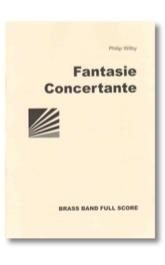
Fantasie Concertante (Score only) - Philip Wilby
This exciting new concerto is a welcome addition to the repertoire of french and tenor horn players alike. Like the 18th-Century Serenade form there are five movements, arranged symmetrically around a slow movement - Soliloquy - which separates movements entitled Burlesque (two) and Valse Caprice (three) respectively. The first and last movements share common material of a more symphonic stature, and the concerto ends with a brisk fugato. The solo horn is (in the band version) accompanied by a quintet of solo players (two cornets, euphonium, trombone, and tuba) who provide the lion's share of the counterpoint and contrast with the main body of musicians who provide musical punctuation in the more sonorous tutti sections. The first movement, Don Quixote's Dream, contains references to Cervantes' famous hero, the Spanish nature of his stories, and the ambling gait of his horseback adventures.
Estimated dispatch 7-9 working days
 View Music