
Results
-
 £35.00
strange geometry
Descriptionstrange geometrywas commissioned by Morgan Griffiths and the Hammonds Saltaire Band for their performance at the Brass in Concert Championships of 2015.As a bit of a space/sci-fi geek, as well as a musician, two events during the summer of 2015 had a particular effect on me. The first was the tragic early death in a plane crash of the famous film composer James Horner. Horner's music, particularly in films like 'Star Trek II: The Wrath of Khan', 'Avatar', 'Apollo 13' and even his debut in Roger Corman's 1980 budget film 'Battle Beyond the Stars', defined for a generation the sound of sci-fi at the cinema. Along with John Williams he created the vocabulary for those who wish to express other-worldly wonder in music and his inventive talent will be much missed in an industry where originality has become something of a dirty word in recent years.The second event was the epic flyby of Pluto by the NASA New Horizons spacecraft. There are many reasons to find this mission inspiring - for example, the scientists and engineers behind it created a craft that has travelled at 37,000 mph for nine years and three billion miles to arrive within seventy-two seconds of the predicted time for the flyby. That they achieved this with such accuracy is an outstanding tribute to humanity's ingenuity and insatiable curiosity. However, the most exciting aspect of the mission was the clear, high resolution pictures of this unthinkably remote and inhospitable world beamed back to mission control. The best previous image of Pluto was an indistinct fuzzy blob - suddenly we could see mountains made of ice, glaciers of methane and carbon monoxide and nitrogen fog - features previously unimagined on a world thought to be a slightly dull ball of cold rock. The BBC's venerable astronomy programme 'The Sky at Night' waxed lyrical about these newly discovered features, referring to "the surprising discoveries of mountains and strange geometry on the surface of this cold distant world".I like to think that Horner would have been as inspired as I have been by this real-life science story, and this piece uses some of the vocabulary of the sci-fi movie soundtrack in a tribute to the memory of a great musician and to the inspirational geeks at NASA who have boldly taken us where no-one has gone before.Note: This work comes with a B4 portrait score. Listen to a preview and follow the music below!
Estimated dispatch 7-14 working days
-
 £35.00
In Pitch Black - Lucy Pankhurst
An extremely emotional and poignant work for brass band composed by Lucy Pankhurst, in memory and tribute to those affected by the Pretoria Pit disaster in Lancashire on 21st December 1910. The piece is chilling in its depiction of the tragic story, sensitively conveying the atmosphere and emotions as perceived before, during and after the event. Through its use of playing techniques, effects, sound combinations and even silences, In Pitch Black offers a powerfully reflective piece.Pritoria Pit DisasterLancashire's worst pit disaster and Britain's third largest loss of life from a single mining accident happened at the No. 3 Bank Pit belonging to the Hulton Colliery Company, just 4 days before Christmas 1910. The pit known as the 'Pretoria Pit' was situated on Hulton Parkland on the border of Atherton and Westhoughton. An explosion occurred at 7.50 am on Wednesday, 21 December 1910, resulting in the death of 344 men and boys, including many members of The Wingates Band.The Writing ExperienceDuring Lucy's research for this work, she acknowledges that she found the harsh reality from the shocking images and historical accounts of the event most disturbing, and is not embarrassed to disclose that it was wholly a very emotional experience in creating the composition. Consequently, she chose to create something to illustrate the true emotion of the situation. She wanted to pay tribute to the lives lost and the devastation which remained in their absence, by creating a piece of music which begins in darkness; desolate and claustrophobic, whilst still leaving the audience feeling uplifted and thoughtful in the final bars.The significance and musical appreciation for the creation of In Pitch Black was formally recognised by BASCA in 2011, when Lucy Pankhurst won the internationally acclaimed British Composer Award (the first time a brass band work had received the award, and the first time a female composer had won the category).Full programme notes are included in the product images.Look and Listen (performance courtesy of Manchester University Brass Band):
In Stock: Estimated dispatch 3-5 working days
-
 £89.95
Revelation (Score and Parts)
Symphony for Double Brass on a theme of Purcell 1995 marked the tercentenary of Purcell's death, and my new score Revelation has been written as a tribute to his music and the ornate and confident spirit of his age. There are five major sections: 1 Prologue 2 Variations on a ground bass I 3 Fugue 4 Variations on a ground bass II 5 Epilogue and Resurrection The score uses many features of the Baroque Concerto Grosso, and arranges players in two equal groups from which soloists emerge to play in a variety ofvirtuoso ensembles. It quotes freely from Purcell's own piece Three Parts on a Ground in which he has composed a brilliant sequence of variations over a repeating six-note bass figure. This original motif can be heard most clearly beneath the duet for Cornet 5 and Soprano at the beginning of the 2nd section. There is, of course, a religious dimension to Revelation as the title suggests, and the score is prefaced by lines by the 17th century poet John Donne. His Holy Sonnet paraphrases the Book of Revelation in which the dead are raised at the sounds of the last trumpet. Donne's trumpets are themselves placed stereophonically ". . . At the round Earth's imagined corners" and it is this feature that today's players represent as they move around the performing area. Their final apocalyptic fanfares can be heard at the close of the score, as Purcell's music re-enters in a lasting tribute to England's first composer of genius. Philip Wilby September 1995 At the round Earth imagined corners, blow your trumpets, angels, and arise, arise from death, you numberless infinities Of souls, and to your scattered bodies go. All whom the flood did, and fire shall o 'erthrow All whom war, dearth, age, agues, tyrannies, Despair, law, chance hath slain, and you whose eyes Shall Behold God, and never taste death woe. John Donne after Revelation Ch. 11 v.15
Estimated dispatch 7-14 working days
-
 £44.95
Revelation (Score Only)
Symphony for Double Brass on a theme of Purcell 1995 marked the tercentenary of Purcell's death, and my new score Revelation has been written as a tribute to his music and the ornate and confident spirit of his age. There are five major sections: 1 Prologue 2 Variations on a ground bass I 3 Fugue 4 Variations on a ground bass II 5 Epilogue and Resurrection The score uses many features of the Baroque Concerto Grosso, and arranges players in two equal groups from which soloists emerge to play in a variety ofvirtuoso ensembles. It quotes freely from Purcell's own piece Three Parts on a Ground in which he has composed a brilliant sequence of variations over a repeating six-note bass figure. This original motif can be heard most clearly beneath the duet for Cornet 5 and Soprano at the beginning of the 2nd section. There is, of course, a religious dimension to Revelation as the title suggests, and the score is prefaced by lines by the 17th century poet John Donne. His Holy Sonnet paraphrases the Book of Revelation in which the dead are raised at the sounds of the last trumpet. Donne's trumpets are themselves placed stereophonically ". . . At the round Earth's imagined corners" and it is this feature that today's players represent as they move around the performing area. Their final apocalyptic fanfares can be heard at the close of the score, as Purcell's music re-enters in a lasting tribute to England's first composer of genius. Philip Wilby September 1995 At the round Earth imagined corners, blow your trumpets, angels, and arise, arise from death, you numberless infinities Of souls, and to your scattered bodies go. All whom the flood did, and fire shall o 'erthrow All whom war, dearth, age, agues, tyrannies, Despair, law, chance hath slain, and you whose eyes Shall Behold God, and never taste death woe. John Donne after Revelation Ch. 11 v.15
Estimated dispatch 7-14 working days
-
 £45.00
Legacy Of Light - Christopher Bond
Legacy of Light was commissioned by the family of Howard Bland, Honorary Secretary of Wessex Band Summer School for many years. Rather than a work in a reflective style, the brief was to provide a work which celebrated his life - energy and music which would be fun to perform and listen to. The bubbling compound time signature combined with the cornet and tuned percussion ostinato to open provide immediate impact with the work's subsequent soaring melodies and joyous style a fitting tribute. The work received its world premiere by the joint forces of the brass and wind bands at the 2024 Wessex Band Summer School, conducted by Michael Fowles.
Estimated dispatch 10-14 working days
-
 £55.00
Italia
ABOUT THIS PIECE: Romance. Elegance. This is an exquisite arrangement of the song originally performed by Chris Botti and Andrea Bocelli: Italia. Composed by Chris Botti and David Foster, Italia is a heartfelt tribute to the beauty and passion of Italy, blending lush melodies with a sense of timeless sophistication. The original, featuring Botti's soaring trumpet lines and Bocelli's rich tenor voice, is celebrated for its emotional depth and breathtaking lyricism. This arrangement adapts those qualities for solo cornet, solo trombone, and brass band, offering a wonderful opportunity to explore the piece's expressive range and captivating musicality. ENSEMBLE: Cornet and Trombone with British Brass Band Accompaniment WHEN YOU BUY THIS PRODUCT, YOU GET: High-quality printed score and parts - DUE TO COPYRIGHT LAW THIS WORK IS ONLY AVAILABLE IN THE UK AND EUROPE LEVEL: 2 LISTEN: DURATION: 3-minutesEXAMPLE SCORE: Click here LEVEL GUIDE: Level 1- Accessible to all Level 2 - c. UK third section and higher Level 3 - c. UK second section and higher Level 4 - c. UK first section and higher Level 5 - c. UK championship section level
Estimated dispatch 5-7 working days
-
 £25.00
Cadishead - Concert March
ABOUT THIS PIECE: Introduce a spirited addition to your next programme with this new march - Cadishead. Written by Adam DJ Taylor in 2019, this vibrant march was composed for the Cadishead Public Band near Manchester as a tribute to the memory of James Roy Hesford. The piece embodies the classic elements of a brass band march, making it a versatile choice for concerts. ENSEMBLE: Standard British Brass Band WHEN YOU BUY THIS PRODUCT, YOU GET: High-quality printed score and parts LEVEL: 1 LISTEN: Click here DURATION: 3-minutes, 20 secondsEXAMPLE SCORE: Click here LEVEL GUIDE: Level 1- Accessible to all Level 2 - c. UK third section and higher Level 3 - c. UK second section and higher Level 4 - c. UK first section and higher Level 5 - c. UK championship section level
Estimated dispatch 5-7 working days
-
 £44.95
FOLLOW THE FLAME (Solo for Flugel Horn or Cornet Bb) - Peter Graham
The Torchbearer was commissioned as the test piece for the 2009 National Brass Band Championships of Great Britain and the FABB Open Contest respectively and pays musical tribute to Eric Ball, considered by many to be the 20th centuryas most influential composer of brass band music. The thematic material is derived from the first phrase of the trio from Eric Ballas Salvation Army march, Torchbearers.Follow the Flame
Estimated dispatch 3-7 working days
-
 £29.95
Cafe 1719 - Jonathan Bates
DURATION: 2'30". DIFFICULTY: 1st Section+. 'Caf 1719' was composed for the Wantage Silver Band as part of their entertainment contest sets based on the music of Johann Sebastian Bach in 2019. This particular short, jazz-inspired work is composed in tribute to the great French Pianist Jacques Loussier (1934-2019) who received global acclaim for his jazz interpretations of Bach's music, along with many other classical composers. Despite being born in the same year and living in the same country, Bach and Handel never actually met, but what if they had? Cafe 1917 acts as a musical meeting point - in a fictional Jazz Cafe by the Rhine, with the tenor horn section performing a 'Loussier-esque' version of Bach's 'Prelude No.2 in C Minor' whilst on the other side of the cafe, the trombone section follow suit with their take on Handel's 'Bourree from Music for the Royal Fireworks'. Eventually the two meet, share ideas and incorporate them into each other's melodies. Amongst the 2 main featured works by Bach and Handel, the tutti interludes are constructed on music from Bach's 'Toccata and Fugue in D Minor'. .
In Stock: Estimated dispatch 1-3 working days
-
 £74.95
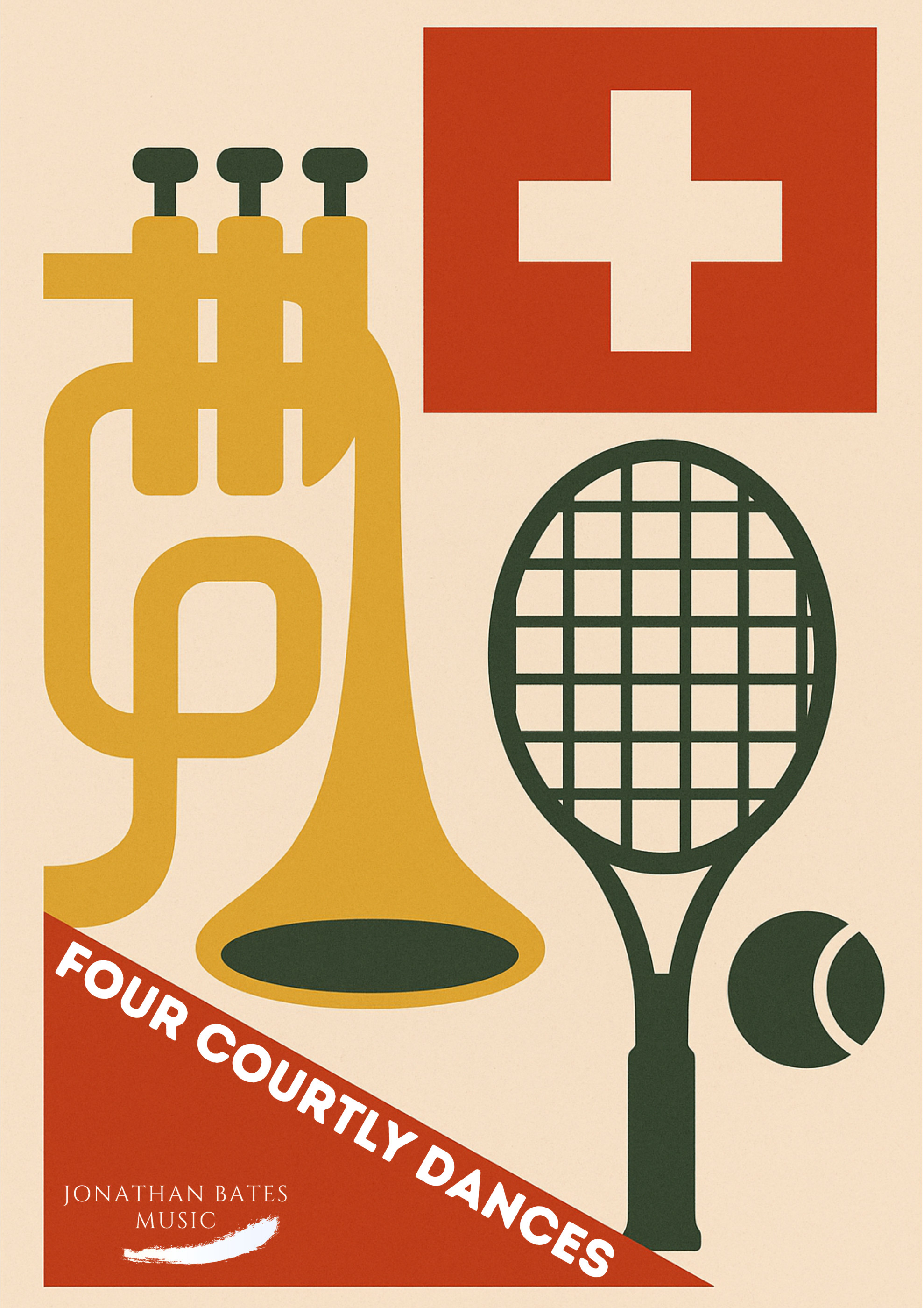
Four Courtly Dances - Jonathan Bates
DURATION: 12'00". DIFFICULTY: 1st+. 'Four Courtly Dances' was composed for Brass Band Burgermusik Luzern in 2025 for their Brass & Sport Gala Concert in the KKL Luzern. The work is a tribute to career of Swiss Tennis great Roger Federer with each movement giving a musical 'nod' to the story of his life and career. Each movement is inspired by a traditional 'courtly' (not in a tennis sense, but that was the idea!) dance:. 1. Inspiration (Almain) . The opening movement is subtitled 'Elegance on Court', backed by a deep-rooted sense of Swiss nationlism, featuring a prelude based upon the traditional Swiss song 'Guggisberglied'. . 2. Success & Failure (Galliard) . A movement centred around the trials and tribulations of an elite sportsperson, with antiphonal cornet & tambourine groups playing avirtuosic musical tennis match across the band. . 3. Rivalry (Sarabande & Canario) . An upbeat movement fused with Spanish and Balkan influences, inspired by Federer's long-running rivalries with Rafael Nadal and Novak Djokovic. . 4. Legacy (Pavane) . A final reflective and uplifting homage to the legacy leftby one of the greatest sportspeople of all time, culminating in a coda whichbrings together all the previous 'ingredients' which made Federer the icon he is. . .
In Stock: Estimated dispatch 1-3 working days
 View Music