
Results
-
 £27.00
Edward Gregson: Birthday Prelude for Brass Band
DescriptionThis short work for brass band was written in 1982 for a concert to celebrate the 80th birthday of Harry Mortimer, one of the great figures in the world of brass bands. Not surprisingly, it references the well-known song Happy Birthday, in a breezy, up-tempo, short concert prelude.The premiere was given at the Free Trade Hall in Manchester by the Fodens Band, conducted by Howard Snell.In 2014 the composer revised it for a trip to the North American Brass Band Championships, where it was performed, also as an 80th birthday tribute, this time to the composer's brother Bram; it was subsequently dedicated to both Harry Mortimer and Bram Gregson.For more information on Edward Gregson's music please visit the composer's website: www.edwardgregson.com
Estimated dispatch 7-14 working days
-
 £30.00
Black Bottom Stomp - Jelly Roll Morton
Ferdinand Joseph LaMothe, professionally known as Jelly Roll Morton, was an American ragtime and early jazz pianist, bandleader and composer who started his career in New Orleans, Louisiana. Widely recognised as a pivotal figure in early jazz, Morton is perhaps most notable as jazz's first arranger, proving that a genre rooted in improvisation could retain its essential spirit and characteristics when notated. His composition "Jelly Roll Blues" was the first published jazz composition in 1915. Morton is also notable for writing such standards as "King Porter Stomp", "Wolverine Blues", "Black Bottom Stomp", and "I Thought I Heard Buddy Bolden Say". Notorious for his arrogance and self-promotion, Morton claimed to have invented jazz outright in 1902, much to the derision of fellow musicians and the critics. At the age of fourteen, Morton began working as a piano player in a brothel (or, as it was referred to back then, a sporting house). In that atmosphere, he often sang smutty lyrics and took the nickname "Jelly Roll". While working there, he was living with his religious, church-going great-grandmother; who he convinced that he worked as a night watchman in a barrel factory. After Morton's grandmother found out that he was playing jazz in a local brothel, she kicked him out of her house and told him that "devil music" would surely bring about his downfall. Born in downtown New Orleans, Louisiana, his exact birth date differs depending to whichever source you want to believe; his half-sisters claimed he was born in September 1885, but his World War 1 draft card showed September 1884 and his California death certificate listed his birth as September 1889. He died in 1941 in Los Angeles.
-
Foyle's War Theme - Jim Parker - Len Jenkins
Foyle's War was a TV crime drama created by screenwriter Anthony Horowitz, and tells the story of Detective Chief Superintendent Christopher Foyle, played by Michael Kitchen, fighting a personal war against crime amidst the turmoil of World War Two. The music for the series was composed by 4 time BAFTA winning Jim Parker and has an ethereal minor key melody, sparsely orchestrated and Wobbleco Music has attempted to capture this atmosphere in its arrangement for Brass Band. An arrangement for a Brass Ensemble is also available. The last episode of the Foyle's War was written in 2014 but such is its popularity that there have been many requests for it to return to the screens, particularly as the writer says that one of the wartime years has yet to be covered. We shall see. Meantime enjoy this beautiful theme.
-
Codebreakers : Bletchley Park - Len Jenkins - Len Jenkins
Bletchley Park was the centre for Allied codebreaking in World War 2, responsible for decoding secret military codes used by enemy forces, in particular those related to the use of the 'Enigma' and other encoding machines. In the course of its endeavours it developed what was effectively the first electronic computer and brought to prominence the genius of Alan Turing when its wartime work was declassified and made public. The composer, Len Jenkins, still lives near Bletchley Park, went to school nearby, and attended training courses there when, after the war, it was used as a telecommunications training centre. This march is dedicated to the memory of all those who worked at Bletchley Park.
-
 £40.00
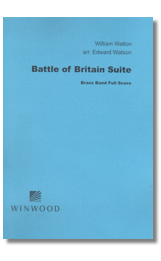
Battle of Britain Suite (Score only) - William Walton
It takes a special ability to compose film scores which serve the images perfectly yet translate into first class concert music. William Walton was such a talent as the continuing popularity of his brilliantly evocative film music shows. This suite includes the famous Dog Fight and majestic March - used for the end titles of the film - along with the Siegfried Music which parodies Wagner's horn call. You can practically feel the buzzing of Spitfires in the air! Winwood Music are delighted to make this music available to the brass band world in a fabulous arrangement by Edward Watson which captures the essence of the original while translating it seamlessly to the new idiom. Duration: 12:15
Estimated dispatch 7-9 working days
-
 £50.00
Battle of Britain Suite (Parts only) - William Walton
It takes a special ability to compose film scores which serve the images perfectly yet translate into first class concert music. William Walton was such a talent as the continuing popularity of his brilliantly evocative film music shows. This suite includes the famous Dog Fight and majestic March - used for the end titles of the film - along with the Siegfried Music which parodies Wagner's horn call. You can practically feel the buzzing of Spitfires in the air! Winwood Music are delighted to make this music available to the brass band world in a fabulous arrangement by Edward Watson which captures the essence of the original while translating it seamlessly to the new idiom. Duration: 12:15
Estimated dispatch 7-9 working days
-
 £62.00
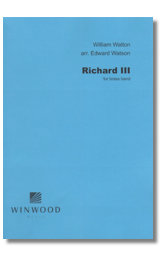
Richard III (Score only) - William Walton
It takes a special ability to compose film scores which serve the images perfectly yet translate into first class concert music. William Walton was such a talent as the continuing popularity of his brilliantly evocative film music shows. This suite presents a rich, vivid musical tapestry with all the drama of the original captured to perfection. Winwood Music are delighted to bring this music from Laurence Olivier's classic film to the brass band world in a fabulous arrangement by Edward Watson - so idiomatic that you'll think this is the original version! There are seven movements: 1. Prelude 2. Fanfare and Processional 3. Sound Drums and Trumpets & Recessional 4. Elegy 5. The Princes in the Tower 6. The Battle of Bosworth Field 7. Death of Richard and Finale
Estimated dispatch 7-9 working days
-
 £74.00
Richard III (Parts only) - William Walton
It takes a special ability to compose film scores which serve the images perfectly yet translate into first class concert music. William Walton was such a talent as the continuing popularity of his brilliantly evocative film music shows. This suite presents a rich, vivid musical tapestry with all the drama of the original captured to perfection. Winwood Music are delighted to bring this music from Laurence Olivier's classic film to the brass band world in a fabulous arrangement by Edward Watson - so idiomatic that you'll think this is the original version! There are seven movements: 1. Prelude 2. Fanfare and Processional 3. Sound Drums and Trumpets & Recessional 4. Elegy 5. The Princes in the Tower 6. The Battle of Bosworth Field 7. Death of Richard and Finale
Estimated dispatch 7-9 working days
-
 £33.62
A Century of Art (Brass Band) Robbert Vos
A Century of Art was composed for Brass Band Kunst naar Kracht from the town of De Goorn (The Netherlands) for its 100th anniversary in 2022. A version for Fanfare Orchestra was commissioned by the Fanfare Project Orchestra in 2023. The title of the work refers to Brass Band Kunst naar Kracht's 100-year existence and the array of art that has been created in that time. A Century of is a flashy and virtuosic opening work where melodic lines are combined with other surprising compositional elements. You can hear, among some references to some famous brass band test pieces, a quote from Lohengrin by Richard Strauss. A transcription of Lohengrin was used at the 1922 British Open in England, one of the most famous brass band competitions in the world, the same year as Brass Band Kunst naar Kracht was founded. To view a performance by Fanfare 'Project Orkest' of the work please visit www.youtube.com/watch?v=D6zuoaxf_kg (please note this is the Fanfare Band version, although it is essentially the same). Duration: 4.00 minutes Difficulty Level: 2nd Section + PDF download includes parts and score. Sheet music available from www.brassband.co.uk Instrumentation: Soprano Cornet Eb Solo Cornet Bb Repiano Cornet Bb 2nd Cornet Bb 3rd Cornet Bb Flugel Horn Bb Solo Horn Eb 1st Horn Eb 2nd Horn Eb 1st Baritone Bb 2nd Baritone Bb 1st Trombone Bb 2nd Trombone Bb Bass Trombone Euphonium Bb Bass Eb Bass BbTimpani Percussion 1-4
In Stock: Estimated dispatch 1-3 working days
-
 £44.83
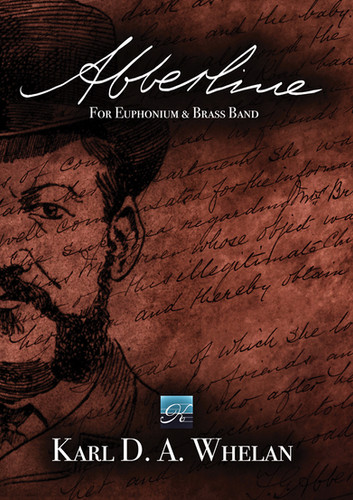
Abberline (Euphonium Solo with Brass Band) Karl Whelan
Inspired by the infamous investigation into Jack the Ripper, Abberline follows Detective Inspector Frederick Abberline through the mist-shrouded streets of Victorian London in his desperate pursuit of a killer who remains forever just out of reach. Scored for brass band and solo euphonium, the piece blends atmospheric textures, shifting musical identities, and virtuosic demands to capture a narrative that is as haunting as it is unresolved. The piece opens in a world of shadows - the foggy alleys of Whitechapel - where tension simmers beneath the surface. The euphonium enters cautiously, as if stalking unseen figures, echoing the danger and uncertainty that cloaked the city in fear. This eerie calm is broken suddenly: the Ripper strikes. The moment is brief but brutal, leaving only silence and horror in its wake. From here, the music shifts into an uneasy, angular waltz: the figure of Abberline takes center stage, portrayed by the soloist as he investigates the aftermath. The waltz is melodically off-kilter and harmonically unstable, capturing both the grotesque nature of the crime and the detective's mental burden. The scene then returns to the streets - but this time, the musical material is more intricate, fragmented, and tense. The threat has deepened, and again the silence is shattered by violence. A second, slightly altered waltz follows, further reflecting Abberline's obsessive descent into the case. In the final section, the chase begins in earnest. Themes from earlier return in quick succession, intensified and overlapping as time runs out. The ancient Dies Irae chant is woven into the texture, evoking fate and judgment. In a final, erratic surge, the euphonium and band race toward an ending that is breathless and unresolved - a reflection of history's unanswered questions and the ghost that always stayed one step ahead. To view a rolling score video of the work please visit https://www.youtube.com/watch?v=i59xYzJRMaI Duration: approx. 7.30 minutes This PDF download includes parts and score. Sheet music available at www.brassband.co.uk (UK) or https://satradecentral.org (USA) Instrumentation: Euphonium Soloist Bb Soprano Cornet Eb Solo Cornet 1-2 & 3-4 Bb Repiano Cornet Bb 2nd Cornet Bb 3rd Cornet Bb Flugel Horn Bb Solo Horn Eb 1st Horn Eb 2nd Horn Eb 1st Baritone Bb 2nd Baritone Bb 1st Trombone Bb 2nd Trombone Bb Bass Trombone Euphonium (tutti) Bb Bass Eb Bass Bb Timpani Percussion 1-3
In Stock: Estimated dispatch 1-3 working days