
Results
-
 £95.00
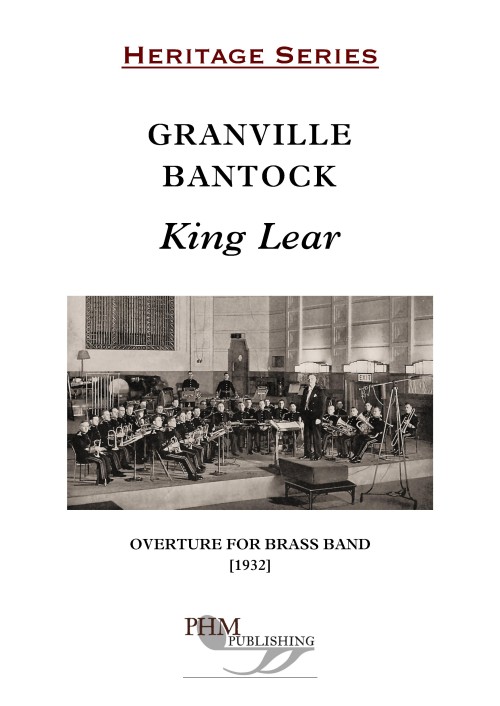
King Lear (Brass Band - Score and Parts) - Bantock, Granville - Hindmarsh, Paul
Sir Granville Bantock (1868 - 1946) composed the second of his five major brass band work for Callender's Cableworks Band, completing the commission on 30 November 1932. Based in the Thames-side district of Belvedere near Erith, the band was active between 1898 and 1961. The works band of the Callender Cable & Construction Co. Ltd, it was at the peak of its popularity during the 1930s and was a frequent broadcaster on the radio. The band employed an in-house arranger and played saxophones in its lighter material. King Lear was one of the band's major commissions and was not published in Bantock's lifetime. The manuscript score and parts were thought to be lost for decades, but were found in the library of the Haydock Band (Lancashire), which had inherited part of Callender's library of manuscripts material and bespoke arrangements after it has been transferred to nearby Prescott Cables Band after Callender's Cable Works closed.King Lear is a substantial work, in essence a dramatic tone poem in the romantic Tchaikovskian manner, presenting a series of character portraits of the foolish old king and his three daughters, Goneril, Regan and Cordelia. The music is dramatic and lyrical by turns, with the most generous lyrical episode revealing perhaps the warm-hearted Cordelia. An expansive melody that flows from this is brought back towards the end as the main climax of the work.In 2001, Bantock's score was recorded by the University of Salford Brass Band, conducted by Dr. Roy Newsome. The original is serviceable, but in comparison with the orchestral version he made in 1936 (part of which was recorded on a Paxton 78 rpm) and later brass band scores, performing editions of which were prepared by others, it lacks colour and range typical of Bantock's orchestral work. Above all it lacks percussion, which can be heard on the recorded extract. With the kind permission of the Bantock Estate, I have prepared a performing edition for publication that incorporates percussion, derived from the orchestral recording and added editorially in similar manner elsewhere. I have revoiced some of the low- lying instrumental parts to present the material in more comfortable ranges. Editorial interventions more elaborate than revoicing the original text have been identified as cue notes.- Paul HindmarshDuration: 15.00
Estimated dispatch 7-14 working days
-
£40.00
King Lear (Brass Band - Score only) - Bantock, Granville - Hindmarsh, Paul
Sir Granville Bantock (1868 - 1946) composed the second of his five major brass band work for Callender's Cableworks Band, completing the commission on 30 November 1932. Based in the Thames-side district of Belvedere near Erith, the band was active between 1898 and 1961. The works band of the Callender Cable & Construction Co. Ltd, it was at the peak of its popularity during the 1930s and was a frequent broadcaster on the radio. The band employed an in-house arranger and played saxophones in its lighter material. King Lear was one of the band's major commissions and was not published in Bantock's lifetime. The manuscript score and parts were thought to be lost for decades, but were found in the library of the Haydock Band (Lancashire), which had inherited part of Callender's library of manuscripts material and bespoke arrangements after it has been transferred to nearby Prescott Cables Band after Callender's Cable Works closed.King Lear is a substantial work, in essence a dramatic tone poem in the romantic Tchaikovskian manner, presenting a series of character portraits of the foolish old king and his three daughters, Goneril, Regan and Cordelia. The music is dramatic and lyrical by turns, with the most generous lyrical episode revealing perhaps the warm-hearted Cordelia. An expansive melody that flows from this is brought back towards the end as the main climax of the work.In 2001, Bantock's score was recorded by the University of Salford Brass Band, conducted by Dr. Roy Newsome. The original is serviceable, but in comparison with the orchestral version he made in 1936 (part of which was recorded on a Paxton 78 rpm) and later brass band scores, performing editions of which were prepared by others, it lacks colour and range typical of Bantock's orchestral work. Above all it lacks percussion, which can be heard on the recorded extract. With the kind permission of the Bantock Estate, I have prepared a performing edition for publication that incorporates percussion, derived from the orchestral recording and added editorially in similar manner elsewhere. I have revoiced some of the low- lying instrumental parts to present the material in more comfortable ranges. Editorial interventions more elaborate than revoicing the original text have been identified as cue notes.- Paul HindmarshDuration: 15.00
Estimated dispatch 7-14 working days
-
 £45.00
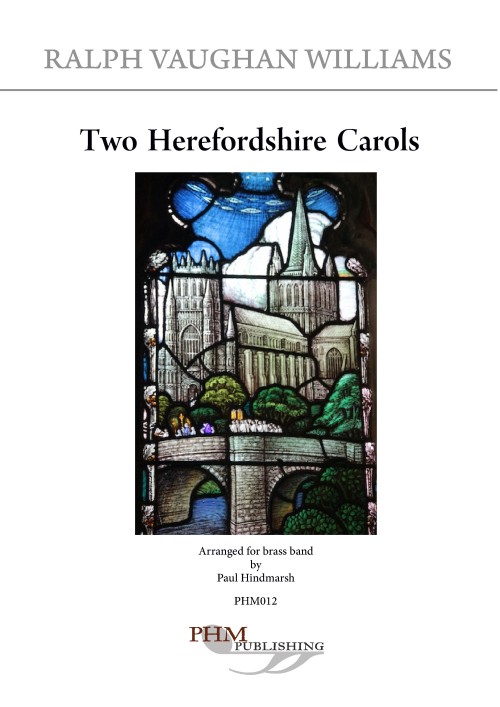
Two Herefordshire Carols (Brass Band - Score and Parts) - Vaughan Williams, Ralph - Hindmarsh, Paul
The two traditional tunes that comprise this straightforward setting were sung to Ralph Vaughan Williams (1872-1958) by Mrs. Esther Smith of Dilwyn, near Hereford, during one of the great composer's folk song collecting tours of England in the early years of the twentieth century. They were included in Twelve Traditional Carols from Herefordshire, edited by E.M. Leather and Vaughan Williams. The words to which Mrs. Smith sung the first tune were probably drawn from eighteenth century evangelical sources. The editors replaced these with six of the 16 verses of a traditional seventeenth century carol text, Joseph and Mary.The second melody, which appears as the centre piece of this arrangement, was sung to a carol that tells of a farmer who ploughed on Christmas Day. It is in fact a translation of a German traditional carol Gelobet seist du Jesu Christ that was published in Goodly Psalmes and Spiritualle Songes (1546) translated by Miles Coverdale. Vaughan Williams used the title Coverdale's Carol.The brass band settings follow the settings made by Vaughan Williams in 1920 for the Oxford Book of Carols. Since his simple harmonic approach is similar in both settings, three verses of his haunting version of Coverdale's Carol have been folded inside four verses of the slightly more animated treatment of Joseph and Mary. The harmonisations of Vaughan Williams have been given some brass band colour, with some verses taken by soloists from the ensemble. The accompaniment figuration that embellishes the second verse of Joseph and Mary has been used to open and close this arrangement and to bind the verses together.- Paul HindmarshDuration: 5.00
Estimated dispatch 7-14 working days
-
 £102.99
Chameleon (Euphonium Solo with Brass Band - Score and Parts) - Doss, Thomas
Chameleon is a three-part solo piece for euphonium and brass band. The different styles within the piece provide lots of variety, requiring refined technique and a great deal of flexibility from the soloist. This composition was commissioned by Georg Pranger, to whom the piece is also dedicated. As a pioneer of the Austrian euphonium soloist scene, Pranger is committed to the unshackling of this wonderful instrument and the creation of great musical momentum, as achieved by this commission.Duration: 8.30
Estimated dispatch 7-14 working days
-
 £99.99
Sparkling Brass (Brass Band - Score and Parts) - Sparke, Philip
Sparkling Brass was commissioned by Osaka Concert Brass, one of Japan's top brass bands, and premiered by them on 27th December 2018 during a concert which celebrated their 10th Anniversary. The work opens in lively mood with fanfare-style figures from the lower band which are answered by the cornets. This interplay intensifies until the mood calms suddenly to introduce a chorale which leads to a duet-cadenza for cornet and euphonium. The rhythmic mood of the opening soon returns and leads to the main theme of the work, a modal caccia which features various section of the band. A short bridge passage leads to a change of key and a new cantabile theme which is introduced by euphoniums and baritone. This is taken up by the full band after another change of key and leads back to the caccia theme. A transformed version of the opening fanfare returns to close the work.Duration: 5.30
Estimated dispatch 7-14 working days
-
 £49.95
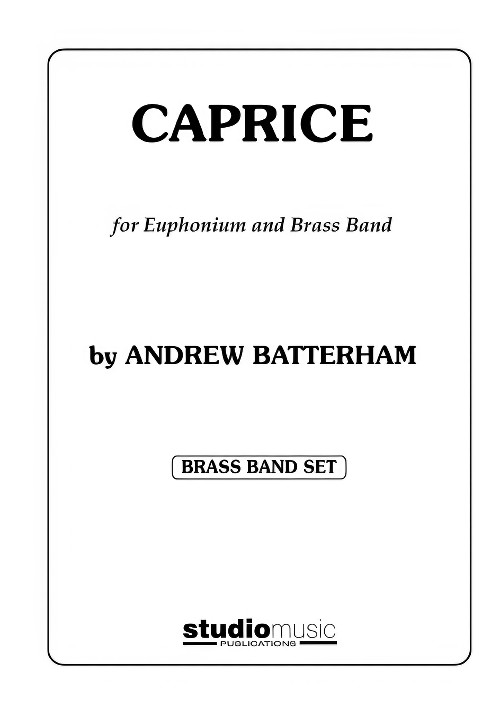
Caprice (Euphonium Solo with Brass Band - Score and Parts) - Batterham, Andrew
Caprice was written for Matthew can Emmerik, to showcase his virtuosity in an engaging piece of concert music. It is in theme and variation form, with the primary material being the theme from the last of Paganini's Ventiquattro Capricci per violino solo. This theme has been the inspiration for similar works by many composers, including Liszt, Brahms, Rachmaninov, Benny Goodman and Andrew Lloyd Webber.In this work, the famous theme is treated to a more contemporary approach.The first variation, Capricious, relies on motor rhythms and jagged dialogues between the soloist and the accompaniment. It is couched in an organic scale reminiscent of the Phrygian mode.The second variation, Sad, is in direct contrast, acting as a traditional ballad and allowing the soloist to explore the expressive side of the instrument.The third variation, Energetic, is a micro set of variations in itself, designed to display the soloist's innovative technique and stamina. Each section is more challenging than the previous one, until the work concludes with a whirlwind dance at breakneck speed.Like all of Batterham's recent work, the musical language of Caprice draws upon classical, jazz, funk and ska elements to create a unique sound where anything can happen, and probably will!
Estimated dispatch 7-14 working days
-
 £154.99
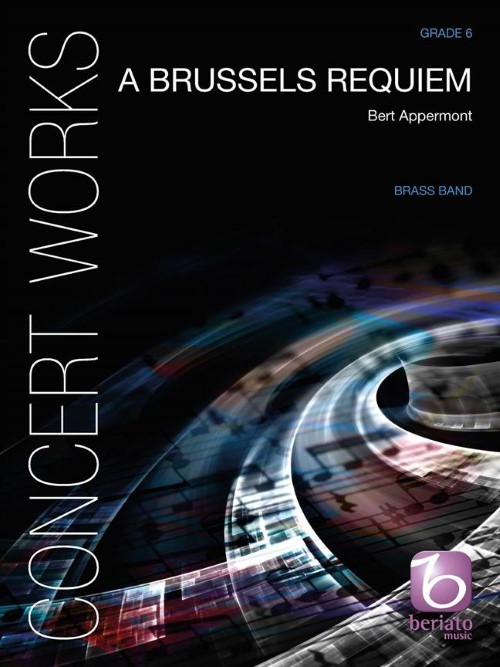
A Brussels Requiem (Brass Band - Score and Parts) - Appermont, Bert
The attacks in Brussels on 22 March 2016 created a shockwave throughout Belgium and the rest of the world. Equally, the attacks in Paris and Nice led to great public indignation, fear and disbelief. What has happened to the western world? Have our cultures grown apart to such an extent that we do not understand each other anymore? Bert Appermont's intention was to voice certain emotions that these acts of terror have caused: particularly fear, grief, anger, and helplessness. He uses the French children's song Au Claire de la Lune as a connecting thread throughout the work. This piece is also about hope and faith in another world, and is meant to pay homage to all victims, resulting in a dignified remembrance. The musical development is presented in four through-composed parts, titled Innocence, In Cold Blood, In Memoriam - We Shall Rise Again and A New Day. This work was commissioned by the Brassband Oberosterreich (Brass Band Upper Austria) to be played at the European Brass Band Championships 2017.Duration: 16.30
Estimated dispatch 7-14 working days
-
 £59.99
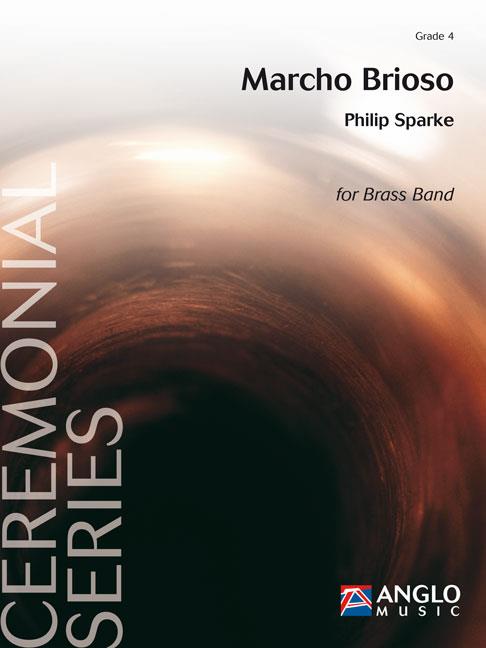
Marcho Brioso (Brass Band - Score and Parts) - Sparke, Philip
Marcho Brioso was commissioned by The Brioso Brass, a British-style brass band from Hokkaido, Japan. They gave the first performance in January 2012.The commission was for a bright and breezy march that the band could use as their theme tune, so Marcho Brioso falls into the composer's series of Broadway-style marches, which includes Slipstream, The Bandwagon and Jubiloso. After a short introduction a solo cornet plays the main theme, accompanied by a euphonium counter-melody. A secondary phrase from the horns and baritones leads to a tutti version of the main theme which is followed by the traditional 'bass' strain. A change of key heralds the trio section, which features a cantabile melody on euphonium; this is then taken up by the full band after a short bridge passage and further change of key. This takes us back to the home key which sees a quiet staccato version of the main theme lead to a recapitulation and a short coda which brings the march to a close.Duration: 3:45
Estimated dispatch 7-14 working days
-
 £44.95
Turris Fortissima (Brass Band - Score and Parts) - Ponsford, Steven
The geographical position of Plymouth (the composer's home city) means that, at various times in history, the city has been the United Kingdom's first line of defence. A series of forts around the coast bears testimony to this and forts have featured on the city's coat of arms ever since. However, the city's forefathers believed that physical security was worthless without a faith in God's protection and this is reflected in the city motto; Turris fortissima est nomen Jehovah (The name of Jehovah is our strongest tower) (Proverbs 18:10). Written for Enfield Citadel Band's tour of the USA in 2007, the music attempts to portray this assurance with the use of the tune Ein' Fest Burg (A mighty fortress is our God) along with the more contemporary Blessed be the Name of the Lord and Shout to the Lord. There is also an apt reference to Dean Goffin's My Strength, My Tower as the music builds to its dramatic final bars.
Estimated dispatch 7-14 working days
-
£22.50
Turris Fortissima (Brass Band - Score only) - Ponsford, Steven
The geographical position of Plymouth (the composer's home city) means that, at various times in history, the city has been the United Kingdom's first line of defence. A series of forts around the coast bears testimony to this and forts have featured on the city's coat of arms ever since. However, the city's forefathers believed that physical security was worthless without a faith in God's protection and this is reflected in the city motto; Turris fortissima est nomen Jehovah (The name of Jehovah is our strongest tower) (Proverbs 18:10). Written for Enfield Citadel Band's tour of the USA in 2007, the music attempts to portray this assurance with the use of the tune Ein' Fest Burg (A mighty fortress is our God) along with the more contemporary Blessed be the Name of the Lord and Shout to the Lord. There is also an apt reference to Dean Goffin's My Strength, My Tower as the music builds to its dramatic final bars.
Estimated dispatch 7-14 working days
 View Music