
Results
-
 £99.99
Sparkling Brass (Brass Band - Score and Parts) - Sparke, Philip
Sparkling Brass was commissioned by Osaka Concert Brass, one of Japan's top brass bands, and premiered by them on 27th December 2018 during a concert which celebrated their 10th Anniversary. The work opens in lively mood with fanfare-style figures from the lower band which are answered by the cornets. This interplay intensifies until the mood calms suddenly to introduce a chorale which leads to a duet-cadenza for cornet and euphonium. The rhythmic mood of the opening soon returns and leads to the main theme of the work, a modal caccia which features various section of the band. A short bridge passage leads to a change of key and a new cantabile theme which is introduced by euphoniums and baritone. This is taken up by the full band after another change of key and leads back to the caccia theme. A transformed version of the opening fanfare returns to close the work.Duration: 5.30
Estimated dispatch 7-14 working days
-
 £29.95
Shine (Brass Band - Score and Parts) - Gott, Barrie
This is another work in a series of swing pieces which began in 1986 with Light-walk (F.S. 462). Shine was written to commemorate 30 years since Light-walk's conception at Star Lake Music Camp. As such, there are brief references to it within the piece. A good understanding of swing style is essential and the articulations should be observed as much as possible. The martellatos should be short and accented. This music should be played with a sense of fun and audience participation is encouraged.
Estimated dispatch 7-14 working days
-
£14.95
Shine (Brass Band - Score only) - Gott, Barrie
This is another work in a series of swing pieces which began in 1986 with Light-walk (F.S. 462). Shine was written to commemorate 30 years since Light-walk's conception at Star Lake Music Camp. As such, there are brief references to it within the piece. A good understanding of swing style is essential and the articulations should be observed as much as possible. The martellatos should be short and accented. This music should be played with a sense of fun and audience participation is encouraged.
Estimated dispatch 7-14 working days
-
 £84.99
Festivus Americas (Brass Band - Score and Parts) - Bulla, Stephen
Dedicated to the North American Brass Band Association, this is music that is full of energy and dynamic extremes. In form it draws from the overture style, although the themes are self-existing and the piece is programmatic. Working well as a festival opener, it sets a mood of excitement. Following the rhythmic fanfares of the opening, the first theme is presented in the cornets followed by a return to the same rhythmic material. A second theme appears in the horn section and is developed, changing into a darker and sinister form of the same motif. Eventually a Maestoso section is reached, full of sustained block chords in the cornets and trombones, as the rest of the band counters with cascading lines that weave straight through the brighter instruments. Duration: 5.00
Estimated dispatch 7-14 working days
-
 £95.00
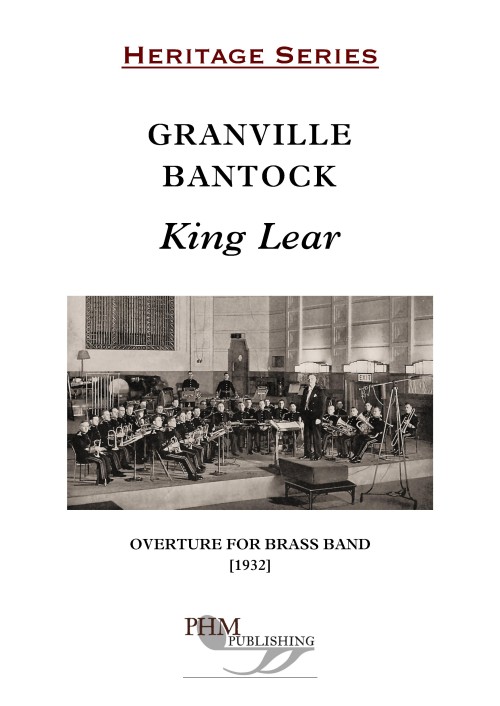
King Lear (Brass Band - Score and Parts) - Bantock, Granville - Hindmarsh, Paul
Sir Granville Bantock (1868 - 1946) composed the second of his five major brass band work for Callender's Cableworks Band, completing the commission on 30 November 1932. Based in the Thames-side district of Belvedere near Erith, the band was active between 1898 and 1961. The works band of the Callender Cable & Construction Co. Ltd, it was at the peak of its popularity during the 1930s and was a frequent broadcaster on the radio. The band employed an in-house arranger and played saxophones in its lighter material. King Lear was one of the band's major commissions and was not published in Bantock's lifetime. The manuscript score and parts were thought to be lost for decades, but were found in the library of the Haydock Band (Lancashire), which had inherited part of Callender's library of manuscripts material and bespoke arrangements after it has been transferred to nearby Prescott Cables Band after Callender's Cable Works closed.King Lear is a substantial work, in essence a dramatic tone poem in the romantic Tchaikovskian manner, presenting a series of character portraits of the foolish old king and his three daughters, Goneril, Regan and Cordelia. The music is dramatic and lyrical by turns, with the most generous lyrical episode revealing perhaps the warm-hearted Cordelia. An expansive melody that flows from this is brought back towards the end as the main climax of the work.In 2001, Bantock's score was recorded by the University of Salford Brass Band, conducted by Dr. Roy Newsome. The original is serviceable, but in comparison with the orchestral version he made in 1936 (part of which was recorded on a Paxton 78 rpm) and later brass band scores, performing editions of which were prepared by others, it lacks colour and range typical of Bantock's orchestral work. Above all it lacks percussion, which can be heard on the recorded extract. With the kind permission of the Bantock Estate, I have prepared a performing edition for publication that incorporates percussion, derived from the orchestral recording and added editorially in similar manner elsewhere. I have revoiced some of the low- lying instrumental parts to present the material in more comfortable ranges. Editorial interventions more elaborate than revoicing the original text have been identified as cue notes.- Paul HindmarshDuration: 15.00
Estimated dispatch 7-14 working days
-
£40.00
King Lear (Brass Band - Score only) - Bantock, Granville - Hindmarsh, Paul
Sir Granville Bantock (1868 - 1946) composed the second of his five major brass band work for Callender's Cableworks Band, completing the commission on 30 November 1932. Based in the Thames-side district of Belvedere near Erith, the band was active between 1898 and 1961. The works band of the Callender Cable & Construction Co. Ltd, it was at the peak of its popularity during the 1930s and was a frequent broadcaster on the radio. The band employed an in-house arranger and played saxophones in its lighter material. King Lear was one of the band's major commissions and was not published in Bantock's lifetime. The manuscript score and parts were thought to be lost for decades, but were found in the library of the Haydock Band (Lancashire), which had inherited part of Callender's library of manuscripts material and bespoke arrangements after it has been transferred to nearby Prescott Cables Band after Callender's Cable Works closed.King Lear is a substantial work, in essence a dramatic tone poem in the romantic Tchaikovskian manner, presenting a series of character portraits of the foolish old king and his three daughters, Goneril, Regan and Cordelia. The music is dramatic and lyrical by turns, with the most generous lyrical episode revealing perhaps the warm-hearted Cordelia. An expansive melody that flows from this is brought back towards the end as the main climax of the work.In 2001, Bantock's score was recorded by the University of Salford Brass Band, conducted by Dr. Roy Newsome. The original is serviceable, but in comparison with the orchestral version he made in 1936 (part of which was recorded on a Paxton 78 rpm) and later brass band scores, performing editions of which were prepared by others, it lacks colour and range typical of Bantock's orchestral work. Above all it lacks percussion, which can be heard on the recorded extract. With the kind permission of the Bantock Estate, I have prepared a performing edition for publication that incorporates percussion, derived from the orchestral recording and added editorially in similar manner elsewhere. I have revoiced some of the low- lying instrumental parts to present the material in more comfortable ranges. Editorial interventions more elaborate than revoicing the original text have been identified as cue notes.- Paul HindmarshDuration: 15.00
Estimated dispatch 7-14 working days
-
 £59.99
Marcho Brioso (Brass Band - Score and Parts) - Sparke, Philip
Marcho Brioso was commissioned by The Brioso Brass, a British-style brass band from Hokkaido, Japan. They gave the first performance in January 2012.The commission was for a bright and breezy march that the band could use as their theme tune, so Marcho Brioso falls into the composer's series of Broadway-style marches, which includes Slipstream, The Bandwagon and Jubiloso. After a short introduction a solo cornet plays the main theme, accompanied by a euphonium counter-melody. A secondary phrase from the horns and baritones leads to a tutti version of the main theme which is followed by the traditional 'bass' strain. A change of key heralds the trio section, which features a cantabile melody on euphonium; this is then taken up by the full band after a short bridge passage and further change of key. This takes us back to the home key which sees a quiet staccato version of the main theme lead to a recapitulation and a short coda which brings the march to a close.Duration: 3:45
Estimated dispatch 7-14 working days
-
 £34.95
Gymnopedie No.1 (Brass Band - Score and Parts) - Satie, Erik - Bowen, Brian
This is a transcription for brass band of the first, and most well-known, of Erik Satie's three Gymnopedies for piano which were composed in 1888. All three are similar melodically and pianistically. However, the first and last are more well-known, partly due to the later orchestrations by Debussy.Some mystery surrounds the Greek-rooted title, yet explicitness is immaterial to an appreciation of the music. This brass version should not mask the naivete of the original score, though that may be easier said than done.Tenor Horn and Eb Bass mutes are requested by the arranger and will enhance the transcription if available.
Estimated dispatch 7-14 working days
-
£17.50
Gymnopedie No.1 (Brass Band - Score only) - Satie, Erik - Bowen, Brian
This is a transcription for brass band of the first, and most well-known, of Erik Satie's three Gymnopedies for piano which were composed in 1888. All three are similar melodically and pianistically. However, the first and last are more well-known, partly due to the later orchestrations by Debussy.Some mystery surrounds the Greek-rooted title, yet explicitness is immaterial to an appreciation of the music. This brass version should not mask the naivete of the original score, though that may be easier said than done.Tenor Horn and Eb Bass mutes are requested by the arranger and will enhance the transcription if available.
Estimated dispatch 7-14 working days
-
 £168.50
Music of the Spheres (Brass Band - Score and Parts) - Sparke, Philip
Music of the Spheres was commissioned by the Yorkshire Building Society Band and first performed by them at the European Brass Band Championships in Glasgow, May 2004. The piece reflects the composers fascination with the origins of the universe and deep space in general. The title comes from a theory, formulated by Pythagoras, that the cosmos was ruled by the same laws he had discovered that govern the ratios of note frequencies of the musical scale. ('Harmonia' in Ancient Greek, which means scale or tuning rather than harmony - Greek music was monophonic). He also believed that these ratios corresponded to the distances of the six known planets from the sun and thatthe planets each produced a musical note which combined to weave a continuous heavenly melody (which, unfortunately, we humans cannot hear). In this work, these six notes form the basis of the sections Music of the Spheres and Harmonia. The pieces opens with a horn solo called t = 0, a name given by some scientists to the moment of the Big Bang when time and space were created, and this is followed by a depiction of the Big Bang itself, as the entire universe bursts out from a single point. A slower section follows called The Lonely Planet which is a meditation on the incredible and unlikely set of circumstances which led to the creation of the Earth as a planet that can support life, and the constant search for other civilisations elsewhere in the universe. Asteroids and Shooting Stars depicts both the benign and dangerous objects that are flying through space and which constantly threaten our planet, and the piece ends with The Unknown, leaving in question whether our continually expanding exploration of the universe will eventually lead to enlightenment or destruction.Duration: 18:00
Estimated dispatch 7-14 working days
 View Music