
Results
-
 £24.95
CONCERTINO CATALONIA (Brass Band) - Bates, Jonathan
Composed for the Flowers Band, this fiery paced Spanish showpiece stays true to the 'concertino' name by featuring many sections within the band. Percussion gives the piece its rhythmic drive, whilst there are a number of individual contributions, starting with euphoniums and baritones, before moving to flugel/solo horn and finally through to the cornets.Duration: 2:15 Grade: Intermediate-Difficult
Estimated dispatch 7-14 working days
-
 £69.99
Czardas (Xylophone Solo with Brass Band - Score and Parts) - Monti, Vittorio - Bomhof, Gert
Vittorio Monti was born on January 6, 1868 in Naples (Italy). His musical education (violin and composition), he enjoyed at the conservatory there. Around his 30's Monti went to Paris. He earned a living as a conductor and wrote several ballets and operettas. In his last years, Monti died in 1922, he devoted himself to teaching and composing. His famous "Czardas" has made his name known even today. Initially the czardas was a Hungarian folk dance , but after the mid-nineteenth century it was even a dance for the upper-class. Czardas begins with a slow introduction, the Lassan (slow and sad), and then the fast part, Friska, follows. Czardas is not, as so many people think typical gypsy music.Duration: 5.30
Estimated dispatch 7-14 working days
-
£94.95
ELECTRA (Brass Band - Score and Parts) - Ellerby, Martin
2012 British Open and the Netherlands Brass Band Championships. Championship Section Test Piece. Electra is loosely based on the play by Sophocles. The 'Elektra Chord' provides the signature chord and motivic elaboration used by composer Richard Strauss to represent the eponymous character of his opera Elektra. There are three clear sections to the work. The first is subtitled 'Lust for Revenge' which is a highly charged element with an ensemble approach to the writing; the second is the lyrically inspired 'Laments' where all the key solos occur and the musical language exploits the more poetic properties of the chord, and the final section, 'Dance to Death' which represents a return to rhythm as the main driving force.
Estimated dispatch 7-14 working days
-
£49.95
ELECTRA (Brass Band - Score only) - Ellerby, Martin
2012 British Open and the Netherlands Brass Band Championships. Championship Section Test Piece. Electra is loosely based on the play by Sophocles. The 'Elektra Chord' provides the signature chord and motivic elaboration used by composer Richard Strauss to represent the eponymous character of his opera Elektra. There are three clear sections to the work. The first is subtitled 'Lust for Revenge' which is a highly charged element with an ensemble approach to the writing; the second is the lyrically inspired 'Laments' where all the key solos occur and the musical language exploits the more poetic properties of the chord, and the final section, 'Dance to Death' which represents a return to rhythm as the main driving force.
Estimated dispatch 7-14 working days
-
£64.95
ESPRIT (Brass Band) - Barry, Darrol
Esprit is a rhapsodic adventure for brass band and percussion.During its twelve minutes, features all soloists and sections of the band. After a vibrant opening the main melodic work is in the lower band accompanied by swirling cornets.The next section is a scherzo like section opened by the horns and closed by the timpani, and in between there are solo's for all.The following adagio is an expressive solo for euphonium accompanied by cup muted cornets and trombones, followed by a section for the flugel which builds up to the full band. A cornet cadenza follows after which a timpani solo takes us to a con brio section in 6/8 which features a round and fugato section which is followed by a slower section for trombones which in turn leads to a musical climax.A short allegro motto section develops an idea from earlier in the piece and leads us into a reprise of the opening section. A vibrant coda concludes the work.Duration: 12:00 Grade: Moderately Difficult
Estimated dispatch 7-14 working days
-
 £60.99
Everest (Brass Band - Score and Parts)
Everest is the name of a restaurant on the 40th floor of a skyscraper in Chicago. In 2003 the composer Jacob de Haan had dinner there together with his publishers and other fellow composers. The idea of composing a march to honour the excellent cuisine, the magnificent view of the skyline and the pleasant atmosphere in the restaurant arose during the visit. The results can be heard in this delightful and unusual work. 04:00
Estimated dispatch 7-14 working days
-
£26.50
GRANDFATHER'S CLOCK (Euphonium/Brass Band) - Doughty, George
Euphonium & Brass Band. Please note: There are no percussion parts in this piece. Recorded on Polyphonic QPRL050D Harry Mortimer - A Tribute in Music
Estimated dispatch 7-14 working days
-
 £40.00
Hallelujah Chorus (from Messiah) (SATB Chorus with Brass Band - Score and Parts) - Handel, George Frideric - Littlemore, Phillip
Handel's?Messiah?was composed in 1741, receiving it's premiere in Dublin a year later. Written in three parts, the Hallelujah Chorus concludes the second part, and is often performed separately from the main oratorio, and especially around Christmas. There are no choral parts included with the set, however it works with all the major editions of vocal score. Duration: 3:30
Estimated dispatch 7-14 working days
-
 £54.99
Here Comes Bobby the Bear (Brass Band - Score and Parts) - Schulte, Andreas Ludwig
Rock music is always a success. And when it is supported verbally as it is done in this composition, the party can begin. Bobby is a friendly circus animal that has seen a lot of the world. There is nothing left to wish for and his freedom from worries radiates from this rock march by Andreas Ludwig Schulte.Duration: 1.45
Estimated dispatch 7-14 working days
-
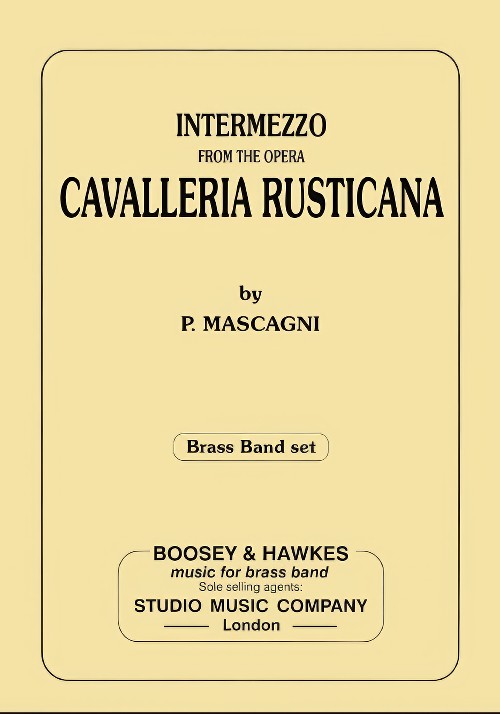 £24.95
Intermezzo (from Cavalleria Rusticana) (Brass Band Marchcard Set) - Mascagni, Pietro
from the opera Cavalleria Rusticana.Please note: there is no score for this work, only a solo cornet conductor part.
Estimated dispatch 7-14 working days
 View Music