
Results
-
 £37.95
Endeavour Score Only)
Commissioned by the Festival of Bands, Brisbane 1988, for the Bicentennial World Brass Band Championship held there on 29th July.Endeavour takes its title from the name of the ship in which Captain James Cook circumnavigated the world and attempts to depict in music some aspects of the history of the great continent which he discovered.The Unknown Continent tells the story of the many fruitless voyages undertaken to find the mysterious Terra Australis and conjures up something of the awe and excitement its discovery engendered. Early struggles and hardships of the first settlers are described in The New Challenge but the true story of Australia over the last 200 years is one of success and Celebration ends the piece in triumph.Duration: 11.30 mins
Estimated dispatch 7-14 working days
-
 £87.95
Masquerade (Score and Parts)
The first performance took place on the 4th. September 1993 at the Free Trade Hall in Manchester during the British Open Brass Band Championships.Note by Philip Wilby:Masquerade is a centenary tribute to Verdi's last opera Falstaff and takes its final scene as the basis for my own piece. Thus I have used some of Verdi's music, and some of Shalespeare's plot, and woven them into a fabric with highly demanding music of my own to produce a work in the great tradition of operatically-based brass band pieces. Such scores date from the very beginnings of band repertory and are often not direct arrangements in the established sense but new compositions produced in homage to a past master. They may still offer performers and audience alike something familiar interwoven with something new. My own piece reuses some elements from the original story: . .Falstaff has been caught in a web of his own lies by the ladies of the town, who propose to teach him a lesson. The story opens at night in Windsor Great Park. The plotters, variously disguised in Hallowe'en fashion (as fairies,elves hobgoblins etc!) assemble in the park to await Falstaff's arrival (musicologists will, perhaps, note a rare use of 'large bottle in F' being used during this scene of suppressed alcoholic revelry!). Falstaff's companions, Bardolph,Piston and Robin, enter (represented here by the three trombones!), and are variously abused by the masqueraders. At the height of the Tout an alarm sounds and Falstaff (euphonium cadenza) enters as Midnight strikes. From a safe hiding place he watches as the disguised Nanetta (principal comet) sings a serene solo as the moon appcars above the trees. With sudden force the others seize him and drag him from his hiding place. As in the traditional game 'Blind Man's Buff', he is roughly turned seven times (a sequence of solo accelerandi) until, at last, he recognizes his assailants as his sometime friends. Far from complaining, Verdi's character concludes the opera with a good-humoured fugue on the words.... 'All the World's a Joke... Every mortal laughs at the others, But he laughs best who has the final laugh. Philip Wilby.
Estimated dispatch 7-14 working days
-
 £44.95
Masquerade (Score Only)
The first performance took place on the 4th. September 1993 at the Free Trade Hall in Manchester during the British Open Brass Band Championships.Note by Philip Wilby:Masquerade is a centenary tribute to Verdi's last opera Falstaff and takes its final scene as the basis for my own piece. Thus I have used some of Verdi's music, and some of Shalespeare's plot, and woven them into a fabric with highly demanding music of my own to produce a work in the great tradition of operatically-based brass band pieces. Such scores date from the very beginnings of band repertory and are often not direct arrangements in the established sense but new compositions produced in homage to a past master. They may still offer performers and audience alike something familiar interwoven with something new. My own piece reuses some elements from the original story: . .Falstaff has been caught in a web of his own lies by the ladies of the town, who propose to teach him a lesson. The story opens at night in Windsor Great Park. The plotters, variously disguised in Hallowe'en fashion (as fairies,elves hobgoblins etc!) assemble in the park to await Falstaff's arrival (musicologists will, perhaps, note a rare use of 'large bottle in F' being used during this scene of suppressed alcoholic revelry!). Falstaff's companions, Bardolph,Piston and Robin, enter (represented here by the three trombones!), and are variously abused by the masqueraders. At the height of the Tout an alarm sounds and Falstaff (euphonium cadenza) enters as Midnight strikes. From a safe hiding place he watches as the disguised Nanetta (principal comet) sings a serene solo as the moon appcars above the trees. With sudden force the others seize him and drag him from his hiding place. As in the traditional game 'Blind Man's Buff', he is roughly turned seven times (a sequence of solo accelerandi) until, at last, he recognizes his assailants as his sometime friends. Far from complaining, Verdi's character concludes the opera with a good-humoured fugue on the words.... 'All the World's a Joke... Every mortal laughs at the others, But he laughs best who has the final laugh. Philip Wilby.
Estimated dispatch 7-14 working days
-
 £57.00
Balkan Gipsies - Paul Voet
Gipsies are wizards with the fiddle. Eastern European folk musicians and gipsies are using a lot of brass in their music. Their brass ensembles are very impressive, so the link to brassbands is quickly made. Based on the folk theme of Manea Tsigailor all cornets join the theme in an up tempo 7/8 bar. Gathered around a campfire gipsies are telling stories and making music. When the lower brass is telling their story all others clap hands. All of a sudden a cornet soloist appears. When we return to the basic theme the story ends with some dazzling bars.
Estimated dispatch 10-14 working days
-
 £77.00
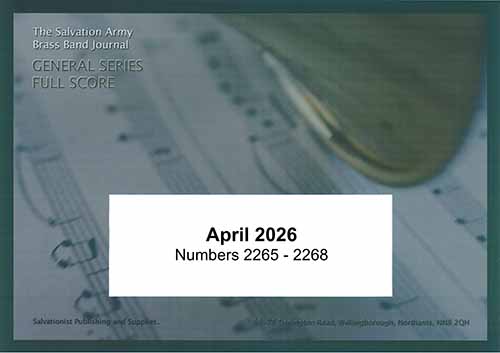
General Series Brass Band Journal, Numbers 2265 - 2268, April 2026
2265: Holy God, we praise your name (Micael Dikantsa)This bolero introduces composer Micael Dikantsa of the Amriswil Corps, Switzerland, and is based on the hymn Holy God, We Praise Your Name (Grosser Gott, wir loben dich). Set in the traditional slow, dramatic bolero style, the work builds steadily from a distinctive percussion figure as the melody passes through different instrumental groups. With its growing intensity and rich scoring, this piece offers an engaging and atmospheric addition to concert programmes.2266: Tell the story (Barrie Gott)This work continues the Swing series that began nearly 40 years ago with Light'Walk. After a bold introduction, the melody unfolds through unison and close'harmony writing, leading to a Flugel Horn solo with scope for improvisation. The well'known hymn I Love to Tell the Story is heard in a New Orleans style before a modulation launches an energetic shout chorus and lively coda. Smooth, relaxed swing style is key throughout.2267: The old rugged cross (Erik Leidzn)This arrangement by Erik Leidzn is an early and lesser'known setting of a well'loved hymn, rediscovered during research into his work. Edited from a rare score found in the USA East Music Department archives, it demonstrates Leidzn's economical and effective style, creating a practical and expressive arrangement at a time when concise, serviceable hymn settings were greatly needed.2268: Heaven came down! (Michael Cooper)Inspired by William Booth's famous challenge to use contemporary styles for sacred purpose, this piece blends high'energy jazz'fusion big'band writing with a joyful gospel hymn. Driven by rhythm, syncopation and precision, the music proclaims its message of transformation and spiritual joy with vitality, clarity and infectious swing.
Estimated dispatch 7-14 working days
-
 £29.95
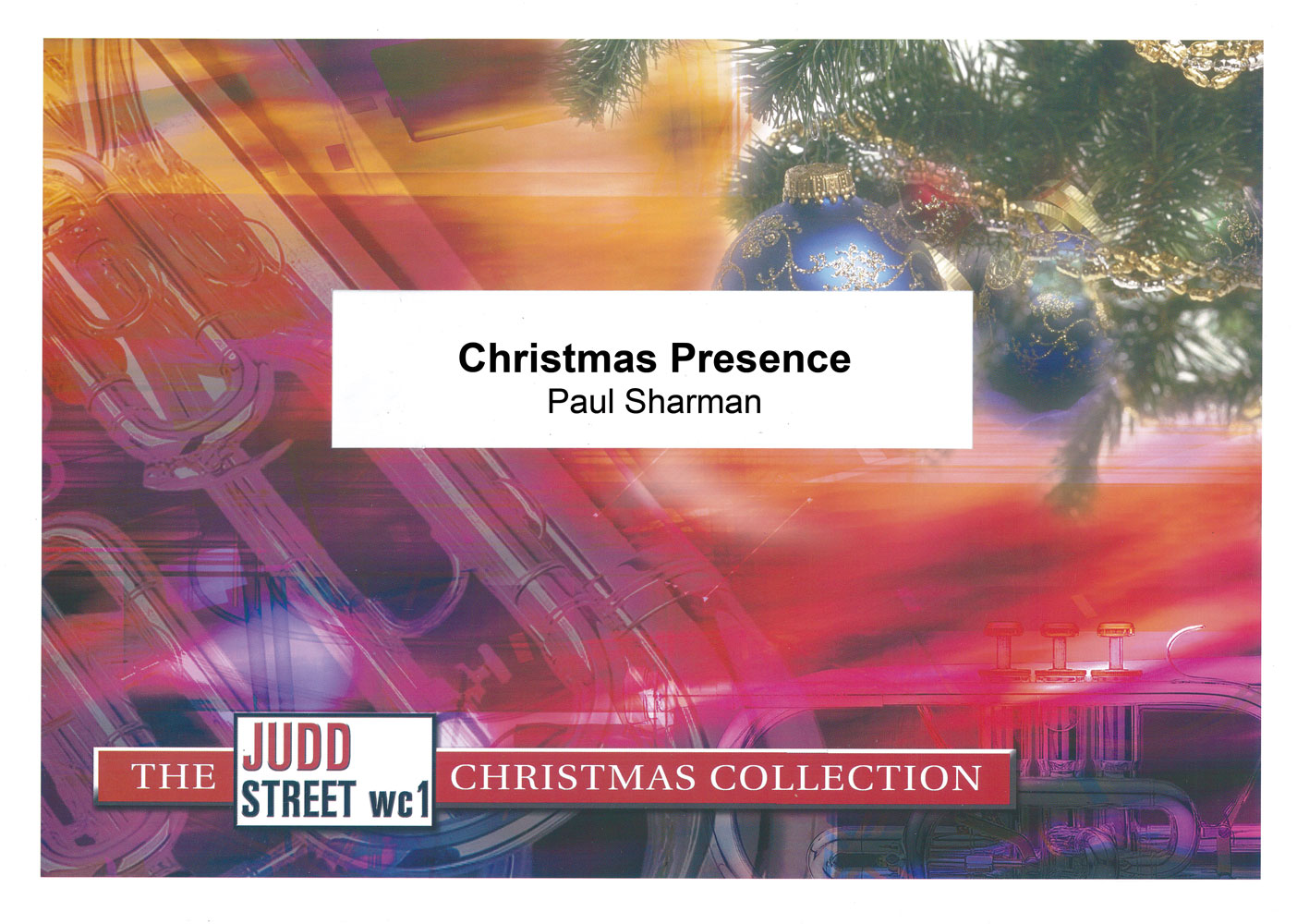
Judd: Christmas Presence
Written for Birmingham Citadel Band to play at their annual carol concert at Symphony Hall, Birmingham, this piece tells the story of the Nativity using the carols 'Who is he?' and 'Calypso Carol' (Christmas Collection 16). Brief appearances are made by the shepherds ('While shepherds watched'), the angels ('Ding dong! merrily on high') and the wise men ('Three kings' march' and 'We three kings of Orient are'). The music finishes with a majestic setting of the chorus of 'Who is he?', reminding us who the baby Jesus is:'Tis the Lord! O wondrous story,'Tis the Lord, the king of Glory!At his feet we humbly fall,Crown him, crown him Lord of all!
Estimated dispatch 7-14 working days
-
 £33.62
E lucevan le stelle (Cornet/Euphonium Duet with Brass Band) Puccini arr.Bushnell
Tosca is an opera in three acts by the Italian composer Giacomo Puccini. The opera is set in June 1800 in Rome, and tells the story of the Kingdom of Naples and the threat to its control of Rome by Napoleon's invasion of Italy. Some of Puccini's best-known arias can be found in Tosca. The opera is based on Victorien Sardou's dramatic play of the same name (La Tosca). Puccini saw the play at least twice in 1889 and begged his publisher, Giulio Ricordi, to obtain the rights to turn it into an opera, which were secured in 1891 - although Puccini relinquished the rights to Alberto Franchetti before being recommissioned in 1895. Puccini wrote "I see in this Tosca the opera I need, with no overblown proportions, no elaborate spectacle, nor will it call for the usual excessive amount of music." It took four years to write, with Puccini arguing with his librettists (Luigi Illica and Giuseppe Giacosa) and his publisher. Although the first performance was delayed by a day due to the unrest in Rome at the time, the opera was premiered on 14 January 1900 at the Teatro Costanzi in Rome. The critics reviews were indifferent, but it was an immediate success with the public. The opera is through-composed, with the different musical elements weaved from piece to piece. Puccini used the Wagner's leitmotif concept to identity different parts of the opera. Taken from Act 3, E lucevan le stelle is sung by Cavaradossi, a painter, who has fallen for the singer Tosca. The corrupt Chief of Police, Baron Scarpia, longs for Tosca himself and, upon suspecting Cavaradossi of helping a political prisoner escape, he takes the opportunity to get rid of Cavaradossi and blackmail Tosca into being with him. The guards lead Cavaradossi to the roof of Castel Sant'Angelo, where he is told he has 1 hour to live before being executed. He asks to write a letter to Tosca, overcome by memories, he sings E lucevan le stelle (And the stars shone). It was selected by the tenor Wynne Evans as one of the most romantic songs for his top ten arias for Classic FM. He described it as "another tenor classic, both tragic and beautiful." This arrangement (for cornet and euphonium duet with brass band) includes alternative parts for horns in F and lower brass in bass clef. A recording of the original song can be found here: www.youtube.com/watch?v=EAqHQMX7GHY
In Stock: Estimated dispatch 1-3 working days
" frameborder="0" allowfullscreen> -
 £48.56
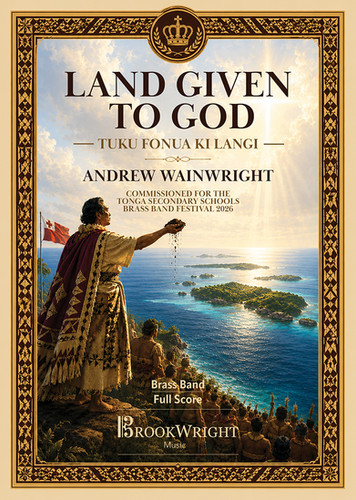
Land Given to God (Tuku Fonua ki Langi) (Brass Band) Andrew Wainwright
Land given to God (Tuku Fonua ki Langi) is a landmark major test-piece for brass band celebrating Tongan faith, history, and cultural identity. Commissioned by Sione Malekamu Manu Jr for the Tonga Secondary School Music Festival, Land given to God marks a monumental achievement in Pacific music literature as the first major brass band test-piece written specifically for the Kingdom of Tonga. Commemorating two centuries of Christianity, this compelling four-movement work traces Tonga's journey from ancient traditions to its historic 1839 dedication to divine protection. The piece draws its principal thematic material from the beloved Tongan hymn Oku 'iai ha ki'i fonua 'oku tu'u 'i 'oseni. The work is divided into four through-composed movements: I. Koe Lotu Mu'a (The Old Religion): Grounded and ritualistic, this movement paints the ancient spiritual order of pre-Christian Tonga - a nation anchored in sacred ancestral tradition on the threshold of change. II. Koe Lotu Fo'ou (The New Religion): Captures a nation in transition, depicting the arrival of Wesleyan missionaries, the conversion of Taufa'ahau (King Siaosi Tupou I), and the powerful 1834 spiritual revival (To 'a e 'Ofa). III. Koe Sivi Fakaosi (The Final Test): A dramatic musical confrontation between doubt and conviction. It recounts the story of Christian teacher Pita Vi being cast into shark-infested waters as a test of faith, surviving unharmed to seal the King's devotion. IV. Koe Tuku Fonua ki Langi (Land Given to God): A solemn, declarative finale recounting the historic 1839 act at Pouono, where King Siaosi Tupou I offered the land and people of Tonga to the divine protection of Heaven. Duration: approx. 8.45 minutes Difficulty Level: 4th Section + This PDF download includes the full score and parts. Sheet music available at www.brassband.co.uk (UK) or https://satradecentral.org (USA) Instrumentation: Soprano Cornet Eb Solo Cornet Bb Repiano Cornet Bb 2nd Cornet Bb 3rd Cornet Bb Flugel Horn Bb Solo Horn Eb 1st Horn Eb 2nd Horn Eb 1st Baritone Bb 2nd Baritone Bb 1st Trombone Bb 2nd Trombone Bb Bass Trombone Euphonium Bb Bass Eb Bass Bb Percussion 1-3
In Stock: Estimated dispatch 1-3 working days
-
 £79.95
Neverland - Christopher Bond
"All children, except one, grow up" wrote J.M. Barrie about Peter Pan in 1911; the first line and an expression of beautiful melancholy and fantasy, coming to represent one of the best-loved children's stories of the twentieth century. 'Peter & Wendy', as the book was first released, has subsequently been transformed into adaptations for film and stage, with subsequent books based on this iconic tale. In writing this new work for brass band, the composer has taken three of the main themes from J. M. Barrie's book, and used these themes to create new musical material, forming a work in three contrasting sections. I. Journey to Neverland The opening of the work, mysterious in its style, reflects the opening chapters of the story - a leafy London street, still in the dead of night - with the music transforming quickly as it builds in texture and momentum - a Journey to Neverland through the night sky; Second Star to the Right and straight on 'til morning. "Then Peter knew that there was not a moment to lose. 'Come,' he cried imperiously, and soared out at once into the night, followed by John and Michael and Wendy. Mr & Mrs Darling and Nana rushed into the nursery too late. The birds were flown." II. The Windows that Closed The central section of the work takes its inspiration from the sense of longing throughout the book, mainly by Peter Pan, the Darling Children & The Lost Boys. Distant memories of life before Neverland, memories of the Lost Boys' mothers, and regret at what the children have missed. Peter says "Long ago, I thought like you that my mother would always keep the window open for me; so I stayed away for moons and moons and moons, and then flew back; but the window was barred, for mother had forgotten all about me, and there was another little boy sleeping in my bed." III. Aboard the Pirate Ship The final section of the work takes its inspiration from the Pirate Ship, and Peter Pan's ultimate battle with its infamous Captain Hook. "In person, he was cadaverous and blackavized, and his hair was dressed in long curls, which at a distance looked like black candles, and gave a singularly threatening expression to his handsome countenance. His eyes were the blue of the forget-me-not, and of a profound melancholy, save when he was plunging his hook into you, at which time two red spots appeared in them and lit them up horribly."
Estimated dispatch 10-14 working days
-
 £61.11
Heligan - Kevin Ackford
Score & Parts A descriptive piece of around 13 minutes telling the story of and taking you on a journey around the Lost Gardens of Heligan. Following the introduction, we begin our journey at the Grand House with the staff scurrying around carrying out their work. Next comes the outbreak of World War 1 when all of the male staff of the house signed up with the Duke of Cornwall's Light Infantry. Following the war only 6 of the gardens 22 staff survived and returned to Heligan. After the war the gardens "Go to Sleep" and become overgrown. Then comes the modern-day workers rediscovering the gardens and beginning to put them back to their former glory. Then the sun rises over the gardens and the birds begin to sing and we find ourselves in the serene lost valley. We then pass through the Jungle before turning the corner and once again see the House and lawns in all their glory.
Estimated dispatch 5-7 working days
 View Music