
Results
-
£60.00
Requiem Paraphrases - Peter Meechan
Requiem Paraphrases uses the opening bars of Mozart's Requiem as its musical material for the whole piece. An aggressive opening is followed by a sounding of Mozart's original theme, in a setting for low brass and solo euphonium. Percussion and woodwind then enter, as the soloist begins to elaborate. A brief return to the opening is followed by a new, percussion driven, section.The euphonium and various soloists in the ensemble interact, exchanging ideas over an ostinato in the marimba. As this section continues towards the cadenza, the ensemble gradually takes on more of an accompanying role, leaving the soloist to again break free, with flourishes and gestures leading to the cadenza.Following this, there is a short recapitulation, before the euphonium brings us to a dramatic conclusion!Requiem Paraphrases was commissioned by, and dedicated to Steven Mead.
Estimated dispatch 12-14 working days
-
 £29.95
Ballet for Band (Score Only)
Ballet for Band was written as the test-piece for the Championship section finals of the National Brass Band Championships, held at the Royal Albert Hall in October 1983.Although the work is not programmatic, within the space of ten minutes, the composer uses a form which might be considered to be the form of a ballet. Therefore there is a fanfare at the beginning which might be the overture, different characters appear, and scenes are quite clearly marked by, for instance, baritones or by muted trombone, although the listener is encouraged to use his own imagination.Thematically the work is tightly controlled, with the same material re-appearing in many different guises, as a flugel horn solo, as a waltz on the horns, and on the euphonium. Horovitz employs a rich harmonic pallet, but the work is most definitely rooted in a tonal language, with hints of Straussian richness later in the work.The work is notable for its middle section, in which the music gets slower and slower, providing a real test of control throughout the band.Ballet for Band was by no means Joseph Horovitz's first work for the medium: his fine "Concerto for Euphonium and Band" is frequently played, and he has also written a cantata entitled "Samson" for choir and band.
Estimated dispatch 7-14 working days
-
 £34.95
Elixir of Youth (Brass Band - Score and Parts)
Elixir of Youth (2013) was written for the 2013 Brass for Heroes charity event where it was premiered on 19th October 2013 at St Paul's Hall in Huddersfield under the baton of Philip Harper. The title of the work reflects the nature of the band that was put together for that premiere performance; an all-star youth band comprising a selection of the country's young brass banding talent, with the term Elixir referring here to the everlasting talent seen in young brass players throughout the United Kingdom's brass bands and bands' and teachers abilities to keep producing such high quality musicians for the banding movement.The work, structured in three sections, is a showcase for band with a heroic opening where fanfare-like gestures in the cornets and trombones juxtapose rapid euphonium and baritone runs, alongside sweeping horns and percussion effects. As the piece progresses, a grove is introduced - just in the tubas at first, accompanied by a hi-hat - before spreading through the band, definitely stuff to tap your toes to! The middle, slower section of the work sees both flugel and cornet solos, with additional inputs from the euphonium and solo horn before a climax and return to the tempo and music of the opening section. A rousing close concludes the work where all of the work's themes are interweaved to create a sense of power, unity and grandeur; an Elixir of Youth.
Estimated dispatch 7-14 working days
-
 £44.95
Funk Engine (Brass Band - Score and Parts)
'Funk Engine' was commissioned by Brass Bands England for the 2016 National Youth Brass Band Championships of Great Britain. What Ryan says about the piece:"When I was commissioned to write a piece for the Championships I decided that I wanted to create something a bit different to standard brass band repertoire. I decided that the best way to do this was to go a bit out of my comfort zone and explore some styles of music that I have yet to experiment with. I have always been a great lover of jazz, funk and big band music and the sounds associated with them. In 'Funk Engine' I have tried to capture some of these sounds, however I am a brass-bander at heart and as such I've tried to create a fusion of styles that hopefully combines the best of brass band and jazz into one piece.'Funk Engine' runs continuously, but is divided into three broad sections - fast, slow, fast. The opening is in driving big band style, which segues into a smoother lyrical section; the pace then picks up into a jazz inspired scherzo. After a delicate transition from the basses and trombones the euphonium plays a soaring scale - bringing us into the central movement - which begins with a series of languid solos before descending into a darker interlude. A flugel solo lightens the mood and the music gains momentum leading into a brief cornet chorale before a euphonium solo leads into a percussive climactic passage for full band. As this section winds down to settle on an open fifth, the Hi-hat and Bass section punctuate the texture with the first notes of the final section."The final section of the piece is in similar big band style to the opening and develops material from the first two movements. The percussion feature heavily at this stage and the tension builds towards a final statement, with the piece concluding with a bang!"
Estimated dispatch 7-14 working days
-
 £14.95
Funk Engine (Score Only)
'Funk Engine' was commissioned by Brass Bands England for the 2016 National Youth Brass Band Championships of Great Britain. What Ryan says about the piece:"When I was commissioned to write a piece for the Championships I decided that I wanted to create something a bit different to standard brass band repertoire. I decided that the best way to do this was to go a bit out of my comfort zone and explore some styles of music that I have yet to experiment with. I have always been a great lover of jazz, funk and big band music and the sounds associated with them. In 'Funk Engine' I have tried to capture some of these sounds, however I am a brass-bander at heart and as such I've tried to create a fusion of styles that hopefully combines the best of brass band and jazz into one piece.'Funk Engine' runs continuously, but is divided into three broad sections - fast, slow, fast. The opening is in driving big band style, which segues into a smoother lyrical section; the pace then picks up into a jazz inspired scherzo. After a delicate transition from the basses and trombones the euphonium plays a soaring scale - bringing us into the central movement - which begins with a series of languid solos before descending into a darker interlude. A flugel solo lightens the mood and the music gains momentum leading into a brief cornet chorale before a euphonium solo leads into a percussive climactic passage for full band. As this section winds down to settle on an open fifth, the Hi-hat and Bass section punctuate the texture with the first notes of the final section."The final section of the piece is in similar big band style to the opening and develops material from the first two movements. The percussion feature heavily at this stage and the tension builds towards a final statement, with the piece concluding with a bang!"
Estimated dispatch 7-14 working days
-
 £33.89
A Christmas Canon (Brass Band) Traditional arr. William Gordon
Seamlessly merging the traditional English carol The First Nowell with Johann Pachelbel's beloved Canon in D, A Christmas Canon is a captivating arrangement designed to bring rich texture and emotional depth to your band's winter concert repertoire.Suitable for intermediate to advanced bands, the piece opens Adagio sostenuto with a gently rolling, scalic ostinato in the euphonium and lower brass, establishing the unmistakable harmonic ground bass of Pachelbel's masterpiece. Over this foundation, expressive solo lines in the flugel and horns gracefully weave the familiar melody of The First Nowell into the texture.As the arrangement unfolds, the scoring gradually builds density and counterpoint. Intricate muted cornet passages give way to flowing arpeggios, bell-like glockenspiel accents, and cascading lines across the band, driving a gradual crescendo into a rich, full-ensemble statement of the carol theme.The work reaches its dramatic climax at an expanded Allargando section, where the full band, supported by percussion, delivers a majestic, fortissimo declaration of the melody before resolving into a warm, lingering final chord.To view a rolling score video of the Amsterdam Staff Band performing this piece please visit: www.youtube.com/watch?v=dr9hMLhAvRMDifficulty Level: 3rd Section +Duration: 3.30 minutesThis PDF download includes the full score and parts.Sheet music available at www.brassband.co.uk (UK) or https://satradecentral.org (USA)Instrumentation:Soprano Cornet EbSolo Cornet Bb1st Cornet Bb2nd Cornet BbFlugel Horn BbSolo Horn Eb1st Horn Eb2nd Horn Eb1st Baritone Bb2nd Baritone Bb1st Trombone Bb2nd Trombone BbBass TromboneEuphonium BbBass EbBass BbTimpaniPercussion 1-2
In Stock: Estimated dispatch 1-3 working days
-
 £33.89
All Your Anxiety (Brass Band) Edward Joy arr. Jonathan Rowsell
All Your Anxiety is a reflective and expressive work for brass band inspired by Edward Joy's sacred song of the same name. Drawing deeply from the hymn's text and message, the piece explores the tension between human unease and the promise of peace found in faith.The work opens with a distinctive eighth-note figure in the euphonium that immediately establishes an unsettled character. Wide intervallic leaps and atypical slur groupings evoke a sense of fragility and uncertainty, musically portraying the weight of sorrow and care described in the opening verse of the hymn. This motivic material becomes the foundation of the entire arrangement, reappearing in varied forms as counter-melody, accompaniment, and featured solo lines across the ensemble.As the piece unfolds, the music gradually broadens and warms, reflecting the invitation of the text to "come to the cross" and leave one's burdens behind. Moments of lyricism and calm contrast with the earlier unease, leading toward a more settled and hopeful conclusion that mirrors the refrain's assurance: "Never a burden He cannot bear, never a friend like Jesus."To view a video of the Canadian Staff Band playing the piece please visit https://www.youtube.com/watch?v=5Ms8ubug4yASheet music available from www.brassband.co.uk or https://satradecentral.orgDifficulty Level: 3rd Section +Length: 3.30 minutesInstrumentation:Soprano Cornet EbSolo Cornet Bb1st Cornet Bb2nd Cornet BbFlugel Horn BbSolo Horn Eb1st Horn Eb2nd Horn Eb1st Baritone Bb2nd Baritone Bb1st Trombone Bb2nd Trombone BbBass TromboneEuphonium BbBass EbBass BbTimpaniPercussion
In Stock: Estimated dispatch 1-3 working days
-
 £33.89
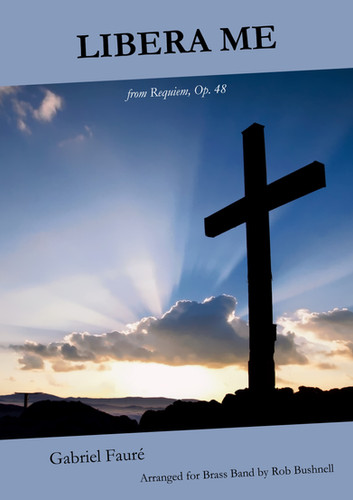
Libera Me from 'Requiem' (Brass Band) Faure arr. Rob Bushnell
Composed between 1887 and 1890, Gabriel Faure's Requiem is not only one of his best-known works but one of the most popular piece of choral music in the Classical repertoire, coming 23rd in the Classic FM's Hall of Fame 2024. Believed to be a tribute to his father (who died in 1885), Faure himself said "My Requiem wasn't written for anything - for pleasure, if I may call it that!" It started life as a five-movement work but was later expanded to be the final seven-movement work we know today. The first version (which Faure called "un petit Requiem") was first performed on 16 January 1888, with Faure conducting, a second version premiered on 21 January 1893 before the final version (reworked for full orchestra) was played on 12 July 1900; the Requiem was performed at the composer's own funeral in 1924.The Libera Me, or Deliver Me, was actually written in 1877 and is the sixth part of the Requiem.Faure once said of the work, "Everything I managed to entertain by way of religious illusion I put into my Requiem, which moreover is dominated from beginning to end by a very human feeling of faith in eternal rest." Upon interview, he also said, "It has been said that my Requiem does not express the fear of death and someone has called it a lullaby of death. But it is thus that I see death: as a happy deliverance, an aspiration towards happiness above, rather than as a painful experience. The music of Gounod has been criticised for its inclination towards human tenderness. But his nature predisposed him to feel this way: religious emotion took this form inside him. Is it not necessary to accept the artist's nature? As to my Requiem, perhaps I have also instinctively sought to escape from what is thought right and proper, after all the years of accompanying burial services on the organ! I know it all by heart. I wanted to write something different."This arrangement is for the British-style brass band, with alternative parts for horns in F and bass-clef lower brass. The tenor solo is featured on the euphonium.A recording of the original composition can be found here: www.youtube.com/watch?v=fXwFNoBHCf0Duration: 4.20 minutes approx.Difficulty Level: 4th Section +PDF download includes parts and score.Sheet music available from www.brassband.co.ukInstrumentation:Soprano Cornet EbSolo Cornet BbRepiano Cornet Bb2nd Cornet Bb3rd Cornet BbFlugel Horn BbSolo Horn Eb1st Horn Eb2nd Horn Eb1st Baritone Bb2nd Baritone Bb1st Trombone Bb2nd Trombone BbBass TromboneEuphonium BbBass EbBass BbTimpani
In Stock: Estimated dispatch 1-3 working days
-
 £67.78
Pyrenean Carol Suite (Brass Band) David Taylor
This attractive suite for brass band by David Taylor features five traditional carols from the Pyrenees region of Spain, as follows:i. Nadal Tindaire (Jingling Christmas) - Occitan traditionalThis Occitan Christmas song tells of musical instruments used to celebrate the Nativity - 'fifes and trumpets, timpani and pipes, or you, clear little bells, along with the angels' choir.'ii. Gabriel's Message (Birjina Gaztetto Bat Zegoen) - Basque traditionalThe most widely-known of the chosen carols, honouring Jesus's mother Mary, this is often sung in its English version, but the melody came from the Basque country. The Basque words were adapted from the Mediaeval song Angelus ad Virginem. Here, we feature the flugel horn. This movement was originally written on its own, with organ accompaniment, for the composer's wife, Diane Scott.iii. El Noi de la Mare (The Child of the Mother) - Catalan traditionalA beautiful Catalan carol celebrating the birth of Jesus, telling of the tasty gifts that the singer would bring - 'Raisins and figs and nuts and olives; Raisins and figs and honey and mato [a Catalan dessert cheese traditionally served with honey.]' Here we feature the euphonium. The tune was made famous by guitarist Andres Segovia, who used it as a favourite encore, and by John Rutter, who made a widely-used setting for choir.iv. Paure Satan (Poor Satan) - Occitan traditionalThis rather unusual carol tells of the pain that Satan is put to by the arrival of the infant Jesus. Its mocking and sarcastic tone is reflected here, where the tuba soloist (as Satan) is given musical trouble throughout by the other parts. At first they conflict with the soloist, then the soloist makes overtures of friendship, which are treated with suspicion followed by contempt. The soloist finally gives in to their accompaniment (or do they?). There are plenty of opportunities for little theatrical touches here, if the tuba player is so inclined! The tuba part in this movement is notably more difficult than the rest of the music, and a number of optional changes have been marked to make the part easier to play, if so desired. The player is also welcome to add suitable extra embellishments to taste if they wish, within the character of the music.v. Fum, Fum, Fum! - Catalan traditionalA favourite Catalan Christmas song for centuries, this rousing melody provides a fitting way to round off the suite, with its repeated rhythmic refrain of the nonsense title phrase. It tells of the Nativity, and then it tells of the celebratory feasting and good times that the singers look forward to to honour it.Although the suite is intended to be performed whole, it is also intended for usage with a selection of movements on occasions where a shorter piece is wanted. Suggested formats include a single movement alone (2, 3, and 5 are likely most appropriate), a pair of movements (any of the first four, plus 5), and a suite of three or four movements (1 and 5, plus one or two of 2, 3, or 4 in the middle). It is suggested that a good way to design a 'pick-your-own-suite' from the movements is to think of the earlier movements as introductory to the final movement.To view a rolling score video featuring Kidlington Concert Brass please visit www.youtube.com/watch?v=QIGdul-yxxgPDF download includes score and parts.Sheet music available from:UK - www.brassband.co.ukUSA - https://satradecentral.orgDifficulty Level: 3rd Section +Length: 9.45 minutesInstrumentation:Soprano Cornet EbSolo Cornet BbRepiano Cornet Bb2nd Cornet Bb3rd Cornet BbFlugel Horn BbSolo Horn Eb1st Horn Eb2nd Horn Eb1st Baritone Bb2nd Baritone Bb1st Trombone Bb2nd Trombone BbBass TromboneEuphonium BbBass EbBass BbTimpaniPercussion 1-2
In Stock: Estimated dispatch 1-3 working days
-
 £34.95
Elixir of Youth - Christopher Bond
Elixir of Youth (2013) was written for the 2013 Brass for Heroes charity event where it was premiered on 19th October 2013 at St Paul's Hall in Huddersfield under the baton of Philip Harper. The title of the work reflects the nature of the band that was put together for that premiere performance; an all-star youth band comprising a selection of the country's young brass banding talent, with the term Elixir referring here to the everlasting talent seen in young brass players throughout the United Kingdom's brass bands and bands' and teachers abilities to keep producing such high quality musicians for the banding movement.The work, structured in three sections, is a showcase for band with a heroic opening where fanfare-like gestures in the cornets and trombones juxtapose rapid euphonium and baritone runs, alongside sweeping horns and percussion effects. As the piece progresses, a grove is introduced - just in the tubas at first, accompanied by a hi-hat - before spreading through the band, definitely stuff to tap your toes to! The middle, slower section of the work sees both flugel and cornet solos, with additional inputs from the euphonium and solo horn before a climax and return to the tempo and music of the opening section. A rousing close concludes the work where all of the work's themes are interweaved to create a sense of power, unity and grandeur; an Elixir of Youth.
Estimated dispatch 10-14 working days
 View Music