
Results
-
 £44.95
Trombone Concerto (Trombone Solo with Brass Band - Score only) - Gregson, Edward
The Gregson Trombone Concerto was originally written in 1979 to a commission from Bedfordshire Education Service, for a new work for Michael Hext, winner of the first BBC Young Musician of the Year competition. This version for brass band was commissioned by Nicholas Childs, Music Director of the Black Dyke Band, specially for Brett Baker, the then principal trombone of the band. He has recorded it on the Doyen label with the Black Dyke Band.The work falls into three main sections, played without a break, but conforming to the traditional pattern of concerto structure. After a slow introduction, containing most of the motivic and rhythmic ideas used in the work, there follows the main fast section which is itself divided into three parts and concludes with a fierce climax (timpani and gong). The slow and rather intense middle section is linked to a cadenza for the soloist, at first unaccompanied but leading to accompanied references to earlier material. The final section is a scherzo which ends dramatically with a re-statement of the opening slow introduction. A brisk coda concludes the work. The interval of a fourth (and its augmented form) provides melodic and harmonic unity for the work, whilst the tonal juxtaposition between E minor and B flat major throughout the concerto is an important element of the structure.The writing for trombone is virtuosic, encompassing the whole range of the instrument, but it also exploits the rather beautiful lyrical sound of which this instrument is capable.Duration: 16.00
Estimated dispatch 7-14 working days
-
 £79.99
A Midwest Fanfare (Brass Band - Score and Parts) - Sparke, Philip
A Midwest Fanfare was commissioned by the Brass Band of Battle Creek and premiered by them during their appearance at the Midwest Clinic in Chicago on 20th December 2017 where this fanfare was the opening piece of the entire event. This piece is designed to be played with the cornets split into two teams either side of the band. It opens with the two groups answering each other antiphonally over a repeated figure in the lower band. A calmer central section introduces a euphonium solo which is then taken up by the whole ensemble. This leads back to a repeat of the opening fanfares over a rhythmic accompaniment and a short coda which brings the work to a close.Duration: 4.00
Estimated dispatch 7-14 working days
-
 £34.95
Chalk Farm No.2 (Brass Band - Score and Parts) - Gregson, Edward
Like so many of the best composers for brass band - Eric Ball, Wilfred Heaton, Elgar Howarth and Robert Simpson - Edward Gregson's youthful talents came to the fore in the Salvation Army. In 1975 Gregson was commissioned by the Chalk Farm Band of the Salvation Army to write a march for the centenary of the birth of the band's most long-serving bandmaster Alfred W Punchard, who conducted the band from 1894 to 1944. In 1909 the Salvation Army published a march called Chalk Farm featuring the old Army chorus 'March on, we shall win the day'.Gregson uses the same tune in his Chalk Farm No 2 march, but this is a symphonic march clearly to be played sitting down. He includes irregular bars of 5 and 7 beats as well as a tongue-in-cheek treatment of the tune, complete with bongos (in the march) and bi-tonality (in the trio). Chalk Farm No 2 imaginatively composed. Gregson's own main theme 'fits' the chorus as a counter-subject. The playful irreverence of the style has more in common with Wilfred Heaton's Praise or Glory, than the conventional Salvation Army March.Duration: 4.00
Estimated dispatch 7-14 working days
-
 £64.95
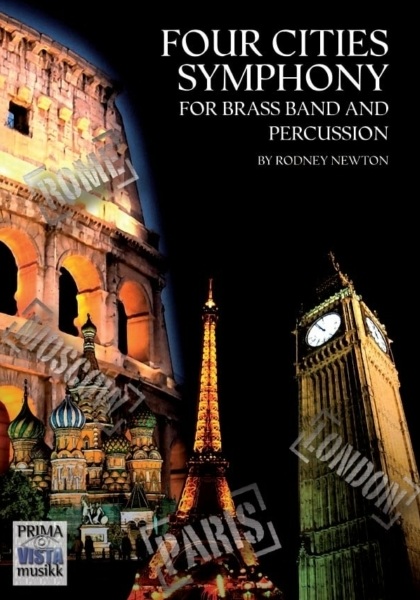
Four Cities Symphony (Brass Band - Score and Parts) - Newton, Rodney
This piece was commissioned by the National Contesting Council as the 4th section test piece for the 2008 Regional Brass Band Championships of Great Britain.This symphony (the composer's 12th) has four movements played without a break. The first centres on two aspects of the city of London: its history and pageantry and its role as a busy modern metropolis.The second movement depicts Paris, its street cafes and boulevards and riverside walks, in the form of a romantic waltz.The third movement is constructed around the Gregorian chants of the Lord's Prayer (Pater noster, qui es in caelis) and the Creed (Credo in unum Deum) in an evocation of the city of Rome. After a powerful climax, mysterious tramping footsteps are heard as the ghosts or a Roman legion march through the city by night. The vision fades and the pater noster is heard once again before the movement is brought to a close with the ancient Ambrosian chant, Christus Vincit, Christus Regnet, Christus Imperat.The final movement is an evocation of the city of Moscow, with its great historic buildings, its turbulent history and its fiery traditional music. At the outset a rather dour folk-like melody is heard which is transformed into a lively Cossack dance.This work is dedicated to Howard Wilson, former principal euphonium of City of Coventry Band who, in 1972, introduced the composer to top section brass band contesting.Duration: 11.00
Estimated dispatch 7-14 working days
-
 £38.00
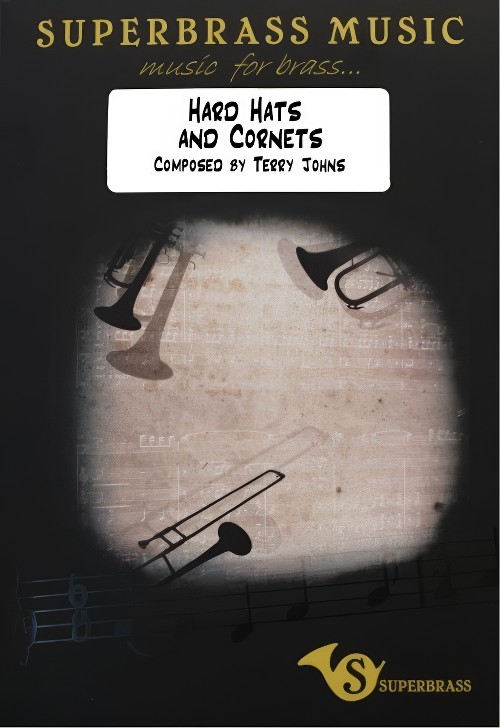
Hard Hats and Cornet (Cornet Section Feature with Brass Band - Score and Parts) - Johns, Terry
This lively and melodic piece was commissioned by Maltby Colliery Band in 2000. It was written as a feature for solo cornet and the cornet section. For its first broadcast performance on Radio Scotland, from Edinburgh in 2009 Mark O'Keefe played the solo part with the band of COOP Glasgow. This piece makes an impressive encore or opening to a band concert and is also available in a version for ten brass. Duration: 3.30
Estimated dispatch 7-14 working days
-
 £24.95
David Of The White Rock (Cornet Solo with Brass Band - Score and Parts) - Bowes, Ray
This melody is reputed to have originated in Caernarvonshire, North Wales. Tradition holds that a bard called David, lying on his deathbed, called for his harp and performed this plaintive tune, expressing a desire that it should be played at his funeral. Ever since the tune has been called by his name and that of his house 'Garagwen' ('Druid Stone' or 'White Rock'). The solo is not just a slow melody with brass band accompaniment but is a composite whole, the band needing as much sensitivity as the soloist in the presentation.
Estimated dispatch 7-14 working days
-
£12.50
David Of The White Rock (Cornet Solo with Brass Band - Score only) - Bowes, Ray
This melody is reputed to have originated in Caernarvonshire, North Wales. Tradition holds that a bard called David, lying on his deathbed, called for his harp and performed this plaintive tune, expressing a desire that it should be played at his funeral. Ever since the tune has been called by his name and that of his house 'Garagwen' ('Druid Stone' or 'White Rock'). The solo is not just a slow melody with brass band accompaniment but is a composite whole, the band needing as much sensitivity as the soloist in the presentation.
Estimated dispatch 7-14 working days
-
 £32.00
Light Cavalry (Brass Band) - Suppe, Franz Von - Greenwood, J. A.
Probably the most played overture in the brass band repertoire (because it works so well). Recorded on numerous occasions and numerous bands both for broadcast and disk. An impressive overture that doesn't require the intensive rehearsal that other overtures require.
Estimated dispatch 7-14 working days
-
 £60.99
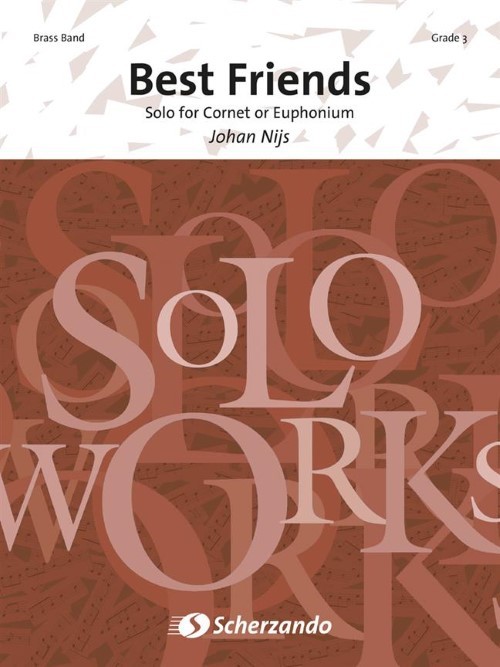
Best Friends (Cornet or Euphonium Solo with Brass Band - Score and Parts) - Nijs, Johan
With Best Friends, Belgian composer Johan Nijs portrays friendship in a wonderful ballad that can be played on the cornet, euphonium or trombone. A great chance to put one of your players in the spotlight!Duration: 3.45
Estimated dispatch 7-14 working days
-
 £24.50
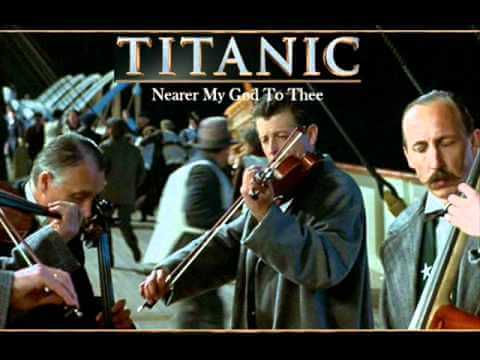
Nearer My God To Thee - Traditional - Gavin Somerset
As the Titanic sank on the 15th April, 1912, eye-witness accounts recall the band playing to the very end in an attempt to keep the passengers calm. This piece played a major part in James Cameron's hit motion picture "Titanic" in 1997, as the heartbreaking scenes of people fighting for survival, and those simply saying good-bye rolled on our screens. This stunning arrangement of the work, as featured in the film, will allow your band to pay tribute to the story of the unsinkable ship, and the 1,517 souls she took with her.
In Stock: Estimated dispatch 1-3 working days
 View Music