
Results
-
 £34.95
By Trevone Bay (Flugel Horn Solo with Brass Band - Score and Parts))
By Trevone Bay was composed for Flugel Soloist Zoe Hancock and the Black Dyke Band to celebrate both their Double Champion Victory at the British Open and National Championships 2014 and Zoe's unique achievement in winning the Best Soloist Award in both contests - an accomplishment never done before. The world premier was performed by Zoe and the band at Birmingham's Symphony Hall on February 8th 2015.By Trevone Bay is a lovely lyrical slow melody that utilises the full range and colour of the flugel horn. Starting with an atmospheric opening the soloist performs the main theme, which repeats with more colour in the accompanying parts and solo line. After introducing a second theme from the ensemble, the solo cornets perform the main melody with the soloist enjoying a lyrical counter melody. The piece develops with a tranquil middle section from the soloist that builds for the second theme to return, performed by the ensemble while the soloist soars over the top. Ending as it starts, the piece dies away to leave the soloist performing the opening melodic phrase to a tranquil close.As for the title: Trevone Bay is a beautiful tiny bay in Cornwall, close to Zoe's home town of Roche. Its tranquil waters lead out to the Celtic Sea and provide a picturesque landscape. The views there can be enjoyed all year round but they are particularly beautiful at sunset.
Estimated dispatch 7-14 working days
-
 £38.95
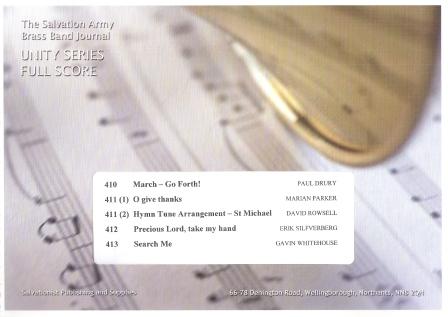
Unity Series Band Journal October 2013 Numbers 410 - 413
No. 410 March - Go Forth! (Paul Drury)This march was written as a tribute to Bandmaster Jack Spowart and the Bo'ness Salvation Army Band. The composer lives in the twon of Bo'ness and has had numerous opportunities to share with the band and the wider corps at various events. This march serves as recognition of the faithful service given in the Lord's name in the town by The Salvation Army for over 100 years. Two tunes are featured, both well-known and instantly recognisable, namely, Forward! be our watchword and We're marching on.No.411 (1) O give thanks (Marian Parker)The composer, Marian Parker, is a new contributor and is the Recruiting Sergeant at Leicester South Corps. This simple, yet rhythmic piece should not pose any technical problems for most bands and features the attractive arrangement of Joanne Pond's contemporary song, 'O give thanks'.No.411 (2) Hymn Tune Arrangement - St Michael (David Rowsell)The hymn tune 'St Michael' was composed in 1551 by French composer Louis Bourgeois and the composer provides a very useful arrangement of this historic hymn.No. 412 Precious Lord, take my hand (Erik Silfverberg O.F.)This well-known Gospel Song is a favourite of many. It has been recorded by many great artists, including Rosetta Tharpe, Elvis Presley and Aretha Franklin. The words were written by Reverend Thomas A. Dorsey, who is often known as the 'Father of Gospel song'.No. 413 Search Me (Gavin Whitehouse)The second new contributor to this journal is Gavin Whitehouse. gavin is the Assistant Music Director for the Greater New York Division and is also the USA Eastern Territorial Songster Leader. This piece combines two songs - one old and one new - which speak of a God who knows us intimately. 'Search me, O God and know my heart today' (associated with the beautiful Maori melody, 'Now is the hour') is woven with a contemporary setting of Psalm 139 by Rebecca St James, the first line of which says, 'You searchme, you know me'.
Estimated dispatch 7-14 working days
-
 £40.00
Two Aquarelles (Euphonium Feature with Brass Band - Score and Parts)
In the late spring of 1917, the Bradford born composer, Frederick Delius (1856 - 1934) composed two short part-songs at his home in Grez-sur-Loing. The river ran along the bottom of his garden and he called the two miniatures To be sung of a summer night on the water. The First World War was at its height, but one would never guess that from the languid and serene quality of these richly textured nocturnes. The songs were first heard in London on 28 June, sung by the Oriana Madrigal Society, conducted by Charles Kennedy Scott. In 1932 Delius's amanuensis, Eric Fenby, arranged them for string orchestra as Two Aquarelles. While I have taken Fenby's title, my arrangement is a note-for-note transcription of the choral original. It was prepared in early in 1993 for Besses o' th' Barn Band, of which I was Musical Director at the time. In the second song, the prominent tenor solo has been given to the solo euphonium, who should stand apart from the band in performance.- Paul HindmarshDuration: 5.00
Estimated dispatch 7-14 working days
-
 £110.00
Diversions After Benjamin Britten (Brass Band - Score and Parts)
Suite by Lucy Pankhurst, Simon Dobson, Paul McGhee and Gavin HigginsHaving devised a collective centenary tribute for Michael Tippett at the 2006 RNCM Festival of Brass (Variations on a Theme of Michael Tippett by five eminent composers of brass band music, PHM002), I commissioned this companion piece as a Benjamin Britten tribute for the 2013 festival. In the late 1970s, while researching a book about the English composer, and Britten's first teacher, Frank Bridge (1879 - 1941), I came across a copy of the printed score of Benjamin Britten's Variations on a Theme of Frank Bridge (Op.10) for string orchestra, in which Britten had written descriptive titles for each of the variations suggesting appropriate character traits of his much loved mentor and guide. The character variations are cast in march, song and dance forms.Taking inspiration from Britten's youthful tribute, I invited four award-winning composers, who have all made significant contributions to the brass band medium, to create their own personal reflections on four aspects of Britten's character and music, designed to form a suite of Diversions after Benjamin Britten, but which can also be played separately.Lucy Pankhurst's hauntingly lyrical Prelude: His Depth refers to the emotional and symbolic subtexts that underpin Britten's operas, taking its musical cue from Britten's many arrangements of folk songs. The flugel horn takes a prominent role throughout.Simon Dobson's breathless Scherzo: His Vitality reminds us with its rapid passage work and leaping bass 'groove' that Britten loved tennis and fast cars in his younger days.Paul McGhee's evocative interpretation of the March: His Sympathy represents Benjamin Britten's pacifism, as the composer writes: 'We view the music through the eyes of a pacifist. Whilst war and violence surround us, we do not engage in it and though it continues to happen around us. With the use of muted effects in most of the band throughout the piece, the flugel horn is the lone voice of reason, standing firm against the mechanical and destructive society in which it is forced to live. As the machine of war continues around the lone voice, the voice is gradually dismissed and mocked as the war machine rumbles on into the distance.'In an extended finale, entitled Toccata: His Skill, Gavin Higgins celebrates Benjamin Britten's consummate creativity. For the RNCM Festival of Brass premiere, the four contrasting movements were framed and connected by Britten's Fanfare for St. Edmundsbury for three trumpets, with the trumpet soloists spaced round the hall. I am grateful to the Britten Estate and publishers Boosey & Hawkes for giving permission for the elements of Britten's fanfare to be incorporated in the collective work.- Paul HindmarshDuration: 19.30
Estimated dispatch 7-14 working days
-
£45.00
Diversions After Benjamin Britten (Brass Band - Score only)
Suite by Lucy Pankhurst, Simon Dobson, Paul McGhee and Gavin HigginsHaving devised a collective centenary tribute for Michael Tippett at the 2006 RNCM Festival of Brass (Variations on a Theme of Michael Tippett by five eminent composers of brass band music, PHM002), I commissioned this companion piece as a Benjamin Britten tribute for the 2013 festival. In the late 1970s, while researching a book about the English composer, and Britten's first teacher, Frank Bridge (1879 - 1941), I came across a copy of the printed score of Benjamin Britten's Variations on a Theme of Frank Bridge (Op.10) for string orchestra, in which Britten had written descriptive titles for each of the variations suggesting appropriate character traits of his much loved mentor and guide. The character variations are cast in march, song and dance forms.Taking inspiration from Britten's youthful tribute, I invited four award-winning composers, who have all made significant contributions to the brass band medium, to create their own personal reflections on four aspects of Britten's character and music, designed to form a suite of Diversions after Benjamin Britten, but which can also be played separately.Lucy Pankhurst's hauntingly lyrical Prelude: His Depth refers to the emotional and symbolic subtexts that underpin Britten's operas, taking its musical cue from Britten's many arrangements of folk songs. The flugel horn takes a prominent role throughout.Simon Dobson's breathless Scherzo: His Vitality reminds us with its rapid passage work and leaping bass 'groove' that Britten loved tennis and fast cars in his younger days.Paul McGhee's evocative interpretation of the March: His Sympathy represents Benjamin Britten's pacifism, as the composer writes: 'We view the music through the eyes of a pacifist. Whilst war and violence surround us, we do not engage in it and though it continues to happen around us. With the use of muted effects in most of the band throughout the piece, the flugel horn is the lone voice of reason, standing firm against the mechanical and destructive society in which it is forced to live. As the machine of war continues around the lone voice, the voice is gradually dismissed and mocked as the war machine rumbles on into the distance.'In an extended finale, entitled Toccata: His Skill, Gavin Higgins celebrates Benjamin Britten's consummate creativity. For the RNCM Festival of Brass premiere, the four contrasting movements were framed and connected by Britten's Fanfare for St. Edmundsbury for three trumpets, with the trumpet soloists spaced round the hall. I am grateful to the Britten Estate and publishers Boosey & Hawkes for giving permission for the elements of Britten's fanfare to be incorporated in the collective work.- Paul HindmarshDuration: 19.30
Estimated dispatch 7-14 working days
-
 £44.95
Joy Through the Ages (Brass Band - Score and Parts)
This work was written for the 125th anniversary of Boscombe Band, celebrated in November 2011, and is the title track of the band' album released in the same year. The music is celebratory in nature and is dedicated to all those who have served in the band during its 125 year history. The theme of the work is a song by Charles Hutchison Gabriel which was the favourite of the band's librarian, Gerald Whittingham, who was 'promoted to Glory' after a long battle with a brain tumour. The title comes from the last verse, 'When with the ransomed in Glory, his face I at last shall see, 'twill be my joy through the ages, to sing of his love for me'.
Estimated dispatch 7-14 working days
-
 £49.99
Marcho Brioso (Brass Band - Score and Parts)
Marcho Brioso was commissioned by The Brioso Brass, a British-style brass band from Hokkaido, Japan. They gave the first performance in January 2012.The commission was for a bright and breezy march that the band could use as their theme tune, so Marcho Brioso falls into the composer's series of Broadway-style marches, which includes Slipstream, The Bandwagon and Jubiloso. After a short introduction a solo cornet plays the main theme, accompanied by a euphonium counter-melody. A secondary phrase from the horns and baritones leads to a tutti version of the main theme which is followed by the traditional 'bass' strain. A change of key heralds the trio section, which features a cantabile melody on euphonium; this is then taken up by the full band after a short bridge passage and further change of key.This takes us back to the home key which sees a quiet staccato version of the main theme lead to a recapitulation and a short coda which brings the march to a close.Duration: 3:40
Estimated dispatch 7-14 working days
-
 £54.95
Festiva Brazilia (Brass Band - Score and Parts)
Using a variety of Latin American musical influences the piece opens with a bass riff that is to be the prominent feature in this work. Accompanied with lively Latin American Samba Percussion section the work is reminiscent of the music heard at the world famous Rio Carnival. There are lots of Latin 'Riffs' and 'Licks' throughout the piece that keep returning in true samba style. This is a real fun piece to perform and the performing notes below act as a guide to getting the most out of this performance.Performing Notes:There are opportunities for soloists within the piece, particularly Solo Cornet, Soprano and Bongo's.When the Cornet and Soprano soloist play their solo part they have an instruction to stand out at the front to perform. It is at the players and conductors discretion where they would like to stand for their solo line.Obviously the Drum Kit soloist is restricted to their current positioning within the band. However, the other percussionists are quite at liberty to come out to the front of the band to perform their solo at rehearsal figure P at the conductors discretion.NB - At the 5th bar of figure P there is an optional repeat section. Performers can repeat this section over and over to extend the percussion feature. Or even add more players from the band to play percussion. If you do not wish to use this opportunity then dismiss the repeat so that there is a 16 bar section between figure P and figure R.There are also a variety of cameo roles for other soloists and musical sections during the piece. Other players and sections can stand to perform various motifs during the piece again at the conductor's discretion.Festiva Brazilia was composed for performers to have fun and enjoy performing the piece as much as possible. Just like the many Samba festivals around Brazil.
Estimated dispatch 7-14 working days
-
 £32.00
Amazing Grace (Brass Band with optional Bagpipes - Score and Parts)
There are several occasions when a brass band is invited to play along with bagpipes and one of the first titles to be mentioned is the American traditional hymn melody, "Amazing Grace". This arrangement was prepared for one such occasion when Brass Band of the Western Reserve, musical director, Dr Keith M Wilkinson, was invited to play at a wedding in 2007. Parts for bagpipes are included in Concert Pitch (as shown in the full score) and in Db, the key in which they are normally pitched.There are optional parts which make the arrangement equally effective without bagpipes. A suggestion when this version is used is to place the cornet soloist at the beginning some distance from the band.
Estimated dispatch 7-14 working days
-
 £54.50
Carnival of Venice (Bb Solo with Brass Band - Score and Parts)
Bb Solo with Brass BandThe Carnival Of Venice is arguably everyone's favourite solo, especially the version by Arban (1820 - 1869), author of the famous brass-playing method book still in regular use today. Young soloists aspire to master the necessary techniques, accomplished soloists know that it is a "sure fire" winner with audiences and listeners love to be dazzled by a virtuoso display of variations on a theme they easily recognise.The theme is a traditional Italian song and has inspired variations for almost every possible instrument. Arban's famous variations were written in 1864. The arrangement remains faithful to the original while maintaining interest in the accompaniments by varying the orchestration. Although the arrangement is listed as featuring the euphonium as the solo instrument, it can also be used successfully as accompaniment for a cornet soloist.The arrangement has been recorded by Jeff Binns, euphonium, and St Louis Brass Band, musical director Keith M Wilkinson, on the CD Strike Up The Band and by Anthony Avitollo, euphonium, and Cuyahoga Valley Brass Band, musical director Keith M Wilkinson, on the CD Around The World.
Estimated dispatch 7-14 working days