
Results
-
 £33.35
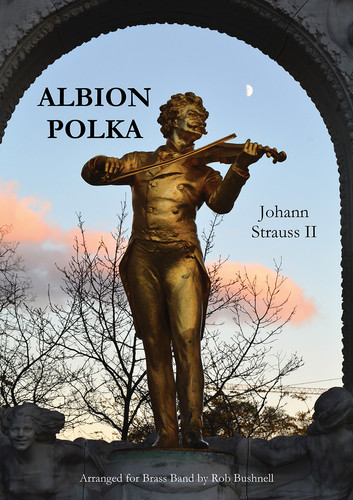
Albion Polka (Brass Band) Johann Strauss II arr. Rob Bushnell
Written in 1851, the Albion Polka was written by Johann Strauss II (or Strauss Junior) and dedicated to Count Albert of Saxe-Coburg-Gotha, husband of Queen Victoria of Great Britain. The work takes its title from the old Roman name for Britain. It is not an unfamiliar addition to the Vienna New Year's Concerts. This arrangement is for the UK-style brass band, with alternative parts for horns in F and bass-clef lower brass. A recording of the original composition can be found here: www.youtube.com/watch?v=KZIC-JhitHU Duration: Approx. 3.00 minutes (without rubato) Difficulty Level: 3rd Section + PDF download includes parts and score. Also includes alternative parts for horns in F and lower brass in bass clef. Instrumentation: Soprano Cornet Eb Solo Cornet Bb Repiano Cornet Bb 2nd Cornet Bb 3rd Cornet Bb Flugel Horn Bb Solo Horn Eb 1st Horn Eb 2nd Horn Eb 1st Baritone Bb 2nd Baritone Bb 1st Trombone Bb 2nd Trombone Bb Bass Trombone Euphonium Bb Bass Eb Bass Bb Timpani Glockenspiel Snare
In Stock: Estimated dispatch 1-3 working days
-
 £33.33
Alleluia (Brass Band) Ralph Manuel arr. Mark Ford
In composing Alleluia, Ralph Manuel created a masterwork for a capella choir. Through its melodic simplicity and warm harmonic textures, it beautifully expresses the sentiments of "Alleluia," its only word of text. The numerous timbral possibilities of brass and percussion provides an exciting palette of sound for this arrangement. This arrangement for brass band is from the pen of Mark Ford in a delightful setting sure to be popular with audiences. To view a rolling score video of the work please visit www.youtube.com/watch?v=Cg4MDGVBpns Duration: 5.00 minutes Difficulty Level: 3rd Section + This PDF download includes the full score and parts. Sheet music available at www.brassband.co.uk (UK) or satradecentral.org (USA) Instrumentation: Soprano Cornet Eb Solo Cornet 1&2 Bb Solo Cornet 3&4 Bb Repiano Cornet Bb 2nd Cornet Bb 3rd Cornet Bb Flugel Horn Bb Solo Horn Eb 1st Horn Eb 2nd Horn Eb 1st Baritone Bb 2nd Baritone Bb 1st Trombone Bb 2nd Trombone Bb Bass Trombone Euphonium Bb Bass Eb Bass Bb Timpani Percussion 1-2 Tuned Percussion
In Stock: Estimated dispatch 1-3 working days
-
 £33.33
Both Sides, Now (Brass Band) Joni Mitchell arr. Andrew Wainwright
Joni Mitchell's Both Sides, Now is a timeless reflection on the shifting landscapes of life, love, and self-understanding. First released in 1969, this iconic song has become a signature of Mitchell's extraordinary songwriting, capturing the delicate interplay between youthful innocence and hard-earned wisdom. With its poignant lyrics and haunting melody, Both Sides, Now continues to resonate across generations. This evocative brass band arrangement by Andrew Wainwright was commissioned by the Fountain City Brass Band for its 2023 tour of England, including a performance at the prestigious Brass in Concert Championships. Featuring prominent solos for baritone and flugel horn, the arrangement makes full use of their lyrical warmth and tonal richness. BrookWright is delighted to be able to now make this arrangement available to brass bands. To view an excerpt of Fountain City Brass Band performing the work please visit www.youtube.com/watch?v=OYaoF_b9wHo Duration: approx. 3.30 minutes Difficulty Level: 4th Section + This PDF download includes parts and score. Sheet music available at www.brassband.co.uk (UK) or www.cimarronmusic.com (USA) Instrumentation: Soprano Cornet Eb Solo Cornet Bb Repiano Cornet Bb 2nd Cornet Bb 3rd Cornet Bb Flugel Horn Bb Solo Horn Eb 1st Horn Eb 2nd Horn Eb 1st Baritone Bb 2nd Baritone Bb 1st Trombone Bb 2nd Trombone Bb Bass Trombone Euphonium Bb Bass Eb Bass Bb Timpani Percussion 1-3
In Stock: Estimated dispatch 1-3 working days
-
 £48.18
Euryanthe Overture (Brass Band) von Weber arr. Barrie Gott
This expert arrangement for brass band by Barrie Gott of Carl Maria von Weber's popular overture, 'Euryanthe' will be a terrific addition to concert programmes.'Euryanthe' is acknowledged as one of Weber's most important operas and is based on the 13th-century French romance L'Histoire du tres-noble et chevalereux prince Gerard, comte de Nevers et la tres-virtueuse et tres chaste princesse Euriant de Savoye, sa mye.Only the overture, an outstanding example of the early German Romantic style (heralding Richard Wagner), is regularly played today.This transcription for brass band attempts to realise the orchestral score as closely as possible. There are many technical challenges that will provide opportunities for the expert level of player and ensemble. It will be and exciting addition to a concert programme. To view a follow-the-score video of the work please visit https://www.youtube.com/watch?v=wMePX1rVigk PDF download includes score and parts. Sheet music available from: UK - www.brassband.co.uk USA - www.solidbrassmusic.com Difficulty Level: 1st Section + Instrumentation: Soprano Cornet Eb Solo Cornet Bb Repiano Cornet Bb 2nd Cornet Bb 3rd Cornet Bb Flugel Horn Bb Solo Horn Eb 1st Horn Eb 2nd Horn Eb 1st Baritone Bb 2nd Baritone Bb 1st Trombone Bb 2nd Trombone Bb Bass Trombone Euphonium Bb Bass Eb Bass Bb Timpani
In Stock: Estimated dispatch 1-3 working days
-
 £44.47
Symphonic Concert March (Brass Band) Bonelli arr. William Himes
Giouse Bonelli's stirring Symphonic Concert March has here been expertly arranged for brass band by William Himes. As the title implies, the Symphonic Concert March was intended for the concert hall. The compositional style is clearly derived from the Italian school of smooth, flowing melodies, clear contrapuntal lines, and contrasting rhythmic material, leaving no doubt as to Bonelli's traditional classical training. To view a rolling score video of Goteborg Brass Band performing the work please visit www.youtube.com/watch?v=JvUldbuuyIk PDF download includes score and parts. Sheet music available from www.brassband.co.uk Difficulty Level: 1st Section + Length: 6.20 minutes Instrumentation: Soprano Cornet Eb Solo Cornet Bb 1st Cornet Bb 2nd Cornet Bb Flugel Horn Bb Solo Horn Eb 1st Horn Eb 2nd Horn Eb 1st Baritone Bb 2nd Baritone Bb 1st Trombone Bb 2nd Trombone Bb Bass Trombone Euphonium Bb Bass Eb Bass Bb Timpani Percussion
In Stock: Estimated dispatch 1-3 working days
-
 £124.95
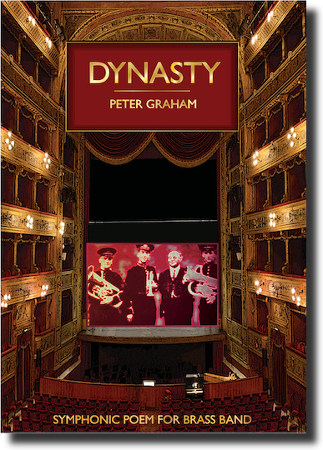
Dynasty - Peter Graham
'Dynasty' was a joint commission for the 2019 British Open and Belgium Championships, and pays homage to the iconic figure of Harry Mortimer through a series of linked narrative passages using his autobiography as a musical point of reference.First heard to widespread acclaim at Symphony Hall, the work will make its European contest premiere at the Belgian National Championships later this year.
Estimated dispatch 3-7 working days
-
 £45.00
Andromeda - Dan Price
Following the popularity of Dan's concert opener Starburst , this sequel provides yet another exciting addition to the concert repertoire, equally at home as a finale or as a concert opener. The work is dedicated to Samantha Harrison and Elland Youth Band, who gave the premiere performance as part of their 2019 European Youth Brass Band programme in Montreaux, Switzerland. Listen: Duration: 00:04:00 Grade: 3/3.5
Estimated dispatch 5-7 working days
-
 £25.00
Prelude 1946
For seventy years, the North West Area Brass Bands Association has been representing bands in the North West of England and surrounding areas. Their members come from Cheshire, Derbyshire, Greater Manchester, Isle of Man, Lancashire, North Wales, Staffordshire and Yorkshire. Prelude 1946 was commissioned to mark this special land-mark year. Taking inspiration from John Williams 1988 Olympic Spirit, the work opens with a heraldic fanfare before moving into its stately main theme, which gradually builds into a triumphant climax. An ideal concert opener for those of you who want to start off a concert with some American-style flair. Duration: 00:03:45 Grade : 3
Estimated dispatch 5-7 working days
-
 £34.95
Showcase - Christopher Bond
Showcase (2015) is a big-impact solo for cornet, with over-the-top jazz and showbiz influences. The work was recorded by Tom Hutchinson and the Cory Band in June 2015, featuring as the opening track on his debut solo album.
Estimated dispatch 10-14 working days
-
£85.00
Life (Bra) - Stijn Aertgeerts
'Life' was written in 2019 for euphonium virtuoso Glenn Van Looy, for a performance at the 'Academie de cuivres et percussion de Larmor-Plage' with an occasional brass ensemble conducted by Florent Didier. Afterwards, the work had disappeared below the radar, until Lorenz Havermans and Bert Van Thienen asked composer Stijn Aertgeerts to make a new version for fanfare band, especially for Koninklijke De Berthoutzonen Hallaar to perform at the World Music Contest 2022 in Kerkrade (NL).
Estimated dispatch 7-14 working days
 Listen to MP3