
Results
-
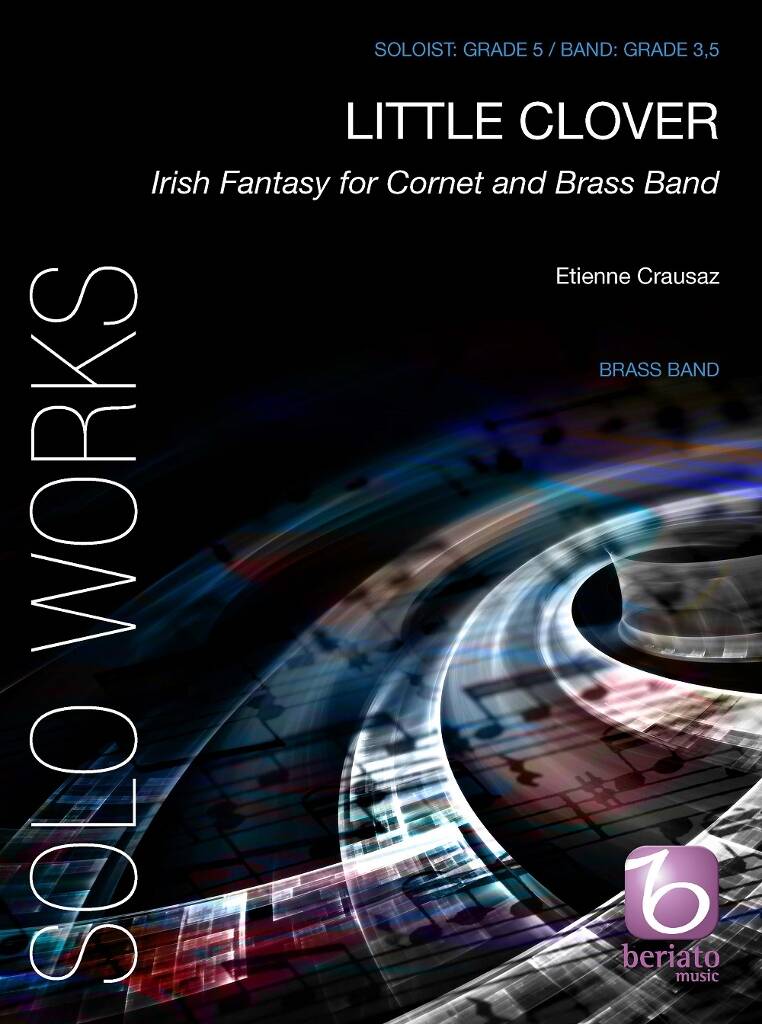 £72.99
Little Clover - Etienne Crausaz
Cornet solo commissioned by Carole Rudaz, a Swiss cornetist, on the occasion of her 40th birthday. Due to its rarity, the four-leaf clover is considered lucky in western culture. But the common three-leaf shamrock, also known as Little Clover, is one of the symbols of Ireland, whose traditional music greatly influenced the general aesthetics of this piece. The work is in three parts: the first, in 6/8, is very lively and virtuosic. After a short cadenza, the second part introduces a theme tinged with melancholy, while the last part is a dance in 2/2 that reprises the theme of the second part to conclude the piece.
Estimated dispatch 5-14 working days
-
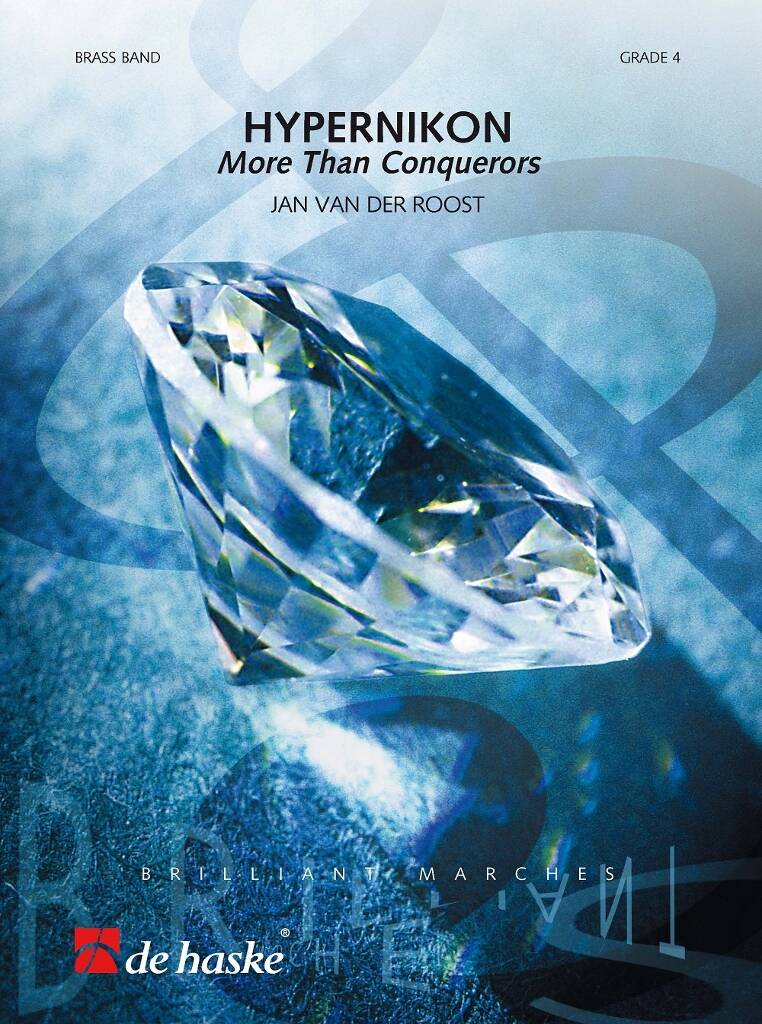 £54.99
Hypernikon - Jan Van der Roost
The Greek word 'hypernikon' roughly translates as 'More Than Conquerors', the motto of Gordon College in Wenham, Massachusetts - the commissioner of this piece. The work is inspired by David Rox's very own name - the first two letters of his name, D and A, sets the first theme is in D major, with these notes being the tonic and dominant of the scale. After the stately intrada, the tempo accelerates and the festive feel of the march emerges. The trio melody serves as a beautiful contrast before finally ending with the opening theme in a grand tutti.
Estimated dispatch 5-14 working days
-
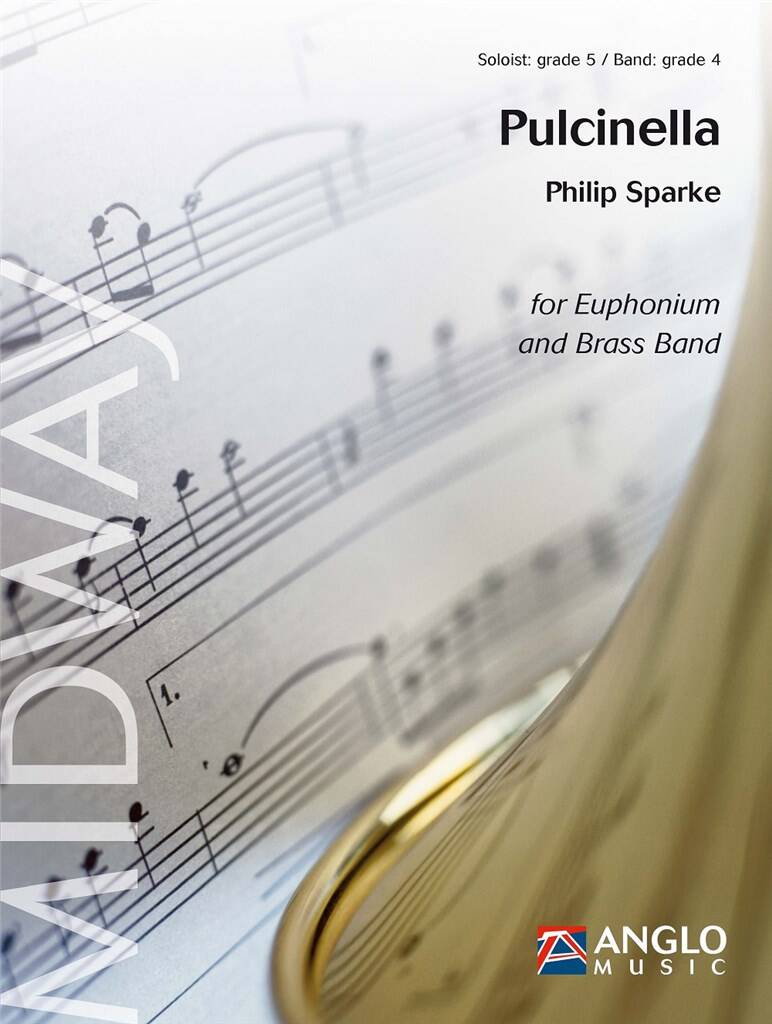 £91.99
Pulcinella - Philip Sparke
Pulcinella was commissioned by the Taiwanese euphonium player Tzu-Hsiang Lin. Lin is a renowned soloist and teacher and a Besson Euphonium Artist. He teaches euphonium at Taipei National University of the Arts, National Taiwan University of Arts, Shih Chien University and National Kaohsiung Normal University. Lin gave the premiere of Pulcinella in both its concert band and brass band versions in January 2021. Pulcinella continues Sparke's series of euphonium solos named after characters of the Italian commedia dell'arte and opens with a long and expressive minor melody for the soloist over a brooding accompaniment. This is taken up briefly by the full band and is extended by the soloist after a change of key. A cadenza, accompanied by fragments of the main melody leads to a complete change of mood, tempo and tonality, introducing a Vivo section starting with a perky syncopated tune for the soloist. The band then uses elements of this new tune to introduce a change of key, where the soloist introduces a more lyrical second subject over a pulsing accompaniment. The band then takes this up and changes key to reintroduce the original Vivo melody, which leads to a short and acrobatic coda to bring the work to a spectacular close.
Estimated dispatch 5-14 working days
-
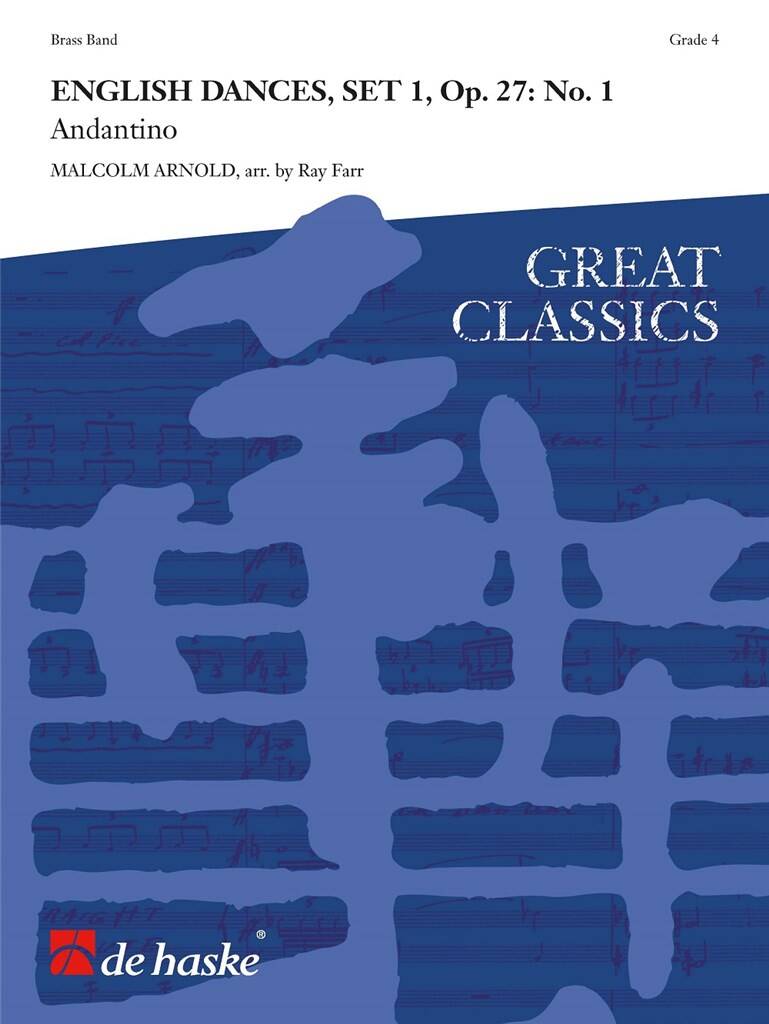 £72.99
English Dances, Set 1, Op. 27: No. 1 - Sir Malcolm Arnold - Ray Farr
English Dances, Set I, opus 27, is a light classic composition that was written for orchestra by the British composer Malcolm Arnold in 1950. The set contains four dances that continue without pause: the individual movements are indicated by the tempo markings. The work came about at the request of Bernard de Nevers, at the time the head of publisher Alfred Lengnick & Co., who asked Arnold to write a suite of dances as an English counterpart to Dvo ak's Slavonic Dances and Bartok's Romanian Folk Dances. The premiere took place in the spring of 1951, played by the London Philharmonic Orchestra, conducted by Sir Adrian Boult. Following the success of the first set, DeNevers asked the composer to write a second one, which Arnold completed the next year (Op. 33). The Andantino from the first set has been skilfully arranged and orchestrated for brass band by Ray Farr.
Estimated dispatch 5-14 working days
-
 £154.60
Circius - Torstein Aagaard-Nilsen
The work is important for me because it was my first piece to be performed outside Norway. Black Dyke Band/David King performed it and did a recording of it in 1991. In the original score I quote a Swedish bishop (Olaus Mangnus) who lived in the 15th century. He travelled around Scandinavia and drew maps - very important historic material. When he came to the north of Norway (where I come from) he decribed the wind from the north as Ciricus: (something like) Worst of all winds is Circius, that revolves (?= turn upside down) heaven and earth. (Well, not a good translation Im afraid). The fast sections reflects the mighty winds from the north. In the middle section, I borrowed afolksong-like tune (by C. Elling, a Norwegian composer). The text (by Kristoffer Janson) tells about old times when the fishermen used open boats: they had to put their lives in the hands of God.
Estimated dispatch 5-14 working days
-
 £125.00
Dark Arteries - Gavin Higgins
Dark Arteries was commissioned by Rambert Dance Company and first performed in May 2015 with the Tredegar Town Band sharing the stage with Rambert dancers. Dark Arteries is a personal and at times highly wrought response to the Miners' Strike and its aftermath. It is in three movements, the first and last are expansive, with widely contrasting sound worlds, from dark, brooding melodies and the haunting sounds of solo flugel horn to wild syncopations on cornets, suggestive of an imposing, but often bleak mining landscape.In 2016 Higgins re-worked Dark Arteries into a virtuoso concert suite, which captures the essence of the work in three connected movements.Dark Arteries Suite was premiered by the National Youth Brass Band of Great Britain, conducted by Bramwell Tovey at the Barbican Centre, London, 22 April 2017.
Estimated dispatch 5-14 working days
-
 £69.99
South Down Pictures - Philip Sparke
South Down Pictures was commissioned by Millenium Brass 2000, an organisation comprising three brass bands from the county of Sussex, England.The bands (Patcham Silver, Hangleton and Brighton Silver) had got together to organise many events to mark the new millennium and these culminated in a concert in Hove Town Hall on July 9th 2000 when all three bands combined to give the first performance of South Down Pictures. The composer spent much of his childhood amongst the South Downs, a range of hills in Sussex which runs parallel to the sea.Opening with a strong unison passage, interrupted briefly by faster figures based on the interval of a fifth, South Down Picturesdevelops with an often-passionate legato melody. Reaching a climax, this is then followed by the main vivo section of the work, whose main theme is based on the earlier 'fifth' figures. A bridge passage leads to a short chorale figure and a rhythmic climax which dissolves into a plaintive cornet solo over staccato chords. This theme is taken up by the whole band and leads back to a recapitulation of the main theme and earlier material. The cornet tune returns triumphantly in the major key before the opening unison passage reappears to provide a stirring coda.
Estimated dispatch 5-14 working days
-
 £59.99
Ballad for Benny - Philip Sparke
The birth of Philip Sparke's second son, Benjamin, was the inspiration for composing Ballad for Benny. A short calm introduction leads to the main ballad theme, a gentle waltz melody. Following the work's climax in which the complete band plays the main theme the sound fades and the piece ends in calm and serenity.
Estimated dispatch 5-14 working days
-
£119.99
Albion - Jan Van der Roost
Albion was commissioned by the Swiss Brass Band Federation as the test piece for the National Brass Band Championships of England, Belgium, The Netherlands, and Switzerland in 2001, and for Norway in 2002. The composition is dedicated to Markus Bach.Albion, along with Excalibur and Stonehenge, is the third major piece for brass band in which Jan Van der Roost took his inspiration from the British Middle Ages. Although the work is not based on an actual story there are unmistakable epic elements found in this symphonic poem. The piece paints a picture of the conquest of Albion (the earliest known name of the British Island), in which the listener is taken back to the timeof King Arthur and his legendary Knights of the Round Table.
Estimated dispatch 5-14 working days
-
 £60.99
Hymn of Faith - Louis Bourgeois - John Blanken
The French composer Louis Bourgeois lived from c.1510 to 1560. Bourgeois was cantor in Geneva and, commissioned by John Calvin, he composed melodies for metrical (rhyming) versions of the psalms. After completing about a hundred one-part psalms, he made some four-part arrangements, which were denounced and even resulted in his imprisonment for a day. Later, Bourgeois published a number of psalm collections, and judging from his book Le droict chemin de musique he was also an excellent educator. The melodies Bourgeois composed, are (contrary to Gregorian chants) particularly suitable for community singing. This applies to his hymn tune Saint Michael, which is why this melody hasbeen used for various texts, written for many occasions. John Blanken made this arrangement for a wedding ceremony: an occasion in which faith and trust play a large - if not the largest - role. Hence the title Hymn of Faith. The arrangement contains four verses of the hymn. After a majestic opening the hymn follows twice, the second verse being embellished in the tenor register. After a short interlude verse three follows, played by a quartet. The majestic opening is then repeated as a modulation into the fourth verse, which concludes the work in a brilliant tutti.
Estimated dispatch 5-14 working days
 View Music