
Results
-
£61.00
I Like It (Bra) - Lionel Richie/Enrique Iglesias/Nadir Khayat/Armando Perez - Mike Kilmartin
"I Like It" is a song performed by Spanish singer Enrique Iglesias taken from his first bilingual studio album, Euphoria. It features guest vocals from American rapper Pitbull. Both artists co-wrote the song with RedOne, who produced it. It also interpolates Lionel Richie's 1983 single "All Night Long (All Night)" with vocals re-recorded by Richie himself. The song was also included on the official soundtrack to MTV reality series Jersey Shore. A version of the song without Pitbull is also found on the international version of Euphoria.
Estimated dispatch 7-14 working days
-
£70.00
Mercy, Mercy, Mercy (Bra) - Joe Zawinul - Dave Collins
"Mercy, Mercy, Mercy" is a very cool and laid back piece written by Joe Zawinul in 1966 for Julian "Cannonball" Adderley. Zawinul played an important role in the development of the jazz rock, along with Chick Corea, Herbie Hancock, John McLaughlin and Miles Davis. Zawinul was best known as the founder of the American jazz fusion band "Weather Report". He was one of the first musicians who used electric pianos and early synthesizers in jazz.
Estimated dispatch 7-14 working days
-
£50.00
Sing Praise - Geert Jan Kroon
Sing praise is an upbeat opener or concert piece that is based on the Old Hundredth. It was a commission by Flevo Brass Emmeloord to praise the conductor/teacher Klaas de Jong. I know Klaas as a high-spirited teacher who always devotes his time to guiding young players and developing music ensembles by investing in youth bands and music education. The title is a reference to the hymn tune Old Hundredth and a message to ensembles to sing praise to teachers and youth.
-
 £34.95
Cloak and Dagger - Jonathan Bates
DURATION: 4 minutes. DIFFICULTY: 1st+. Cloak and Dagger was composed for the Carlton Main Frickley Colliery Band's 'Murder Mystery' set at the 2018 Brass in Concert Championships. The work acts as a feature for Flugel Horn, Baritone and Trombone, each acting as a suspect in a pseudo musical 'who dunnit?'. Each solo is starkly different in charcter revealing the personality traits of the 3 mysterious suspects!.
In Stock: Estimated dispatch 1-3 working days
-
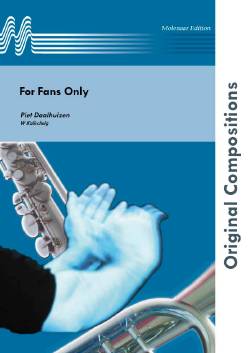 £70.00
For Fans Only - Piet Daalhuizen/W Kalischnig
Piet Daalhuisen (Hilversum, 1939) was already known in the world of wind bands because of his medleys 'With a smile to the classics' and 'Pop for the People' (both in splendid wind band arrangements by Marcel Peeters). Here is a new medley For Fans Only, consisting of a series of stirring tunes, arranged for wind band by Walter Kalischnig, a Slovenian musician who settled in The Netherlands back in 1953 and wrote several fine compositions and wind band arrangements.
Estimated dispatch 10-14 working days
-
£44.00
Nar jeg blir 66 - Udo Jurgens & Wolfgang de Hofer - Idar Torskangerpoll
This song is famous in Norway through recordings and performances by Wenche Myhre. She recorded the song for the first time in 1983 and it has been a part of her repertoire ever since.It is composed by Austrian composer and artist Udo Jurgens who has recorded the song himself. The lyrics is by German lyricist Wolfgang Hofer.This arrangement present the song in a swinging shuffle-style with opportunities to "open up" for solos and improvisations.
Publisher Closed for Holidays. Est Delivery 13-14th Aug
-
£39.00
Doc McStuffins Theme - Hanley, Lewis & Petty - Idar Torskangerpoll
From the TV series with the same name. A tribute to the Doc who can repair any toy. This simple and short shuffle-tune will fit any entertainment concert.Watch the balance when melody is in part 3. You may leave out some players if necessary.
Publisher Closed for Holidays. Est Delivery 13-14th Aug
-
 £34.95
Island Whirl - Paul Lovatt-Cooper
Commissioned by Margaret Milligan for Ian, her husband who is the musical director of Callendar Brass, based in Callendar near Stirling in Scotland. With Celtic drums and the use of the Scottish traditional song 'An Eriskay Love Lilt' the piece works very well as a lively concert/2nd half opener or even as a piece to liven up the middle of a concert programme. Circa 3'30".
Estimated dispatch 10-14 days
-
 £24.95
Be My Love - Nicholas Brodszky & Sammy Cahn - Ray Farr
Be My Love was written for the film The Toast of New Orleans in 1950 and was nominated for an Academy Award in the same year. The story revolves around a rough-and-tumble fisherman from the Louisiana Bayous, who is gifted...
Estimated dispatch 5-7 working days
-
 £24.95
Home of Legends - Paul Lovatt-Cooper
Home of Legends was commissioned by and composed for the 'Brass Band Summer School'. The music pays homage to the many legends who have been involved with this prestigious institution throughout its history. The BBSS staff are regarded as some...
Estimated dispatch 5-7 working days

 View Music