
Results
-
 £72.99
A Tribute to Elvis - Thijs Oud
Richard Strauss's Also Sprach Zarathustra is used in this great medley to introduce the King of Rock and Roll. Just imagine him walking onto the Las Vegas stage and then put your whole heart into performing three of his best known hits. An extra touch of entertainment can be added with members of your band singing the chorus to CC Rider. Everyone will love this tribute to the legendary performer.
Estimated dispatch 5-14 working days
-
 £54.99
Earth Song - Ron Sebregts
Michael Jackson, the King of Pop, died in Los Angeles on June 25th 2009. He can without any shadow of a doubt be compared with artists such as Elvis Presley, Jimi Hendrix, and John Lennon - all of them musicians who will never die in the hearts of their fans. Why not keep the legend of Michael Jackson alive in your next concert with this hit from Michael Jackson's repertoire arranged for Brass Band.
Estimated dispatch 5-14 working days
-
 £115.60
Dream a Little Dream of Me - Gus Kahn - Reid Gilje
This song was written in 1931 by Fabian Andre and Wilbur Schwandt with lyrics by Gus Kahn. It's now one of the most popular songs from the Great American Songbook and it's also recorded in many versions. Ella Fitzgerald, Louis Armstrong and Nat King Cole are among the most famous ones that have recorded it. In later years singers like Michael Buble, Diana Krall land Robin Williams have all recorded "Dream a Little Dream of Me". This arrangement is inspired by the version by American band Chicago from their 1995 album release "Night & Day".
Estimated dispatch 5-14 working days
-
 £290.99
Hymn Of The Highlands - Philip Sparke
Hymn Of The Highlands was commissioned by David King and the Yorkshire Building Society Band for first performance at the 2002 European Brass Band Championships Gala Concert in Brussels. The complete suite lasts approximately 35 minutes however it is possible that pieces of different lengths can be constructed to feature particular soloists or fit different programming constraints.
Estimated dispatch 5-14 working days
-
 £54.99
Can You Feel the Love Tonight - Alan Mencken - Ron Sebregts
The Lion King was a smash-hit box office success all over the world, and is still the highest grossing 2D animated film in the US. Can You Feel The Love Tonight, is a delightful concert band arrangement of the song from this Walt Disney classic, sung and composed by Elton John. A Disney favourite for young and old alike, your musicians will look forward to playing this piece both in rehearsal and in concert!
Estimated dispatch 5-14 working days
-
 £84.99
Let Me Entertain You - Don Campbell
This is a must-play item for any light concert programme. Robbie Williams is currently considered to be the king of pop, with his massive hit Angels being voted the number one song in many charts of all time greatest pop songs. He appeals to an extremely diverse audience ensuring every person at your concert will leave singing the songs from this superb work.
Estimated dispatch 5-14 working days
-
 £104.99
4Evers - Harm Evers
Bundle of 4 Marches written by the 'King of Marches' Harm Evers. 1. In Festive Mood 2. Parade of Sails 3.Times Square4. Pioneers March
Estimated dispatch 5-14 working days
-
 £95.00
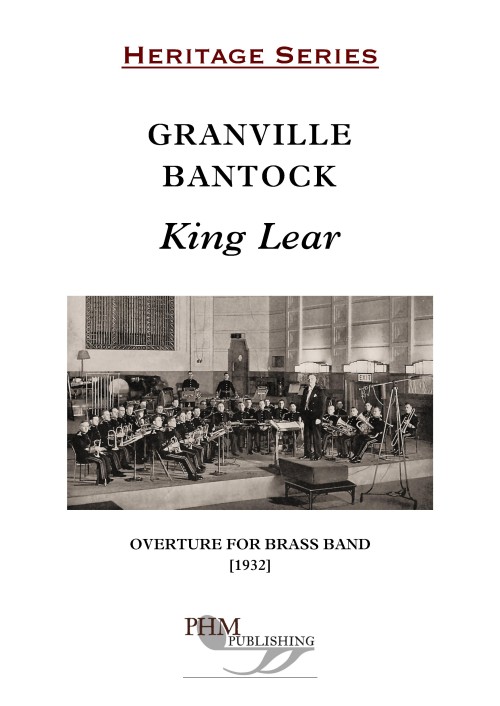
King Lear (Brass Band - Score and Parts) - Bantock, Granville - Hindmarsh, Paul
Sir Granville Bantock (1868 - 1946) composed the second of his five major brass band work for Callender's Cableworks Band, completing the commission on 30 November 1932. Based in the Thames-side district of Belvedere near Erith, the band was active between 1898 and 1961. The works band of the Callender Cable & Construction Co. Ltd, it was at the peak of its popularity during the 1930s and was a frequent broadcaster on the radio. The band employed an in-house arranger and played saxophones in its lighter material. King Lear was one of the band's major commissions and was not published in Bantock's lifetime. The manuscript score and parts were thought to be lost for decades, but were found in the library of the Haydock Band (Lancashire), which had inherited part of Callender's library of manuscripts material and bespoke arrangements after it has been transferred to nearby Prescott Cables Band after Callender's Cable Works closed.King Lear is a substantial work, in essence a dramatic tone poem in the romantic Tchaikovskian manner, presenting a series of character portraits of the foolish old king and his three daughters, Goneril, Regan and Cordelia. The music is dramatic and lyrical by turns, with the most generous lyrical episode revealing perhaps the warm-hearted Cordelia. An expansive melody that flows from this is brought back towards the end as the main climax of the work.In 2001, Bantock's score was recorded by the University of Salford Brass Band, conducted by Dr. Roy Newsome. The original is serviceable, but in comparison with the orchestral version he made in 1936 (part of which was recorded on a Paxton 78 rpm) and later brass band scores, performing editions of which were prepared by others, it lacks colour and range typical of Bantock's orchestral work. Above all it lacks percussion, which can be heard on the recorded extract. With the kind permission of the Bantock Estate, I have prepared a performing edition for publication that incorporates percussion, derived from the orchestral recording and added editorially in similar manner elsewhere. I have revoiced some of the low- lying instrumental parts to present the material in more comfortable ranges. Editorial interventions more elaborate than revoicing the original text have been identified as cue notes.- Paul HindmarshDuration: 15.00
Estimated dispatch 7-14 working days
-
£40.00
King Lear (Brass Band - Score only) - Bantock, Granville - Hindmarsh, Paul
Sir Granville Bantock (1868 - 1946) composed the second of his five major brass band work for Callender's Cableworks Band, completing the commission on 30 November 1932. Based in the Thames-side district of Belvedere near Erith, the band was active between 1898 and 1961. The works band of the Callender Cable & Construction Co. Ltd, it was at the peak of its popularity during the 1930s and was a frequent broadcaster on the radio. The band employed an in-house arranger and played saxophones in its lighter material. King Lear was one of the band's major commissions and was not published in Bantock's lifetime. The manuscript score and parts were thought to be lost for decades, but were found in the library of the Haydock Band (Lancashire), which had inherited part of Callender's library of manuscripts material and bespoke arrangements after it has been transferred to nearby Prescott Cables Band after Callender's Cable Works closed.King Lear is a substantial work, in essence a dramatic tone poem in the romantic Tchaikovskian manner, presenting a series of character portraits of the foolish old king and his three daughters, Goneril, Regan and Cordelia. The music is dramatic and lyrical by turns, with the most generous lyrical episode revealing perhaps the warm-hearted Cordelia. An expansive melody that flows from this is brought back towards the end as the main climax of the work.In 2001, Bantock's score was recorded by the University of Salford Brass Band, conducted by Dr. Roy Newsome. The original is serviceable, but in comparison with the orchestral version he made in 1936 (part of which was recorded on a Paxton 78 rpm) and later brass band scores, performing editions of which were prepared by others, it lacks colour and range typical of Bantock's orchestral work. Above all it lacks percussion, which can be heard on the recorded extract. With the kind permission of the Bantock Estate, I have prepared a performing edition for publication that incorporates percussion, derived from the orchestral recording and added editorially in similar manner elsewhere. I have revoiced some of the low- lying instrumental parts to present the material in more comfortable ranges. Editorial interventions more elaborate than revoicing the original text have been identified as cue notes.- Paul HindmarshDuration: 15.00
Estimated dispatch 7-14 working days
-
 £43.99
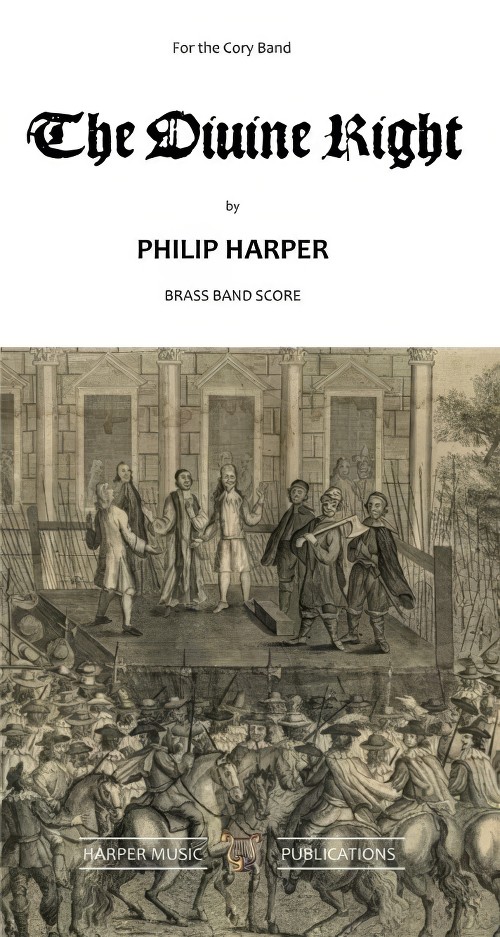
The Divine Right (Brass Band - Score only) - Harper, Philip
At the time of composing this piece, the Arab Spring was sweeping through the Middle East. It seemed that almost every week a new country's people had risen up against the regimes and dictatorships which had prevailed for generations, leaving many nations at a defining crossroads in their history. There were so many possible ways ahead: so many hopes, yet so many uncertainties.This music is a depiction of these revolutionary times, and several musical themes are in turn presented, discussed, considered, fought over, altered, rejected or accepted.Most nations have had, or probably will have, their own Arab Spring, including the United Kingdom. Events of 17th Century Britain provide the context for this piece, particularly those following the execution of the tyrant King Charles I on 30 January 1649. The regicide was in part due to Charless steadfast belief in the Divine Right of Kings, and led to a tumultuous interregnum, where England stood at its own defining crossroads. The music begins turbulently, before King Charles appears and is led to the gallows outside Banqueting House in central London where he is brutally decapitated. From the assembled crowd rose, according to one observer,a moan as I never heard before and desire I may never hear again.The music descends to emptiness.The musical argument which follows is not strictly programmatic, but a number of musical themes are all thrown into the melting pot, representing ideas such as: religion; military force; reasoned Parliamentary debate; and the chattering, irrepressible voice of the people. Additionally, there are some quotations from the music of royalist composer Thomas Tomkins (1572-1656), who was often in tune with the feeling of the times.This defining episode in England's history was brought to a close with the Restoration of the monarchy in 1660, and as the exiled King Charles II rode back into London the diarist John Evelyn wrote:Never was so joyful a day seen in this nation. I stood in the Strand and beheld it, and blessed God.At the end of the piece the bells ring out, and the musical appearance of the King has transformed from turbulent to triumphant.Duration: 17.00
Estimated dispatch 7-14 working days
 View Music