
Results
-
 £84.99
Snow Island - Thierry Deleruyelle
The Swiss canton of Valais is home to a number of wind and brass bands that regularly stand on the podium in Swiss and European competitions. For the general public, the Valais is above all a unique place, between the Rhone Glacier and Lake Geneva, where life is pleasant. The brass players of the five music associations of the villages of Crans-Montana - an internationally renowned "snow island" - were awarded the organisation of the 224 cantonal festival, for which this work was commissioned.
Estimated dispatch 5-14 working days
-
 £154.99
A Road Less Travelled By - Philip Sparke
A Road Less Travelled By was commissioned by Palangos Orkestras for the Championship Section of the 2020 European Brass Band Championships held in Palanga, Lithuania. The title alludes to a poem by American author, Robert Frost, which appeared in his 1916 collection, Mountain Intervals. In common with most of the composer's larger works, the piece is not programmatic, but purely abstract. The choice of title shares Sparke's view of how composers can often develop. There can be no 'destination' in a composer's career, but rather a continuing journey to an unknown place. Set in three movements, which play without a break, A Road Less Travelled By opens with a Moto Perpetuo firmly rooted in classical language, form and syntax. A continuous river of semiquavers, veering from melody to accompaniment and back again, adds drive, energy and motion. The second movement, Nocturne, is in the form of a free fantasia; solos for vibraphone, flugel horn and euphonium set the stage for a central cornet solo, quietly echoed by the full band. A triumphal climax is reached before the movement dissolves into a Scherzo Finale. A brief coda based on earlier material drives the piece to a close.
Estimated dispatch 5-14 working days
-
 £67.50
Columbus - Thierry Deleruyelle
Columbus is a brilliant and dynamic overture for brass band, with a soft and melodious central passage. In addition to the many American towns that hold the name, Columbus is a European space laboratory that is part of the International Space Station. Launched in 2008 by the American space shuttle Atlantis, it makes it possible to carry out continuous scientific experiments in fundamental physics, life sciences, fluid physics, etc. Several hundred experiments take place within Columbus every year. Commissioned by the Brass Band Bourgueillois, this piece celebrates the 10th anniversary of the launch of the band at the instigation of its conductor, Michael Auclert. The ensemble brings together musicians from the various wind bands of the Bourgueillois region and beyond. Thus, just like the space laboratory that inspired this work, the Brass Band Bourgueillois also serves as a laboratory, albeit a musical one, within a territory that is discovering this ensemble and its original repertoire.
Estimated dispatch 5-14 working days
-
 £169.99
Destination Moon - Paul Raphael
Destination Moon was first performed by Cory Band at the 2017 European Championships in Ostend, Belgium, and is inspired by the Belgian comic-book hero Tintin. The first part is called 'Science' and describes the development of the theory of space travel. The second part is 'Humanity' which addresses human concerns and philosophies about our place in the universe. The third part is 'The Launch' which ends with a repetition of the words 'Earth to Moon Rocket are you receiving me?' as the rocket vanishes into a tiny speck in the sky.
Estimated dispatch 5-14 working days
-
 £164.99
Raveling Unraveling - Philip Sparke
Winning Performance EBBC Lille 2016 Raveling, Unraveling In Search of 'La Valse' was written for the Cory Band as their own-choice test piece for the 2016 European Brass Band Championships in Lille. The piece found its genesis in Sparke's The Unknown Journey (2014) for concert band, and the use of Ravel's La Valse as a structural undercurrent to the original piece is an act of reverence. Sparke's aim was to produce a work that is organic rather than episodic in nature. The composer's view is that little in music does this better than La Valse and for this reason he uses various sections of this masterpiece, both manipulated and quoted verbatim (including much of itsstunningclosing passages) to provide the overall geography of his new work. As the music progresses, more of the Ravel appears, surfacing completely as the piece reaches its climax - a gesture of homage to the French master.
Estimated dispatch 5-14 working days
-
£76.99
Variazioni in Blue - Jacob de Haan
Variazioni in Blue is a series of variations in which elements from the Blues, such as the specific 'blue notes', run throughout the piece. Following a stately introduction, which includes part of the theme, is an ornamental variation in 'classical style'. We then hear a variation in 'Blues style", followed by a fast variation with an Eastern European folklore feel. The 'Andante con espressivo' is particularly fine with its attractive harmonic changes. This variation develops into a repeat of the previous folklore variations with its 'major' variation forming a climax towards the end.
Estimated dispatch 5-14 working days
-
 £137.99
Klezmer Discovery - Sjaak van der Reijden
The Yiddish word 'Klezmer' has been derived from the Old Hebrew words 'Kley' (tool, instrument) and 'Zemer' (song, singing, making music).Klezmer is the traditional music of Jews from Eastern Europe.Yiddish musicians (Klezmorim) were regularly invited to come and play at Yiddish weddings as well as several other Jewish celebrations and festive occasions. Despite its close connection with traditional Eastern European folk music, Klezmer music has succeeded in preserving its distinctive Jewish character. 'Klezmer Discovery' is a voyage of discovery through the richly varied music of the Jewish people from Eastern Europe.The introduction consists of a number of motives from differenttraditional melodies (a Mitzve Tenzel and L'cha Dodi), followed by a melody in 3/8th time (Kandel's Hora). This dance melody originally came from Bessarabia (present-day Moldavia) and was taken along to America by Jewish musicians round 1900. Subsequently, 'Der Terk in Amerika', a composition by famous clarinet player Naftule Brandwein can be heard. A number of fast, cheerful dance melodies (bulgars) form the finale of 'Klezmer Discovery' (Lebedyk un Freylekh, Lomir sich iberbetn and Sherele).
Estimated dispatch 5-14 working days
-
 £56.90
Balkan Gipsies - Paul Voet
Gipsies are wizards with the fiddle. Eastern European folk musicians and gipsies are using a lot of brass in their music. Their brass ensembles are very impressive, so the link to brassbands is quickly made. Based on the folk theme of Manea Tsigailor all cornets join the theme in an up tempo 7/8 bar. Gathered around a campfire gipsies are telling stories and making music. When the lower brass is telling their story all others clap hands. All of a sudden a cornet soloist appears. When we return to the basic theme the story ends with some dazzling bars.
Estimated dispatch 5-14 working days
-
 £119.99
Thyellene - Kevin Houben
Thyellene depicts of a battle that took place on the 'Tielenheide' - a stretch of moorland near the Belgian village of Tielen in 1597. In that memorable battle Prince Maurice of Nassau, commander of the Dutch army, defeated Count Varax, a general of the Spanish army - with a considerably smaller troop than the enemy. This great heroic subject has been transformed into this equally great work for brass band, which won the third prize at the 2009 European Composers Competition.
Estimated dispatch 5-14 working days
-
 £60.99
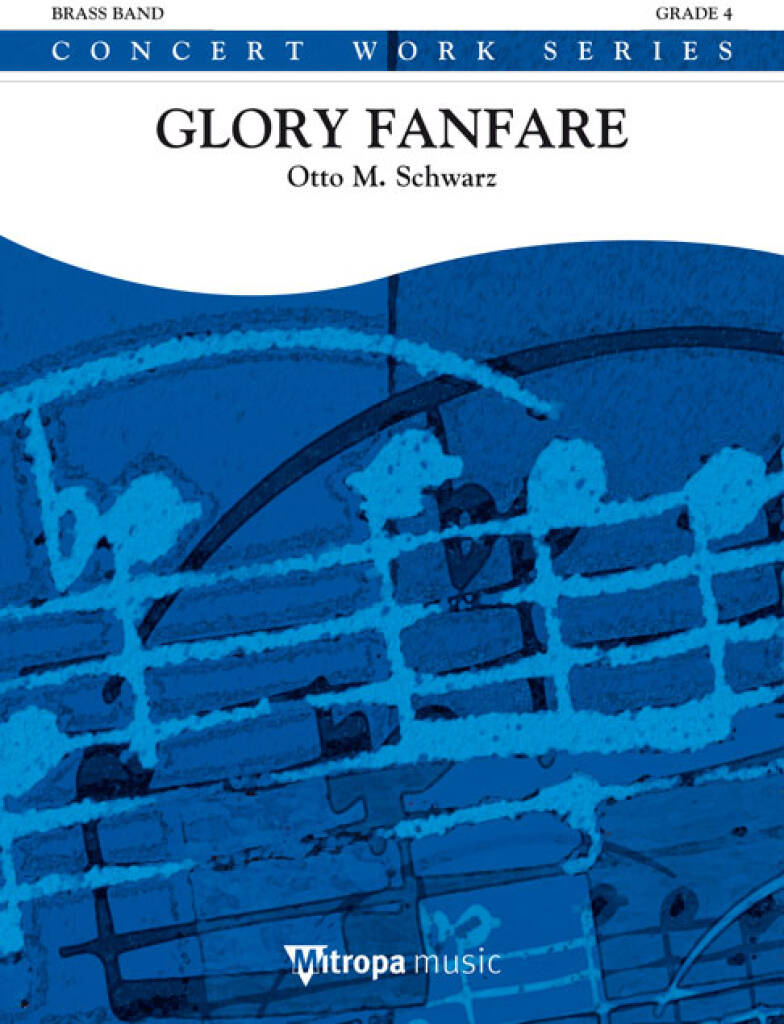
Glory Fanfare - Otto M. Schwarz
Glory Fanfare was commissioned by the Brass Band of Upper-Austria for the 2010 European Brass Band Championships in Linz, and was performed as the fi rst piece in the gala concert. The double chorus of cornets is particularly ingenious and itsvirtuosic character adds to all the excitement. Modern elements, such as funky bass lines played along with the drum kit, help drive the festive atmosphere and create a piece that will captivate your audience from the word go!
Estimated dispatch 5-14 working days
 View Music