
Results
-
 £110.00
Diversions after Benjamin Britten (Brass Band - Score and Parts)
Suite by Lucy Pankhurst, Simon Dobson, Paul McGhee and Gavin HigginsHaving devised a collective centenary tribute for Michael Tippett at the 2006 RNCM Festival of Brass (Variations on a Theme of Michael Tippett by five eminent composers of brass band music, PHM002), I commissioned this companion piece as a Benjamin Britten tribute for the 2013 festival. In the late 1970s, while researching a book about the English composer, and Britten's first teacher, Frank Bridge (1879 - 1941), I came across a copy of the printed score of Benjamin Britten's Variations on a Theme of Frank Bridge (Op.10) for string orchestra, in which Britten had written descriptive titles for each of the variations suggesting appropriate character traits of his much loved mentor and guide. The character variations are cast in march, song and dance forms.Taking inspiration from Britten's youthful tribute, I invited four award-winning composers, who have all made significant contributions to the brass band medium, to create their own personal reflections on four aspects of Britten's character and music, designed to form a suite of Diversions after Benjamin Britten, but which can also be played separately.Lucy Pankhurst's hauntingly lyrical Prelude: His Depth refers to the emotional and symbolic subtexts that underpin Britten's operas, taking its musical cue from Britten's many arrangements of folk songs. The flugel horn takes a prominent role throughout.Simon Dobson's breathless Scherzo: His Vitality reminds us with its rapid passage work and leaping bass 'groove' that Britten loved tennis and fast cars in his younger days.Paul McGhee's evocative interpretation of the March: His Sympathy represents Benjamin Britten's pacifism, as the composer writes: 'We view the music through the eyes of a pacifist. Whilst war and violence surround us, we do not engage in it and though it continues to happen around us. With the use of muted effects in most of the band throughout the piece, the flugel horn is the lone voice of reason, standing firm against the mechanical and destructive society in which it is forced to live. As the machine of war continues around the lone voice, the voice is gradually dismissed and mocked as the war machine rumbles on into the distance.'In an extended finale, entitled Toccata: His Skill, Gavin Higgins celebrates Benjamin Britten's consummate creativity. For the RNCM Festival of Brass premiere, the four contrasting movements were framed and connected by Britten's Fanfare for St. Edmundsbury for three trumpets, with the trumpet soloists spaced round the hall. I am grateful to the Britten Estate and publishers Boosey & Hawkes for giving permission for the elements of Britten's fanfare to be incorporated in the collective work.- Paul HindmarshDuration: 19.30
Estimated dispatch 7-14 working days
-
£45.00
Diversions after Benjamin Britten (Brass Band - Score only)
Suite by Lucy Pankhurst, Simon Dobson, Paul McGhee and Gavin HigginsHaving devised a collective centenary tribute for Michael Tippett at the 2006 RNCM Festival of Brass (Variations on a Theme of Michael Tippett by five eminent composers of brass band music, PHM002), I commissioned this companion piece as a Benjamin Britten tribute for the 2013 festival. In the late 1970s, while researching a book about the English composer, and Britten's first teacher, Frank Bridge (1879 - 1941), I came across a copy of the printed score of Benjamin Britten's Variations on a Theme of Frank Bridge (Op.10) for string orchestra, in which Britten had written descriptive titles for each of the variations suggesting appropriate character traits of his much loved mentor and guide. The character variations are cast in march, song and dance forms.Taking inspiration from Britten's youthful tribute, I invited four award-winning composers, who have all made significant contributions to the brass band medium, to create their own personal reflections on four aspects of Britten's character and music, designed to form a suite of Diversions after Benjamin Britten, but which can also be played separately.Lucy Pankhurst's hauntingly lyrical Prelude: His Depth refers to the emotional and symbolic subtexts that underpin Britten's operas, taking its musical cue from Britten's many arrangements of folk songs. The flugel horn takes a prominent role throughout.Simon Dobson's breathless Scherzo: His Vitality reminds us with its rapid passage work and leaping bass 'groove' that Britten loved tennis and fast cars in his younger days.Paul McGhee's evocative interpretation of the March: His Sympathy represents Benjamin Britten's pacifism, as the composer writes: 'We view the music through the eyes of a pacifist. Whilst war and violence surround us, we do not engage in it and though it continues to happen around us. With the use of muted effects in most of the band throughout the piece, the flugel horn is the lone voice of reason, standing firm against the mechanical and destructive society in which it is forced to live. As the machine of war continues around the lone voice, the voice is gradually dismissed and mocked as the war machine rumbles on into the distance.'In an extended finale, entitled Toccata: His Skill, Gavin Higgins celebrates Benjamin Britten's consummate creativity. For the RNCM Festival of Brass premiere, the four contrasting movements were framed and connected by Britten's Fanfare for St. Edmundsbury for three trumpets, with the trumpet soloists spaced round the hall. I am grateful to the Britten Estate and publishers Boosey & Hawkes for giving permission for the elements of Britten's fanfare to be incorporated in the collective work.- Paul HindmarshDuration: 19.30
Estimated dispatch 7-14 working days
-
 £39.95
Nightlights (Eb Bass Solo with Brass Band - Score and Parts) - Pankhurst, Lucy
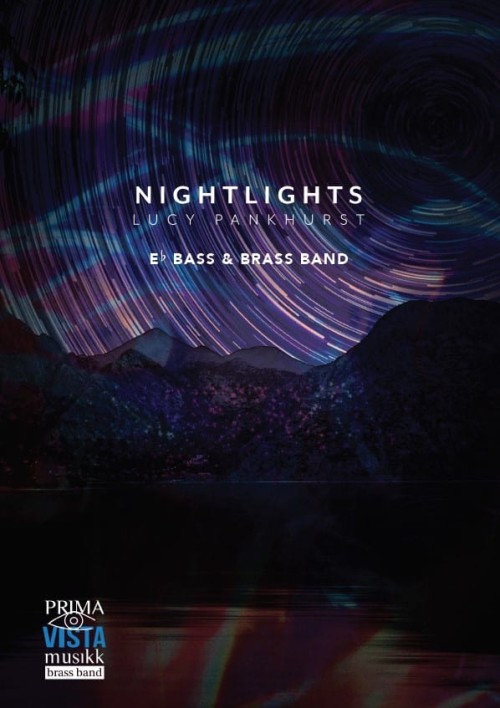
Nightlights was commissioned by Chris Jeans and Don Collins for Youth Brass 2000, to be used as part of their programme at the 2019 European Championships. Written during January 2019, Nightlights received its world premiere by Youth Brass 2000, conducted by Chris Jeans with Siobhan Bates as soloist, at the 2019 European Brass Band Championships in Montreux, Switzerland.Originally written as a Tenor Horn solo, this version for Tuba was arranged for and is dedicated to Dr Joanna Ross Hersey.Nightlights is intended to illustrate a winter's evening looking out across Lake Geneva from Montreux. Tiny lights appear beneath the mountains from faraway homes and vehicles, flickering in the distance and shimmering in the reflections on the water. Tiny, blinking nightlights against the inky blue of the clear sky. Thousands of stars shine above, blurring the boundaries between land, water, and the heavens into a sparkling ether. Transfixed, the bustle of sounds and lights from Montreux seems a lot further away than it is in reality. Eventually, each little light blinks out, one at a time, leaving the chill of the cold night air and an empty sky.Duration: 4.30
Estimated dispatch 7-14 working days
-
 £39.95
Nightlights (Tenor Horn Solo with Brass Band - Score and Parts) - Pankhurst, Lucy
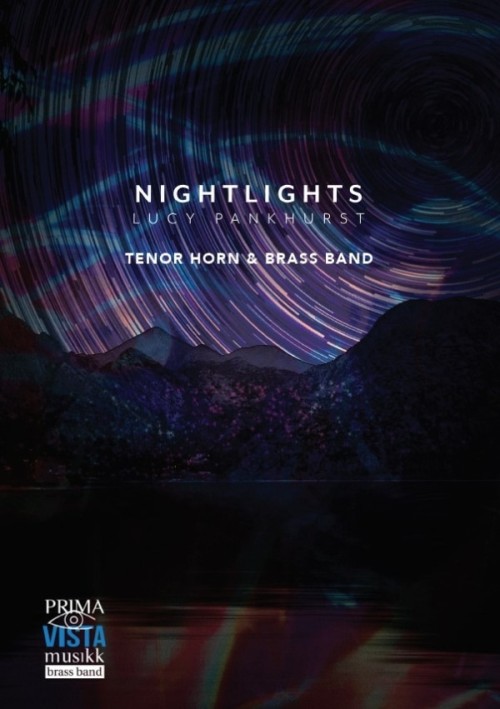
Nightlights was commissioned by Chris Jeans and Don Collins for Youth Brass 2000, to be used as part of their programme at the 2019 European Championships. Written during January 2019, Nightlights received its world premiere by Youth Brass 2000, conducted by Chris Jeans with Siobhan Bates as soloist, at the 2019 European Brass Band Championships in Montreux, Switzerland.Nightlights is intended to illustrate a winter's evening looking out across Lake Geneva from Montreux. Tiny lights appear beneath the mountains from faraway homes and vehicles, flickering in the distance and shimmering in the reflections on the water. Tiny, blinking nightlights against the inky blue of the clear sky. Thousands of stars shine above, blurring the boundaries between land, water, and the heavens into a sparkling ether. Transfixed, the bustle of sounds and lights from Montreux seems a lot further away than it is in reality. Eventually, each little light blinks out, one at a time, leaving the chill of the cold night air and an empty sky.Duration: 4.30
Estimated dispatch 7-14 working days
-
 £99.95
SEA PICTURES (Brass Band - Score and Parts) - Sparke, Philip
An atmospheric and descriptive work, Sea Pictures is in three sections. The quiet but very difficult opening describes the sea at dawn when all is still save for the cries of the early-morning gulls and deep movements of the sea itself. The sun rises and the next section pictures it glistening and sparkling on the waves. A school of playful dolphins passes. As they swim into the distance we are alone again with the sun and the waves. But there are distant rumblings; from far away a storm approaches. Cool breezes disturb the surface of the sea as it clouds over. And then the storm is upon us, turning the sea into the most awful force in all nature. Then, as suddenly as it had begun, it abates, leaving the sea once again serene in sunlight. All is calm but, as the work fades to a close, distant claps of thunder remind us that we are always at the mercy of the power and ficklesness of nature. Championship section. Duration 20:13
Estimated dispatch 7-14 working days
-
£57.95
SEA PICTURES (Brass Band - Score only) - Sparke, Philip
An atmospheric and descriptive work, Sea Pictures is in three sections. The quiet but very difficult opening describes the sea at dawn when all is still save for the cries of the early-morning gulls and deep movements of the sea itself. The sun rises and the next section pictures it glistening and sparkling on the waves. A school of playful dolphins passes. As they swim into the distance we are alone again with the sun and the waves. But there are distant rumblings; from far away a storm approaches. Cool breezes disturb the surface of the sea as it clouds over. And then the storm is upon us, turning the sea into the most awful force in all nature. Then, as suddenly as it had begun, it abates, leaving the sea once again serene in sunlight. All is calm but, as the work fades to a close, distant claps of thunder remind us that we are always at the mercy of the power and ficklesness of nature. Championship section. Duration 20:13
Estimated dispatch 7-14 working days
-
 £40.00
A Song for Bram (Brass Band - Score and Parts) - Gregson, Edward
A Song for Bram is a short work, originally composed piano and brass band, and is dedicated to the memory of Bramwell Tovey, a close friend and colleague of the composer, and a conductor, composer, pianist and musician of huge talent, who sadly passed away before his time in the summer of 2022. In this short piece the composer has tried to imagine what kind of tune Bram would have improvised at the piano, something he frequently engaged in. No doubt it would have been a mixture of bluesy jazz, hymn tune, and love song, and this is how the solo piano takes off. In the middle section of a what is a simple tertiary structure, introduced are quotes from two hymn tunes Bram particularly loved, never having forgotten his Salvation Army roots. Bram's 'Song' returns, this time on a plaintive flugelhorn horn, and which reaches a climax with the full band before receding, literally, into the distance.....(to a new life beyond?).Duration: 6.00
Estimated dispatch 7-14 working days
-
£14.00
A Song for Bram (Brass Band - Score only) - Gregson, Edward
A Song for Bram is a short work, originally composed piano and brass band, and is dedicated to the memory of Bramwell Tovey, a close friend and colleague of the composer, and a conductor, composer, pianist and musician of huge talent, who sadly passed away before his time in the summer of 2022. In this short piece the composer has tried to imagine what kind of tune Bram would have improvised at the piano, something he frequently engaged in. No doubt it would have been a mixture of bluesy jazz, hymn tune, and love song, and this is how the solo piano takes off. In the middle section of a what is a simple tertiary structure, introduced are quotes from two hymn tunes Bram particularly loved, never having forgotten his Salvation Army roots. Bram's 'Song' returns, this time on a plaintive flugelhorn horn, and which reaches a climax with the full band before receding, literally, into the distance.....(to a new life beyond?).Duration: 6.00
Estimated dispatch 7-14 working days
-
 £45.00
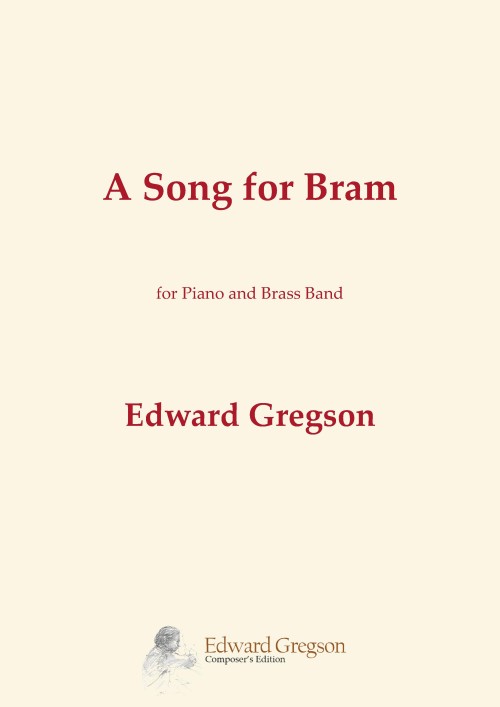
A Song for Bram (Piano Solo with Brass Band - Score and Parts) - Gregson, Edward
A Song for Bram is a short work, originally composed piano and brass band, and is dedicated to the memory of Bramwell Tovey, a close friend and colleague of the composer, and a conductor, composer, pianist and musician of huge talent, who sadly passed away before his time in the summer of 2022. In this short piece the composer has tried to imagine what kind of tune Bram would have improvised at the piano, something he frequently engaged in. No doubt it would have been a mixture of bluesy jazz, hymn tune, and love song, and this is how the solo piano takes off. In the middle section of a what is a simple tertiary structure, introduced are quotes from two hymn tunes Bram particularly loved, never having forgotten his Salvation Army roots. Bram's 'Song' returns, this time on a plaintive flugelhorn horn, and which reaches a climax with the full band before receding, literally, into the distance.....(to a new life beyond?).Duration: 6.00
Estimated dispatch 7-14 working days
-
£15.00
A Song for Bram (Piano Solo with Brass Band - Score only) - Gregson, Edward
A Song for Bram is a short work, originally composed piano and brass band, and is dedicated to the memory of Bramwell Tovey, a close friend and colleague of the composer, and a conductor, composer, pianist and musician of huge talent, who sadly passed away before his time in the summer of 2022. In this short piece the composer has tried to imagine what kind of tune Bram would have improvised at the piano, something he frequently engaged in. No doubt it would have been a mixture of bluesy jazz, hymn tune, and love song, and this is how the solo piano takes off. In the middle section of a what is a simple tertiary structure, introduced are quotes from two hymn tunes Bram particularly loved, never having forgotten his Salvation Army roots. Bram's 'Song' returns, this time on a plaintive flugelhorn horn, and which reaches a climax with the full band before receding, literally, into the distance.....(to a new life beyond?).Duration: 6.00
Estimated dispatch 7-14 working days
 View Music