Results
-
 £33.20
Je te veux (Brass Band) Satie arr. Rob Bushnell
Je te veux, or I Want You, is a valse chantee (sung waltz) by the French composer Erik Satie, with lyrics by Henry Pacory. It was written for Paulette Darty, who first sang it in 1903 at La Scala, Paris, with Satie accompanying. There are various versions that Satie produced, the original for piano and voice, a version for brass 'orchestra', for full orchestra (where a trio section was added), and a version for solo piano (but including the new trio section). This arrangement is for the UK-style brass band, with alternative parts for horns in F and bass-clef lower brass, and is of the longer version (with the trio section). As a result, it lends itself to being performed in a various of ways, with the ensemble has the option of selecting the part of it compound ternary form to play: (A-B-A)(C-D-C)(A-B-A). A recording of the original composition can be found here: www.youtube.com/watch?v=FA3JJdmwJU8 Difficulty Level: 4th Section + Duration: 4 or 5 minutes (depending on tempo and without any cuts) PDF download includes parts and score. Sheet music available at www.brassband.co.uk (UK) or https://satradecentral.org (USA) Instrumentation: Soprano Cornet Eb Solo Cornet Bb Repiano Cornet Bb 2nd Cornet Bb 3rd Cornet Bb Flugel Horn Bb Solo Horn Eb 1st Horn Eb 2nd Horn Eb 1st Baritone Bb 2nd Baritone Bb 1st Trombone Bb 2nd Trombone Bb Bass Trombone Euphonium Bb Bass Eb Bass Bb Timpani Drum Kit Auxiliary Percussion (Glockenspiel, Cymbal & Triangle)
In Stock: Estimated dispatch 1-3 working days
-
 £33.20
Menuet (Brass Band) Ravel arr. Rob Bushnell
Le Tombeau de Couperin (The Grave of Couperin) was written by Maurice Ravel between 1914 and 1917, originally a suite of piece for solo piano. Based on what was considered a traditional Baroque suite, Ravel wanted to pay homage to Baroque French keyboard music, whilst retaining his 20th-century chromaticism, making the work neoclassicist. Each movement is dedicated to the memory of a friend of the composer who died fighting in World War I. Ravel produced an orchestral version in 1919, omitting two of the original six movements. The Menuet was written in memory of Jean Dreyfus; Ravel had recuperated at his home. This arrangement is for the British-style brass band, with alternative parts for horns in F and bass-clef lower brass. A recording of the original composition can be found here: www.youtube.com/watch?v=jnNwEcBTSmk. Duration: Approx. 4 minutes Difficulty Level: 2nd Section + Duration: 4 minutes (depending on tempo and without any cuts) PDF download includes parts and score. Sheet music available at www.brassband.co.uk (UK) or https://satradecentral.org (USA) Instrumentation: Soprano Cornet Eb Solo Cornet Bb Repiano Cornet Bb 2nd Cornet Bb 3rd Cornet Bb Flugel Horn Bb Solo Horn Eb 1st Horn Eb 2nd Horn Eb 1st Baritone Bb 2nd Baritone Bb 1st Trombone Bb 2nd Trombone Bb Bass Trombone Euphonium Bb Bass Eb Bass Bb Timpani Percussion - Vibraphone & Glockenspiel
In Stock: Estimated dispatch 1-3 working days
-
 £33.20
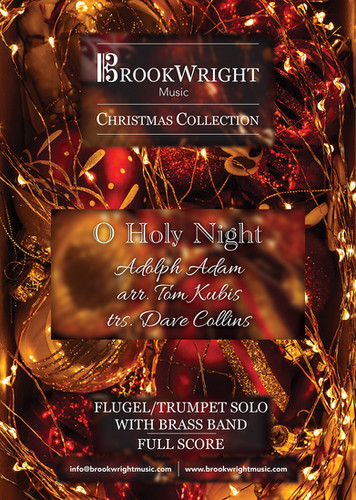
O Holy Night (Flugel/Trumpet Solo with Band) arr. Tom Kubis trs. Dave Collins
This stunning arrangement of O Holy Night, showcases the lyrical and expressive potential of the Flugel Horn or Trumpet, arranged by acclaimed jazz composer Tom Kubis and transcribed by Dave Collins. Originally made famous by the legendary Wayne Bergeron with the Tom Kubis Big Band, this arrangement has since become a favourite among brass soloists worldwide. It received its concert premiere with the North York Temple Band (Canada) under Bandmaster Glenn Barlow, featuring the virtuosic talents of Marcus and Harrington Venables. The piece was later recorded by the International Staff Band, conducted by Dr. Stephen Cobb, on their 2016 album Celebrate the Season. The featured soloist on that recording was the world-renowned Philip Cobb. This arrangement offers flexible performance options - it can be presented as a solo feature or as a duet for Flugel Horn and Soprano Cornet (cued into the parts), making it ideal for both concert settings and festive performances. To view a video of Philip Cobb performing the solo with the International Staff Band, please visit www.youtube.com/watch?v=1x_hjZyDjrA&list=RD1x_hjZyDjrA&start_radio=1 Duration: approx. 3.45 minutes Difficulty Level: 3rd Section + PDF download includes parts and score. Sheet music available at www.brassband.co.uk (UK) or https://satradecentral.org (USA) Instrumentation: Flugel Horn/Trumpet Soloist Bb Soprano Cornet Eb Solo Cornet Bb Repiano Cornet Bb 2nd Cornet Bb 3rd Cornet Bb Flugel Horn Bb Solo Horn Eb 1st Horn Eb 2nd Horn Eb 1st Baritone Bb 2nd Baritone Bb 1st Trombone Bb 2nd Trombone Bb Bass Trombone Euphonium Bb Bass Eb Bass Bb Bass Drum Percussion 1-3
In Stock: Estimated dispatch 1-3 working days
-
 £33.20
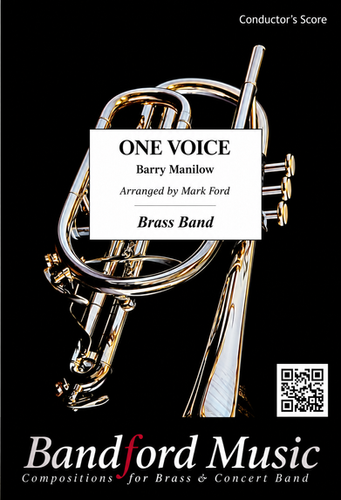
One Voice (Brass Band) Barry Manilow arr. Mark Ford
Originally released in 1979 as the title track of Barry Manilow's sixth studio album, One Voice has become an enduring anthem for unity and social courage. It is a stirring ballad that reminds us how a single, brave voice can ignite a chorus of solidarity and lead the way toward positive change. Expertly crafted for brass band by Mark Ford, this setting captures the intimate, soaring spirit of the original while leveraging the unique textures of the brass band. The piece begins with a delicate, lyrical flugel horn solo, representing the 'single voice' of the title. As the arrangement progresses, the rest of the ensemble joins in, building from a gentle accompaniment into a magnificent, wall-of-sound finale that is sure to leave your audience inspired. To view a rolling score video of the work please visit https://youtu.be/RcQ5xbnyNjs Duration: Approx. 3.15 minutes Difficulty Level: 4th Section + This PDF download includes the full score and parts. Sheet music available at www.brassband.co.uk (UK) or https://satradecentral.org (USA) Instrumentation: Soprano Cornet Eb Solo Cornet Bb Repiano Cornet Bb 2nd Cornet Bb 3rd Cornet Bb Flugel Horn Bb Solo Horn Eb 1st Horn Eb 2nd Horn Eb 1st Baritone Bb 2nd Baritone Bb 1st Trombone Bb 2nd Trombone Bb Bass Trombone Euphonium Bb Bass Eb Bass Bb Timpani Glockenspiel Percussion
In Stock: Estimated dispatch 1-3 working days
-
 £36.89
Polonaise from 'Scenes de Ballet' (Brass Band) Glazunov arr. Rob Bushnell
Alexander Glazunov was a Russian composer who was a gifted musician from childhood. He was seen as the natural heir to the nationalist revolution that had started with the Mighty Handful. Despite quickly turning from this to absolute forms of music, taking a keen interest in ballet music, his compositions still alludes to Russian folk tunes. He wrote four dance compositions, of which Scenes de Ballet was the first in 1894. The suite Scenes de Ballet, opus 52 has eight movements and was dedicated to the orchestra of the Russian Opera, St Petersburg. First performed in 1895 at a concert of the Imperial Music Society with Glazunov conducting. This arrangement of the final movement is for the British-style brass band, with alternative parts for horns in F and bass-clef lower brass. A recording of the original composition can be found here: https://www.youtube.com/watch?v=BS-Yx-bmxPg Duration: approx. 5.20 minutes Difficulty Level: 2nd Section + PDF download includes parts and score. Sheet music available at www.brassband.co.uk (UK) or https://satradecentral.org (USA) Instrumentation: Soprano Cornet Eb Solo Cornet Bb Repiano Cornet Bb 2nd Cornet Bb 3rd Cornet Bb Flugel Horn Bb Solo Horn Eb 1st Horn Eb 2nd Horn Eb 1st Baritone Bb 2nd Baritone Bb 1st Trombone Bb 2nd Trombone Bb Bass Trombone Euphonium Bb Bass Eb Bass Bb Timpani Percussion 1 - Snare Percussion 2 - Triangle, Cymbal & Bass Drum
In Stock: Estimated dispatch 1-3 working days
-
 £36.89
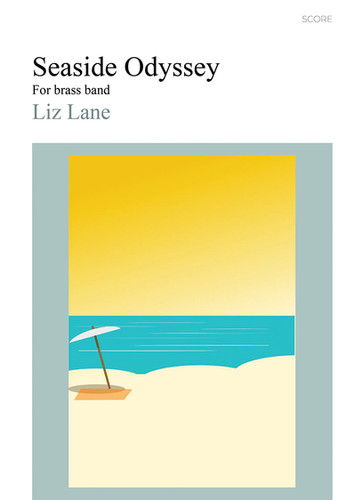
Seaside Odyssey (Brass Band) Liz Lane
Seaside Odyssey is a celebration of the British seaside! The music represents a juxtaposition between natural and manmade elements; there are two main musical themes - the reflective sea (a wordless setting of John Masefield's Sea Fever) and a more lively 'seaside' theme, heard separately in different ways and later together. From childhood memories, sand, beach and cliffs to cafes, ice creams, fish and chips, buckets and spades, boating trips, beach huts, bandstands, piers, theatres, gardens, mini golf, arcades and more, Seaside Odyssey is a journey from dawn to dusk with the sea at the heart of the music. This work was commissioned by Grimethorpe Colliery Band for its seaside tour, August 2023, where it performed at Paignton, Lyme Regis, Weymouth, Shanklin and Herne Bay. Includes optional poems and words specially curated from poets associated with the seaside towns, which can be read before a performance. Duration: approx. 5 minutes This PDF download includes parts and score. Sheet music available at www.brassband.co.uk (UK) or https://satradecentral.org (USA) Instrumentation: Eb Soprano Cornet Bb Solo Cornet Bb Repiano Cornet Bb Cornet 2 Bb Cornet 3 Bb Flugelhorn Eb Solo Tenor Horn Eb Tenor Horn 1 Eb Tenor Horn 2 Bb Baritone 1 Bb Baritone 2 Bb Trombone 1 Bb Trombone 2 Bass Trombone Bb Euphonium Eb Bass Bb Bass Percussion 1: timpani, triangle and optional 'arcade jackpot' effect (see score/part) Percussion 2: 3 suspended cymbals (2 ride, 1 crash) and hi-hat Percussion 3: snare, tom-toms and bass drum Percussion 4: glockenspiel
In Stock: Estimated dispatch 1-3 working days
-
 £33.20
Verleih Uns Frieden (Brass Band) Mendelssohn arr. Edward Mylechreest
Felix Mendelssohn's stunning Choral Cantata has here been adapted to the brass band by Edward Mylechreest. A setting of Martin Luther's sacred words, this short piece is a staple of the choral canon and is widely regarded as a choral masterpiece. The hymn tune melody repeats three times throughout the piece (first from the trombones, then the horns, followed by a full band chorale), each time an emploring prayer and statement of the text. This arrangement can also be used for accompaniment to the original Chorale, remaining in the original Eb major key signature. Knowledge of the original piece will be of great benefit to the performer and conductor alike. Sheet music available from: UK - www.brassband.co.uk USA - www.solidbrassmusic.com Difficulty Level: 4th Section + Instrumentation: Soprano Cornet Eb Solo Cornet Bb 1st Cornet Bb 2nd Cornet Bb Flugel Horn Bb Solo Horn Eb 1st Horn Eb 2nd Horn Eb 1st Baritone Bb 2nd Baritone Bb 1st Trombone Bb 2nd Trombone Bb Bass Trombone Euphonium Bb Bass Eb Bass Bb Percussion Tacet
In Stock: Estimated dispatch 1-3 working days
-
 £24.95
Lest We Forget - Christopher Bond
Lest We Forget is a phrase added as a final line at the end of the Ode of Remembrance, taken from Laurence Binyon's poem For the Fallen, first published in The Times newspaper in September 1914. Providing the title for this work for brass band, the piece aims to combine both the acoustic nature of the brass band medium alongside narrated passages and pre-recorded extracts to provide a moving tribute. The words originally spoken by Prime Minister Herbert Asquith in 1914 can be narrated in performance. However, a free audio download, manipulated to sound like a 1914 radio broadcast is available from Prima Vista. Lest We Forget received its premiere at The Sage, Gateshead, on November 17th 2014, performed by the Grimethorpe Colliery Band, conducted by Robert Childs. The work opened their winning Brass in Concert programme, and has since been performed by bands all over the world as a fitting tribute to the Great War.
Estimated dispatch 10-14 working days
-
 £38.00
Monteverdi Three Miniatures
ABOUT THIS PIECE: Monteverdi - Three Miniatures, is an engaging and educational brass band arrangement by Adam Taylor, originally composed for the British Open Youth Brass Band Contest at the Guild 2015. This piece masterfully reimagines themes from the works of Claudio Monteverdi, presenting them in a contemporary style that's both accessible and inspiring for modern brass ensembles. Ideal for youth bands and ensembles looking to explore early music in a fresh format, Monteverdi - Three Miniatures offers flexibility and creativity. The arrangement includes adaptable tempos to match your interpretation, a featured duet with parts available in both Bb and Eb, and written percussion parts that can be expanded with additional instruments or streamlined for smaller sections. Players are encouraged to add their own ornamentation, allowing for personal expression and an authentic touch to the music. With its nod to the grandeur of the late Renaissance and early Baroque periods, this piece serves not only as an excellent concert addition but also as a valuable educational tool, introducing young musicians to Monteverdi's timeless work. Dive into this vibrant arrangement and bring the essence of Monteverdi's genius to your next performance. ENSEMBLE: Standard British Brass Band (with adaptations) WHEN YOU BUY THIS PRODUCT, YOU GET: High-quality printed score and parts LEVEL: 1 LISTEN: Click here DURATION: 5-minutes, 30-secondsEXAMPLE SCORE: Click here LEVEL GUIDE: Level 1- Accessible to all Level 2 - c. UK third section and higher Level 3 - c. UK second section and higher Level 4 - c. UK first section and higher Level 5 - c. UK championship section level
Estimated dispatch 5-7 working days
-
£55.00
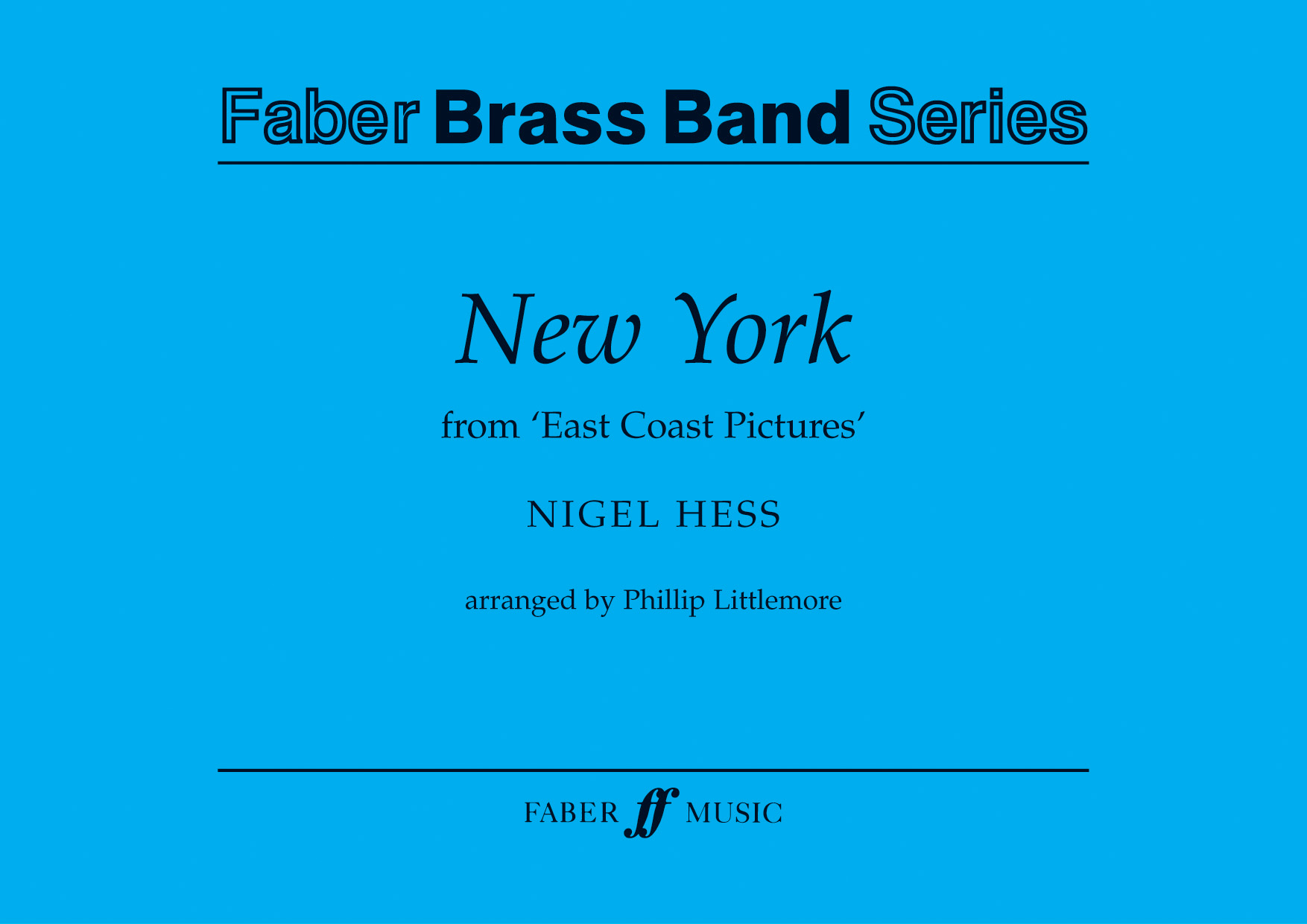
New York - Nigel Hess
For anyone who is familiar with this bizarre and wonderful city, this piece needs no explanation. New York is the third movement of East Coast Pictures, originally written for wind band, commissioned in 1985 by the British Youth Wind Orchestra with funds from National Westminster Bank plc. These three short 'pictures' were inspired by several visits by the composer to a small part of the USA's East Coast, an area that provides great extremes in the geography and the people.The bass clef Euphonium parts can be purchased as individual downloads here.Brass Band Grades 4/5: Premier Youth and 2nd SectionDuration: 6 minutes
In Stock: Estimated dispatch 1-3 working days
 Watch video