
Results
-
 £40.00
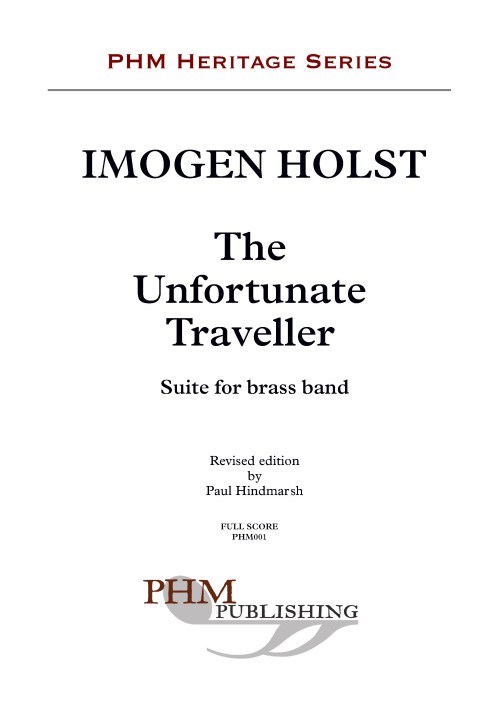
The Unfortunate Traveller (Brass Band - Score only) - Holst, Imogen - Hindmarsh, Paul
Imogen Holst (1907-1984) submitted The Unfortunate Traveller (1929) as her final work as a student portfolio at the Royal College of Music, where her composition teacher was Gordon Jacob. The title was taken from Thomas Nashe's famous 1594 picaresque novel of the same title. The Suite was first performed on 12 February 1933 at her Majesty's Theatre, Carlisle, by the St. Stephen's Band, with the composer conducting. Te concert was given in memory of Holst's uncle, Dr. H.A. Lediard. Holst had been impressed with the band's performance of his A Moorside Suite at the 1928 National Brass Band Championships (The Crystal Palace, South London) and was keen to work with them. Writing in Imogen Holst, a life in music, Christopher Grogan indicates that it was Gustav Holst's suggestion to include his daughter's work in the programme, quoting Imogen Holst's remarks made in interview to The Daily Mail as follows: "....it is the first time, so far as I know, that a woman has conducted a brass band at a public concert....It has been a delight to rehearse the St. Stephen's Band. It was their performance at the Crystal Palace Festival that inspired me to write this Suite, which I have dedicated to them."Imogen Holst accompanied her father to the Crystal Palace in 1928 to hear the performances of A Moorside Suite, and was so excited by the played and, audibly, by her father's music that she decided to write a brass band piece for her final examination. Te result was The Unfortunate Traveller (1929). However, it was not possible for her to present a brass band work for examination. She arranged it for string orchestra so that it could be played before she left the RCM in July 1930. Following the premiere of the original in 1933, the manuscripts did not resurface until 1969 Imogen found them among her late mother's effects. Although she requested score and parts be destroyed, they ended up in the possession of Manchester composer John Golland, who marked up the score presumably with the intention of creating a new performing edition. The original scoring reveals a lack of experience with what can be a tricky medium.With the agreement of the Holst Foundation, a revised edition, with additional percussion, was prepared in 2011 since when the work has been fortunate to travel round the world as a concert and contest piece. The original includes drums in the March only. The title was taken from Tomas Nashe's famous 1594 picaresque novel of the same title. Several Morris Dance tunes are introduced during the course of the four short movements, including Bonnie Green Garters, Shepherd's Hey, The Rose and The Wind Blaws Cauld. Quirky twists and turns of harmony and spirited rhythms that remind us how much Imogen Holst loved tradition English dance music.In September 2025, I made a performing edition of the composer's arrangement for string orchestra. The manuscript lacks the final movement, which I arranged in a similar style, ie. without extending the upper ranges. Making this edition raised some issues regarding the accuracy of my band version and some of the solutions I used to smooth out the voicing. I have used the composer's second thoughts to refine my performing edition and to correct a textual errors.- Paul HindmarshDuration: 10.00
Estimated dispatch 7-14 working days
-
 £168.50
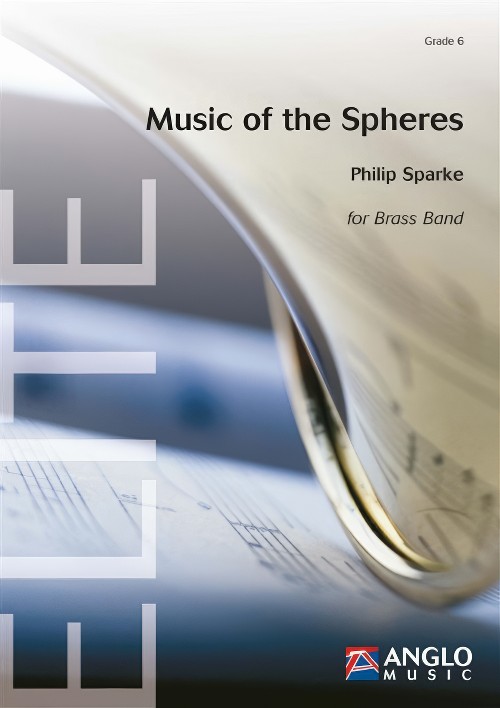
Music of the Spheres (Brass Band - Score and Parts) - Sparke, Philip
Music of the Spheres was commissioned by the Yorkshire Building Society Band and first performed by them at the European Brass Band Championships in Glasgow, May 2004. The piece reflects the composers fascination with the origins of the universe and deep space in general. The title comes from a theory, formulated by Pythagoras, that the cosmos was ruled by the same laws he had discovered that govern the ratios of note frequencies of the musical scale. ('Harmonia' in Ancient Greek, which means scale or tuning rather than harmony - Greek music was monophonic). He also believed that these ratios corresponded to the distances of the six known planets from the sun and thatthe planets each produced a musical note which combined to weave a continuous heavenly melody (which, unfortunately, we humans cannot hear). In this work, these six notes form the basis of the sections Music of the Spheres and Harmonia. The pieces opens with a horn solo called t = 0, a name given by some scientists to the moment of the Big Bang when time and space were created, and this is followed by a depiction of the Big Bang itself, as the entire universe bursts out from a single point. A slower section follows called The Lonely Planet which is a meditation on the incredible and unlikely set of circumstances which led to the creation of the Earth as a planet that can support life, and the constant search for other civilisations elsewhere in the universe. Asteroids and Shooting Stars depicts both the benign and dangerous objects that are flying through space and which constantly threaten our planet, and the piece ends with The Unknown, leaving in question whether our continually expanding exploration of the universe will eventually lead to enlightenment or destruction.Duration: 18:00
Estimated dispatch 7-14 working days
-
£42.50
Music of the Spheres (Brass Band - Score only) - Sparke, Philip
Music of the Spheres was commissioned by the Yorkshire Building Society Band and first performed by them at the European Brass Band Championships in Glasgow, May 2004. The piece reflects the composers fascination with the origins of the universe and deep space in general. The title comes from a theory, formulated by Pythagoras, that the cosmos was ruled by the same laws he had discovered that govern the ratios of note frequencies of the musical scale. ('Harmonia' in Ancient Greek, which means scale or tuning rather than harmony - Greek music was monophonic). He also believed that these ratios corresponded to the distances of the six known planets from the sun and thatthe planets each produced a musical note which combined to weave a continuous heavenly melody (which, unfortunately, we humans cannot hear). In this work, these six notes form the basis of the sections Music of the Spheres and Harmonia. The pieces opens with a horn solo called t = 0, a name given by some scientists to the moment of the Big Bang when time and space were created, and this is followed by a depiction of the Big Bang itself, as the entire universe bursts out from a single point. A slower section follows called The Lonely Planet which is a meditation on the incredible and unlikely set of circumstances which led to the creation of the Earth as a planet that can support life, and the constant search for other civilisations elsewhere in the universe. Asteroids and Shooting Stars depicts both the benign and dangerous objects that are flying through space and which constantly threaten our planet, and the piece ends with The Unknown, leaving in question whether our continually expanding exploration of the universe will eventually lead to enlightenment or destruction.Duration: 18:00
Estimated dispatch 7-14 working days
-
 £67.50
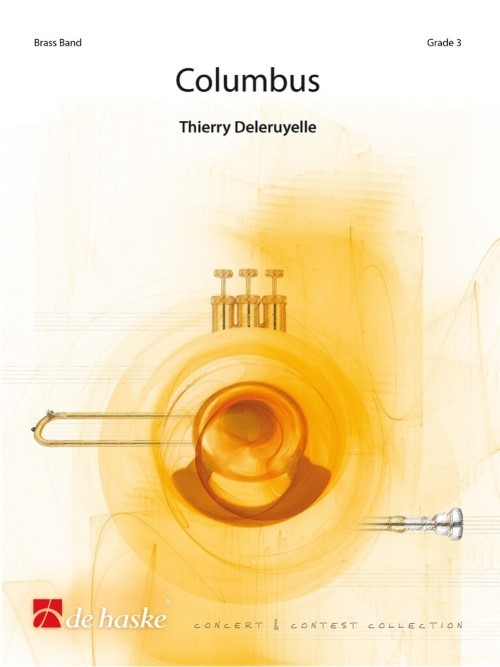
Columbus (Brass Band - Score and Parts) - Deleruyelle, Thierry
Columbus is a brilliant and dynamic overture for brass band, with a soft and melodious central passage. In addition to the many American towns that hold the name, Columbus is a European space laboratory that is part of the International Space Station. Launched in 2008 by the American space shuttle Atlantis, it makes it possible to carry out continuous scientific experiments in fundamental physics, life sciences, fluid physics, etc. Several hundred experiments take place within Columbus every year. Commissioned by the Brass Band Bourgueillois, this piece celebrates the 10th anniversary of the launch of the band at the instigation of its conductor, Michal Auclert. The ensemble brings together musicians from the various wind bands of the Bourgueillois region and beyond. Thus, just like the space laboratory that inspired this work, the Brass Band Bourgueillois also serves as a laboratory, albeit a musical one, within a territory that is discovering this ensemble and its original repertoire.Duration: 5.15
Estimated dispatch 7-14 working days
-
 £44.95
Deus Invictus - God Unconquered (Brass Band - Score and Parts) - Mackereth, Andrew
Deus Invictus draws its inspiration from well-known words from Romans 8: 38-39; 'For I am convinced that neither death nor life, neither angels nor demons, neither the present nor the future, nor any owers, neither height nor depth, nor anything else in all creation, can separate us from the love of God'. The music reflects the confidence and certainty of the scripture text while, as in everyday life, trials and tests come along which are reflected in a sequence of musical skirmishes. The work introduces the 19th century hymn 'St Albinus' to a wider audience and also includes references to the tunes 'St Margaret' and 'Rachie'. A setting of the Easter Hymn, 'Christ the Lord is risen today!', is heard followed by a final reprise of 'St Albinus'.
Estimated dispatch 7-14 working days
-
£22.50
Deus Invictus - God Unconquered (Brass Band - Score only) - Mackereth, Andrew
Deus Invictus draws its inspiration from well-known words from Romans 8: 38-39; 'For I am convinced that neither death nor life, neither angels nor demons, neither the present nor the future, nor any owers, neither height nor depth, nor anything else in all creation, can separate us from the love of God'. The music reflects the confidence and certainty of the scripture text while, as in everyday life, trials and tests come along which are reflected in a sequence of musical skirmishes. The work introduces the 19th century hymn 'St Albinus' to a wider audience and also includes references to the tunes 'St Margaret' and 'Rachie'. A setting of the Easter Hymn, 'Christ the Lord is risen today!', is heard followed by a final reprise of 'St Albinus'.
Estimated dispatch 7-14 working days
-
£79.95
The Lost Village of Imber (Brass Band - Score and Parts) - Bond, Christopher
The Lost Village of Imber was commissioned by Bratton Silver Band in 2019 in celebration of 160 years of the band; 1859-2019. Structured in three movements, the complete work was premiered by Cory Band at Wiltshire Music Centre in February 2020.The village of Imber on Salisbury Plain had been inhabited for over one thousand years when it was evacuated in 1943 to make way for military training in the Second World War. At the time, with preparations for the Allied invasion of Europe underway, most villagers put up no resistance, despite being upset, with the belief that they'd return once the war had concluded. To this day, Imber and its surrounding land remain a military training ground. The villagers never returned, and just the shell of what was once a community remains.Structured in three movements, it is on this very real story that the work is based, setting out the series of events of 1943 in chronological order.The first movement, On Imber Downe, portrays a sense of jollity and cohesiveness, a community of individuals living and working together before news of the evacuation had broken. Sounds of the village are heard throughout, not least in a series of percussive effects, the anvil of the blacksmith; the cowbell of the cattle and the bells of the church.The second movement, The Church of St. Giles, begins mysteriously and this sonorous, atmospheric opening depicts Imber in its desolate state and the apprehension of residents as they learn they have to leave their homes. Amidst this is the Church, a symbol of hope for villagers who one day wish to return, portrayed with a sweeping melodic passage before the music returns to the apprehension of villagers facing eviction around their sadness at losing their rural way of life.In complete contrast, the third movement, Imemerie Aeternum, portrays the arrival of the military, complete with the sounds of the ammunition, firing and tanks, sounds which were all too familiar to those living in the surround areas. To close, the Church of St. Giles theme returns in a triumphant style, representing the idea that the church has always been, even to this day, a beacon of hope for the villagers and local community, both the centrepiece and pinnacle of a very real story.Duration: 13.30
Estimated dispatch 7-14 working days
-
£59.95
The Long Cloud of Witnesses (Brass Band - Score and Parts) - Downie, Kenneth
This music was written for the Amsterdam Staff Band's 50th Anniversary. The idea for using this theme in appreciation of the pioneers of the band who had gone before came to me during the thanksgiving service for my own mother's life. She was a life-long Salvationist, and the large crowd that gathered for her thanksgiving in Winchester gave such an inspiring rendition of this hymn at the end of the service that it moved me to write the music. In the closing pages of the score I have tried to suggest that final parade when those who loved the Lord join the 'long cloud of witnesses' in procession to their eternal home. - Kenneth Downie
Estimated dispatch 7-14 working days
-
£29.95
The Long Cloud of Witnesses (Brass Band - Score only) - Downie, Kenneth
This music was written for the Amsterdam Staff Band's 50th Anniversary. The idea for using this theme in appreciation of the pioneers of the band who had gone before came to me during the thanksgiving service for my own mother's life. She was a life-long Salvationist, and the large crowd that gathered for her thanksgiving in Winchester gave such an inspiring rendition of this hymn at the end of the service that it moved me to write the music. In the closing pages of the score I have tried to suggest that final parade when those who loved the Lord join the 'long cloud of witnesses' in procession to their eternal home. - Kenneth Downie
Estimated dispatch 7-14 working days
-
 £91.99
Time Remembered (Brass Band - Score and Parts) - Sparke, Philip
The initial idea was for a millennium piece, which it is, but rather than add to the many celebratory pieces that have understandably been written to salute the 3rd millennium, Philip Sparke thought it would perhaps be appropriate to think about the aspects of life that are constantly with us (such as faith and philosophy) rather than the exciting changes that the year 2000 has undeniably wrought. This calm meditative work will bring a moment of serenity and reflection to any concert.Duration: 8.30
Estimated dispatch 7-14 working days
 View Music