
Results
-
 £15.99
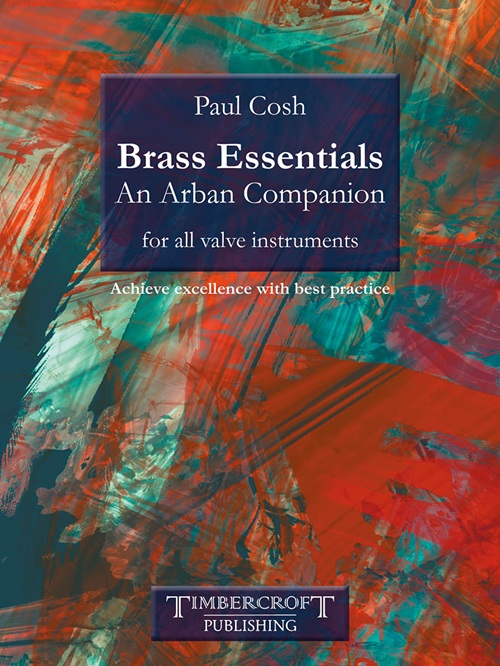
Brass Essentials - An Arban Companion (for all valve instruments)
Brass Essentials: An Arban Companion works through the Arban Cornet Method in the sequence that the excerpts appear in the original publication. It is not a method in itself, but a way to address the building blocks of a solid technique - good sound, good intonation, developing technical skills and applying rhythmic accuracy. It is suitable for all valve instruments.Simply choose which of the sections applies to the issues you are facing in your playing at any given time. Advice is given at the head of each section on how to deal with the technical processes involved for that particular area of practice as well as suggestions on rehearsal and performance tempi.A regular approach to the most basic aspects of playing a brass instrument will help maintain a strong technique whilst addressing any problems that may occur during your playing life, as they do from time to time. It can also provide a regular practice diet that will encourage real attention to detail.Brass Essentials: An Arban Companion can be used as a resource for teachers helping players starting out on their musical journey, but also performers at any point in their musical life as a back-to-basics approach is often the way forward when dealing with playing issues. The overriding principle is that every note counts!Section Headings : Set-Up, Articulation and Sound; Light Articulations; Syncopation, Spacing and Rhythm; Single Tonguing; Controlled Slurring Technique; Running Scales and Chromatics; Breathing, Shaping and Phrasing; Arpeggios, Dominant Sevenths and Diminished Sevenths; Triple Tonguing; Double Tonguing; The Studies
Estimated dispatch 7-14 working days
-
 £45.00
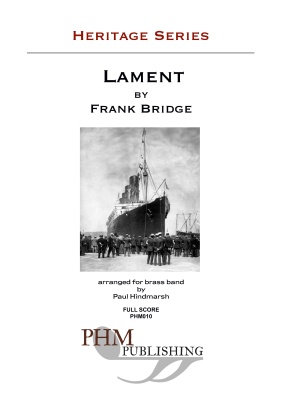
Lament (Brass Band - Score and Parts)
The English composer Frank Bridge (1879 - 1941) did not take an active part in the First World War. However, he was devastated by the slaughter on the western and the eastern fronts, especially the loss of so many of his musicians friends and colleagues. Writing in 1963, his former pupil Benjamin Britten confessed that 'a lot of my feelings about the First World War which people seemed to see in the War Requiem came from Bridge. He had written a piano sonata in memory of a friend killed in France and though he didn't encourage me to take a stand for the sake of a stand, he did make me argue and argue and argue. His own pacifism was not aggressive, but typically gentle'.Bridge composed this Lament for string orchestra on 14 June 1915, in memory of Catherine Crompton, who drowned when the Cunard liner Lusitania was torpedoed by a German submarine on 7 May, 1915. According to figures researched by Liverpool historian Kevin Roach (www.lusitania.net), 1201 men, women and children lost their lives out of the 1962 people aboard. Ninety-four children died, including Catherine, her twin brother Paul and four other siblings. Paul Crompton, Snr. (44), a British businessman working in Philadelphia, his wife Gladys (40) and the family nanny were also drowned. How Bridge's dedication came about is uncertain. The music critic Edwin Evans, who knew Bridge well, has written that the Catherine was a young friend. It is also possible that he came across the family photograph which was published in many newspapers in the wake of the tragedy. By that time, Bridge was greatly distressed by the war as a whole. It seems perfectly in keeping with his pacifist leanings and the strength of his reaction, that this poignant and deeply touching 'war memorial' should mourn a child who he did not know, rather than one of the thousands of young men who fell in battle.Through the musical tears of this melancholy lullaby, Bridge may have regarded the death of young Catherine Crompton as symbolic of the loss of so many innocent lives in wartime. His response to this personal tragedy was characteristically spontaneous and utterly sincere. It is one of his most effective miniatures, poignant yet restrained in its lyrical beauty, with a compelling directness and simplicity of construction.This brass band transcription is pitched one tone lower than the original for string orchestra.- Paul HindmarshDuration: 5.00
Estimated dispatch 7-14 working days
-
 £164.99
Music of the Spheres (Brass Band - Score and Parts)
Music of the Spheres was commissioned by the Yorkshire Building Society Band and first performed by them at the European Brass Band Championships in Glasgow, May 2004. The piece reflects the composers fascination with the origins of the universe and deep space in general. The title comes from a theory, formulated by Pythagoras, that the cosmos was ruled by the same laws he had discovered that govern the ratios of note frequencies of the musical scale. ('Harmonia' in Ancient Greek, which means scale or tuning rather than harmony - Greek music was monophonic). He also believed that these ratios corresponded to the distances of the six known planets from the sun and thatthe planets each produced a musical note which combined to weave a continuous heavenly melody (which, unfortunately, we humans cannot hear). In this work, these six notes form the basis of the sections Music of the Spheres and Harmonia. The pieces opens with a horn solo called t = 0, a name given by some scientists to the moment of the Big Bang when time and space were created, and this is followed by a depiction of the Big Bang itself, as the entire universe bursts out from a single point. A slower section follows called The Lonely Planet which is a meditation on the incredible and unlikely set of circumstances which led to the creation of the Earth as a planet that can support life, and the constant search for other civilisations elsewhere in the universe. Asteroids and Shooting Stars depicts both the benign and dangerous objects that are flying through space and which constantly threaten our planet, and the piece ends with The Unknown, leaving in question whether our continually expanding exploration of the universe will eventually lead to enlightenment or destruction.Duration: 18:00
Estimated dispatch 7-14 working days
-
 £99.95
Malcolm Arnold Variations (Score and Parts)
MALCOLM ARNOLD VARIATIONS was commissioned by Philip Biggs and Richard Franklin for the 20th All England Masters International Brass Band Championship held in the Corn Exchange, Cambridge on 25 May 2008. The work is dedicated to Anthony Day, long time carer of Sir Malcolm Arnold in his final years. I first met Malcolm and Anthony in 1990 and remained in constant touch until Malcolm's passing in 2006. Anthony, of course, remains a friend and plays his own role subliminally in this piece. The work is not based on any of Malcolm Arnold's own themes, rather it is a portrait of him (and by association Anthony Day) through my eyes and as a result of my friendship with both parties over some 18 years. If there is any theme as such it is the personalities of the players, the protagonist and his carer placed together by my own efforts coloured and influenced by aspects of Arnold's style and technique without recourse to direct quotation but through allusion and parody. It is of course designed as a brass band test piece but in my eyes is first and foremost a musical challenge. The pyrotechnical elements are there but always secondary to the musical thrust of the work's structure. I have long beforehand submerged myself in Malcolm Arnold's music and ultimately delivered this tribute. Music Directors will be advised to acquaint themselves with the composer's personal music, particularly the film scores, symphonies, concertos and ballets: the solutions towards a successful interpretation of my piece are all in there - and YES, I want, and sanction, this piece to be interpreted, and therein lies the challenge for those of you 'up front'! The challenge for players is that of virtuosity, ensemble and careful attention to where they are individually in relation to their colleagues - a question of balance, taste and insight. With regard to tempi, as is my usual custom, I have indicated all metronome marks with the prefix circa. I would suggest that the fast music is played at these tempos but that the more rubato moments can be allowed some freedom in expression and fluidity of line. With regard to the type of mutes to be employed - this decision I leave to the discretion of players and conductors. Structurally the work is cast as an Introduction, 20 Variations and a Finale. Some variations are self contained, others run into each other as sequences in the same tempo. In other variations, segments are repeated and developed. I could describe the overall concept as a miniature ballet or a condensed film score - there is much drama and character and the repeated elements assist this in driving the action forward. I have deliberately avoided the more extremely dark qualities of Malcolm's own music in this, my celebration of this master-composer, as I have always viewed (and evidenced by my previous Masters scores Tristan Encounters and Chivalry) that the Cambridge contest is a 'sunshine- affair' and firmly believe that Malcolm Arnold would have had it no other way too!
Estimated dispatch 7-14 working days
-
 £49.95
Malcolm Arnold Variations (Score Only)
MALCOLM ARNOLD VARIATIONS was commissioned by Philip Biggs and Richard Franklin for the 20th All England Masters International Brass Band Championship held in the Corn Exchange, Cambridge on 25 May 2008. The work is dedicated to Anthony Day, long time carer of Sir Malcolm Arnold in his final years. I first met Malcolm and Anthony in 1990 and remained in constant touch until Malcolm's passing in 2006. Anthony, of course, remains a friend and plays his own role subliminally in this piece. The work is not based on any of Malcolm Arnold's own themes, rather it is a portrait of him (and by association Anthony Day) through my eyes and as a result of my friendship with both parties over some 18 years. If there is any theme as such it is the personalities of the players, the protagonist and his carer placed together by my own efforts coloured and influenced by aspects of Arnold's style and technique without recourse to direct quotation but through allusion and parody. It is of course designed as a brass band test piece but in my eyes is first and foremost a musical challenge. The pyrotechnical elements are there but always secondary to the musical thrust of the work's structure. I have long beforehand submerged myself in Malcolm Arnold's music and ultimately delivered this tribute. Music Directors will be advised to acquaint themselves with the composer's personal music, particularly the film scores, symphonies, concertos and ballets: the solutions towards a successful interpretation of my piece are all in there - and YES, I want, and sanction, this piece to be interpreted, and therein lies the challenge for those of you 'up front'! The challenge for players is that of virtuosity, ensemble and careful attention to where they are individually in relation to their colleagues - a question of balance, taste and insight. With regard to tempi, as is my usual custom, I have indicated all metronome marks with the prefix circa. I would suggest that the fast music is played at these tempos but that the more rubato moments can be allowed some freedom in expression and fluidity of line. With regard to the type of mutes to be employed - this decision I leave to the discretion of players and conductors. Structurally the work is cast as an Introduction, 20 Variations and a Finale. Some variations are self contained, others run into each other as sequences in the same tempo. In other variations, segments are repeated and developed. I could describe the overall concept as a miniature ballet or a condensed film score - there is much drama and character and the repeated elements assist this in driving the action forward. I have deliberately avoided the more extremely dark qualities of Malcolm's own music in this, my celebration of this master-composer, as I have always viewed (and evidenced by my previous Masters scores Tristan Encounters and Chivalry) that the Cambridge contest is a 'sunshine- affair' and firmly believe that Malcolm Arnold would have had it no other way too!
Estimated dispatch 7-14 working days
-
 £99.95
Breath of Souls (Brass Band - Score and Parts)
Breath of Souls was commissioned by Weyland and Yvonne Roberts. It was composed especially for the 100th National Brass band Championships of Great Britain at the Royal Albert hall on October 15th 2011.Weyland has worked in science for many years and has always been fascinated by nature's capacity to grow and rebuild regardless of Mother Nature's catastrophic power. This is evident with the news of tsunami, forest fires, earthquakes and volcanic disasters around the world where animals, plant life and humans have overcome adversity and have demonstrated that unique regenerative quality.Speaking about the piece composer Paul Lovatt-Cooper commented: "With Breath of Souls I wanted to compose a piece of music that was a celebration of life. Not only that, but a piece of music that from the very first notes heard in the percussion and cornets, is bustling with activity, emulating that in life everything that is living has a soul and breathes - nothing stays still and everything keeps moving and growing.Just like life itself Breath of Souls also grows musically with each bar. You will hear many and various motifs and ideas grow and develop as the piece develops."
Estimated dispatch 7-14 working days
-
 £15.00
Breath of Souls (Brass Band - Study Score)
Breath of Souls was commissioned by Weyland and Yvonne Roberts. It was composed especially for the 100th National Brass band Championships of Great Britain at the Royal Albert hall on October 15th 2011.Weyland has worked in science for many years and has always been fascinated by nature's capacity to grow and rebuild regardless of Mother Nature's catastrophic power. This is evident with the news of tsunami, forest fires, earthquakes and volcanic disasters around the world where animals, plant life and humans have overcome adversity and have demonstrated that unique regenerative quality.Speaking about the piece composer Paul Lovatt-Cooper commented: "With Breath of Souls I wanted to compose a piece of music that was a celebration of life. Not only that, but a piece of music that from the very first notes heard in the percussion and cornets, is bustling with activity, emulating that in life everything that is living has a soul and breathes - nothing stays still and everything keeps moving and growing.Just like life itself Breath of Souls also grows musically with each bar. You will hear many and various motifs and ideas grow and develop as the piece develops."
Estimated dispatch 7-14 working days
-
 £44.95
Funk Engine (Brass Band - Score and Parts)
'Funk Engine' was commissioned by Brass Bands England for the 2016 National Youth Brass Band Championships of Great Britain. What Ryan says about the piece:"When I was commissioned to write a piece for the Championships I decided that I wanted to create something a bit different to standard brass band repertoire. I decided that the best way to do this was to go a bit out of my comfort zone and explore some styles of music that I have yet to experiment with. I have always been a great lover of jazz, funk and big band music and the sounds associated with them. In 'Funk Engine' I have tried to capture some of these sounds, however I am a brass-bander at heart and as such I've tried to create a fusion of styles that hopefully combines the best of brass band and jazz into one piece.'Funk Engine' runs continuously, but is divided into three broad sections - fast, slow, fast. The opening is in driving big band style, which segues into a smoother lyrical section; the pace then picks up into a jazz inspired scherzo. After a delicate transition from the basses and trombones the euphonium plays a soaring scale - bringing us into the central movement - which begins with a series of languid solos before descending into a darker interlude. A flugel solo lightens the mood and the music gains momentum leading into a brief cornet chorale before a euphonium solo leads into a percussive climactic passage for full band. As this section winds down to settle on an open fifth, the Hi-hat and Bass section punctuate the texture with the first notes of the final section."The final section of the piece is in similar big band style to the opening and develops material from the first two movements. The percussion feature heavily at this stage and the tension builds towards a final statement, with the piece concluding with a bang!"
Estimated dispatch 7-14 working days
-
 £14.95
Funk Engine (Score Only)
'Funk Engine' was commissioned by Brass Bands England for the 2016 National Youth Brass Band Championships of Great Britain. What Ryan says about the piece:"When I was commissioned to write a piece for the Championships I decided that I wanted to create something a bit different to standard brass band repertoire. I decided that the best way to do this was to go a bit out of my comfort zone and explore some styles of music that I have yet to experiment with. I have always been a great lover of jazz, funk and big band music and the sounds associated with them. In 'Funk Engine' I have tried to capture some of these sounds, however I am a brass-bander at heart and as such I've tried to create a fusion of styles that hopefully combines the best of brass band and jazz into one piece.'Funk Engine' runs continuously, but is divided into three broad sections - fast, slow, fast. The opening is in driving big band style, which segues into a smoother lyrical section; the pace then picks up into a jazz inspired scherzo. After a delicate transition from the basses and trombones the euphonium plays a soaring scale - bringing us into the central movement - which begins with a series of languid solos before descending into a darker interlude. A flugel solo lightens the mood and the music gains momentum leading into a brief cornet chorale before a euphonium solo leads into a percussive climactic passage for full band. As this section winds down to settle on an open fifth, the Hi-hat and Bass section punctuate the texture with the first notes of the final section."The final section of the piece is in similar big band style to the opening and develops material from the first two movements. The percussion feature heavily at this stage and the tension builds towards a final statement, with the piece concluding with a bang!"
Estimated dispatch 7-14 working days
-
£70.00
Fire in the Sky - Peter Meechan
Fire in the Sky takes its inspiration from the stunning town of Montreux in Switzerland. I was commissioned to write the work 5 days before I visited this Montreux and was at work forming ideas for the piece as I arrived on the shore of Lake Geneva and its amazing views of the Alps.Whilst the scenery is without doubt some of the most incredible views I have ever witnessed, it was the history of the town that set Fire in the Sky in motion. Whilst there, it occurred to me that many of my musical heroes had lived or performed there, and three of them in particular had a strong connection with the town. Miles Davis, Igor Stravinsky and Freddie Mercury graced Montreux - the large convention centre, where the famous summer jazz festival is held, named its two halls after Davis and Stravinsky, and there is a quite breathtaking statue of Mercury in the town too.Each musician also commemorates an anniversary in 2011, the year of the premiere of Fire in the Sky; it is 40 years since the death of Stravinsky and both Miles Davis and Freddie Mercury died in 1991, making it 20 years since their deaths. So it seemed fitting to write a piece that in some way acknowledges them, and is a kind of personal athanksa for all they have given, and continue to give, me.The title comes from the famous Deep Purple song, Smoke on the Water - whose second line is aFire in the Skya and is a reference to the night the townas casino was set alight by a Frank Zappa fan. The piece tries to recreate the atmosphere of that night, paint a picture of fire in the sky (and smoke on the water) and also uses small anuggetsa of the music of my three greatest musical heroes, Miles Davis, Freddie Mercury and Igor Stravinsky.Fire in the Sky was commissioned by the Tomra Brass Band, Norway, and is dedicated to Stijn BerbeA and Nick Ost - both of whom are connected with the band (teaching and conducting), and both have been close friends - personally and musicaly - for many years. I am indebted to them for the opportunity to write this piece.
Estimated dispatch 12-14 working days
 View Music