
Results
-
 £109.99
The Power of the Megatsunami - Carl Wittrock
The word 'tsunami' is of Japanese origin. When you look it up in a dictionary, you will find that it means 'a great sea wave produced by submarine earth movement or volcanic eruption'. A megatsunami is the superlative of this awesome expressionof power that nature can create, and has catastrophic consequences. When Carl Wittrock completed this composition not many such big earth movements had occurred, but since then we have become all too familiar with the disastrousconsequences which a tsunami may have. On the 26th of December 2004 a heavy seaquake took place near the Indonesian island of Sumatra. Tidal waves 10 meters in height ravaged the coastal regions of many countries for miles around. The tsunamitook the lives of thousands of people and destroyed many villages and towns. There are more areas which run the risk of being struck by a tsunami, such as the island of La Palma, one of the Canary Islands. This island is based on oceaniccrust at a fracture zone and as such is one of nature's time bombs. The consequences of a natural calamity like a megatsunami are immense. In the case of La Palma, the tidal wave will move in the direction of South America, where it may reach 50km inland, destroying everything on its way. In his composition Wittrock describes an ordinary day which will have an unexpected ending. Right from the beginning there seems to be something in the air, the music creating an oppressiveatmosphere of impending disaster. Themes are interrupted, broken off suddenly, followed by silence, suggesting the calm before the storm. Suddenly a short climax (glissandi in the trombone part) indicates the seaquake, and the megatsunami isa fact. Hereafter follows a turbulent passage symbolising the huge rolling waves. After nature's force has spent itself, resignation sets in and the composition ends with a majestic ode to nature.
Estimated dispatch 5-14 working days
-
 £54.99
Just a Game - John DeBee
Music that sounds as clear as a bell and is very suitable for elementary bands. Attention to the "clap hands" part where there are two rhythms played simultaneously. Tip: Instruct the audience that can participate. A short rehearsal is necessary in connection with the two-parts. Luck and laughter guaranteed!
Estimated dispatch 5-14 working days
-
 £69.99
Auld Lang Syne - Menno Haantjes
Whereas 'Auld Lang Syne' may be considered the best-known Scottish song ever, yet at the same time it is an obscure one, for there are but few people who know the complete text by heart. After the familiar 'Should auld acquaintance be forgot .....' many people take their refuge to lyrics like 'rum tee dum ta dee ..... lah, lah, lah ........... for auld lang syne'. Even in Scotland only a handful of persons know the entire text and are able to give a correct rendering of it. The current lyrics have been attributed to the Scottish poet Robert Burns. Burns, however, he did not write the whole poem : after he had heard an old man sing the centuries-old Scotchballad, he wrote it down and added a number of stanzas (1788). Historical research teaches us that the ballad served many purposes, both political and religious. Nowadays, 'Auld Lang Syne' is sung as a Christmas Carol and it is also sung on New Year's Eve at the turning of the year. Apart from that, though, the song is also sung on many other occasions sometimes with different lyrics, which usually have Love, Friendship and/or Parting as their themes, as these go well with the fascinating melody. In this arrangement a low-sounding solo instrument is central. The harmonization in the accompaniment fits in perfectly with the sentiments this song will evoke. Should auld acquaintance be forgot And never brought to mind? Should auld acquintance be forgot. And days of auld lang syne? For auld lang syne, my dear, For auld lang syne, We'll take a cup of kindness yet, For auld lang syne.
Estimated dispatch 5-14 working days
-
 £109.99
Columbus - Rob Goorhuis
Christopher Columbus was born in Genoa in 1451. His father was a wool merchant. Originally he seemed destined to follow in his father's footsteps, and thus sailed the oceans to countries as far apart as Iceland and Guinea. In 1476 his ship was sunk during a battle off the coast of Portugal. Columbus saved his own life by swimming to shore. In 1484 he conceived the idea of sailing to the Indies via a westward sea route, but it was only in 1492 that he was able to realize this plan. On this first voyage he was in command of three ships: the flag-ship, called the Santa Maria, the Pinta, and the Ni?a. From Spain Columbus sailed via the Canary Islands to the Bahamas, whichhe sighted on October 12th 1492. Without being aware of it Columbus discovered the 'New World' he thought he had landed in the eastern part of Asia. The motif from Dvooak's 9th Symphony 'Aus der neuen Welt' forms a little counterfeit history at this point in the composition. After this first voyage Columbus was to undertake another three long voyages to America. These voyages were certainly not entirely devoid of misfortune. More than once he was faced with shipwreck, mutiny and the destruction of settlements he had founded. After Columbus had left for Spain from Rio Belen in 1503, he beached his ships on the coast of Jamaica. The crew were marooned there and it was only after a year that Columbus succeeded in saving his men and sailing back to Spain with them. In the music the misunderstanding about which continent Columbus discovered in his lifetime resounds, for does this part in the composition not contain Asiatic motifs? Poor Columbus! In 1506 the famous explorer died in Valladolid.
Estimated dispatch 5-14 working days
-
 £74.99
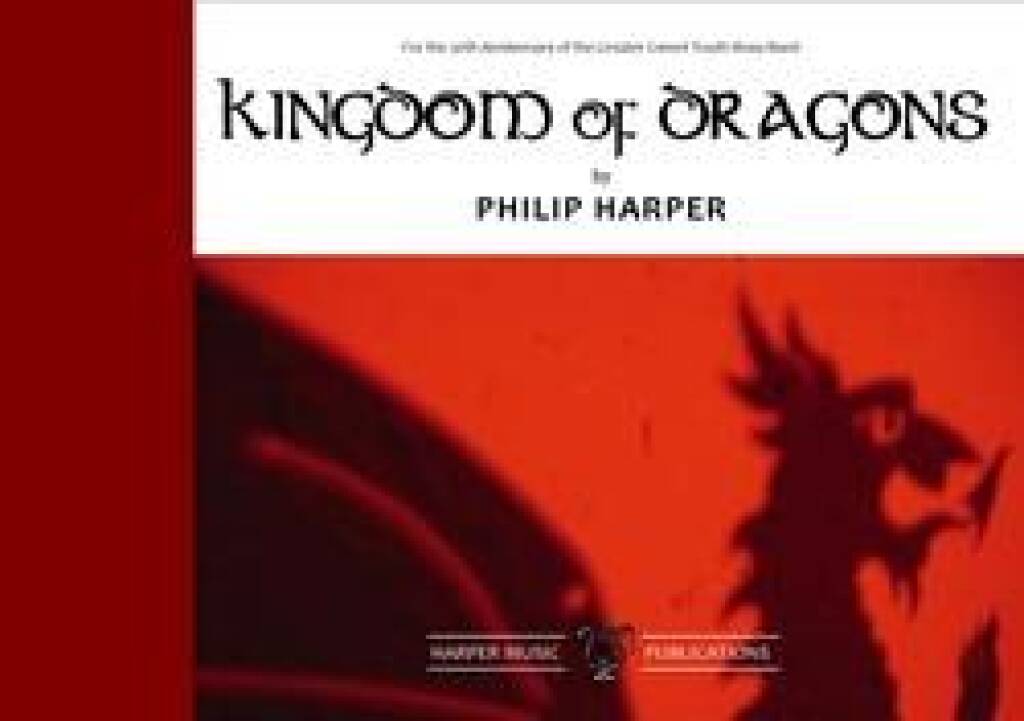
Kingdom of Dragons - Philip Harper
The 'Kingdom of Dragons' is Gwent in South Wales, known in ancient times as the Kingdom of Gwent, and more recently home to the Newport Gwent Dragons Rugby Union team. This piece was commissioned by the Gwent Music Service with additionalfunding from Ty Cerdd - Music Centre Wales to celebrate the 50th anniversary in 2010 of the formation of the Gwent Youth Brass Band. Although the music is continuous, it is divided into four distinct sections, each one representing one of theunitary authorities which make up the County of Gwent. I. Monmouthshire, which has a large number of ancient castlesII. Blaenau Gwent, an historic area of iron and coal miningIII. Torfaen, where Pontypool Park is a notablelandmarkIV. Newport, the largest city in the region. The music begins with a two-bar fanfare, which sets out all the thematic material of the piece. The mood of pageantry that follows describes some of the ancient castles inMonmouthshire, with rolling tenor drums and fanfaring cornets. After a majestic climax the music subsides and quite literally descends into the coal mines of Blaenau Gwent. The percussion provides effects that suggest industrial machineryclanking into life, and the music accelerates to become a perilous white-knuckle ride on the underground railroad. There is a brief respite as a miner's work-song is introduced and, after a protracted build-up, this is restated at fortissimo beforethe music comes crashing to an inglorious close, much like the UK's mining industry itself. The middle sonorities of the band portray the tranquillity of Pontypool Park, a place of great natural beauty. Brief cadenzas for cornet and euphoniumlead to a full band reprise of the pastoral mood. At the end of this section we find ourselves at the top of the park's 'Folly Tower' from which the distant castle turrets of Monmouthshire are visible. Pontypool RFC was one of eleven clubs inthe first Welsh league in 1881 and a brief but bruising musical portrayal of the formidable Pontypool front-row, the 'Viet Gwent' leads into the work's final section. This portrays Newport, a symbol for progress and optimism for the future, idealsshared by the Gwent Youth Band itself. The music is a vigorous fugue which advances through various keys and episodes before the final triumphant augmented entry which brings the work to a magnificent conclusion. NOTES ONPERFORMANCEPercussion requirements: (3 players) Timpani, 2 Tenor Drums, 2 Tom toms, Snare Drum (sticks and brushes required), Bass Drum, Clash Cymbals, Suspended Cymbal, Hi-hat, Sizzle Cymbal, Tambourine, Metal block with metalbeater (eg hammer), Rattle (eg football rattle), Glockenspiel, Xylophone
Estimated dispatch 5-14 working days
-
 £74.99
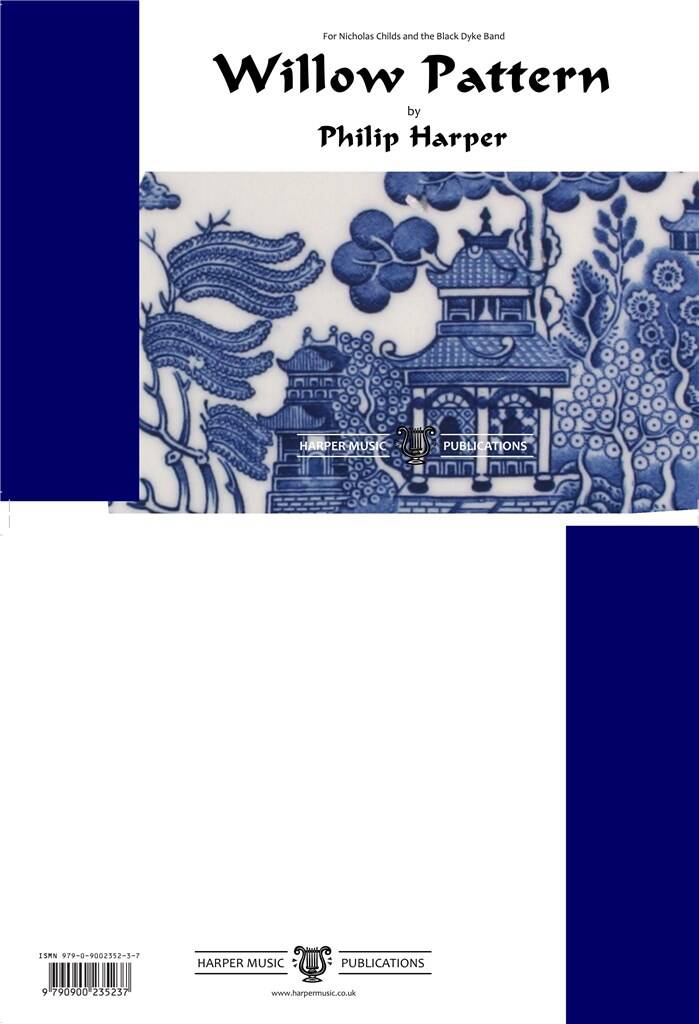
Willow Pattern - Philip Harper
Composed in 2009 for Nicholas Childs and the Black Dyke BandThis piece tells the Willow Pattern legend through music. Several leitmotifs are used both for the different characters and also for some of the important emotions in the tale. Additionally, Knoon-se's part is mainly played by the flugel horn, Changby the euphonium, the Mandarin by the Eb Bass and the Duke Ta-jin by the trombone. The Willow Pattern LegendOnce, in ancient China, there lived a wealthy and powerful Mandarin who had a beautiful daughter, Knoon-se. She had fallen in love with Chang, a humble accountant, which angered her father who imprisoned her in the Pavilion by the river with only theexotic birds for company. She learnt that the Mandarin planned to marry her to the pompous Duke Ta-jin and that the wedding would take place on the day the blossom fell from the willow tree, so she sent Chang a message: "Gather thy blossom, ere it bestolen". The Duke arrived by sea amid great fanfare when the tree was heavy with bud, and nights of magnificent banquets followed. After one such occasion when the Mandarin slept, Chang crept over the crooked fence and tiptoed into the Pavilion to rescueKnoon-se, but as they escaped the alarm was raised. They fled over the bridge with the Mandarin close on their heels brandishing his whip.They managed to escape by boat to a secluded island where they lived happily for a time. Meanwhile, the Mandarin learned of their refuge and, intent on revenge, he ordered his soldiers to kill them. As Knoon-se and Chang slept at night, the men setfire to the pagoda in which they lived and the lovers perished in the flames. However, the Gods, moved by the lovers' plight, transformed their souls into two turtle-doves which rose from the charred remains, soaring above the Earth, symbolising eternal happiness. Willow Pattern is dedicated to the memory of Jean Harper who passed away as I was completing the piece and who was a great collector of porcelain and china-ware. NOTES ON PERFORMANCEMute Requirements:Metal mutes soprano cornet, repiano cornet, 2nd cornets, 3rd cornets (6 in total) Cup mutes all cornets and trombones (10 + 3) Harmon mutes soprano cornet, solo cornets, repiano cornet (6) Percussion Requirements:There are two parts for percussion on the score. The minimum requirements are as follows: 2 players - Timpani, 2 Large tom toms, 2 Wood Blocks, Triangle, Sleigh Bells, Whip, Clash Cymbals, Suspended Cymbal, Hi-hat, Glockenspiel, Xylophone, Tam tam (or susp. cym.) For performances with extra resources, and to achieve closer authenticity, the full requirements are as follows: 3 players - Timpani, 3 Taiko Drums played with thick wooden sticks (or Large tom toms), 2 Wood Blocks, Triangle, Chinese Bells (or Sleigh Bells), Whip, Clash Cymbals, Chinese Cymbals (small clash cymbals approx 12"), Suspended Cymbal, Glockenspiel,Xylophone, Tam tam
Estimated dispatch 5-14 working days
-
 £154.99
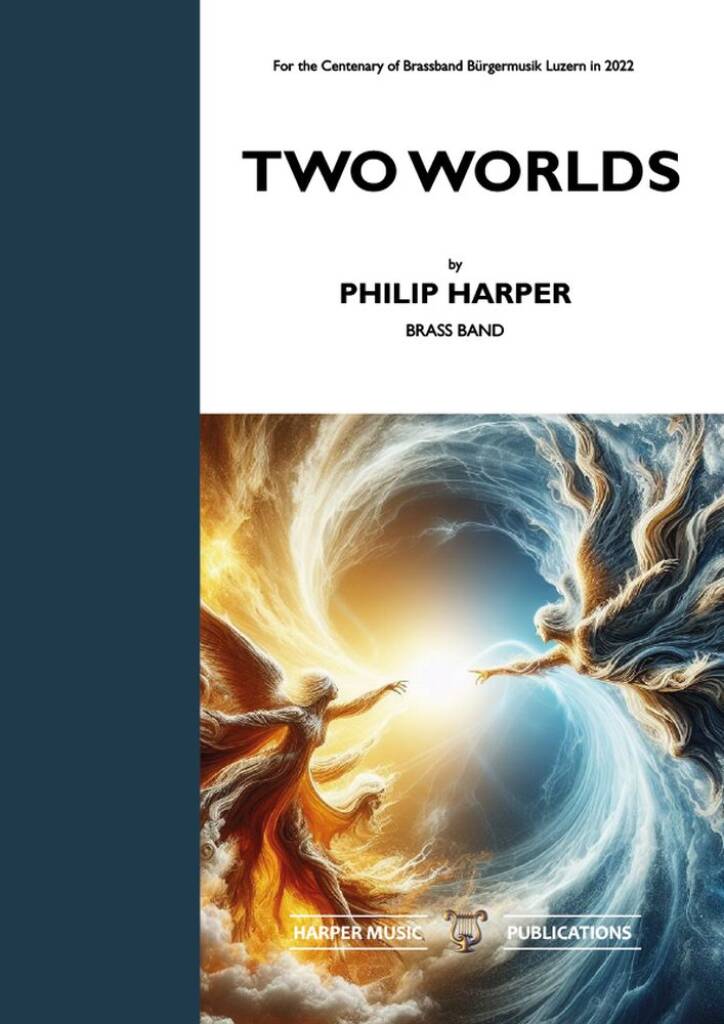
Two Worlds - Philip Harper
A powerful musical journey through time, Two Worlds explores the enduring force of storytelling. In an imaginary encounter, the Egyptian Pharaoh Tutankhamun and the American President Lincoln - in reality, separated by 5,000 years - meet to discuss the myths, truths and beliefs that shaped their respective civilizations. From the divine sun gods of Ancient Egypt to America's dream of equality, this evocative work blends fantasy and history with bold, cinematic music. At once dramatic and thought-provoking, Two Worlds reminds us that the stories we believe in can unite or divide, destroy or inspire.Commissioned for the centenary of the Swiss Brassband Burgermusik Luzern, in 2022.
Estimated dispatch 5-14 working days
-
 £127.30
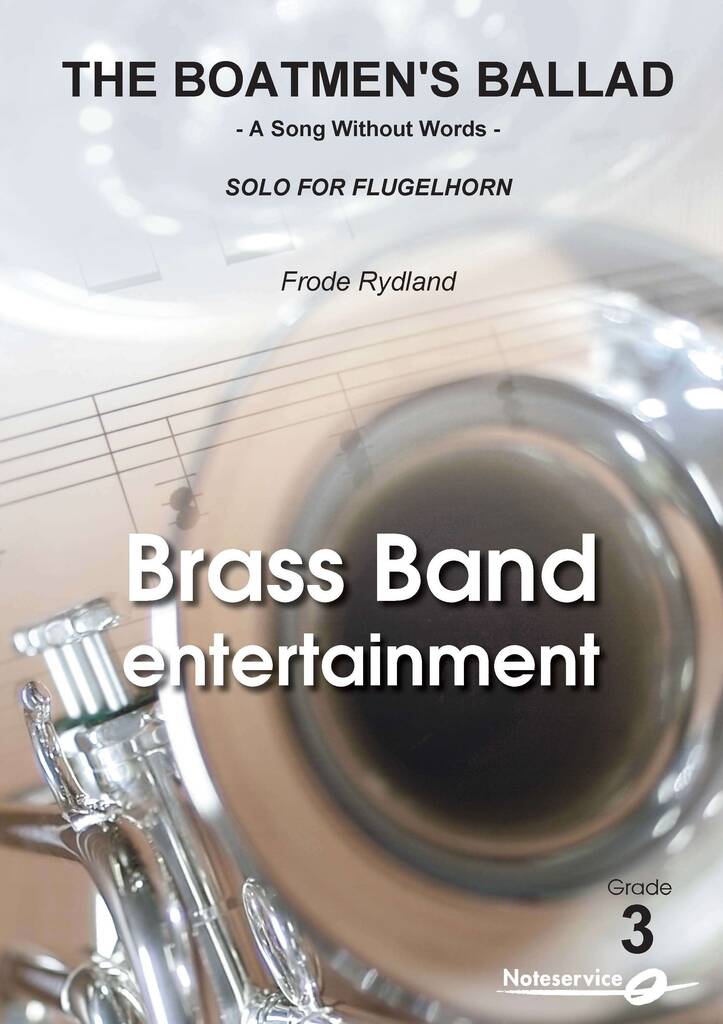
The Boatmen's Ballad - A Song Without Words - Frode Rydland
The Boatmen's Ballad describes the families of the coast guards, who are left at home hoping their beloved husband or father will survive yet another storm. To be a boatman was a very dangerous work and everybody knew that it was not for sure that they returned home.Commissioned for Eikanger-Bjorsvik Musikklag for their 2017 Siddis and Brass in Concert winning program "Tales of the North Sea".
Estimated dispatch 5-14 working days
-
 £127.30
Haven't Met You Yet - Michael Bublé - Bjørn Morten Kjærnes
"Haven't Met You Yet" is the first single from Canadian singer Michael Buble's sixth album, Crazy Love, released on August 31, 2009. According to Buble, the single and its official music video are "about everyone's dream of finding a relationship and love." Buble co-wrote "Haven't Met You Yet" with Alan Chang and Amy Foster-Gillies and dedicated it to his then fiancee and now wife, Luisana Lopilato (who appears as his love interest in the music video).2012, Nick Jonas covered the song in the TV series Smash, so this music can also be used in a TV/Movie theme concert.Soloist options:Attached is a vocal lead that can be used with the arrangement. It is then recommended to dampen the melody in the ensemble, especially on the verses. (See list below)There are some performers or groups that can have these bars as solos:9-17 Flugelhorn17-24 Euphonium/Horn37-45 Euphonium45-52 Baritone/Trombone61-69 Horn/ Flugelhorn78-85 Euphonium/Baritone86-95 Flugelhorn107-end Flugelhorn/EuphoniumIf you want to use an instrumental soloist throughout the piece, they can use the vocal lead and transpose it to their instrument. Then the conductor should dampen or remove the above solos in the band.
Estimated dispatch 5-14 working days
-
 £83.60
Los Hermanos de Bop - Mark Taylor - Sandy Smith
Los Hermanos De Bop is a composition by Mark Taylor (arr. Sandy Smith). In the Obrasso webshop are the Sheet Music for Brass Band with the article no. 16198 available. The sheet music is classified in Difficulty level C (medium). More Music for entertainment for Brass Band can be found using the flexible search function. Use the free trial score for Los Hermanos De Bop and get a musical impression from the audio samples and videos available for the Brass Band piece. With the user-friendly search function in the Obrasso webshop, you can find in just a few steps more sheet music from Mark Taylor for Brass Band. So that you can complete your concert program, show all music sheets can be displayed with one click on Music for entertainment in Difficulty level C (medium) . Los Hermanos De Bop is one of many brass music compositions that have been published by Musikverlag Obrasso. Next to Mark Taylor over 100 composers and arrangers work for the Swiss music publishing house. In addition to the notes for Brass Band you will also find literature in other formats such as Brass Band, Concert Band, Junior Band, Brass Ensemble, Woodwind Ensemble, Symphony Orchestra as well as CDs and Music Education. A large part of the publisher's own literature from top brass bands such as the Black Dyke Band, Cory Band, Brighouse & Rastrick Band or the Oberaargauer Brass Band was recorded on Obrasso Records. All sound carriers are also available digitally on the popular portals of Apple, Amazon, Google, Spotify and other providers worldwide. All Obrasso sheet music is produced on high quality paper. The slightly yellowish note paper offers a good contrast and is easy on the eyes in difficult lighting conditions. Delivery to private customers worldwide is free of shipping costs. Order your sheet music now directly from Obrasso Verlag.
Estimated dispatch 5-14 working days
 View Music