
Results
-
 £159.99
Time Machine - Thomas Doss
Time Machine is a journey through time that begins in the Stone Age. Evolution and the coming of man take place. The journey takes us into the present, in which disorientation and chaos abound. We travel further into the future. An unfamiliar, quiet and surreal landscape lies before us and we wander through it, bewildered as we become aware of the destruction of the environment. Suddenly, and for no reason, memories from our childhood are awoken. Cultures have become completely mixed into one and the evolution of man has run its course. We realise that there is no "afterwards" as before us lies the Stone Age once again... The wheel of time spins blindly on and all isrepeated.
Estimated dispatch 5-14 working days
-
 £50.00
Unsquare Dance - Dave Brubeck
As in the famous 'Take Five' Brubeck enjoyed playing with time signatures that most people would find unfamiliar. The reason for the title of this piece is obvious when one notices that it is in 7/4 time! This arrangement forBrass Band is by Mark Freeh and includes the Score and all parts. It would be suitable for a good secondary school band.
Estimated dispatch 5-14 working days
-
 £74.99
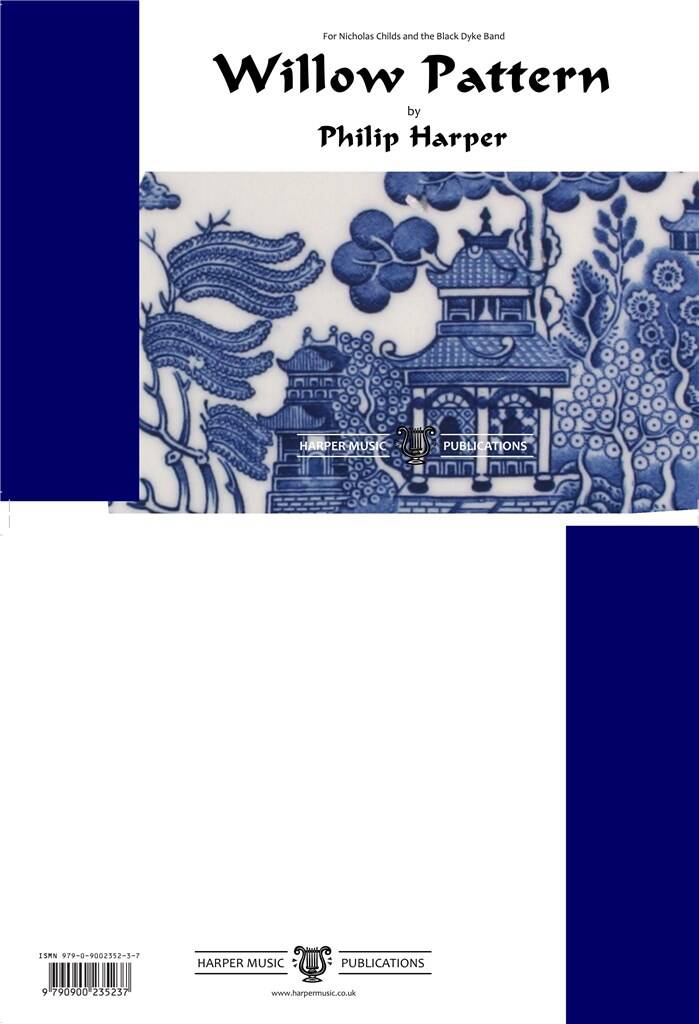
Willow Pattern - Philip Harper
Composed in 2009 for Nicholas Childs and the Black Dyke BandThis piece tells the Willow Pattern legend through music. Several leitmotifs are used both for the different characters and also for some of the important emotions in the tale. Additionally, Knoon-se's part is mainly played by the flugel horn, Changby the euphonium, the Mandarin by the Eb Bass and the Duke Ta-jin by the trombone. The Willow Pattern LegendOnce, in ancient China, there lived a wealthy and powerful Mandarin who had a beautiful daughter, Knoon-se. She had fallen in love with Chang, a humble accountant, which angered her father who imprisoned her in the Pavilion by the river with only theexotic birds for company. She learnt that the Mandarin planned to marry her to the pompous Duke Ta-jin and that the wedding would take place on the day the blossom fell from the willow tree, so she sent Chang a message: "Gather thy blossom, ere it bestolen". The Duke arrived by sea amid great fanfare when the tree was heavy with bud, and nights of magnificent banquets followed. After one such occasion when the Mandarin slept, Chang crept over the crooked fence and tiptoed into the Pavilion to rescueKnoon-se, but as they escaped the alarm was raised. They fled over the bridge with the Mandarin close on their heels brandishing his whip.They managed to escape by boat to a secluded island where they lived happily for a time. Meanwhile, the Mandarin learned of their refuge and, intent on revenge, he ordered his soldiers to kill them. As Knoon-se and Chang slept at night, the men setfire to the pagoda in which they lived and the lovers perished in the flames. However, the Gods, moved by the lovers' plight, transformed their souls into two turtle-doves which rose from the charred remains, soaring above the Earth, symbolising eternal happiness. Willow Pattern is dedicated to the memory of Jean Harper who passed away as I was completing the piece and who was a great collector of porcelain and china-ware. NOTES ON PERFORMANCEMute Requirements:Metal mutes soprano cornet, repiano cornet, 2nd cornets, 3rd cornets (6 in total) Cup mutes all cornets and trombones (10 + 3) Harmon mutes soprano cornet, solo cornets, repiano cornet (6) Percussion Requirements:There are two parts for percussion on the score. The minimum requirements are as follows: 2 players - Timpani, 2 Large tom toms, 2 Wood Blocks, Triangle, Sleigh Bells, Whip, Clash Cymbals, Suspended Cymbal, Hi-hat, Glockenspiel, Xylophone, Tam tam (or susp. cym.) For performances with extra resources, and to achieve closer authenticity, the full requirements are as follows: 3 players - Timpani, 3 Taiko Drums played with thick wooden sticks (or Large tom toms), 2 Wood Blocks, Triangle, Chinese Bells (or Sleigh Bells), Whip, Clash Cymbals, Chinese Cymbals (small clash cymbals approx 12"), Suspended Cymbal, Glockenspiel,Xylophone, Tam tam
Estimated dispatch 5-14 working days
-
 £94.99
Wigerathorp - Jan de Haan
Brass Band Gloria Dei, the group that commissioned this work, has its roots in the Frisian town of Gerkesklooster (the Netherlands), where the settlement Wigerathorp used to be. In the 13th century, a monastery was erected here, named Jeruzalem. This inspired the composer to base the work on the well-known melodious hymn Jerusalem by Sir Hubert Parry. Gercke's Overture - the monastery was built by order of landowner Gercke Harkema - is followed by a slow movement in which the founders of the monastery, The Monks of Claercamp, take shape through the Gregorian chant Veni creator spiritus. In the last movement, Monastery Jerusalem, the main theme develops in all its glory.
Estimated dispatch 5-14 working days
-
 £149.99
Redbad - Jan de Haan
Redbad was written for the Championship Section of the Dutch Brass Band Championships - and thus it contains plenty of musical and technical challenges. In this work of seven connected movements we get to know Redbad, who was the King of the Frisians from c. 680 to 719. The composer drew his inspiration from historical information, but also from stories, anecdotes, myths and legends around this figure. The themes within the composition are closely interwoven whereas the music is varied and appealing - from heroic motifs to the melancholy of elegies. Impressive tutti passages alternate with fragments that sound more open and in which various players can take centre stage. To crown it all, the work concludes with a majestic finale.
Estimated dispatch 5-14 working days
-
 £174.99
The Turing Test - Simon Dobson
Alan Turing is considered the father of modern computational science and much, if not all, of our modern computer technology and the connectivity that we now take for granted is born of the work of this one great, but troubled man. His famous test was designed to prove whether artificial intelligence (AI) could successfully imitate human thought. The single movement of The Turing Test is essentially non-programmatic, but it does seek to show something of the emotion and colour of Turing's life in its different sections. The composer employs bi-tonality and complex rhythms to show opposing worlds colliding. At the end of each test, we must decide: has true AI beenborn?
Estimated dispatch 5-14 working days
-
 £54.99
Peche Melba - Peter Martin
A delicacy for the eye, ear, and taste buds that was originally created by a Parisian cook in London. A musical haven of peace as a dessert and a romantic highlight of a diner a la carte. The melodic lines are relaxed and smooth and will definitely take you to another dimension for a while.
Estimated dispatch 5-14 working days
-
 £54.99
Peking Duck - Peter Martin
If there is one country whose music everyone can recognize, it is China. Both the pentatonic patterns and the atmosphere will take you there. And Peking Duck is a delicacy that you simply must try!
Estimated dispatch 5-14 working days
-
 £76.99
Bread and Games - William Vean
'Panem et Circenses', Bread and Games were essential for keeping the citizens of ancient Rome in check. While the bread was meant for the poorest among the Romans, the Games were Popular Pastime Number One for everybody.There were different kinds of games, such as chariot races (especially popular with female spectators), or wild-beast fights, where lions, tigers, bulls or bears were set on one another or even on human beings. Most popular, however, were the Gladiator fights. In 'Bread and Games' William Vean depicts one of the many fights in the antique Colosseum. 1. Entrance of the Gladiators: By powerful bugle-calls the attention of the peoplewas asked for, after which the Gladiators entered the Arena at the sound of heroic marching-music.2.Swordfight: We can hear that the fights were not mere child's play in this part.On the contrary, they were a matter of life and death and were fought accordingly.3.Mercy of the Emperor: Sometimes a wounded gladiator could be fortunate, depending on the mercy of the audience. Waving one's handkerchief meant mercy, a turned-down thumb meant no pardon. The Emperor had the right to take the final decision, but he usually complied with the wish of the majority of the public. 4.Lap of Honour: Gladiators were mainly selected among slaves, convicted criminals, or prisoners of war. Consequently, winning was very important, as it would mean fame, honour and sometimes even wealth. A lap of honour, therefore, was the winner's due reward.
Estimated dispatch 5-14 working days
-
 £154.99
REM-scapes - Thomas Doss
Sweet echoes of Beethoven's Moonlight Sonata in the introduction bring a gentle slumber. Breathing is calm and sleep holds the promise of rest and relaxation.With the onset of the REM sleep phase, however, in which most dreams take place and where the day's events are worked through, we hear other sounds played.With distorted sounds, reminiscent of an old gramophone, the music pulls the listener inevitably ever deeper into the dreamscape, in a very realistic dangerous situation that comes to a dramatic head. It triggers a desperate struggle between theimpulse to awaken and the exhausting urge to flee. For a short moment, it seems as if the wakeful urge has won out, before dream's powerful spell is again cast, and there's no escape...
Estimated dispatch 5-14 working days
 View Music