
Results
-
 £84.99
Voyage with the VOC - William Vean
The Netherlands have been an important trading nation for a long time partly as a result of their geographical situation. One of the first multinationals in The Netherlands was the 'Verenigde Oostindische Compagnie' (VOC). The aim of the VOC was to send ships to Asia in order to buy pepper and spices, and to take over the Portuguese monopoly in this field. The Company was successful. An era of great prosperity resulted, in which the art of painting (Rembrandt van Rijn) as well as science (Constantijn Huygens) flourished alongside a thriving economy. 1. The Sails are set : There is a lot of hustle and bustle on the quay. The crew are preparing fordeparture. Goodbyes are said and once the sails have been hoisted the ship sets out to sea.2. A Visit to the Rajah of Yogyakarta: After a voyage of many months the place of destination is reached. A visit to the Radja, the king of the area around Yokyakarta, follows. The dishes and beverages and the native culture in general are very pleasant after having been on a diet of ship's biscuit and water for such a long time.3. The Holds have been loaded: The holds have been loaded to the brim, and the voyage home can be begin!4. Death sails along: Life at sea is rough. not seldom did a sailor die of a tropical disease or scurvy. After a memorial service, the Captain would speak the words 'One, two, three, in God's name ...' and the body, wrapped in canvas, would be committed to the sea.5. A joyful homecoming: After many months of hardship coming home is perhaps the best part of the entire voyage. The quay is filled with people eager to give the crew a warm welcome.
Estimated dispatch 5-14 working days
-
 £19.95
The Falcon in the Snow for Brass Band - Paul Saggers
The Falcon in the Snow is a musical depiction of British explorer Robert Falcon Scott's expedition to reach the South Pole, the work is divided into five sections, using quotes from Falcon Scott's own journal:Saturday November 26, 1910 - "We advertised our start at 3.P.M., and at three minutes to that hour the Terra Nova pushed off from the jetty".Robert Falcon Scott led the British Antarctic Expedition from 1910 to 1913, aiming to be the first to reach the South Pole. Leaving from Cardiff, Wales, in June 1910, the expedition arrived at the Ross Ice Shelf in January 1911. Scott's team established base camp at Cape Evans on Ross Island and began preparations for the push to the Pole.Thursday February 2, 1911 - "The Blizzard, Nature's protest-the crevasse, Nature's pitfall".The expedition faced numerous challenges, including harsh weather, difficult terrain, and the logistics of transporting supplies and equipment over long distances. Scott divided his men into different teams for the Pole attempt, with one led by himself and the other by Ernest Shackleton, who was eventually sent home due to illness.Tuesday January 16, 1912 - "The Norwegians have forestalled us and are first at the pole. It is a terrible disappointment, and I am very sorry for my loyal companions".Scott's team set out for the South Pole, enduring extreme conditions and struggling with low food supplies. They reached the Pole on January 17, 1912, only to discover that the Norwegian explorer Roald Amundsen had beaten them to it by 34 days.Thursday January 18, 1912 - "We have turned our back now on the goal of our ambition and must face our 800 miles of solid dragging".Disheartened, the team began the long and arduous journey back to base camp. Tragically, Scott and his companions-Edward Wilson, Henry Bowers, Lawrence Oates, and Edgar Evans-perished during their return journey. They were slowed by extreme weather and suffering from exhaustion and malnutrition.Thursday March 29, 1912 - "For God's sake look after our people".Their final camp, found in November 1912, became their tomb. Scott's journal, recovered with his body, provides a poignant record of their struggles.Despite the tragic outcome, Scott's expedition contributed significantly to the understanding of the Antarctic region. The scientific research and specimens collected during the journey provided valuable insights into the continent's natural history and biology. Additionally, the expedition stimulated public interest in polar exploration and science, leaving a legacy in the chronicles of exploration.
-
 £39.95
Sing with the Band Medley No.1
Includes: Part 1: Tavern in the Town; My Grandfather's Clock; Little Brown Jug. Part 2: Cockles and Mussels; A Farmer's Boy; Loch Lomond; John Brown's Body. Word Sheet included
Estimated dispatch 7-14 working days
-
 £35.00
Ascension - Lucy Pankhurst
A major work written for the RNCM Brass Festival Competition 2005, and inspired by the nature of Ascension - creating a Musical depiction of the spiritual journey towards enlightenment, sanctuary and ultimate inner peace.As aninitial muse for this work, the 'Tibetan Singing Bowl' is utilised with the Brass Band in order to represent this path to Serenity, together withBaoding Balls(Chinese Health Balls) to mark the point of Final Ascension.Programme notes from the composer, Lucy Pankhurst:Ascension is a Musical depiction of the Spiritual Journey towards enlightenment, sanctuary and ultimate inner peace.As my initial muse for this work, the Singing Bowl is utilised with the Brass Band in order to represent this path to Serenity. "Tibetan" Singing Bowls date back to the 8th Century A.D., originating in the pre-Buddhist shamanic Bon Po culture in the Himalayas and are still used in modern Monasteries. The original purpose of them still remains a mystery, with accounts stating that it is forbidden to disclose the true function of the Bowls, as the "secrets of sound" yield so much Power, that they must be kept hidden.Listening to the tones created by the Singing Bowl effectively silences the internal dialogue of the listener, making it an excellent tool for Meditation, Centering and entering trance-like states. In Buddhism, as with many cultures, sound is an important part of Spiritual Practice. There are 9 methods to reach Enlightenment in the Buddhist Doctrine ; the seventh is SOUND.These Bowls are used by Healers in a similar way to help balance the body's residual energies. The Bowls are usually made from seven different sacred metals, intended to correlate directly to the seven sacred "Planets" : GOLD (Sun), SILVER (Moon), MERCURY (Mercury), COPPER (Venus), IRON (Mars), TIN (Jupiter), ANTIMONY (Saturn). Any one Bowl can create up to seven different frequencies (tones) simultaneously. In Healing, the Singing Bowl is played whilst balanced on the palm of the hand, struck three times to stabilise the surrounding energies, before rotating the wooden "beater" around the outer circumference of the Bowl to create the "singing" effect.I have included an optional Vibraphone part (to be played with a Double Bass Bow) with Tubular Bells, to be used only in performances where a Singing Bowl cannot be acquired. However, a traditional Bowl should be used whenever possible, to create this specific and unique sound.Baoding Balls or Chinese Health Balls are also utilised in this work. Their appearance in the Music here, however, is to mark the point of Final Ascension, where the music reaches its ultimate goal. These delicate cloisonne iron Balls are said to stimulate the acupressure points on the hand, thus improving the Chi and Energy Paths (Life Force) throughout the entire body. The delicate "tinkle" produced by these spheres is hypnotic and captivating. For this reason, where no Baoding Balls are obtainable for performance, only delicate metallic percussion should be used in replacement (i.e. Crotales, Antique Cymbals or (liberal) single strikes on a Triangle etc.). Bell Trees, Wind Chimes and Cow Bells should not be used.As in many cultures, the number three is important in Ascension, as it represents not only the purification from the Singing Bowl, but also it is a number of confirmation, reiterated throughout the music in the metallic percussion in addition to the Brass, re-affirming the correct path to Enlightenment.
In Stock: Estimated dispatch 3-5 working days
-
 £42.95
TWO HYMNS TO THE MOTHER OF GOD (Brass Band) - Tavener, John - Littlemore, Phillip
Two Hymns (A Hymn to the Mother of God (3:00); Hymn for the Dormition of the Mother of God (3:45)) were written in memory of the composer's mother. The first, originally composed for double choir, is a setting of a text from the Liturgy of St. Basil. It speaks of the almost cosmic power attributed to the Mother of God by the Orodox Church. The second comes from the Vigil Service for the Dormition (or falling asleep) of the Mother of God. She invites the apostles to gather together from the ends of the earth to bury her body in Gethsemane, and asks her son to receive her spirit.
Estimated dispatch 7-14 working days
-
 £39.95
SING WITH THE BAND Selection No.1 (Brass Band) - Siebert, Edrich
Includes: Part 1: Tavern in the Town; My Grandfather's Clock; Little Brown Jug. Part 2: Cockles and Mussels; A Farmer's Boy; Loch Lomond; John Brown;s Body. Word Sheet included
Estimated dispatch 7-14 working days
-
 £38.95
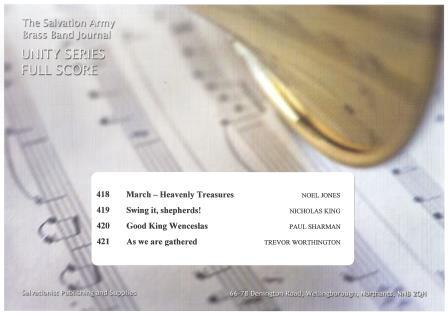
Unity Series Band Journal June 2014 Numbers 418-421
No.418 March - Heavenly Treasures (Noel Jones)Rich people cannot take money with them when they die but Christians have the joy of laying up treasure in Heaven. This march by Noel Jones incorporates two choruses 'Lay up treasure in Heaven' (TBCS 249)and 'Bright Crowns' (TB 78).No.419 Swing it, Shepherds! (Nicholas King)The traditional English Carol, 'While shepherds watched' and the spiritual carol 'Rise up, shepherd!' are combined in a bright swing arrangement by Deputy Songsters Leader Nicholas King, who is also a member of the Music Ministries Unit.No.420 Good King Wenceslas (Paul Sharman)The lyrics of the well-known carol 'Good King Wenceslas' were written by John Mason Neale in the 1850s and the tune used comes from a collection of medieval Latin songs, Piae Cantiones, published in 1582. It has been given a light-hearted treatment, which also features brief references to other carols.No.421 As we are gathered (Trevor Worthington)An arrangement of John Daniels' lovely song, the words of which say:As we are gathered, Jesus is here;One with each other, Jesus is here;Joined by the Spirit, washed in the blood,Part of the Body, the Church of God.As we are gathered, Jesus is here;One with each other, Jesus is here.
Estimated dispatch 7-14 working days
-
 £60.00
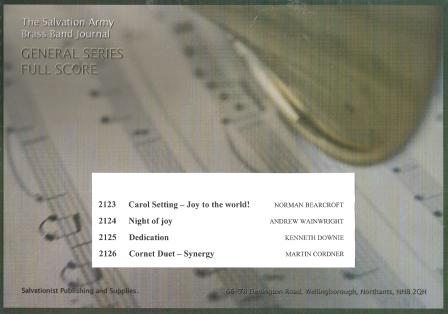
General Series Band Journal August 2013 Numbers 2123-2126
No. 2123 Carol Setting - Joy to the world! (Lieut. Colonel Norman Bearcroft)'Joy to the world' is a melody often attributed to Handel, but it is a bringing together of a couple of brief snippets of themes from his oratorio, 'Messiah'. These were put together by Lowell Mason to form the tune, 'Antioch', which we use for this carol. The carol has been arranged in majestic style by Lieut-Colonel Norman Bearcroft.No. 2124 Night of Joy (Andrew Wainwright)'Night of Joy' is based on a traditional Spanish Christmas song entitled 'Cantemos a Maria' ('Let's sing to Mary').No. 2125 Dedication (Dr Kenneth Downie)A setting of Colonel Brindley Boon's beautiful song of dedication, 'I dedicate myself to thee' (Musical Salvationist, November 1950).No. 2126 Cornet Duet - Synergy (Captain Martin Cordner)This piece celebrates the Biblical principle of believers working together in the Body of Christ and incorporates the song with words by Catherine Baird 'We're in Gods Army and we fight together with the composers own melody to Philip Paul Bliss's words 'Whosoever heareth! shout, shout the sound.
Estimated dispatch 7-14 working days
-
 £38.50
Smash
Imagine the nocturnal life of a big city. Countless people who want to escape the hustle and bustle of everyday life. The streets appear in the light of the advertising boards and from nightclubs you can hear loud music. Music whose rhythm goes directly through the body and puts you in a cheerful mood.
Estimated dispatch 7-14 working days
-
 £107.95
When Worlds Collide (Score and Parts)
Subtitled: Little Green Men in Intergalactic Spaceships with Ray-Guns and Phasers, A Space Symphony for Brass band. Written for the free choice test piece for Brass Band Buizingen for the Flemish Open Brass Band Championships. When Worlds Collide seeks to recreate the atmosphere and sentiment of the American cult Sci-Fi movies of the 1950's such as Robert Wise's 1951 film 'The day the Earth Stood Still' and 'Invasion of the Body Snatches' directed by Don Siegel in 1956, as well as Rudolph Mate's 1951 film 'When Worlds Collide'. It is programmatic with subtitled sub-sections as follows: Crop Circles; Lights in the Sky; Strange Happenings; Sightings; "We Come in Peace"; Alien Abduction; Analysis of the Earthlings; Teleportation; New Understandings; Visions of Far Off Worlds; Colonisation.
Estimated dispatch 7-14 working days
 View Music
 Watch video