
Results
-
£94.00
Across the Ocean (Bra) - Pimpanit Karoonyavanich
After "The Poseidon" and "A Journey to The Bermuda Triangle", "Across The Ocean" is the third composition that inspired Pimpanit by her favorite sea painting of Romain Steppe, a Belgian painter who lived in the 19th century (1859-1927). It depicts 3 different images of the sea connected to the emotion of sailors. The first part gives the mixed feelings between agitation and excitement reflecting the turbulent sea which is challenging for the sailors to discover the new land. The second part reflects the beautiful calm sea when the sun sets. That gives warm and romantic feelings but hidden with loneliness especially for the sailors who travel far away from home and miss their loved one. Then the image suddenly changes to the angry sea with rain and storm in the third part. To end the first part's theme comes back declaring that the adventure starts again!
Estimated dispatch 7-14 working days
-
£68.00
Nearer, My God, To Thee (Bra) - Lowell Mason & James L. Stevens - Mike Kilmartin
"Nearer, My God, to Thee" is a 19th-century Christian hymn which retells a story from 'Genesis': "So he came to a certain place and stayed there all night, because the sun had set. And he took one of the stones of that place and put it at his head, and he lay down in that place to sleep. Then he dreamed, and behold, a ladder was set up on the earth, and its top reached to heaven; and there the angels of God were ascending and descending on it..."The hymn was also used by other composers like Carl Nielsen and Charles Ives, and was played by the string ensemble on the movie 'Titanic' when the vessel sank.This arrangement is based on the beautiful BYO choir version and Mike Kilmartin did a great job making a lovely band version of it.
Estimated dispatch 7-14 working days
-
£75.00
Black Hole (Bra) - Stijn Aertgeerts
Black Hole is the slow movement from the bigger piece 'Supernova', commissioned by Royal Fanfare Band 'De Ware Eendracht'- Schriek (B). Supernova is the story of a dying star, an incredible galactic explosion. If a supernova would erupt at the location of the sun, it would evaporate the earth. After the outburst is all that remains a black hole. An area of pure darkness that has swallowed all life.
Estimated dispatch 7-14 working days
-
£33.00
Carnaval Dorado
Translated literally, Carnaval Dorado means 'golden carnival'. Whilst composing this piece, I had in mind a marching carnival band that slowly forms out of the morning mist but then quickly starts marching with energy and purpose in the early sunshine. There is a brief siesta halfway through where the 'band' conserves its energy in the mid-day sun but soon the percussion section calls the band
In Stock: Estimated dispatch 1-3 working days
-
£51.00
Metropolis
Metropolis was composed for James McLeod, Principal Euphonium of the Leyland Band. Inspired by a tour to Dubai in October 2014, the opening of the piece portrays a journey through the city on the main highway surrounded by the impressive skyline. This then moves into a slower passage reflecting the sun setting as the buildings start to illuminate the night sky. The final section encapsulates the
In Stock: Estimated dispatch 1-3 working days
-
.png) £34.95
£34.95A King is Born! - Jonathan Bates
DURATION: 3'00". DIFFICULT: 1st+. 'A King is Born!' was composed for Skelmanthorpe Band's programme of music celebrating the 30th anniversary of Walt Disney's 'The Lion King' at the 2024 Red Admiral Entertainment Championships. The baking sun rises slowly over the savannah, as the newly born heir to the throne - Simba - sleeps peacefully ahead of his triumphant presentation to the animals as the future Lion King.
In Stock: Estimated dispatch 1-3 working days
-
 £29.95
Fall of Icarus, The - Jonathan Bates
DURATION: 4 minutes. DIFFICULTY: 2nd+. The Fall of Icarus was composed for the Lions Youth Brass Band as the finale to their runers-up set at the 2018 National Youth Brass Band Championships of Great Britain. The music is inspired by the steady rise towards the sun of the Greek mythological character Icarus, as his impending fate becomes closer and closer. This work was designed as a more widely accesible alternative to the much loved March from the Pines of Rome by Respighi.
In Stock: Estimated dispatch 1-3 working days
-
 £61.11
Heligan - Kevin Ackford
Score & Parts A descriptive piece of around 13 minutes telling the story of and taking you on a journey around the Lost Gardens of Heligan. Following the introduction, we begin our journey at the Grand House with the staff scurrying around carrying out their work. Next comes the outbreak of World War 1 when all of the male staff of the house signed up with the Duke of Cornwall's Light Infantry. Following the war only 6 of the gardens 22 staff survived and returned to Heligan. After the war the gardens "Go to Sleep" and become overgrown. Then comes the modern-day workers rediscovering the gardens and beginning to put them back to their former glory. Then the sun rises over the gardens and the birds begin to sing and we find ourselves in the serene lost valley. We then pass through the Jungle before turning the corner and once again see the House and lawns in all their glory.
Estimated dispatch 5-7 working days
-
 £25.00
Ring'd with the Azure World
DescriptionRing'd with the Azure World was commissioned by the Harmonia Brass quintet for their final recital at the University of Huddersfield in 2016.He clasps the crag with crooked hands; Close to the sun in lonely lands, Ring'd with the azure world, he stands.The wrinkled sea beneath him crawls; He watches from his mountain walls, And like a thunderbolt he falls.- The Eagle by Alfred, Lord TennysonThe music was inspired by Tennyson's poem reproduced above; it seeks simply to reflect the spirit of the poem. It opens in sparse, lonely mood as the eagle surveys the world beneath. The work quickens in three bursts using metrical modulation to disguise the actual moment of acceleration, reflecting the lazy energy stored in the circling raptor before concluding dramatically in a fall 'like a thunderbolt'. Tennyson's poem, although brief, has inspired much analysis and writing, and is notable for being written in the (then somewhat unfashionable) iambic tetrameter, indicating a foursquare emphasis reflected in the main theme of the music. This is heard first in an octatonic version and later in a purely tonal (if somewhat modal) version. The instrumentation reflects that of Harmonia Brass, a quintet composed of brass band instruments (two B flat cornets, an E flat tenor horn, tenor trombone and E flat tuba). However the music is also available for the more conventional brass quintet of two trumpets, french horn, trombone and tuba.To listen to an audio export preview and follow the music, click play on the video below!Performance Notes1st cornet/trumpet requires a cup mute, ideally with an adjustable cup (the marking "tight" denotes that the cup should be adjusted closer to the bell), and a harmon mute with the tube removed (denoted by "TR" in the score). 2nd cornet/trumpet requires a fibre straight mute and a harmon mute with the tube removed. Tenor horn require a fibre straight mute and a practice mute (any sort) - in the orchestral brass version the french horn requires a stop mute. Trombone requires a cup mute (only). Tuba requires a fibre straight mute and a practice mute (of any sort).Metronome marks should be closely observed - starting either too fast or too slow will have a disproportionate effect on the tempi later in the piece due to the metrically controlled tempo changes.
Estimated dispatch 7-14 working days
-
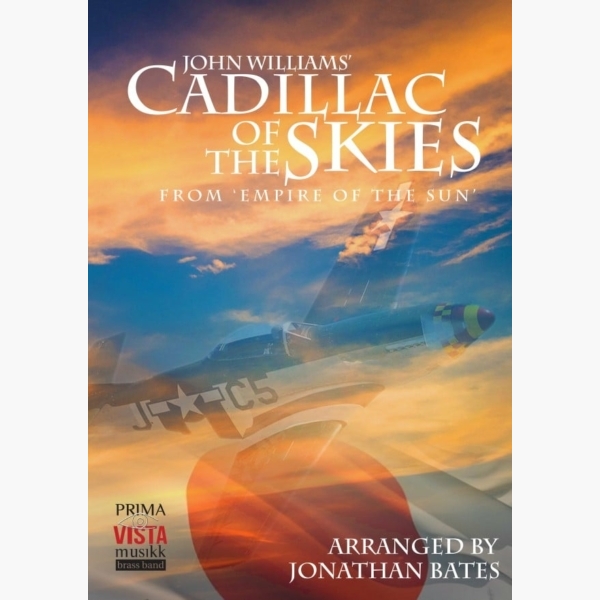 £29.95
Cadillac of the Skies - John Williams - Jonathan Bates
Cadillac of the Skies is taken from the score of the 1987 film Empire of the Sun, by John Williams. As Jim, played by a young Christian Bale, watches in amazement as a P-51 aircraft attacks the camp where he...
Estimated dispatch 5-7 working days

 View Music
