
Results
-
 £59.77
Sleigh Ride Suite (Brass Band) Leopold Mozart arr. Alex McGee
Today Leopold Mozart (1719-1787) is known almost exclusively as the stern father of Wolfgang, but he was a prominent and successful musician in his own time. The Sleigh Ride, composed just before Wolfgang was born, certainly shows that Mozart the elder had as good a sense of humour as his more famous son. Wolfgang must, in fact, have known and enjoyed his father's piece - he included a short Sleigh Ride in his German Dances, K.605, in 1791. Leopold's more complicated piece is a programmatic serenade, with short titles for each section: a musical picture of a cold evening's ride to a party. The score calls for sleigh bells, rattle, a whip, and triangle. The action begins with a short overture (Intrada), followed by the Sleigh Ride itself, a lively duple-meter dance accompanied by jangling sleigh bells and punctuated by the cracking of a whip. There is then a nice bit of musical pantomime - The Young Lady Shivers With Cold. The sleigh finally arrives at the party, a ball with a small dance orchestra. The Ball Begins, not surprisingly, with a courtly menuet, and the End of the Ball is a spirited Kehraus, a lively rondo-form dance. This transcription faithfully seeks to convey the light touch of the Age of Enlightenment to the modern brass band and provides ensembles with new material for their annual Christmas concerts. To view a rolling score video of the work please visit https://www.youtube.com/watch?v=tgrBe1u8Xag Duration: Approx. 11.45 minutes Difficulty Level: 3rd Section + PDF download includes parts and score. Sheet music available from www.brassband.co.uk Instrumentation: Soprano Cornet Eb Solo Cornet Bb Repiano Cornet Bb 2nd Cornet Bb 3rd Cornet Bb Flugel Horn Bb Solo Horn Eb 1st Horn Eb 2nd Horn Eb 1st Baritone Bb 2nd Baritone Bb 1st Trombone Bb 2nd Trombone Bb Bass Trombone Euphonium Bb Bass Eb Bass BbTimpani Percussion 1-2
In Stock: Estimated dispatch 1-3 working days
-
 £37.35
Polonaise from 'Scenes de Ballet' (Brass Band) Glazunov arr. Rob Bushnell
Alexander Glazunov was a Russian composer who was a gifted musician from childhood. He was seen as the natural heir to the nationalist revolution that had started with the Mighty Handful. Despite quickly turning from this to absolute forms of music, taking a keen interest in ballet music, his compositions still alludes to Russian folk tunes. He wrote four dance compositions, of which Scenes de Ballet was the first in 1894. The suite Scenes de Ballet, opus 52 has eight movements and was dedicated to the orchestra of the Russian Opera, St Petersburg. First performed in 1895 at a concert of the Imperial Music Society with Glazunov conducting. This arrangement of the final movement is for the British-style brass band, with alternative parts for horns in F and bass-clef lower brass. A recording of the original composition can be found here: https://www.youtube.com/watch?v=BS-Yx-bmxPg Duration: approx. 5.20 minutes Difficulty Level: 2nd Section + PDF download includes parts and score. Sheet music available at www.brassband.co.uk (UK) or https://satradecentral.org (USA) Instrumentation: Soprano Cornet Eb Solo Cornet Bb Repiano Cornet Bb 2nd Cornet Bb 3rd Cornet Bb Flugel Horn Bb Solo Horn Eb 1st Horn Eb 2nd Horn Eb 1st Baritone Bb 2nd Baritone Bb 1st Trombone Bb 2nd Trombone Bb Bass Trombone Euphonium Bb Bass Eb Bass Bb Timpani Percussion 1 - Snare Percussion 2 - Triangle, Cymbal & Bass Drum
In Stock: Estimated dispatch 1-3 working days
-
 £41.09
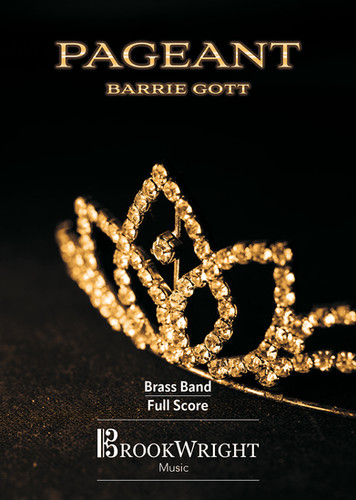
Pageant (Brass Band) Barrie Gott
Born during the isolation of the COVID-19 pandemic, Pageant by Australian composer Barrie Gott transforms the simple interval of a fourth into an engaging, multi-faceted set of variations. Written specifically with 4th Section bands in mind, this work delivers rich textural contrast, clear educational rewards, and a crowd-pleasing arc that moves from regal tradition to high-energy rock. The piece opens with a majestic herald, setting a ceremonial tone as a warm, mellow melody dialogues with bright, fanfare-like brass. From there, the music moves through three distinct stylistic worlds: a delicate, nimble variation inspired by the craft of Eric Ball's A Little Suite for Band; a smooth, lyrical ballad featuring the solo cornet and flugel horn; and a high-energy finale grounded in a driving 6/8 rock groove, bringing the work to a dramatic, cinematic finish. To listen to a recording of Toowoomba Municipal Band performing the work please visit: https://on.soundcloud.com/i9X5JsWQedaAbiWzXf Duration: approx. 6.45 mins Difficulty Level: 4th Section + This PDF download includes the full score and parts. Sheet music available at www.brassband.co.uk (UK) or https://satradecentral.org (USA) Instrumentation: Soprano Cornet Eb Solo Cornet Bb Repiano Cornet Bb 2nd Cornet Bb 3rd Cornet Bb Flugel Horn Bb Solo Horn Eb 1st Horn Eb 2nd Horn Eb 1st Baritone Bb 2nd Baritone Bb 1st Trombone Bb 2nd Trombone Bb Bass Trombone Euphonium Bb Bass Eb Bass Bb Timpani Percussion 1-4
In Stock: Estimated dispatch 1-3 working days
-
 £8.50
£8.50FIRST SUITE FOR JUNIOR BRASS (score) - Frederick, Mike
The score shows brass band scoring & percussion.Contents / Comments:
In Stock: Estimated dispatch 1-3 working days
-
 £27.50
FIRST SUITE FOR JUNIOR BRASS (score & parts) - Frederick, Mike
The score shows brass band scoring & percussion.Contents / Comments:
In Stock: Estimated dispatch 1-3 working days
-
 £44.95
Reflections (Flugel and Tenor Horn Duet with Brass Band - Score and Parts) - Graham, Peter
Duet for Flugel and Tenor Horn or Two Bb Cornets from War of the Worlds SuiteEach movement of War of the Worlds is available separately allowing for a variety of "mini-suite" combinations eg: Movements 1,2 and 5 or 3,4 and 5 etc. For movements 1, 4 and 5 see the BB Concert Music tab. Complete suite also available.Reflections is the second movement of the suite War of the Worlds which was commissioned by the Senzoku Gakuen College of Music Saxophone Orchestra and first performed by them in the Maeda Hall, Japan on June 29 2012, the composer conducting. The music is dedicated to Professor Shin-ichi Iwamoto. The transcription for brass band was first performed by the Brighouse & Rastrick Band, conductor David King, in the Bridgewater Hall Manchester on September 8 2012.The suite takes inspiration from the 1953 film script adaptation of the famous HG Wells novel and key scenes from the film are set as individual movements: Reflections - here mankind contemplates a life forever changed as the invaders progress their colonisation of Planet Earth.
Estimated dispatch 7-14 working days
-
 £44.95
Deliverance (from War of the Worlds Suite) (Soprano Cornet or Tenor Horn Solo with Brass Band - Score and Parts) - Graham, Peter
Deliverance is the fourth movement of the suite War of the Worlds which was commissioned by the Senzoku Gakuen College of Music Saxophone Orchestra and first performed by them in the Maeda Hall, Japan on June 29 2012, the composer conducting. The music is dedicated to Professor Shin-ichi Iwamoto. The transcription for brass band was first performed by the Brighouse & Rastrick Band, conductor David King, in the Bridgewater Hall Manchester on September 8 2012.The suite takes inspiration from the 1953 film script adaptation of the famous HG Wells novel and key scenes from the film are set as individual movements: Deliverance - survivors seek sanctuary in the Church of Santa Maria, still standing among the burning ruins of Los Angeles, and pray for deliverance from the invaders.Each movement of War of the Worlds is available separately allowing for a variety of "mini-suite" combinations eg: Movements 1,2 and 5 or 3,4 and 5 etc.
Estimated dispatch 7-14 working days
-
 £64.95
Dance Spirit (Brass Band - Score and Parts) - Wiffin, Rob
Dance Spirit is a three movement suite of dances comprising Stomping Dance, Waltz Interlude and Duende linked by solo dancer cadenzas. It started life as the wind band piece Spirit of the Dance. In it I attempted to capture some of the elements of this most fundamental of human activities, the urge to move our bodies to the rhythm of the music. In re-working it for brass band I extended the duration of the Waltz Interlude and increased the technical level in some areas with the intention of making it a suitable test piece.Stomping Dance - The suite starts with perhaps the most basic dance feeling, the desire to stomp our feet to the music, unrefined, no knowledge of steps needed. The heavy stomp is not always present in the music here, and sometimes you can sense the dancers trying something a little more refined, but it is always lurking in the background, ready to draw us back to the elemental rhythm of the beat.Waltz Interlude - Of course, dance does not always have to have heat, it can be elegant and restrained, emphasising fluidity of line and movement. In the waltz it is occasionally suspended by the held poses before the motion starts again. Unlike the outer movements, the Waltz Interlude is cool, danced in moonlight rather than under the sun. The two dancers sometimes move as one and at other times the man provides a frame for the more intricate arabesques of his partner.Duende - During my time living in Spain I went to watch some flamenco dancing. I was expecting the normal tourist cliches but the dancers were serious students of Flamenco Nuevo y Viejo (new and old). They performed with passion to some pounding asymmetric rhythms and their performance was the inspiration for Duende. Duende as a term is hard to define. It is a spirit of performance - that moment when you are right in the middle of the creative spirit of the music. It is about soul and a heightened state of emotion. Federico Garcia Lorca wrote: I have heard an old maestro of the guitar say, The duende is not in the throat; the duende climbs up inside you, from the soles of the feet. Meaning this: it is not a question of ability, but of true, living style, of blood, of the most ancient culture, of spontaneous creation.- Rob WiffinDuration: 13.45
Estimated dispatch 7-14 working days
-
 £100.00
King Arthur (Scenes from a Radio Drama) (Brass Band - Score and Parts) - Britten, Benjamin - Hindmarsh, Paul
King Arthur (Scenes from a radio drama) was the first of 28 scores Benjamin Britten (1913-1976) composed for radio between 1937 and 1947. It was an ambitious dramatisation of King Arthur's life and times - part pageant, part play, part cantata - written by D.G. Bridson.This colourful suite incorporates the Introduction, a dramatic Wild Dance, some of the music underscoring the scenes for Galahad and The Holy Grail, and two vivid battle scenes, ending with The Final Battle and Apotheosis.King Arthur (Scenes from a radio drama) for brass band should not be confused with a much longer orchestral suite which Paul Hindmarsh devised from the same source in 1995.Suitable for Premier Youth/2nd Section Bands and aboveDuration: 14.00
Estimated dispatch 7-14 working days
-
£19.99
King Arthur (Scenes from a Radio Drama) (Brass Band - Score only) - Britten, Benjamin - Hindmarsh, Paul
King Arthur (Scenes from a radio drama) was the first of 28 scores Benjamin Britten (1913-1976) composed for radio between 1937 and 1947. It was an ambitious dramatisation of King Arthur's life and times - part pageant, part play, part cantata - written by D.G. Bridson.This colourful suite incorporates the Introduction, a dramatic Wild Dance, some of the music underscoring the scenes for Galahad and The Holy Grail, and two vivid battle scenes, ending with The Final Battle and Apotheosis.King Arthur (Scenes from a radio drama) for brass band should not be confused with a much longer orchestral suite which Paul Hindmarsh devised from the same source in 1995.Suitable for Premier Youth/2nd Section Bands and aboveDuration: 14.00
Estimated dispatch 7-14 working days
 View Music