
Results
-
£73.00
Stealing Apples - Fats Waller - Reid Gilje
"Stealing Apples" is an old swing-tune written by Fats Waller. Performances by Benny Goodman and his big band made the song very popular.In this arrangement for brass band, the mallet percussion is very essential. Mallet Percussion presents the melody from letter A and is also featured as soli-instruments from letter L to P. These parts can alternatively be played as vibraphone solo.Please be aware of the balance at letter A. Horn and Trombones must play piano but well articulated. Letter D must sound sparkling and fresh with articulated and powerful trombones and cornets (using straight-mute).Make shue that the 8th-notes are not played too dotted two bars before letter G. Almost even 8th-notes accentuated on the start of the slur is a good tip.Watch the balance at letter H. This part have to sound homogeniously.The soloistic Soprano Cornet at letter Q must be played in the style of Benny Goodan. The accompaniment must not be too powerful from letter R to S. Best of luck with the performance!
Estimated dispatch 7-14 working days
-
£67.00
Hymne til gleden - Ludwig van Beethoven - Bjorn Morten Kjaernes
Schiller's text of 1785 was partially used by Beethoven in1824 when he did finish the 4th movement of his 9th Symphony. The melody has later been used in very many contexts. As the anthem of the European Union, a lot of movies (A clockwork Orange, Die Hard, etc.), music to video games, as the anthem of Rhodesia, as rebel song in Chile and by FIFA. Therefore, it can be used in most settingsThis Young Band arrangement focuses on the main melody. In the original, the B part is repeated in each variation, but to get three variations (out of four), this repetition has been cut. The first variation should be played as soft as possible, but still with a nice sound. Crescendo to forte (f) and going back to pp should be as a surprise.
Estimated dispatch 7-14 working days
-
£86.00
Minnen fran Holmen - Jerker Johansson
The first theme played by the solo clarinet was written by Jerker Johansson the summer 1997, when he was composing in Swedish folk music style for an intended radio programme in which his father should participate reading poems in local dialect. Unfortunately, the project was discontinued. In the spring 2015 Mr. Johansson however started to work on the theme again, this time adding a song theme of broader character. Holmen is the name of the homestead where Mr. Johansson's father Arne grew up. It is beautifully located in the parish of Skarv, situated east of Skara, one of the oldest towns in Sweden. At Holmen, the composer spent his childhood summers and his recollections are filled with many bright moments and happy memories. The piece was premiered May 22, 2015 by the Goteborg Wind Orchestra conducted by the composer.
Estimated dispatch 7-14 working days
-
£70.00
Milestone - Peter Meechan
Milestone is a concerto commissioned by Mark Wilkinson (with funds provided by the Arts Council England) to celebrate 21 years as Principal Cornet with Fodens Band. In three movements, the work is intended to not only demonstrate the soloistas virtuosic skills, but also his ability to communicate to the audience.The first movement, titled Milestone, combines sections of driving rhythms (intended to represent Markas years of continuing hard work), in the accompaniment with long legato phrases from the soloist interspersed with dexterous, virtuosic, passages.The second movement, Song, features a simple chord sequence, over which the soloist asingsa a melody, each time varying and each time becoming more expressive, leading to an emotional climax.The final movement, Twenty One, is a quasi-celebratory dance. Opening with the band clapping, the soloist weaves their way through the various textures in the band. Occasionally making both a musical and metaphorical nod to the industrious nature of the first movement, the chord sequence of the second movement also re-appears, before a brief coda takes us to the conclusion of the work.
Estimated dispatch 12-14 working days
-
£44.95
CHRISTUS VICTOR (Brass Band Set) - Kenneth Downie
This is a glorious selection of music to celebrate the supreme victory of Jesus Christ. The predominant theme of 'Crown Him!' comes from the Thomas Kelly hymn 'Look, ye saints! The sight is glorious' which are associated with Henry Smart's tune 'Regent Square'. Also featured are Andre Crouch's song 'Soon and very soon' as well as Dave Bilborough's 'All hail the lamb'. In the final pages of the score, all three tunes come together in a statement of affirmation.
Estimated dispatch 7-14 working days
-
£59.95
BEULAH LAND (Brass Band Set) - Wilfred Heaton - Paul Hindmarsh
Wilfred Heaton began to assemble material for 'Beulah Land' in the early 1990s following a request from the Amsterdam Staff Band for a new work. Despite reminding himself on the manuscript that he should either complete or destroy the work before his death, ultimately he did not manage either. This edition was subsequently realised in 2003 for the tour of the USA Western States by the Amsterdam Staff Band.'Beulah Land' is Heaton's vision of the joy that awaits the Christian in Heaven and, according to his family, is reminiscent of the kind of music he often improvised at the piano. The three movements are as follows;1. Better World; a waltz sequence on the tune 'Zealley' to which the words 'There is a better world, they say' are sung.2. Heavenly Home; an elegiac cortege using the tunes 'My home is in Heaven', 'I have a home that is fairer than day' and 'The home over there'.3. Happy Land; Beginning in waltz rhythm this soon gives way to a sequence of free variations on the song 'There is a happy land, Far, far away'.
Estimated dispatch 7-14 working days
-
£59.95
QUINTESSENCE (Brass Band Set) - Robert Redhead
Originally written for the Melbourne Staff Band's tour of the UK in 1978 and, more specifically, their participation in The Salvation Army International Congress in London, the music expresses the quintessence of Australian Salvationism. The five sections are; 1. An original theme expressing the immensity of the Australian continent. 2. Australia's sons, let us rejoice representing the character of the people. 3. Glory, glory, glory hallelijah from the song The Christian Mission. 4. A meditative setting of At Thy feet I bow adoring, written by two Australian Salvationists. 5. A development of the previous themes bringing the work to its climactic conclusion.
Estimated dispatch 7-14 working days
-
Diamonds - Jerry Lordan - Len Jenkins
In November 1962, ex-Shadows members Jet Harris and Tony Meehan decided to work as a duo and went to No 1 with a Jerry Lordan composition, "Diamonds". Harris, a bass player, took an ordinary Fender guitar and detuned every string a whole tone to enable him to hit notes which were lower than an ordinary guitar. However, it was apparently difficult to work with on stage since once the strings were slackened they would go out of tune very easily. The duo went on to have a second Top 10 hit with "Scarlett O'Hara" which is also available from Wobbleco Music in an arrangement for brass band. Both arrangements seek to capture the characteristic style of 60's rock music and retain the signature drum solos for which they are rightly remembered. But in addition, both pieces also appeal to a younger generation who may not have heard the originals. Our young kit drummer in Woburn Sands 'A' Band commented "...the (drum) part has the slightest shuffle feel to it, which improves the groove of the song, and to replicate the vintage snare-drum sound, I have heard that you can place a towel or a cloth over the head of the drum. I think it would work well...(otherwise) the drum part stays relatively simple and repetitive"...Chance to re-create the sound of the 60's.....Go for it!
-
 £49.95
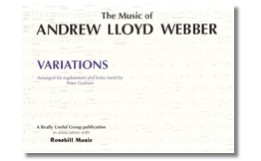
Variations - Andrew Lloyd Webber arr. Peter Graham
There are numerous sets of variations based on Paganinni's famous violin piece, but surely this is the only one written as the result of a wager on a football match! The composer wrote these variations for his cello-playing brother Julian in payment of a bet on a Leyton Orient match and they later formed part of the show Song and Dance. Peter Graham's arrangement of some of the best-loved sections ideally suits the euphonium.
Estimated dispatch 7-9 working days
-
 £4.95
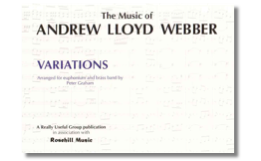
£4.95Variations (Euphonium Solo) (Score and Parts) - Andrew Lloyd Webber arr. Peter Graham
There are numerous sets of variations based on Paganinni's famous violin piece, but surely this is the only one written as the result of a wager on a football match! The composer wrote these variations for his cello-playing brother Julian in payment of a bet on a Leyton Orient match and they later formed part of the show Song and Dance. Peter Graham's arrangement of some of the best-loved sections ideally suits the euphonium.
Estimated dispatch 7-9 working days