
Results
-
 £91.99
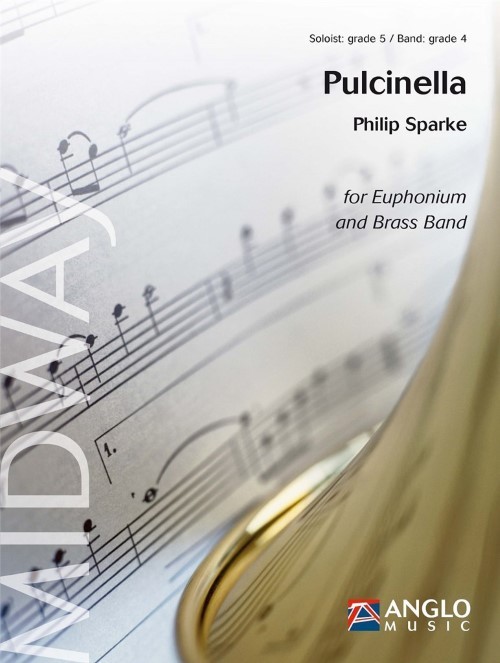
Pulcinella (Euphonium Solo with Brass Band - Score and Parts) - Sparke, Philip
Pulcinella was commissioned by the Taiwanese euphonium player Tzu-Hsiang Lin. Lin is a renowned soloist and teacher and a Besson Euphonium Artist. He teaches euphonium at Taipei National University of the Arts, National Taiwan University of Arts, Shih Chien University and National Kaohsiung Normal University. Lin gave the premiere of Pulcinella in both its concert band and brass band versions in January 2021. Pulcinella continues Sparke's series of euphonium solos named after characters of the Italian commedia dell'arte and opens with a long and expressive minor melody for the soloist over a brooding accompaniment. This is taken up briefly by the full band and is extended by the soloist after a change of key. A cadenza, accompanied by fragments of the main melody leads to a complete change of mood, tempo and tonality, introducing a Vivo section starting with a perky syncopated tune for the soloist. The band then uses elements of this new tune to introduce a change of key, where the soloist introduces a more lyrical second subject over a pulsing accompaniment. The band then takes this up and changes key to reintroduce the original Vivo melody, which leads to a short and acrobatic coda to bring the work to a spectacular close. Duration: 6.45
Estimated dispatch 7-14 working days
-
 £154.99
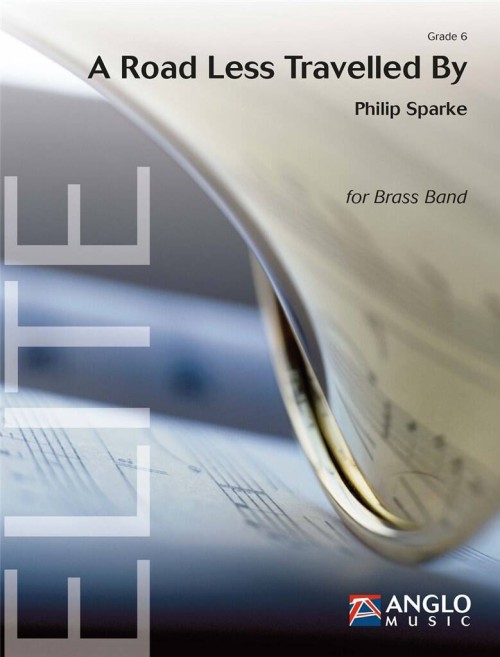
A Road Less Travelled By (Brass Band - Score and Parts) - Sparke, Philip
A Road Less Travelled By was commissioned by Palangos Orkestras for the Championship Section of the 2020 European Brass Band Championships held in Palanga, Lithuania.The following was written by the composer, Philip Sparke:The title alludes to a poem by American author, Robert Frost, which appeared in his 1916 collection, Mountain Intervals: The Road Not Taken.In common with most of my larger works, this piece in not programmatic, but purely abstract; there is no extrinsic musical story. The choice of title shares my view of how composers can often develop. There can be no 'destination' in a composer's career, but rather a continuing journey to an unknown place. From piece to piece a composer needs to decide his or her next steps, never really knowing where they might lead. As Frost so eloquently describes, these sorts of instinctive decisions guide all our lives.Set in three movements, which play without a break, A Road Less Travelled By opens with a Moto Perpetuo firmly rooted in classical language, form and syntax. A continuous river of semiquavers, veering from melody to accompaniment and back again, adds drive, every and motion. The second movement, Nocturne, is in the form of a free fantasia; solos for vibraphone, flugel horn and euphonium set the stage for a central cornet solo, quietly echoed by the full band. A triumphal climax is reached before the movement dissolves into a Scherzo Finale. Mercurial and quixotic in nature, this third movement starts jovially until trios for trombones and horns darken the atmosphere. A change of mood and meter leads to a reprise of the opening and a return of the cornet melody, this time accompanied by figures derived from the scherzo theme. A brief coda based on earlier material drives the piece to a close.Duration: 15.30
Estimated dispatch 7-14 working days
-
£36.50
A Road Less Travelled By (Brass Band - Score only) - Sparke, Philip
A Road Less Travelled By was commissioned by Palangos Orkestras for the Championship Section of the 2020 European Brass Band Championships held in Palanga, Lithuania.The following was written by the composer, Philip Sparke:The title alludes to a poem by American author, Robert Frost, which appeared in his 1916 collection, Mountain Intervals: The Road Not Taken.In common with most of my larger works, this piece in not programmatic, but purely abstract; there is no extrinsic musical story. The choice of title shares my view of how composers can often develop. There can be no 'destination' in a composer's career, but rather a continuing journey to an unknown place. From piece to piece a composer needs to decide his or her next steps, never really knowing where they might lead. As Frost so eloquently describes, these sorts of instinctive decisions guide all our lives.Set in three movements, which play without a break, A Road Less Travelled By opens with a Moto Perpetuo firmly rooted in classical language, form and syntax. A continuous river of semiquavers, veering from melody to accompaniment and back again, adds drive, every and motion. The second movement, Nocturne, is in the form of a free fantasia; solos for vibraphone, flugel horn and euphonium set the stage for a central cornet solo, quietly echoed by the full band. A triumphal climax is reached before the movement dissolves into a Scherzo Finale. Mercurial and quixotic in nature, this third movement starts jovially until trios for trombones and horns darken the atmosphere. A change of mood and meter leads to a reprise of the opening and a return of the cornet melody, this time accompanied by figures derived from the scherzo theme. A brief coda based on earlier material drives the piece to a close.Duration: 15.30
Estimated dispatch 7-14 working days
-
 £159.99
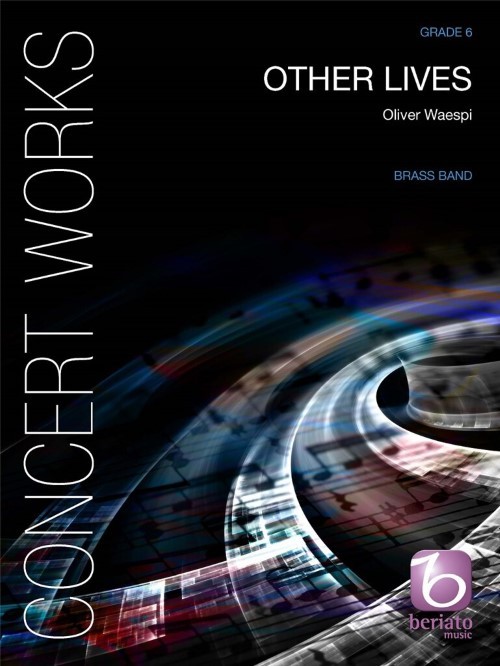
Other Lives (Brass Band - Score and Parts) - Waespi, Oliver
Other Lives is works perfectly for a competition but can also be programmed as concert work. The dark chords at the beginning of the piece are derived from Der Doppelganger, one of Franz Schubert's late songs. After a short development the music begins to accelerate and find its own shape, gradually moving away from the introduction. The entire first part, Rage, has an intensely agitated character. The ensuing Reflection turns back to the initial chord progression, before a series of interspersing solos explore time and space at a slower pace. After another musical surge, the music is brought close to silence and then gives way to the third part, Redemption. Here, a widely spaced sound field contains a remote allusion to another work by Schubert, Ruckblick. After this farewell, an abstract musical transformation triggers an emotional change, as the initial motifs are now presented in their inversed form in order to create a much brighter harmonic landscape. Moreover, in the last part of the piece, Renewal, the grim, tense atmosphere of the first part is transformed into a great energy.Duration: 18.00
Estimated dispatch 7-14 working days
-
 £55.50
Autumn Dreams (Valse Brillante) (Trombone Solo with Brass Band - Score and Parts) - Zimmerman, Leopold A. - Wilkinson, Keith M.
Leopold A Zimmerman (1866 - 1935) succeeded the legendary Arthur Pryor as trombone soloist in the Sousa Band and, following his predecessor's example as well as that of other soloists in the band, composed several solos to demonstrate his considerable talents. This arrangement was been requested by Brett Baker for a recording with Black Dyke Band.
Estimated dispatch 7-14 working days
-
 £26.95
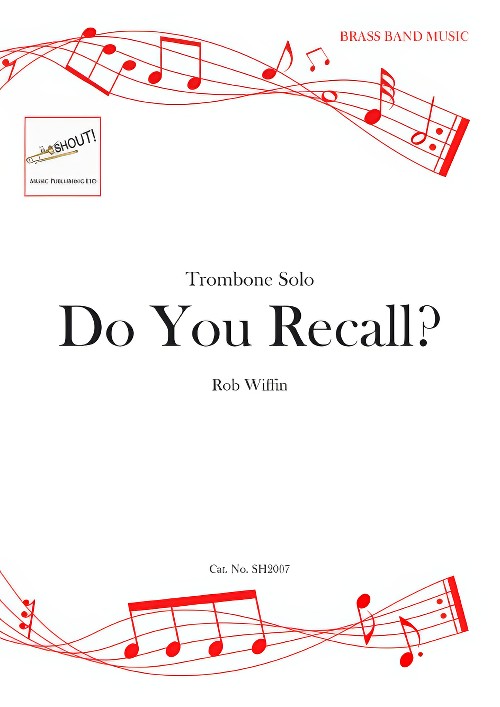
Do You Recall? (Trombone Solo with Brass Band - Score and Parts) - Wiffin, Rob
A slow, bluesy solo for trombone with band accompanimentLike many people, I took the opportunity offered by the COVID lockdown in Spring of 2020 to sort through old paperwork. I discovered a lot of songs that had not seen the light of day for many years and were mostly written with just the melody and chord symbols. Some offered the potential of becoming instrumental solos with a combination of heart-on-the-sleeve melodies the like of which I would not write now, together with maybe a greater sophistication in the instrumental writing. I had the notion in the back of my mind that Do you recall?; would work as a trombone solo but it seemed to fight me all the way. However, once finished it has proved to appeal to trombonists and has already been recorded by Brett Baker. It is not intrinsically difficult but needs a sense of the appropriate slow swing style and good control throughout the range.- Rob WiffinDuration: 4.15
Estimated dispatch 7-14 working days
-
 £44.95
Music of a Legacy - Contest Version (Brass Band - Score and Parts) - Ponsford, Steven
This piece pays tribute to the vast heritage of Salvation Army brass band music. Written in one movement, it is rhapsodic in nature and quotes references from just a few of the many iconic pieces from the past, progressing naturally through the different styles of music; firstly marches, followed by meditations, major works and then solos. The underpinning theme that binds the work together is the much-loved hymn, by Timothy Dudley-Smith, drawing particular attention to the last line of the first verse; 'Lord for the years, we bring our thanks today'. This is music of thanksgiving to the rich inheritance that inspires writers today to continue the mission of the gospel through this very special and unique genre.
Estimated dispatch 7-14 working days
-
£22.50
Music of a Legacy - Contest Version (Brass Band - Score only) - Ponsford, Steven
This piece pays tribute to the vast heritage of Salvation Army brass band music. Written in one movement, it is rhapsodic in nature and quotes references from just a few of the many iconic pieces from the past, progressing naturally through the different styles of music; firstly marches, followed by meditations, major works and then solos. The underpinning theme that binds the work together is the much-loved hymn, by Timothy Dudley-Smith, drawing particular attention to the last line of the first verse; 'Lord for the years, we bring our thanks today'. This is music of thanksgiving to the rich inheritance that inspires writers today to continue the mission of the gospel through this very special and unique genre.
Estimated dispatch 7-14 working days
-
£44.95
Music of a Legacy (Brass Band - Score and Parts) - Ponsford, Steven
This piece pays tribute to the vast heritage of Salvation Army brass band music. Written in one movement, it is rhapsodic in nature and quotes references from just a few of the many iconic pieces from the past, progressing naturally through the different styles of music; firstly marches, followed by meditations, major works and then solos. The underpinning theme that binds the work together is the much-loved hymn, by Timothy Dudley-Smith, drawing particular attention to the last line of the first verse; 'Lord for the years, we bring our thanks today'. This is music of thanksgiving to the rich inheritance that inspires writers today to continue the mission of the gospel through this very special and unique genre.
Estimated dispatch 7-14 working days
-
£22.50
Music of a Legacy (Brass Band - Score only) - Ponsford, Steven
This piece pays tribute to the vast heritage of Salvation Army brass band music. Written in one movement, it is rhapsodic in nature and quotes references from just a few of the many iconic pieces from the past, progressing naturally through the different styles of music; firstly marches, followed by meditations, major works and then solos. The underpinning theme that binds the work together is the much-loved hymn, by Timothy Dudley-Smith, drawing particular attention to the last line of the first verse; 'Lord for the years, we bring our thanks today'. This is music of thanksgiving to the rich inheritance that inspires writers today to continue the mission of the gospel through this very special and unique genre.
Estimated dispatch 7-14 working days
 View Music