
Results
-
 £39.95
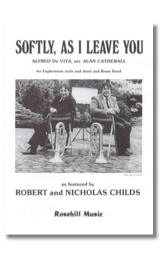
Softly, As I Leave You - Alfred de Vita arr. Alan Catherall
Made popular by many singers over the years, this lovely song was first arranged for the Childs brothers as a solo, and later a duet, by Alan Catherall. It was first performed in the duet version at the Royal Albert Hall, London, in October 1985, conducted by their late father, John Childs. Also available with piano Brass Band Set comprises: Detailed condensed conductor score Solo B-flat Euphonium B-flat Euphonium Duet (2) E-flat Soprano Cornet Solo B-flat Cornet (4) 2nd B-flat Cornet (2) 3rd B-flat Cornet (2) B-flat Flugelhorn* Solo E-flat Horn* 1st E-flat Horn* 2nd E-flat Horn 1st B-flat Baritone 2nd B-flat Baritone 1st B-flat Trombone 2nd B-flat Trombone Bass Trombone B-flat Euphonium (2) E-flat Bass (2) B-flat Bass (2) 1st Percussion 2nd Percussion 3rd Percussion (Drum Kit) * Alternative parts for use as solo or duet provided. There is no Repiano Cornet part.
Estimated dispatch 7-9 working days
-
 £15.00
My Love is Like a Red, Red Rose - Helen Douthwaite
Robert Burns' beautiful melody is brought to life as a euphonium solo with brass band accompaniment in this simple, yet highly effective, arrangement by Helen Douthwaite.Originally arranged by Helen for the Kirkintilloch Youth Band, the piece not only features the soloist with a carefully crafted, accessible solo line, but also enables the rest of the band to shine through the tutti elements.Set includes score and parts for:Solo CornetRepiano Cornet2nd Cornet3rd CornetFlugelhornSolo Eb Tenor Horn1st Eb Tenor Horn2nd Eb Tenor Horn1st Baritone2nd Baritone1st Trombone2nd TromboneBass TromboneEuphoniumEb BassBb Bass (optional)GlockenspielPercussionAdditional world parts also provided include F Horn 1/2/3, Baritone 1/2 in bass clef, Trombone 1/2 in bass clef, Euphonium in bass clef, Tuba.
In Stock: Estimated dispatch 3-5 working days
-
 £74.95
Eden (Score and Parts)
This work was commissioned by the Brass Band Heritage Trust as the test piece for the final of the 2005 Besson National Brass Band Championship, held at the Royal Albert Hall, London.The score is prefaced by the final lines from Milton's epic poem Paradise Lost (completed in 1663), in which Adam and Eve, expelled from Paradise, make their uncertain way into the outside world:"...The world was all before them, where to chooseTheir place of rest, and providence their guide:They hand in hand with wandering steps and slow,Through Eden took their solitary way."My work is in three linked sections. In the first, the characters of Adam, Eve and the serpent guarding the Tree of Knowledge are respectively represented by solo euphonium, cornet and trombone. The music opens in an idyllic and tranquil mood and leads into a duet between euphonium and cornet. Throughout this passage the prevailing mood darkens, though the soloists seem to remain oblivious to the increasingly fraught atmosphere. A whip-crack announces the malevolent appearance of the solo trombone who proceeds to engage the solo cornet in a sinister dialogue.The second section interprets the Eden story as a modern metaphor for the havoc mankind has inflicted upon the world, exploiting and abusing its resources in the pursuit of wealth. Though certainly intended here as a comment on the present-day, it is by no means a new idea: Milton himself had an almost prescient awareness of it in Book I of his poem, where men, led on by Mammon:"...Ransacked the centre and with impious handsRifled the bowels of their mother earthFor treasures better hid. Soon had his crewOpened into the hill a spacious woundAnd digged out ribs of gold."So this section is fast and violent, at times almost manic in its destructive energy. At length a furious climax subsides and a tolling bell ushers in the third and final section.This final part is slow, beginning with an intense lament featuring solos for tenor-horn, flgel-horn and repiano cornet and joined later by solo baritone, soprano cornet, Eb-bass and Bb-bass.At one stage in the planning of the work it seemed likely that the music would end here - in despair. Then, mid-way through writing it, I visited the extraordinary Eden Project in Cornwall. Here, in a disused quarry - a huge man-made wound in the earth - immense biomes, containing an abundance of plant species from every region of the globe, together with an inspirational education programme, perhaps offer a small ray of hope for the future. This is the image behind the work's conclusion and the optimism it aims to express is real enough, though it is hard-won and challenged to the last.John Pickard 2005
Estimated dispatch 7-14 working days
-
 £29.50
Eden (Score Only)
This work was commissioned by the Brass Band Heritage Trust as the test piece for the final of the 2005 Besson National Brass Band Championship, held at the Royal Albert Hall, London.The score is prefaced by the final lines from Milton's epic poem Paradise Lost (completed in 1663), in which Adam and Eve, expelled from Paradise, make their uncertain way into the outside world:"...The world was all before them, where to chooseTheir place of rest, and providence their guide:They hand in hand with wandering steps and slow,Through Eden took their solitary way."My work is in three linked sections. In the first, the characters of Adam, Eve and the serpent guarding the Tree of Knowledge are respectively represented by solo euphonium, cornet and trombone. The music opens in an idyllic and tranquil mood and leads into a duet between euphonium and cornet. Throughout this passage the prevailing mood darkens, though the soloists seem to remain oblivious to the increasingly fraught atmosphere. A whip-crack announces the malevolent appearance of the solo trombone who proceeds to engage the solo cornet in a sinister dialogue.The second section interprets the Eden story as a modern metaphor for the havoc mankind has inflicted upon the world, exploiting and abusing its resources in the pursuit of wealth. Though certainly intended here as a comment on the present-day, it is by no means a new idea: Milton himself had an almost prescient awareness of it in Book I of his poem, where men, led on by Mammon:"...Ransacked the centre and with impious handsRifled the bowels of their mother earthFor treasures better hid. Soon had his crewOpened into the hill a spacious woundAnd digged out ribs of gold."So this section is fast and violent, at times almost manic in its destructive energy. At length a furious climax subsides and a tolling bell ushers in the third and final section.This final part is slow, beginning with an intense lament featuring solos for tenor-horn, flgel-horn and repiano cornet and joined later by solo baritone, soprano cornet, Eb-bass and Bb-bass.At one stage in the planning of the work it seemed likely that the music would end here - in despair. Then, mid-way through writing it, I visited the extraordinary Eden Project in Cornwall. Here, in a disused quarry - a huge man-made wound in the earth - immense biomes, containing an abundance of plant species from every region of the globe, together with an inspirational education programme, perhaps offer a small ray of hope for the future. This is the image behind the work's conclusion and the optimism it aims to express is real enough, though it is hard-won and challenged to the last.John Pickard 2005
Estimated dispatch 7-14 working days
-
 £45.00
Ocean of Storms
Ocean of Storms or Oceanus Procellarum is one of only a few lunar maria or 'seas' on the moon's surface to be called an ocean, due to its immense size. The work opens atmospherically with a sense of weightlessness and introduces the main thematic idea. As the work develops the turbulent ebb and flow of the storm increases in its ferocity with solo spots for solo cornet, solo euphonium, flugelhorn and baritone. Duration: 00:05:45 Grade: 6
Estimated dispatch 5-7 working days
-
 £37.15
Seaside Odyssey (Brass Band) Liz Lane
Seaside Odyssey is a celebration of the British seaside! The music represents a juxtaposition between natural and manmade elements; there are two main musical themes - the reflective sea (a wordless setting of John Masefield's Sea Fever) and a more lively 'seaside' theme, heard separately in different ways and later together. From childhood memories, sand, beach and cliffs to cafes, ice creams, fish and chips, buckets and spades, boating trips, beach huts, bandstands, piers, theatres, gardens, mini golf, arcades and more, Seaside Odyssey is a journey from dawn to dusk with the sea at the heart of the music.This work was commissioned by Grimethorpe Colliery Band for its seaside tour, August 2023, where it performed at Paignton, Lyme Regis, Weymouth, Shanklin and Herne Bay.Includes optional poems and words specially curated from poets associated with the seaside towns, which can be read before a performance.Duration: approx. 5 minutesThis PDF download includes parts and score.Sheet music available at www.brassband.co.uk (UK) or https://satradecentral.org (USA)Instrumentation:Eb Soprano CornetBb Solo CornetBb Repiano CornetBb Cornet 2Bb Cornet 3Bb FlugelhornEb Solo Tenor HornEb Tenor Horn 1Eb Tenor Horn 2Bb Baritone 1Bb Baritone 2Bb Trombone 1Bb Trombone 2Bass TromboneBb EuphoniumEb BassBb BassPercussion 1: timpani, triangle and optional 'arcade jackpot' effect (see score/part)Percussion 2: 3 suspended cymbals (2 ride, 1 crash) and hi-hatPercussion 3: snare, tom-toms and bass drumPercussion 4: glockenspiel
In Stock: Estimated dispatch 1-3 working days
-
 £29.72
Still, Still, Still (Horn Section Feature with Brass Band) arr. Stephen Tighe
Still, still, still is an Austrian Christmas carol and lullaby. The melody is a folk tune from the Salzburg area and the tune appeared for the first time in 1865 in a folksong collection. The words describe the peace of the infant Jesus and his mother as the baby is sung to sleep. They have changed slightly over the years, but the modern standard German version was established in the mid-19th century.This arrangement by Stephen Tighe features the flugelhorn and horn section with brass band.PDF download includes score and parts.Sheet music available from:UK - www.brassband.co.ukUSA - www.solidbrassmusic.comDifficulty Level: 4th Section +Instrumentation:Soprano Cornet EbSolo Cornet BbRepiano Cornet Bb2nd Cornet Bb3rd Cornet BbFlugel Horn BbSolo Horn Eb1st Horn Eb2nd Horn Eb1st Baritone Bb2nd Baritone Bb1st Trombone Bb2nd Trombone BbBass TromboneEuphonium BbBass EbBass BbTimpaniSleigh BellsDrum KitGlockenspiel
In Stock: Estimated dispatch 1-3 working days
-
 £53.00
The Goodbye - Paul Voet
We sail the ocean with stubborn, hardworking but weak hearted Flemish fishermen to the Northern parts of the Atlantic. A sailor is leaving his wife or girlfriend not knowing if he is going to come back soon. Leaving for good fishing grounds around Iceland. This sad song(the first line of the text says; The wind that blows from the east, my love, is not going to blow for ever) is a solo for flugelhorn accompanied by the whole lower brass section. In a certain way of counterpoint tenorhorns, baritones and euphoniums are woven around thesoloist. The warmth from these saxhorn section is coloured by some chords from trombones and a quite virtuosi marimba line.
Estimated dispatch 10-14 working days
-
 £35.00
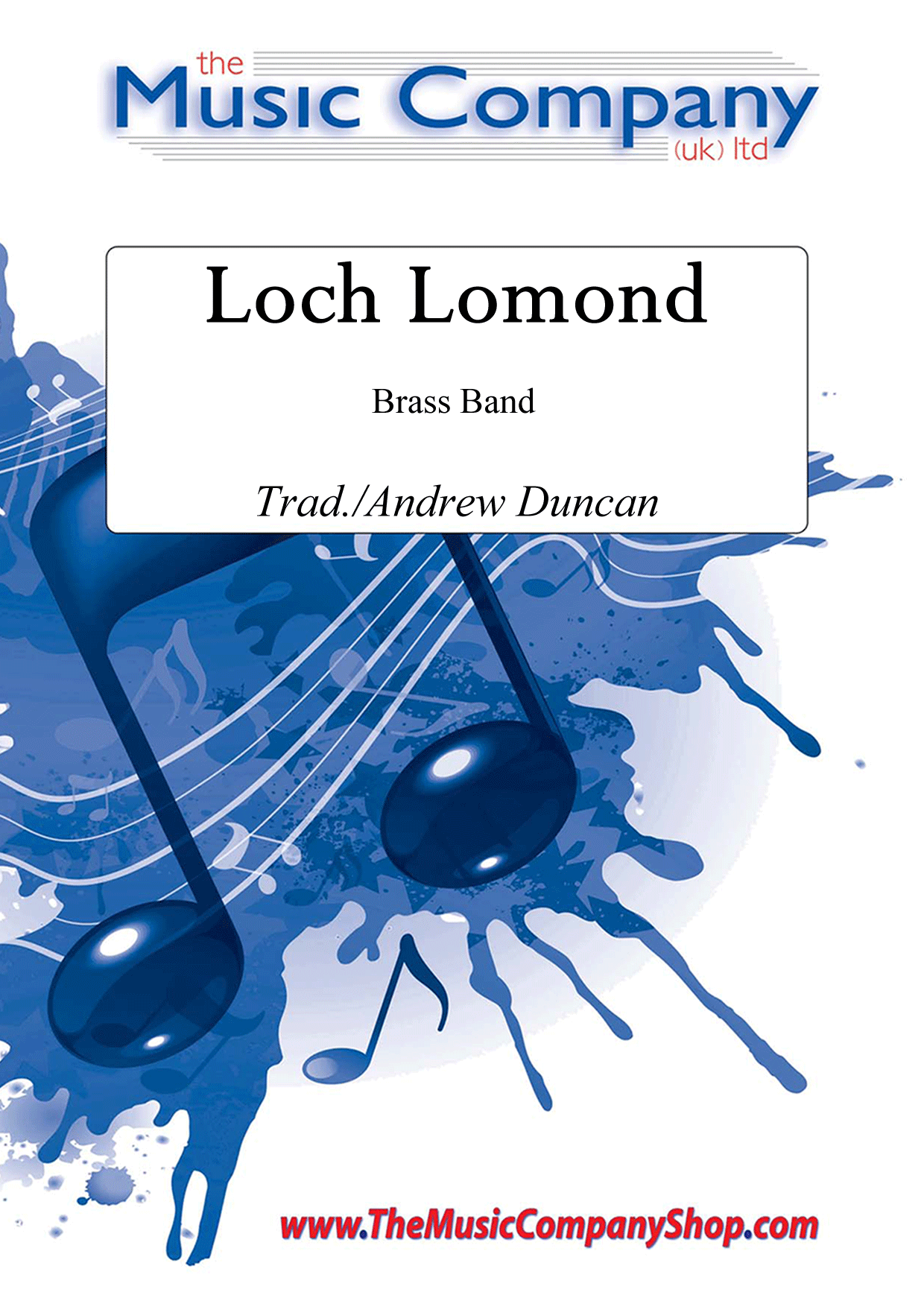
Loch Lomond - Andrew Duncan
A great arrangement of this Scottish classic 'anthem'.Opening with beautiful tranquility of the familiar melody, led by a solo line on the Flugelhorn. The piece then develops and grows into a rousing, up-beat rendition with further growth and counter-melodies through to its full-on closing.With optional bagpipes and/or electric guitar parts, this is a super tribute to a classic melody.Look and Listen (performance courtesy of Kingdom Brass 2012, includes addition of a sung verse to further engage the audience):
In Stock: Estimated dispatch 3-5 working days
-
 £39.95
Pie Jesu (Score and Parts) - Andrew Lloyd Webber arr. Ray Steadman-Allen
The official authorized brass band arrangement of the 'Pie Jesu' movement of Andrew Lloyd Webber's Requiem. Ray Steadman-Allen has expertly transcribed the piece for soprano cornet and solo cornet or flugelhorn and brass band. Ideal for concert or devotional use.
Estimated dispatch 7-9 working days
 Watch video
 View Music