
Results
-
 £92.20
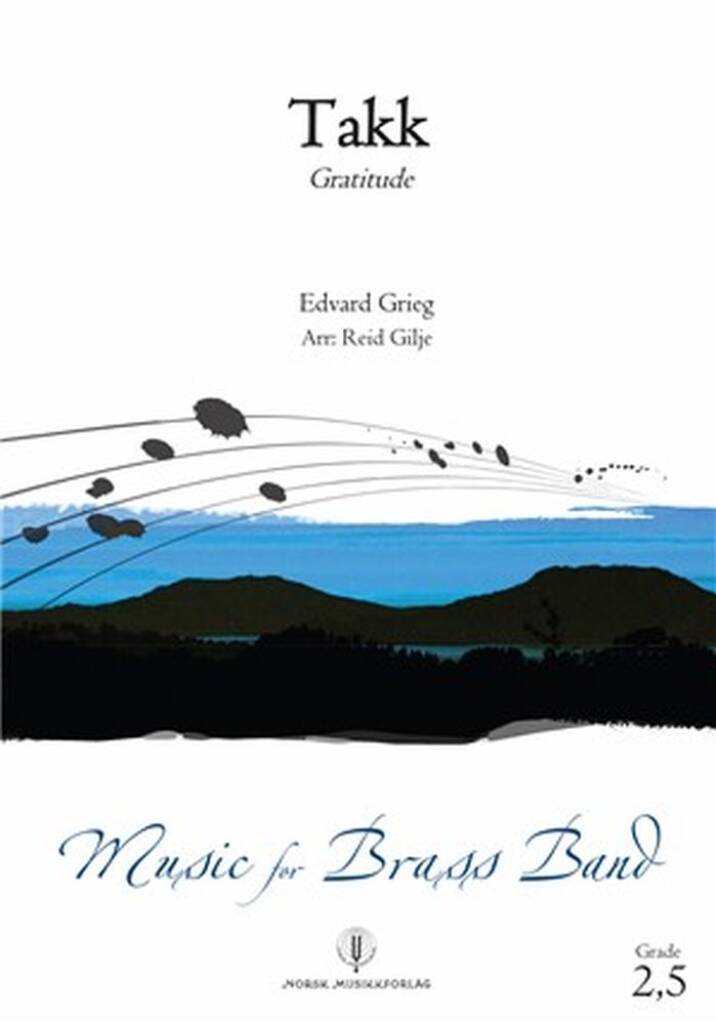
Takk - Edvard Grieg - Reid Glje
"Gratitude" is one of Grieg's beautiful lyrical pieces, Op. 62 No. 2.Eva Knardahl made a beautiful recording that I well remember was used as background for a picture cavalcade by the Norwegian Broadcasting Corporation during the passing of His Majesty King Olav V of Norway in 1991.In this arrangement for band, I have tried to vary the instrumentation, both for the sake of more colours and to emphasize the drama.This piece should be played rubato with elastic phrasing. The form can be described as AABACoda. The most dramatic section is the B part from measure 25, which peaks just before measure 38. The last four measures (from measure 53) can be done a bit 'meno' in tempo.Reid Gilje
Estimated dispatch 5-14 working days
-
 £19.95
The Falcon in the Snow for Brass Band - Paul Saggers
The Falcon in the Snow is a musical depiction of British explorer Robert Falcon Scott's expedition to reach the South Pole, the work is divided into five sections, using quotes from Falcon Scott's own journal:Saturday November 26, 1910 - "We advertised our start at 3.P.M., and at three minutes to that hour the Terra Nova pushed off from the jetty".Robert Falcon Scott led the British Antarctic Expedition from 1910 to 1913, aiming to be the first to reach the South Pole. Leaving from Cardiff, Wales, in June 1910, the expedition arrived at the Ross Ice Shelf in January 1911. Scott's team established base camp at Cape Evans on Ross Island and began preparations for the push to the Pole.Thursday February 2, 1911 - "The Blizzard, Nature's protest-the crevasse, Nature's pitfall".The expedition faced numerous challenges, including harsh weather, difficult terrain, and the logistics of transporting supplies and equipment over long distances. Scott divided his men into different teams for the Pole attempt, with one led by himself and the other by Ernest Shackleton, who was eventually sent home due to illness.Tuesday January 16, 1912 - "The Norwegians have forestalled us and are first at the pole. It is a terrible disappointment, and I am very sorry for my loyal companions".Scott's team set out for the South Pole, enduring extreme conditions and struggling with low food supplies. They reached the Pole on January 17, 1912, only to discover that the Norwegian explorer Roald Amundsen had beaten them to it by 34 days.Thursday January 18, 1912 - "We have turned our back now on the goal of our ambition and must face our 800 miles of solid dragging".Disheartened, the team began the long and arduous journey back to base camp. Tragically, Scott and his companions-Edward Wilson, Henry Bowers, Lawrence Oates, and Edgar Evans-perished during their return journey. They were slowed by extreme weather and suffering from exhaustion and malnutrition.Thursday March 29, 1912 - "For God's sake look after our people".Their final camp, found in November 1912, became their tomb. Scott's journal, recovered with his body, provides a poignant record of their struggles.Despite the tragic outcome, Scott's expedition contributed significantly to the understanding of the Antarctic region. The scientific research and specimens collected during the journey provided valuable insights into the continent's natural history and biology. Additionally, the expedition stimulated public interest in polar exploration and science, leaving a legacy in the chronicles of exploration.
-
 £45.00
Lament (Brass Band - Score and Parts)
The English composer Frank Bridge (1879 - 1941) did not take an active part in the First World War. However, he was devastated by the slaughter on the western and the eastern fronts, especially the loss of so many of his musicians friends and colleagues. Writing in 1963, his former pupil Benjamin Britten confessed that 'a lot of my feelings about the First World War which people seemed to see in the War Requiem came from Bridge. He had written a piano sonata in memory of a friend killed in France and though he didn't encourage me to take a stand for the sake of a stand, he did make me argue and argue and argue. His own pacifism was not aggressive, but typically gentle'.Bridge composed this Lament for string orchestra on 14 June 1915, in memory of Catherine Crompton, who drowned when the Cunard liner Lusitania was torpedoed by a German submarine on 7 May, 1915. According to figures researched by Liverpool historian Kevin Roach (www.lusitania.net), 1201 men, women and children lost their lives out of the 1962 people aboard. Ninety-four children died, including Catherine, her twin brother Paul and four other siblings. Paul Crompton, Snr. (44), a British businessman working in Philadelphia, his wife Gladys (40) and the family nanny were also drowned. How Bridge's dedication came about is uncertain. The music critic Edwin Evans, who knew Bridge well, has written that the Catherine was a young friend. It is also possible that he came across the family photograph which was published in many newspapers in the wake of the tragedy. By that time, Bridge was greatly distressed by the war as a whole. It seems perfectly in keeping with his pacifist leanings and the strength of his reaction, that this poignant and deeply touching 'war memorial' should mourn a child who he did not know, rather than one of the thousands of young men who fell in battle.Through the musical tears of this melancholy lullaby, Bridge may have regarded the death of young Catherine Crompton as symbolic of the loss of so many innocent lives in wartime. His response to this personal tragedy was characteristically spontaneous and utterly sincere. It is one of his most effective miniatures, poignant yet restrained in its lyrical beauty, with a compelling directness and simplicity of construction.This brass band transcription is pitched one tone lower than the original for string orchestra.- Paul HindmarshDuration: 5.00
Estimated dispatch 7-14 working days
-
 £45.00
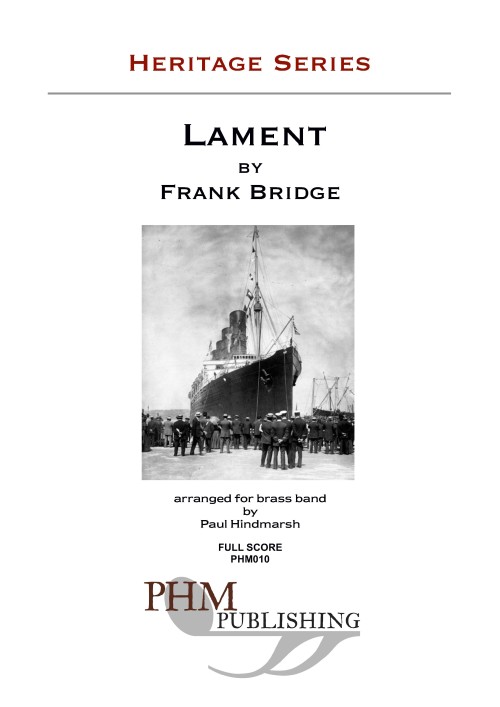
Lament (Brass Band - Score and Parts) - Bridge, Frank - Hindmarsh, Paul
The English composer Frank Bridge (1879 - 1941) did not take an active part in the First World War. However, he was devastated by the slaughter on the western and the eastern fronts, especially the loss of so many of his musicians friends and colleagues. Writing in 1963, his former pupil Benjamin Britten confessed that 'a lot of my feelings about the First World War which people seemed to see in the War Requiem came from Bridge. He had written a piano sonata in memory of a friend killed in France and though he didn't encourage me to take a stand for the sake of a stand, he did make me argue and argue and argue. His own pacifism was not aggressive, but typically gentle'.Bridge composed this Lament for string orchestra on 14 June 1915, in memory of Catherine Crompton, who drowned when the Cunard liner Lusitania was torpedoed by a German submarine on 7 May, 1915. According to figures researched by Liverpool historian Kevin Roach (www.lusitania.net), 1201 men, women and children lost their lives out of the 1962 people aboard. Ninety-four children died, including Catherine, her twin brother Paul and four other siblings. Paul Crompton, Snr. (44), a British businessman working in Philadelphia, his wife Gladys (40) and the family nanny were also drowned. How Bridge's dedication came about is uncertain. The music critic Edwin Evans, who knew Bridge well, has written that the Catherine was a young friend. It is also possible that he came across the family photograph which was published in many newspapers in the wake of the tragedy. By that time, Bridge was greatly distressed by the war as a whole. It seems perfectly in keeping with his pacifist leanings and the strength of his reaction, that this poignant and deeply touching 'war memorial' should mourn a child who he did not know, rather than one of the thousands of young men who fell in battle.Through the musical tears of this melancholy lullaby, Bridge may have regarded the death of young Catherine Crompton as symbolic of the loss of so many innocent lives in wartime. His response to this personal tragedy was characteristically spontaneous and utterly sincere. It is one of his most effective miniatures, poignant yet restrained in its lyrical beauty, with a compelling directness and simplicity of construction.This brass band transcription is pitched one tone lower than the original for string orchestra.- Paul HindmarshDuration: 5.00
Estimated dispatch 7-14 working days
 View Music
 Watch video