
Results
-
 £44.95
Concertino (Eb Horn Solo with Brass Band -Score and Parts) - Wood, Gareth
.
Estimated dispatch 7-14 working days
-
 £59.70
Nola (Xylophone Solo with Brass Band - Score and Parts) - Arndt, Felix - Smith, Sandy
A great light swing work to feature your start xylophonist!
Estimated dispatch 7-14 working days
-
 £29.50
The Rose - Amanda McBroom - Rob Westacott
This classic song has been entertaining audiences around the globe since it was originally written back in 1977. It didn't reach world-wide success until the piece was recorded by artist Bette Midler and featured in the film, The Rose. Songwriter, Amanda McBroom recalls that she wrote the piece in just 45 minutes. The work has now been arranged as a gorgeous Euphonium solo with lower brass (flugelhorn down the band) accompaniment and is a great new addition to a soloist's repertoire. The work is not technically demanding and the lyrical tone of the piece is one that will allow players of all ages to shine with this solo. To download the playback audio to play along to, please RIGHT CLICK HERE & Save As .
In Stock: Estimated dispatch 1-3 working days
-
 £24.50
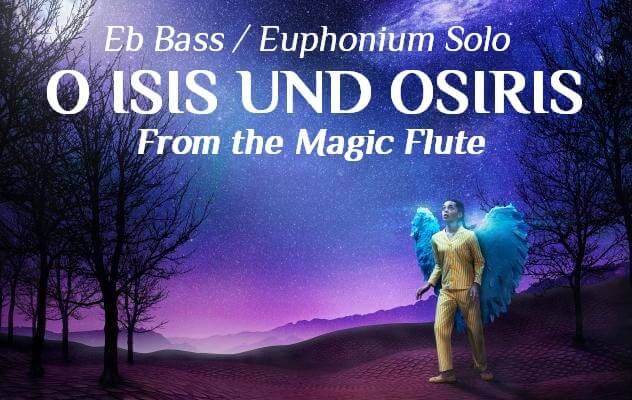
O Isis Und Osiris - W.A. Mozart - Andi Cook
The Magic Flute (Die Zauberflote) is one of Mozart's most successful operas, premiered only 2 months before the composer's early death. Skilfully arranged now as an Eb Tuba solo (with an Euphonium solo part as an alternative option), this is a chance for your band's tuba player to show the instruments in a new light, not often seen on the concert stage. The Aria O Isis Und Osiris is performed at the start of the second act of the opera and allows the soloist to show off the more lyrical and operatic side of the instrument.
In Stock: Estimated dispatch 1-3 working days
-
 £24.50
The Sleigh Race - Alfred Caldicott - Lynda Nicholson
Every year, bands across the country search for something new and different for their Christmas concerts. This year, look no further! In this comedy item, originally composed for piano duet, the feeling of Christmas is ever present. The playful melody is passed around the band including a percussion section solo (with cues for the band if no percussion available). Audience participation can be used as they rattle keys to mimic the sounds of Sleigh Bells. Of course, no comedy work would be complete without some singing from the band. This really is a treat for all concerned and is a piece that will make any Christmas concert come to life with something different.
In Stock: Estimated dispatch 1-3 working days
-
 £24.50
Away In A Manger - William J. Kirkpatrick - Tom Bassett
The most well-known of carols, set to William Kirkpatrick's melody, 'Cradle Song' first appeared in the late nineteenth century. It is known the world over and synonymous with the sounds of children singing this gentle, lyrical song. Arranged here as a flugel solo with warm harmonies and accompaniments from the band, this is a great addition to any Christmas concert programme.
In Stock: Estimated dispatch 1-3 working days
-
 £22.50
Edward Gregson: Concertante for Piano and Brass Band
DescriptionProgramme NoteThe Concertante for Piano and Brass Band was written in 1966, when the composer was an undergraduate student at the Royal Academy of Music in London. It received its first public concert performance in 1967 at the Royal Festival Hall, London, when the composer was the soloist with the International Band of the Salvation Army, conducted by Bernard Adams. It was one of the first major works to be written for this particular combination.The Concertante is unashamedly romantic in idiom and is in three movements: Prelude, Nocturne and Rondo. The Prelude is cast in sonata form and opens with a short cadenza-like flourish from the soloist, followed by two main ideas - the first sweepingly dramatic, the second highly lyrical. The interplay between these two themes forms the main focus of the movement, and after a return to the opening theme, an exuberant codetta brings the music to a close, albeit a quiet one. https://morthanveld.com/wp-content/uploads/2017/09/Gregson-Concertante-1st-movt-clip.mp3The tender Nocturne opens with an introduction from the band that contains precursors of the two main ideas to follow. The solo piano announces the main theme, which has a slightly 'bluesy' character with its flattened third and seventh notes of the scale, and is a love song dedicated to the composer's wife-to-be. The band enters with phrases of a chorale already hinted at in the introduction - Ray Steadman-Allen's hymn tune 'Esher' - but never quite presented in its complete state. Both ideas are developed alongside each other, with eventually the first theme returning, this time with piano and band together, and building to a majestic climax, before subsiding to a peaceful coda - a return to the very opening of the movement. https://morthanveld.com/wp-content/uploads/2017/09/Gregson-Concertante-movt-2-clip.mp3The final Rondo is full of energetic rhythms and changing time patterns. The main theme is playful in character, with much interplay between soloist and band, whilst the middle section presents a new theme, and one that has more than a hint of the hymn tune 'Onward Christian Soldiers', in what amounts to a good humoured parody. The opening Rondo theme returns, this time leading to a powerful and dissonant climax from the band. This is followed by an extended piano cadenza, underlying the virtuoso aspect of the work, and leading to an energetic and life-affirming coda, which brings the work to a triumphant conclusion. https://morthanveld.com/wp-content/uploads/2017/09/Gregson-Concertante-movt-3-clip.mp3Duration: 18 minutesInstrumentation:Please note that there is no 1st/Repiano Cornet part in this work. The 1st/Repiano Cornet player should join the Solo Cornet bench. As such an extra Solo Cornet part is provided in the set of parts.Version for two pianosA version of the Concertante for two pianos is available for rehearsal purposes. Piano 1 is the solo part and Piano 2 the band reduction. However, for those pianists not needing to rehearse the work in this way, a solo piano part is also provided with the main set of band parts.To view a preview of the solo part for the first movement click here.The youthful Gregson (his work was written as a third year undergraduate) was seemingly a bit of a musical magpie - but one heck of a skilful one at that.These were shiny baubles of poise, panache and pastiche, with affectionate, remarkably mature nods of appreciation towards Gershwin, Rachmaninov, Ireland and even Elmer as well as Leonard Bernstein.The rich colour palette and flowing lines (with the tenderest of central Nocturnes) were a joy - as were the little buds of motifs that dotted the score like seeds ready to be planted on a future fertile brass band compositional field. - Iwan Fox, 4Barsrest.com, June 2019For more information on Edward Gregson's music please visit the composer's website: www.edwardgregson.com
Estimated dispatch 7-14 working days
-
 £35.00
Edward Gregson: Fanfare for a New Era (for Brass Band)
DescriptionComposer's NoteThe Fanfare has been designed to be partly antiphonal, with four separate brass 'choirs' initially playing their own music, and so some spatial separation is desirable. Soprano and solo cornets should be placed centrally, standing behind the rest of the band - or in some venues could even be placed off-stage in a side balcony, but still close to the band. If the Fanfare is played by a contesting size band, one of the solo cornets should play the 1st cornet part together with the usual player ie the number of players on the 1st, 2nd, and 3rd cornet parts should be equal. Otherwise the number of players in each of the two cornet 'choirs' is at the discretion of the conductor. The Tubular Bells accompanying the cornets 1-3 group should be placed close to that group. See inside back cover for suggested band formation.The style of playing should replicate that of symphonic brass, with a minimum of vibrato and with long notes being sustained without decaying.Programme NoteCommissioned in 2020 by Youth Brass 2000, Fanfare for a New Era was designed to be partly antiphonal - thus the separation of the band into four brass 'choirs', each with their own percussion accompaniment. First, soprano and solo cornets, rather like heraldic trumpeters, announce the main idea, majestic in character. Then horns, baritones, and euphoniums, with timpani, enter with stately figurations. Next, the heraldic trumpeters usher in trombones and tubas, to the accompaniment of tom-toms and snare drum, presenting a faster and rhythmic dance-like theme. Finally, the remaining cornets amplify the pealing of bells. All four elements then come together, surrounding the audience with a 'joyful noise' of festive brass and percussion.The original symphonic brass version of this fanfare can be purchased as part of a set of Three Fanfares HERE.For more information on Edward Gregson's music please visit the composer's website: www.edwardgregson.com
Estimated dispatch 7-14 working days
-
 £37.35
Fallen Souls (Brass Band) Andrew Wainwright
Fallen Souls was the winner of Grimethorpe Colliery Band's 1st Annual Composition Competition in 2023. This depictive and impactful work explores the theme of human fallibility. The piece begins with a slow, yearnful introduction that depicts a fall from grace, represented by a horn solo that reflects the innate goodness of humanity. However, the music soon becomes more agitated and dissonant as it represents the temptations that can lead us astray. The opening reaches a climax of chaos and despair, as we are shown the devastating consequences of our choices. The following section depicts the temptations of humanity. The music is chaotic and seductive in this section, with regular time changes and rhythmic instability, representing the many temptations that surround us. The section ends with a sense of uncertainty, as we are left wondering whether we will succumb to these temptations. There is a reprise of the opening horn solo, and a return to the notion of human fallibility, but this time in extended form. Again there is a build toward chaos, and the music becomes more complex and textured, reflecting the complexity of the human journey. The work ends somewhat abruptly with a blaze, leaving the listener with a sense of both hope and uncertainty. To view a rolling score video featuring Grimethorpe Colliery Band please visit www.youtube.com/watch?v=rM-p8CjnYo0 Duration: 5.00 minutes approx. Difficulty Level: 1st Section + PDF download includes parts and score. Sheet music available from www.brassband.co.uk/sheet-music/fallen-souls-brass-band-andrew-wainwright-brookwright Instrumentation: Soprano Cornet Eb Solo Cornet Bb Repiano Cornet Bb 2nd Cornet Bb 3rd Cornet Bb Flugel Horn Bb Solo Horn Eb 1st Horn Eb 2nd Horn Eb 1st Baritone Bb 2nd Baritone Bb 1st Trombone Bb 2nd Trombone Bb Bass Trombone Euphonium Bb Bass Eb Bass BbTimpani Percussion 1-3
In Stock: Estimated dispatch 1-3 working days
-
 £7.46
£7.46King (Concertino for Solo Trombone & Brass Band) Brenton Broadstock - Solo Copy
King is a major new addition to the trombone repertoire, commissioned in 2024 by Brett Baker as a deeply personal homage to his mentor, the legendary David King. This compelling Concertino for Solo Trombone and Brass Band seeks to capture the multifaceted personality of its namesake through three distinct movements: i. Rhapsodic: A movement defined by fluid tempo shifts and evocative mood changes. ii. Introspective: A generous, lyrical section that highlights the expressive capabilities of the soloist. iii. Fast & Passionate: A high-energy finale characterized by determination, optimism, and rhythmic drive. The work is masterfully constructed with pitch material derived directly from the name 'David,' establishing a thematic core introduced by the soloist in the opening bars and woven throughout the entire ensemble texture. It is an essential work for soloists looking for a piece that combines technical brilliance with profound musical narrative. To listen to an excerpt featuring Brett Baker and Flowers Band please visit: https://youtu.be/i-px4OmjplQ Duration: Approx. 12.00 minutes Difficulty Level: 1st Section + This PDF download includes the solo part only. Full set available here. Sheet music available at www.brassband.co.uk (UK) or https://satradecentral.org (USA) Instrumentation:Trombone Soloist* Soprano Cornet Eb Solo Cornet Bb Repiano Cornet Bb 2nd Cornet Bb 3rd Cornet Bb Flugel Horn Bb Solo Horn Eb 1st Horn Eb 2nd Horn Eb 1st Baritone Bb 2nd Baritone Bb 1st Trombone Bb 2nd Trombone Bb Bass Trombone Euphonium Bb Bass Eb Bass Bb Timpani Percussion 1-3 *For bands with only 3 trombones where one is the soloist, the 1st trombone part is covered in other parts throughout the piece.
In Stock: Estimated dispatch 1-3 working days
 View Music