
Results
-
 £169.99
The Spirit of Puccini - Hermann Pallhuber
The famous Puccini motifs in this work are taken from Tosca (E lucevan le stelle), Turandot (Nessun dorma), Gianni Schicci (O mio babbino caro) and a quite funny little persifl age of the aria Senti L'ora e vicina from Tosca. The Spirit of Puccini has testing moments for each of the principal players of the bands sections. Even although the music was inspired by this famous Italian composer, Hermann Pallhuber has succeeded in creating a piece of 'real band music' combining both the Italian influences and the modern British brass band sound.
Estimated dispatch 5-14 working days
-
 £104.99
Parnassus - Jan Van der Roost
Since most of the bands competing in the 4th Section of the Dutch National Championships have many young players, this piece is stylistically youthful-- especially in the opening and closing sections. An arpeggio pattern appears numerous times in all registers and is the basic musical element of the main melody, alternating with a second theme that has a slightly different melodic character. The middle section is conceived like a chorale, introduced and developed stepwise: firstly with short patterns and gradually in increasingly long snippets, until it's played in its glorious entirety at measure 216. No real solo passages are included but rather small chambercombinations, thus offering the opportunity to various players to display their technical and performance skills. The finale recaptures musical material from the first section of the piece and provides a majestic conclusion.
Estimated dispatch 5-14 working days
-
 £54.99
Southern Fried Chicken - Peter Martin
Chicken is a versatile type of meat which is consumed all over the world. And it tastes differently everywhere, but in the south of the United States chicken still tastes like real chicken. The music is in the recognizable square-dance style. Can you remain seated?
Estimated dispatch 5-14 working days
-
 £74.99
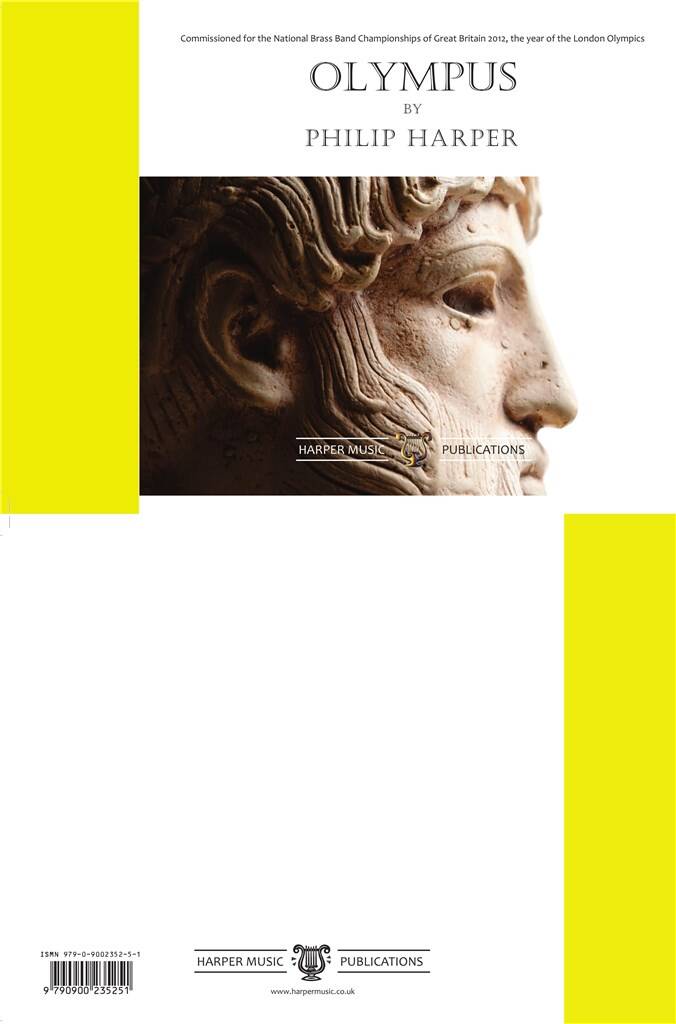
Olympus - Philip Harper
Selected as the test-piece for the 3rd Section Regional contests of the National Brass Band Championships 2012The music begins with a depiction of the exciting Opening Ceremony where noisy fanfares and sudden swells add to the cosmopolitan flag-waving clamour. Without a break the music leads to The Chariot Race, a fast compound-time gallop withthundering hooves in the basses and percussion, and a heroic melody introduced by the tenor horns. Chariot racing was the main equestrian event in the Ancient Greek Games, which were founded in memory of King Oenomaus. In the Greek legend he suffereddefeat in a chariot race to his son-in-law and Zeus' grandson, Pelops, but much of the music is bitter-sweet to symbolise the fact that Pelops had to cheat to win drawing parallels with some of the issues still facing modern-day athletics. A slow, mystical passage follows, describing The Temple of Zeus at Olympia. The statue of Zeus, who was honoured throughout the Ancient Games' history, was housed inside the temple and was one of the Seven Wonders of the Ancient World. Themusic depicts this period of the dawn of one of mankind's most ancient civilisations and there is a series of solo passages above a drone. The next section is called The Olympic Flame and a broad and lyrical anthem-like melody develops slowly in the euphoniums, which gradually ascends until the horns can take it over before passing upwards again to the cornets (Higher). The musicbursts into bright life at the lighting of the flame and the regular rhythmic pattern which has been established goes through an accelerando (Faster). The final section is called The Olympic Truce and aims to capture the cooperative spirit of the ancient practice of ending wars for the duration of the games. The anthem-like melody makes an affirmatory return (Stronger) and the work ends asit began with a blaze of colour and a real sense of optimism and global celebration. "Citius, Altius, Fortius" (Faster, Higher, Stonger)NOTES ON PERFORMANCEPercussion requirements: 1 to 3 players (3 Timpani, Snare Drum, Tenor Drum, Cymbals, Glockenspiel, Triangle)
Estimated dispatch 5-14 working days
-
 £146.80
How to Train Your Dragon - John James Powell - Fredrick Schjelderup
"How to train your dragon" is an American animation film about a little viking village which gets attacked by dragons.In the movie, the young character Birk must convince his father and the rest of the village that he will be a viking warrior and fight the dragons.During the process of becoming a real warrior, Birk wants to become friends with the dragons, rather than fight them.The film music is originally written by John James Powell and describes the drama, tension og romance.In this arrangement you'll find the themes "This is Birk" and "Dragon Battle".
Estimated dispatch 5-14 working days
-
 £59.99
Flowerdale From 'Hymn Of The Highlands' - Philip Sparke
Flowerdale is a forest in Wester Ross, Scotland, which is well-known for it's beautiful waterfall. This piece, for solo Soprano Cornet, is one of the movements from Philip Sparke's epic suite Hymn of the Highlands. It depicts the tall trees swaying gently in the wind with the serenity of the area being reflected by the subtle accompaniment of the band. Let your soprano player bloom into colour with this exquisite solo. A real show stopper.
Estimated dispatch 5-14 working days
-
 £79.95
Lost Village of Imber, The - Christopher Bond
The village of Imber on Salisbury Plain had been inhabited for over one thousand years when it was evacuated in 1943 to make way for military training in the Second World War. At the time, with preparations for the Allied invasion of Europe underway, most villagers put up no resistance, despite being upset, with the belief that they'd return once the war had concluded. To this day, Imber and its surrounding land remain a military training ground. The villagers never returned, and just the shell of what was once a community remains. Structured in three movements, it is on this very real story that the work is based, setting out the series of events of 1943 in chronological order. The first movement, On Imber Downe, portrays a sense of jollity and cohesiveness - a community of individuals living and working together before news of the evacuation had broken. Sounds of the village are heard throughout, not least in a series of percussive effects - the anvil of the blacksmith; the cowbell of the cattle and the bells of the church. The second movement, The Church of St. Giles, begins mysteriously and this sonorous, atmospheric opening depicts Imber in its desolate state and the apprehension of residents as they learn they have to leave their homes. Amidst this is the Church, a symbol of hope for villagers who one day wish to return, portrayed with a sweeping melodic passage before the music returns to the apprehension of villagers facing eviction around their sadness at losing their rural way of life. In complete contrast, the third movement, Imemerie Aeternum, portrays the arrival of the military, complete with the sounds of the ammunition, firing and tanks - sounds which were all too familiar to those living in the surround areas. To close, the Church of St. Giles theme returns in a triumphant style, representing the idea that the church has always been, even to this day, a beacon of hope for the villagers and local community - both the centrepiece and pinnacle of a very real story. The work was commissioned by Bratton Silver Band in celebration of the band's 160th Anniversary, with funding from the Arts Council National Lottery Project Grants Fund and the Brass Bands England Norman Jones Trust Fund.
Estimated dispatch 10-14 working days
-
£110.00
Legend - Geert Jan Kroon
Other than the title, there is no real story that connects this piece to eyeballs or werewolves. There is no real legend that precedes this work. The legend will evolve in the listener's mind while listening to this piece. For me, it started with the title. It was dreamed up by my son. He also suggested a musical gesture, which I then used to build all the musical materials in this piece. I have sought to capture a dark atmosphere with a sense of excitement. Although, there are some not so dark moments in the piece which serve as a musical contrast. I would like to invite every listener to imagine a world where there exists a legend of a bleeding eyeball and a blind werewolf. And if you do dream up a great story, please let me know and share it with each other!
-
 £74.99
Cornet Concerto No.1 - Jonathan Bates
My 'Cornet Concerto No.1' was composed for Lode Violet and Brass Band Willebroek in 2018 and features 2 movements, entitled 'Dystopia' and 'Utopia'. . The nature of the music in the opening section, 'Dystopia', is very jagged, disjointed and unsettling, as the soloist almost battles against the constant churning of the mechanical accompaniment, trying to persevere with it's own ideas and styles without being dragged into conforming to it's surroundings. The movement is based largely on the 3 note interval heard right at the outset of the piece (C, D & G#, a series of notes that lends itself so well to different modes, scales, harmonies and intervals) and this forms much of the rhythmic and harmonic structure of the opening section.Whilst this movement acts as a virtuoso feature to demonstrate the extended capabilities of both the soloist and instrument, I feel the accompanying ensemble plays an equal role in the narrative of 'dystopia', and features a number of demanding and prominent episodes for soloists within the accompanying band. A short and heavy coda concludes the movement, with a sense of real pain and sorrowfulness as the music fades away into darkness. . 'Utopia' opens in an instantly more hopeful nature, with the soloist introducing the first real 'theme' of the movement, taken up shortly by the accompaniment. Throughout this movement, there are a number of timbral and melodic references back to the darkness of 'dystopia', but transformed into a much more positive outlook and soundworld. There is a moment of quiet reflect (using the initial 3 note cell as a basis) before flying head first into a frenzied wild 'tarantella' like section, full of joy and energy which tests the dexterity and light-natured approach to virtuosity (much unlike the heavier material in the 1st movement) of the soloist. Primarily, the concept of this finale is fun - joy, happiness, and freedom from restraint, so the addition of a quirky 'tongue-in-cheek' habanera section offers a brief moment of respite from the craziness of the tarantella. To conclude the work, there is an extended cadenza for the soloist which is built on several motifs heard throughout the concerto, which leads the band into a dramatic and energetic final few bars.. Jonathan Bates. (2018). .
In Stock: Estimated dispatch 1-3 working days
-
Great Scott! It's Ragtime - Various - Matt Kingston
Catchy Ragtime tunes aplenty in this bestselling medley. A hoot to play and a real crowd-pleaser.
 View Music