
Results
-
 £35.00
A Suffolk Prelude - Andrew Duncan
Written for the Ipswich & Norwich Co-Op Band, A Suffolk Prelude is based around five traditional tunes from Suffolk:'Nutting Time','Blackberry Fold','Cupid's Garden','A Seaman's Life''The Bold Richard'The piece begins on the percussion and timpani alone leading through a crescendo into the first statement of the fanfare which is derived from a motif from the tune 'Nutting Time'. This leads into a playing of the 'Nutting Time' tune which is then developed as the tune is passed around the band.'Nutting Time' is a jolly lighthearted tune about a 'fair maid' who meets a handsome young farmer called 'Johnny' when out gathering nuts in the wood. After a pause on the tubular bells the slow tune 'Blackberry Fold' is presented as a solo for Flugel Horn, then as a full band version.'Blackberry Fold' is a touching song about a Suffolk squire who gets married well below his station to a beautiful milkmaid, simply because he loves her! They live happily ever after.The next tune to be heard is the juanty 'Cupid's Garden' played firstly as a solo on the Euphonium, and again this is about the subject of love. This song is sung from a sailors prospective and he tells how he met a lovely maiden and has promised to marry her when he returns from duty at sea.The trombones then play the noble tune 'A Seaman's Life'. This tune seems to serve as a warning to young girls about the fickle nature and the total unsuitability of marrying a sailor! 'Oh a seaman's life is a merry merry life, they'll rob young girls of their heart's delight, they will leave them behind for to sail one morn, but they never know when they'll return'. Despite this it is a fine tune!The last tune featured is 'The Bold Richard' which is played by all the bass instruments in the band. This is a song telling how the Royal Navy friggate 'The Bold Richard' went to battle against a French friggate destroying her and taking her crew as prisoners.Suffolk Prelude goes on to feature a slow version of the tune 'A Seaman's Life' played alongside a fast version of the tune 'Cupid's Garden'. The opening fanfare then returns leading into a final coda section.
In Stock: Estimated dispatch 3-5 working days
-
£40.00
When the Girl in Your Arms - Tepper, Bennett & Coleman - Broadbent, D
"When the Girl in Your Arms (Is the Girl in Your Heart)," written by Sid Tepper and Roy Bennett and produced for Cliff Richard in 1961, is a tender pop ballad that captures the sweet certainty of love. A chart success in Britain and beyond, it became one of the signature early hits in Richard's career, and remains a nostalgic emblem of early 1960s romantic pop.
In Stock: Estimated dispatch 1-3 working days
-
 £94.90
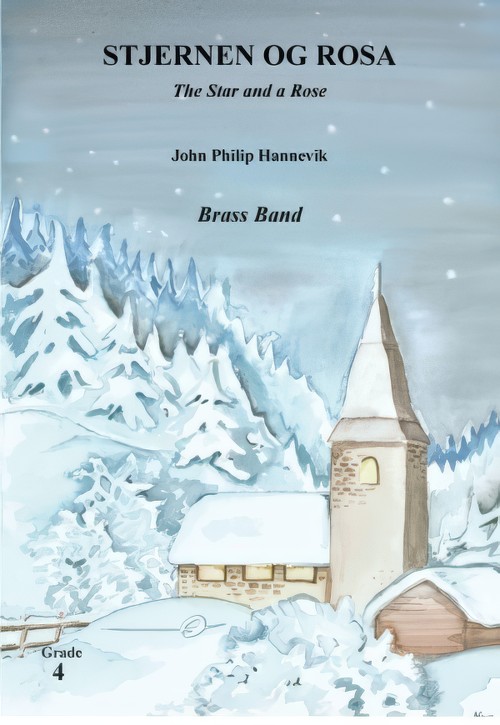
Stjernen og Rosa (The Star and a Rose) (Brass Band - Score and Parts) - Hannevik, John Philip
The Star and a Rose is a big-scale Christmas piece for band, featuring four seasonal chorales.The first is a Gregorian-like chant Hodie Christus natus est.In this section of the piece, a soloist can be placed away from the band, maybe on a gallery. The soloist can be a tenor instrument, maybe trombone, or you can feature a vocal soloist. After this, the music leads us on to the old German Christmas chorale Lo, how a rose e'er blooming. This song is given a fairly rhythmical treatment, but make sure that the melody is presented in a cantabile style. An interlude follows, before the piece presents one of the most used and loved Scandinavian Christmas chorales, Mitt hjerte alltid vanker (My Heart will always wander), composed by the Danish bishop Hans Adolph Brorson around 1732. This song is building towards a climax, before the solo horn brings it all down to the Stable view described in the lyrics. Then comes a transition that brings us in to the final section of the piece, which presents the international Christmas Carol Adeste Fideles. As many will notice, I have borrowed a section from David Wilcocks majestic harmonization towards the end.The title of the piece has its background form the lyrics in My heart will always wander, where the text speaks about the stars in the sky. But also in the Latin text for Adeste Fideles: Stella duce, Magi, Christum adorantes. The Rose is of course from the lyrics in the chorale Lo, how a Rose.Duration: 10.30
Estimated dispatch 7-14 working days
-
 £75.00
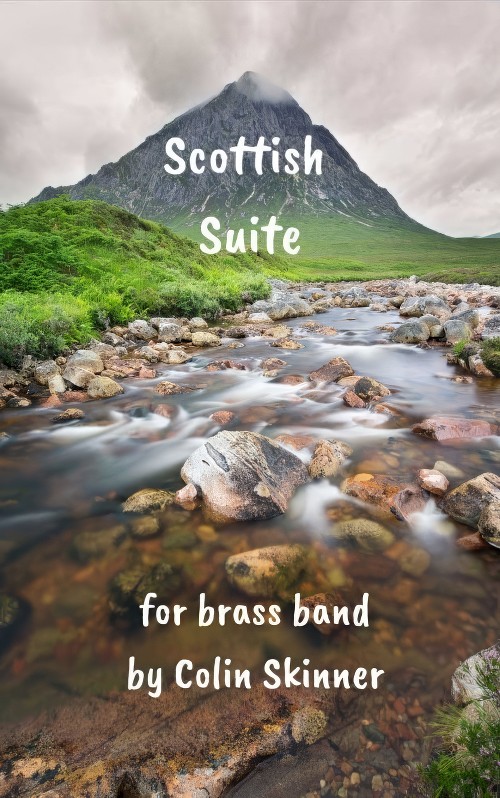
Scottish Suite (Brass Band - Score and Parts) - Skinner, Colin
A? four movement Gaelic suite for brass band. Includes: Simmer Dim (The night-long twilight in Orkney and Shetland in midsummer, when dusk runs more or less directly into dawn and it is never truly dark); Dance o' the Tattie-Bogles (Another name for scarecrows. We imagine them in the fields, one by one coming to life and joining in an extraordinary and chaotic dance); Sweetheart Abbey (Inspired by the ruined abbey near Dumfries founded by Dervorguilla of Galloway, in memory of her husband. After his death, she kept his embalmed heart with her for the rest of her life and it was buried alongside her when she died); Clanjamfrie (A drunken rabble meet in a remote Highland pub and proceed to talk nonsense and dance the night away). Duration: 11.15
Estimated dispatch 7-14 working days
-
 £15.00
Harrison's Dream (Brass Band - Study Score) - Graham, Peter
At 8.00pm on the 22nd of October 1707, the Association, flagship of the Royal Navy, struck rocks off the Scilly Isles with the loss of the entire crew. Throughout the rest of the evening the remaining three ships in the fleet suffered the same fate. Only 26 of the original 1,647 crew members survived. This disaster was a direct result of an inability to calculate longitude, the most pressing scientific problem of the time. It pushed the longitude question to the forefront of the national consciousness and precipitated the Longitude Act. Parliament funded a prize of �20,000 to anyone whose method or device would solve the dilemma.For carpenter and self-taught clockmaker John Harrison, this was the beginning of a 40 year obsession. To calculate longitude it is necessary to know the time aboard ship and at the home port or place of known longitude, at precisely the same moment. Harrison's dream was to build a clock so accurate that this calculation could be made, an audacious feat of engineering.This work reflects on aspects of this epic tale, brilliantly brought to life in Dava Sobel's book Longitude. Much of the music is mechanistic in tone and is constructed along precise mathematical and metrical lines. The heart of the work however is human - the attraction of the �20,000 prize is often cited as Harrison's motivation. However, the realisation that countless lives depended on a solution was one which haunted Harrison. The emotional core of the music reflects on this, and in particular the evening of 22ndOctober 1707.- Peter GrahamJuly 2000 Recorded on Polyphonic QPRL219D Master Brass (Volume Fifteen). Duration: 14'30"
Estimated dispatch 7-14 working days
-
 £119.95
Harrison's Dream (Brass Band - Score and Parts) - Graham, Peter
At 8.00pm on the 22nd of October 1707, the Association, flagship of the Royal Navy, struck rocks off the Scilly Isles with the loss of the entire crew. Throughout the rest of the evening the remaining three ships in the fleet suffered the same fate. Only 26 of the original 1,647 crew members survived. This disaster was a direct result of an inability to calculate longitude, the most pressing scientific problem of the time. It pushed the longitude question to the forefront of the national consciousness and precipitated the Longitude Act. Parliament funded a prize of �20,000 to anyone whose method or device would solve the dilemma.For carpenter and self-taught clockmaker John Harrison, this was the beginning of a 40 year obsession. To calculate longitude it is necessary to know the time aboard ship and at the home port or place of known longitude, at precisely the same moment. Harrison's dream was to build a clock so accurate that this calculation could be made, an audacious feat of engineering.This work reflects on aspects of this epic tale, brilliantly brought to life in Dava Sobel's book Longitude. Much of the music is mechanistic in tone and is constructed along precise mathematical and metrical lines. The heart of the work however is human - the attraction of the �20,000 prize is often cited as Harrison's motivation. However, the realisation that countless lives depended on a solution was one which haunted Harrison. The emotional core of the music reflects on this, and in particular the evening of 22ndOctober 1707.- Peter GrahamJuly 2000 Recorded on Polyphonic QPRL219D Master Brass (Volume Fifteen). Duration: 14'30"
Estimated dispatch 7-14 working days
-
£44.95
Harrison's Dream (Brass Band - Score only) - Graham, Peter
At 8.00pm on the 22nd of October 1707, the Association, flagship of the Royal Navy, struck rocks off the Scilly Isles with the loss of the entire crew. Throughout the rest of the evening the remaining three ships in the fleet suffered the same fate. Only 26 of the original 1,647 crew members survived. This disaster was a direct result of an inability to calculate longitude, the most pressing scientific problem of the time. It pushed the longitude question to the forefront of the national consciousness and precipitated the Longitude Act. Parliament funded a prize of �20,000 to anyone whose method or device would solve the dilemma.For carpenter and self-taught clockmaker John Harrison, this was the beginning of a 40 year obsession. To calculate longitude it is necessary to know the time aboard ship and at the home port or place of known longitude, at precisely the same moment. Harrison's dream was to build a clock so accurate that this calculation could be made, an audacious feat of engineering.This work reflects on aspects of this epic tale, brilliantly brought to life in Dava Sobel's book Longitude. Much of the music is mechanistic in tone and is constructed along precise mathematical and metrical lines. The heart of the work however is human - the attraction of the �20,000 prize is often cited as Harrison's motivation. However, the realisation that countless lives depended on a solution was one which haunted Harrison. The emotional core of the music reflects on this, and in particular the evening of 22ndOctober 1707.- Peter GrahamJuly 2000 Recorded on Polyphonic QPRL219D Master Brass (Volume Fifteen). Duration: 14'30"
Estimated dispatch 7-14 working days
 View Music