
Results
-
£40.00
Dreams and Dances (Flugel solo) - Harper, P
Dreams and Dances was composed for Black Dyke flugel star Zoe Hancock in 2012. This is a substantial seven minute solo for one of the most characteristic of the brass band's instruments.It begins slowly and dreamily, with a flugel line encompassing both lyrical and florid styles, before moving via a short cadenza to a set of dances in a quick 6/8 time. The solo part would be a challenge for any player, but the accompaniment parts should be manageable by all.
In Stock: Estimated dispatch 1-3 working days
-
 £95.00
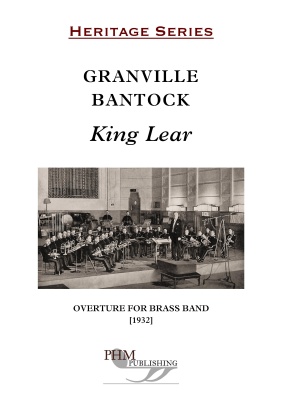
King Lear (Brass Band - Score and Parts)
Sir Granville Bantock (1868 - 1946) composed the second of his five major brass band work for Callender's Cableworks Band, completing the commission on 30 November 1932. Based in the Thames-side district of Belvedere near Erith, the band was active between 1898 and 1961. The works band of the Callender Cable & Construction Co. Ltd, it was at the peak of its popularity during the 1930s and was a frequent broadcaster on the radio. The band employed an in-house arranger and played saxophones in its lighter material. King Lear was one of the band's major commissions and was not published in Bantock's lifetime. The manuscript score and parts were thought to be lost for decades, but were found in the library of the Haydock Band (Lancashire), which had inherited part of Callender's library of manuscripts material and bespoke arrangements after it has been transferred to nearby Prescott Cables Band after Callender's Cable Works closed.King Lear is a substantial work, in essence a dramatic tone poem in the romantic Tchaikovskian manner, presenting a series of character portraits of the foolish old king and his three daughters, Goneril, Regan and Cordelia. The music is dramatic and lyrical by turns, with the most generous lyrical episode revealing perhaps the warm-hearted Cordelia. An expansive melody that flows from this is brought back towards the end as the main climax of the work.In 2001, Bantock's score was recorded by the University of Salford Brass Band, conducted by Dr. Roy Newsome. The original is serviceable, but in comparison with the orchestral version he made in 1936 (part of which was recorded on a Paxton 78 rpm) and later brass band scores, performing editions of which were prepared by others, it lacks colour and range typical of Bantock's orchestral work. Above all it lacks percussion, which can be heard on the recorded extract. With the kind permission of the Bantock Estate, I have prepared a performing edition for publication that incorporates percussion, derived from the orchestral recording and added editorially in similar manner elsewhere. I have revoiced some of the low- lying instrumental parts to present the material in more comfortable ranges. Editorial interventions more elaborate than revoicing the original text have been identified as cue notes.- Paul HindmarshDuration: 15.00
Estimated dispatch 7-14 working days
-
£40.00
King Lear (Brass Band - Score only)
Sir Granville Bantock (1868 - 1946) composed the second of his five major brass band work for Callender's Cableworks Band, completing the commission on 30 November 1932. Based in the Thames-side district of Belvedere near Erith, the band was active between 1898 and 1961. The works band of the Callender Cable & Construction Co. Ltd, it was at the peak of its popularity during the 1930s and was a frequent broadcaster on the radio. The band employed an in-house arranger and played saxophones in its lighter material. King Lear was one of the band's major commissions and was not published in Bantock's lifetime. The manuscript score and parts were thought to be lost for decades, but were found in the library of the Haydock Band (Lancashire), which had inherited part of Callender's library of manuscripts material and bespoke arrangements after it has been transferred to nearby Prescott Cables Band after Callender's Cable Works closed.King Lear is a substantial work, in essence a dramatic tone poem in the romantic Tchaikovskian manner, presenting a series of character portraits of the foolish old king and his three daughters, Goneril, Regan and Cordelia. The music is dramatic and lyrical by turns, with the most generous lyrical episode revealing perhaps the warm-hearted Cordelia. An expansive melody that flows from this is brought back towards the end as the main climax of the work.In 2001, Bantock's score was recorded by the University of Salford Brass Band, conducted by Dr. Roy Newsome. The original is serviceable, but in comparison with the orchestral version he made in 1936 (part of which was recorded on a Paxton 78 rpm) and later brass band scores, performing editions of which were prepared by others, it lacks colour and range typical of Bantock's orchestral work. Above all it lacks percussion, which can be heard on the recorded extract. With the kind permission of the Bantock Estate, I have prepared a performing edition for publication that incorporates percussion, derived from the orchestral recording and added editorially in similar manner elsewhere. I have revoiced some of the low- lying instrumental parts to present the material in more comfortable ranges. Editorial interventions more elaborate than revoicing the original text have been identified as cue notes.- Paul HindmarshDuration: 15.00
Estimated dispatch 7-14 working days
-
 £40.00
The Maid of the Mist (Trumpet Solo)
Herbert L Clarke (1867 - 1945) is regarded by many as one of the finest cornet players of all time, noted not only for his amazing technique but also for his warm, lyrical tone. He has left a multitude of cornet solos as well as collections of studies which are still very widely used. He was a member of The Sousa Band briefly in 1893 and then from 1898 to 1917 where he was not only the distinguished cornet soloist but also became assistant director.The Maid Of The Mist dates from 1912 and is named after the famous sightseeing boat trips at Niagara Falls.This arrangement was prepared for a concert in May, 2009, given by Brass Band of the Western Reserve, musical director Keith M Wilkinson, in which Michael Sachs, principal trumpet of the Cleveland Orchestra, appeared as guest soloist.
Estimated dispatch 7-14 working days
-
 £30.00
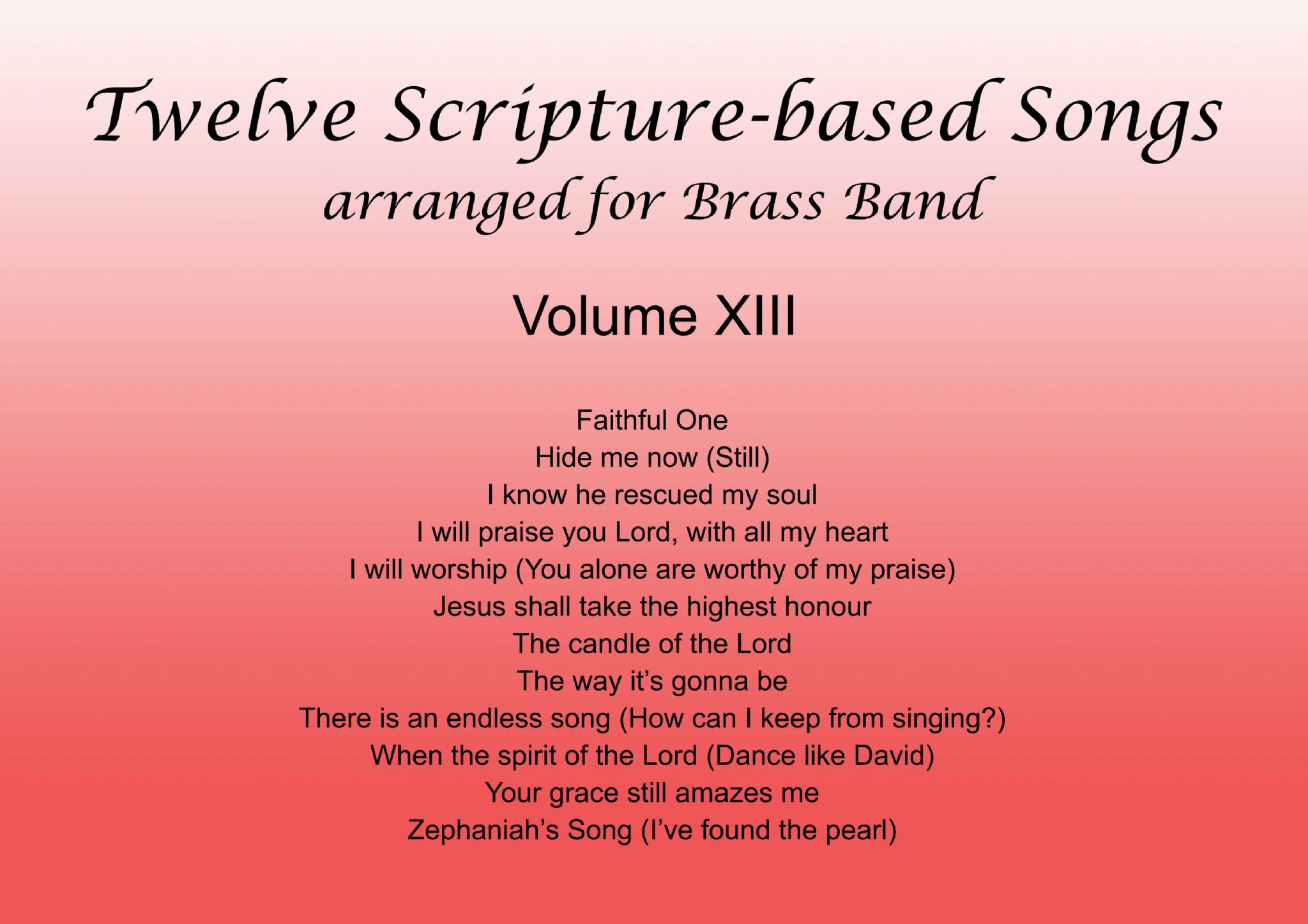
Twelve Scripture-Based Songs Volume XIII
Twelve scripture-Based Songs arranged for Brass Band (Volume XIII) are packaged and marketed in complete sets which include a full score and a set of master parts. It is intended that these parts be used as 'masters', for the purpose of photocopying a quantity of parts to accommodate the precise instrumentation needs of the band for which this has been purchased.Faithful One Brian Doerksen arr. Mervyn ClarkeHide me now (Still) Reuben Morgan arr. Paul SharmanI know he rescued my soul (My redeemer lives) Reuben Morgan arr. Dean JonesI will praise you Lord, with all my heart Dick KrommenhoekI will worship (You alone are worthy of my praise) David Ruiss arr .Dean JonesJesus shall take the highest honour Chris Bowater arr. Steven PonsfordThe candle of the Lord Joy Webb arr. Michael KenyonThe way it's gonna be Doug Horley arr. Dean JonesThere is an endless song (How can I keep from singing?) Chris Tomlin, Matt Redman and Ed Cash arr. Brian HoggWhen the spirit of the Lord (Dance like David) Anon arr. Andrew MackerethYour grace still amazes me Craig Phillips and Dean Phillips arr. David E JonesZephaniah's Song (I've found the pearl) arr. William Himes
Estimated dispatch 7-14 working days
-
 £33.20
Men of Harlech (Brass Band) Welsh Traditional arr. Alex McGee
This contemporary take by Alex McGee on the Welsh folk song Men of Harlech will be an entertaining addition to concert programmes. The arranger writes: 'Men of Harlech is perhaps one of the most well known of all traditional Welsh folk songs, but not like this. This setting was inspired by a composer who I first encountered as a 14-year-old playing in his first regional brass band, Gareth Wood. Upon learning of the death of Gareth I felt compelled to honour his memory and his music in composition. I struck upon the idea to do what he had done to the tune Sosban Fach to Men of Harlech, to take the tune as the raw material and try to craft it into something new yet recognisable, modern yet accessible. The work attempts to highlight what for me are the underlying characteristics of we Welsh; prone to melancholy but quick to find joy, contradictory, inviting, welcoming and warm but capable of housing a fierce streak of nationalistic pride. I dedicate this work to Gareth Wood and thank him for his music.' To view a rolling score video of the work please visit: https://www.youtube.com/watch?v=YSoZnpnhEjQ Duration: 3.30 minutes Difficulty Level: 3rd Section + PDF download includes parts and score. Sheet music available from www.brassband.co.uk Instrumentation: Soprano Cornet Eb Solo Cornet Bb Repiano Cornet Bb 2nd Cornet Bb 3rd Cornet Bb Flugel Horn Bb Solo Horn Eb 1st Horn Eb 2nd Horn Eb 1st Baritone Bb 2nd Baritone Bb 1st Trombone Bb 2nd Trombone Bb Bass Trombone Euphonium Bb Bass Eb Bass BbTimpani Percussion 1-2
In Stock: Estimated dispatch 1-3 working days
-
 £33.20
Nessun Dorma (Trombone Solo with Brass Band) Puccini arr. Ian Jones
This trombone solo with brass band was arranged by Ian Jones for Ronald Prussing, principal trombone of the Sydney Symphony Orchestra, for a recording with the Melbourne Staff Band. Nessun Dorma is an aria from the final act of Puccini's opera Turandot. It is one of the best loved of all Puccini's arias. To view a follow-the-score video featuring Ronald Prussing performing the solo with the Melbourne Staff Band, please visit www.youtube.com/watch?v=n9fREiH41sQ Sheet music available from: UK - www.brassband.co.uk USA - www.solidbrassmusic.com Instrumentation: Trombone Soloist Bb Soprano Cornet Eb Solo Cornet Bb 1st Cornet Bb 2nd Cornet Bb Flugel Horn Bb Solo Horn Eb 1st Horn Eb 2nd Horn Eb 1st Baritone Bb 2nd Baritone Bb 1st Trombone Bb 2nd Trombone Bb Bass Trombone Euphonium Bb Bass Eb Bass Bb Timpani Percussion
In Stock: Estimated dispatch 1-3 working days
-
 £35.00
The water is wide. Trad. Arr Andrew Duncan
Recommended - Championship to 3rd Section The Water is Wide or, Oh Wally Wally, is an arrangement for brass band of the popular and hauntingly beautiful traditional song. This arrangement is a feature for the Solo Cornet section of the band, beginning with just one solo cornet then adding another until all four are playing the melody line together. Includes Score & Parts
-
 £58.00
Notturno - Felix Mendelssohn Bartholdy/Willy Hautvast
This part from Mendelssohn's 'Midsummer Night's Dream' is a nice piece full of atmosphere allowing a wind band to excel. Above all, the French horn section comes to the fore. The work is well suited for different occasions both solemn and festive. This is one of the first arrangements for wind band written by Willy Hautvast.
Estimated dispatch 10-14 working days
-
 £18.00
Es ist ein Ros Entsprungen
DescriptionEs ist ein Ros Entsprungen is sometimes sung to the English words "A Great and Mighty Wonder". This tune to the reformation era German carol first appeared in the Speyer Hymnal in Cologne in 1599. This harmonisation of the tune by Michael Praetorius in 1609, one of his earliest publications. Praetorius was, along with his slightly younger contemporary Heinrich Schutz, the foremost German composer of the day, and became famous for his choral music. Much of this was written for multiple groups positioned around the church and conducted by a central conductor, giving a multi-phonic effect similar to the Venetian music of Gabrieli. Today his most famous music is Terpsichore, a collection of over 300 secular dances.You can follow the preview video of the score below.PercussionPercussion required are timpani and clash cymbals only; if clash cymbals are not available this part should be omitted (rather than played on a suspended cymbal).Mutes2 x solo cornets, second cornets and all trombones will require cup mutes
Estimated dispatch 7-14 working days
 View Music