
Results
-
 £15.00
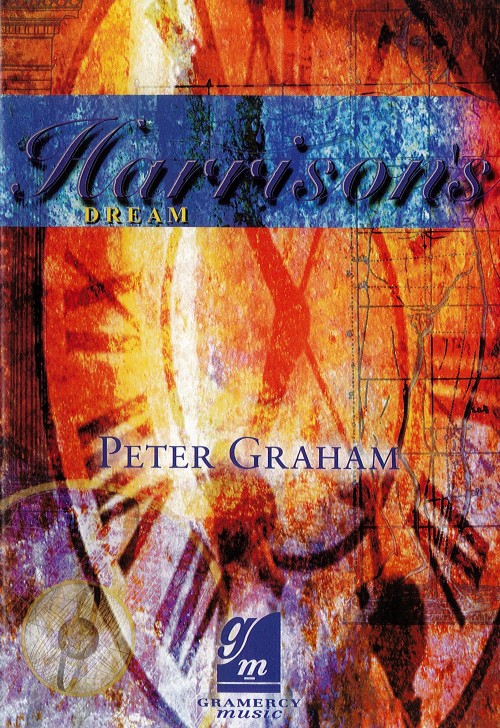
Harrison's Dream (Brass Band - Study Score) - Graham, Peter
At 8.00pm on the 22nd of October 1707, the Association, flagship of the Royal Navy, struck rocks off the Scilly Isles with the loss of the entire crew. Throughout the rest of the evening the remaining three ships in the fleet suffered the same fate. Only 26 of the original 1,647 crew members survived. This disaster was a direct result of an inability to calculate longitude, the most pressing scientific problem of the time. It pushed the longitude question to the forefront of the national consciousness and precipitated the Longitude Act. Parliament funded a prize of �20,000 to anyone whose method or device would solve the dilemma.For carpenter and self-taught clockmaker John Harrison, this was the beginning of a 40 year obsession. To calculate longitude it is necessary to know the time aboard ship and at the home port or place of known longitude, at precisely the same moment. Harrison's dream was to build a clock so accurate that this calculation could be made, an audacious feat of engineering.This work reflects on aspects of this epic tale, brilliantly brought to life in Dava Sobel's book Longitude. Much of the music is mechanistic in tone and is constructed along precise mathematical and metrical lines. The heart of the work however is human - the attraction of the �20,000 prize is often cited as Harrison's motivation. However, the realisation that countless lives depended on a solution was one which haunted Harrison. The emotional core of the music reflects on this, and in particular the evening of 22ndOctober 1707.- Peter GrahamJuly 2000 Recorded on Polyphonic QPRL219D Master Brass (Volume Fifteen). Duration: 14'30"
Estimated dispatch 7-14 working days
-
 £119.95
Harrison's Dream (Brass Band - Score and Parts) - Graham, Peter
At 8.00pm on the 22nd of October 1707, the Association, flagship of the Royal Navy, struck rocks off the Scilly Isles with the loss of the entire crew. Throughout the rest of the evening the remaining three ships in the fleet suffered the same fate. Only 26 of the original 1,647 crew members survived. This disaster was a direct result of an inability to calculate longitude, the most pressing scientific problem of the time. It pushed the longitude question to the forefront of the national consciousness and precipitated the Longitude Act. Parliament funded a prize of �20,000 to anyone whose method or device would solve the dilemma.For carpenter and self-taught clockmaker John Harrison, this was the beginning of a 40 year obsession. To calculate longitude it is necessary to know the time aboard ship and at the home port or place of known longitude, at precisely the same moment. Harrison's dream was to build a clock so accurate that this calculation could be made, an audacious feat of engineering.This work reflects on aspects of this epic tale, brilliantly brought to life in Dava Sobel's book Longitude. Much of the music is mechanistic in tone and is constructed along precise mathematical and metrical lines. The heart of the work however is human - the attraction of the �20,000 prize is often cited as Harrison's motivation. However, the realisation that countless lives depended on a solution was one which haunted Harrison. The emotional core of the music reflects on this, and in particular the evening of 22ndOctober 1707.- Peter GrahamJuly 2000 Recorded on Polyphonic QPRL219D Master Brass (Volume Fifteen). Duration: 14'30"
Estimated dispatch 7-14 working days
-
£44.95
Harrison's Dream (Brass Band - Score only) - Graham, Peter
At 8.00pm on the 22nd of October 1707, the Association, flagship of the Royal Navy, struck rocks off the Scilly Isles with the loss of the entire crew. Throughout the rest of the evening the remaining three ships in the fleet suffered the same fate. Only 26 of the original 1,647 crew members survived. This disaster was a direct result of an inability to calculate longitude, the most pressing scientific problem of the time. It pushed the longitude question to the forefront of the national consciousness and precipitated the Longitude Act. Parliament funded a prize of �20,000 to anyone whose method or device would solve the dilemma.For carpenter and self-taught clockmaker John Harrison, this was the beginning of a 40 year obsession. To calculate longitude it is necessary to know the time aboard ship and at the home port or place of known longitude, at precisely the same moment. Harrison's dream was to build a clock so accurate that this calculation could be made, an audacious feat of engineering.This work reflects on aspects of this epic tale, brilliantly brought to life in Dava Sobel's book Longitude. Much of the music is mechanistic in tone and is constructed along precise mathematical and metrical lines. The heart of the work however is human - the attraction of the �20,000 prize is often cited as Harrison's motivation. However, the realisation that countless lives depended on a solution was one which haunted Harrison. The emotional core of the music reflects on this, and in particular the evening of 22ndOctober 1707.- Peter GrahamJuly 2000 Recorded on Polyphonic QPRL219D Master Brass (Volume Fifteen). Duration: 14'30"
Estimated dispatch 7-14 working days
-
 £59.99
Eloise (Brass Band - Score and Parts) - Ryan, Paul - Sparke, Philip
Paul and Barry Ryan were identical twin sons of 1950's pop singer Marion Ryan and were born on 24th October 1948. They were groomed for stardom and had started singing as a duo before their fifteenth birthday. They were signed by Decca in 1965 and brilliantly marketed as clean-cut fashion icons. Their first single 'Don't Bring Me Your Heartaches' reached the UK top twenty but their success as twin performers lasted only three years. In 1968 Barry embarked on a solo career while Paul concentrated on writing and producing. Eloise with its melodramatic vocal style and heavily orchestrated backing was an early success of this new collaboration and went on to be covered by a variety of artists, including punk legends The Damned.Duration 5:30
Estimated dispatch 7-14 working days
-
 £40.00
Symphonic Dance No.3 (Brass Band - Score and Parts) - Rachmaninoff, Sergei - Littlemore, Phillip
Completed in 1940, the set of?Symphonic Dances?was Sergei Rachmaninov's last composition. The work is fully representative of the composer's late style with its curious, shifting harmonies, the almost Prokofiev-like grotesquerie of the outer movements and the focus on individual instrumental tone colours throughout.?Rachmaninov composed the Symphonic Dances four years after his Third Symphony, mostly at the Honeyman Estate, 'Orchard Point', in Centerport, New York, overlooking Long Island Sound. The three-movement work's original name was Fantastic Dances, with movement titles of 'Noon', 'Twilight' and 'Midnight'. When the composer wrote to the conductor Eugene Ormandy in late August, he said that the piece was finished and needed only to be orchestrated, but the manuscript for the full score actually bears completion dates of September and October 1940. It was premiered by Ormandy and the Philadelphia Orchestra, to whom it is dedicated, on 3rd January, 1941. This arrangement is of the last dance and is a kind of struggle between the?Dies Iraetheme, representing Death, and a quotation from Rachmaninov's own?Vespers?(also known as the All-night Vigil, 1915), representing Resurrection. The Resurrection theme proves victorious in the end as the composer actually wrote the word 'Hallelujah' at the relevant place the score (one bar after Fig. 16 in this arrangement).?Duration: 3:45
Estimated dispatch 7-14 working days
-
 £38.95
Unity Series Band Journal - Numbers 510 - 513, October 2022
510: March - There is a fountain (Zachary Docter)This bright and cheerful march takes two songs as its basis; Jesus loves me! This I know (S.A.S.B. 807) and There is a fountain (S.A.S.B 202).511: Shine, Jesus, shine (Marcus Venables)While this piece was originally written for young people at a summer music camp in Canada, the piece is a light programme item suitable for smaller ensembles of any age.512: My Trust (Alan Williams)This setting is based on the simple chorus In thee, O Lord, do I put my trust (S.A.S.B 594). Ordinarily heard in 3/4 times, this 4/4 version of the tune has the space for reflection written into the notation.513: Power in the blood (Martyn Thomas)This is a blues/rock arrangement of the traditional hymn Would you be free from your burden of sin? (S.A.S.B 451). It can be used as a stand-alone piece or equally well as an accompaniment for congregational singing.
Estimated dispatch 7-14 working days
-
 £38.95
Unity Series Band Journal October 2014 Numbers 422 - 425
No. 422 March - Jubilant Day! (Harold Burgmayer)This accessible march was written for the small, but faithful, corps band in Lock Haven, Pannsylvania, USA, on the occasion of the corps' 125th anniversary.No. 423 Euphonium Solo - Abide with me (Martin Cordner)A sensitive three-verse setting of William H. Monk's well-known tune for Euphonium and band.No. 424 March - God's Faithfulness! (Howard Davies)This march was written to assist celebrations for a recent Salvation Army Congress held in the Indonesian Territory. The music is deliberately written in the style of a 'parade (or street) march' with a steady and unhurried tempo.No. 425 Song Arrangement - Oi, oi, we are gonna praise the Lord! (Doug Engle)This chorus by Doug Horley uses some 'invented' words, but it clearly communicates how our response should be to a God who loves us.
Estimated dispatch 7-14 working days
-
 £38.95
Unity Series Band Journal October 2013 Numbers 410 - 413
No. 410 March - Go Forth! (Paul Drury)This march was written as a tribute to Bandmaster Jack Spowart and the Bo'ness Salvation Army Band. The composer lives in the twon of Bo'ness and has had numerous opportunities to share with the band and the wider corps at various events. This march serves as recognition of the faithful service given in the Lord's name in the town by The Salvation Army for over 100 years. Two tunes are featured, both well-known and instantly recognisable, namely, Forward! be our watchword and We're marching on.No.411 (1) O give thanks (Marian Parker)The composer, Marian Parker, is a new contributor and is the Recruiting Sergeant at Leicester South Corps. This simple, yet rhythmic piece should not pose any technical problems for most bands and features the attractive arrangement of Joanne Pond's contemporary song, 'O give thanks'.No.411 (2) Hymn Tune Arrangement - St Michael (David Rowsell)The hymn tune 'St Michael' was composed in 1551 by French composer Louis Bourgeois and the composer provides a very useful arrangement of this historic hymn.No. 412 Precious Lord, take my hand (Erik Silfverberg O.F.)This well-known Gospel Song is a favourite of many. It has been recorded by many great artists, including Rosetta Tharpe, Elvis Presley and Aretha Franklin. The words were written by Reverend Thomas A. Dorsey, who is often known as the 'Father of Gospel song'.No. 413 Search Me (Gavin Whitehouse)The second new contributor to this journal is Gavin Whitehouse. gavin is the Assistant Music Director for the Greater New York Division and is also the USA Eastern Territorial Songster Leader. This piece combines two songs - one old and one new - which speak of a God who knows us intimately. 'Search me, O God and know my heart today' (associated with the beautiful Maori melody, 'Now is the hour') is woven with a contemporary setting of Psalm 139 by Rebecca St James, the first line of which says, 'You searchme, you know me'.
Estimated dispatch 7-14 working days
-
 £38.95
Unity Series Band Journal October 2015 Number 434 - 437
No. 434 March - Joyful Peace (Eiliv Herikstad)This march will pose few technical difficulties to most Unity Series bands. Keep the playing light and distinct throughout. Although the music is simple, please warn against carelessness!No. 435 Marching! (Stephen Forman)This bright energetic work from Major Stephen Forman features the well-known song 'We are marching' as its main theme. This South African song, called 'Siyahamba' in the original Zulu language, became popular in North American churches in the 1990s and soon spread internationally becoming a much featured song within many churches.No. 436 Chorus Arrangement - Turn your eyes upon Jesus (David Edmonds)A very simple, yet effective arrangement of this much-loved chorus, the words of which simply say:Turn your eyes upon Jesus,Look full in his wonderful face;And the things of earth will grow strangely dimIn the light of his glory and graceNo. 437 March - Ever Onward (Charles Craig)The Devonshire Corps of Tiverton celebrated its 140th birthday in 2014. Although small in number, it is highly regarded and respected for its Christian witness and work throughout the community.The march is written in a traditional style and should present no difficulties to the average band.
Estimated dispatch 7-14 working days
-
 £38.95
Unity Series Band Journal - Numbers 498 - 501, October 2021
498: Prelude - Armageddon (Munashe Chikwezvero)This prelude to worship is based on the tune Armageddon (T.B. 181) and features the well-known hymn Who is on the Lord's side? (S.A.S.B. 992) by Frances Ridley Havergal499: Joshua (William Gordon)An easy-listening swing setting of the spiritual Joshua fought the battle of Jericho.500: Trombone Solo - O save me, dear Lord! (Erik Silfverberg)This devotional setting of the song I bring thee my cares and my sorrows by General Evangeline Booth, is scored here as a trombone solo.501: This is my desire (Gavin Lamplough)Meditative music based on two popular worship songs, Reuben Morgan's This is my desire (S.A.S.B. 397) and Martin Smith's Thank you for saving me (S.A.S.B. 477).
Estimated dispatch 7-14 working days
 View Music