
Results
-
 £30.00
Amazing Grace (W. Walker arr. by Paul Pennicotte-Henrie) - Brass Band Sheet Music Full Score and Parts - LM642
COMPOSER: W. WalkerARRANGER: Paul Pennicotte-Henrie"Amazing Grace" is a Christian hymn published in 1779 by English Anglican clergyman, abolitionist, and poet John Newton. It is possibly the most sung and most recorded hymn in the world and is especially popular in the United States, where it is used for both religious and secular purposes. Newton wrote the words from personal experience; he grew up without any particular religious conviction, but his life's path was formed by a variety of twists and coincidences that were often put into motion by others' reactions to what they took as his recalcitrant insubordination. He was pressed into service with the Royal Navy, and after leaving the service, he became involved in the Atlantic slave trade.In 1748, a violent storm battered his vessel off the coast of County Donegal, Ireland, so severely that he called out to God for mercy. While this moment marked his spiritual conversion, he continued slave trading until 1754 or 1755, when he ended his seafaring altogether. Newton began studying Christian theology and later became an abolitionist.Ordained in the Church of England in 1764, Newton became the curate of Olney, Buckinghamshire, where he began to write hymns with poet William Cowper. "Amazing Grace" was written to illustrate a sermon on New Year's Day of 1773. It is unknown if there was any music accompanying the verses; it may have been chanted by the congregation. It debuted in print in 1779 in Newton's and Cowper's Olney Hymns, but settled into relative obscurity in England. In the United States, "Amazing Grace" became a popular song used by Baptist and Methodist preachers as part of their evangelizing, especially in the American South, during the Second Great Awakening of the early 19th century. It has been associated with more than 20 melodies. In 1835, American composer William Walker set it to the tune known as "New Britain" in a shape note format; this is the version most frequently sung today.
In Stock: Estimated dispatch 3-5 working days
-
 £34.95
Down In The Brunner Mine - Anthony Ritchie
Down in the Brunner Mine was commissioned by The Onslow Brass Band in Wellington, New Zealand, and first performed and broadcast in 1996. It is a short set of variations based on a New Zealand folk song called Down in...
Estimated dispatch 5-7 working days
-
£70.00
Apophenia - Peter Meechan
aApophenia is the experience of seeing patterns or connections in random or meaningless data.aApophenia is a trumpet concerto in three movements written for American trumpet virtuoso Rex Richardson. Each of the three movements features a different instrument; Movement 1 is for the Bb trumpet, the second is for flugel horn and trumpet, and the third is for trumpet and piccolo trumpet.Each of the three movements of Apophenia relate to the phenomenon of viewing Dark Side of the Rainbow - a name used to refer to the act of listening to the 1973 Pink Floyd album The Dark Side of the Moon whilst watching the 1939 film The Wizard of Oz, where moments where the film and the album appear to correspond with each other.Movement 1 is a fast a furious movement. Solo and ensemble interact at high tempo, swapping and creating new ideas, leading each other in new directions. Aside from the trumpet soloist, the kit player also acts as a quasi soloist.The second movement takes its musical inspiration from the Pink Floyd song Us and Them. It is during this segment of the film that some of the most amazing moments of connection happen.The final movement is a dance - and a tour de force for the soloist who begins on the Bb trumpet, before switching to the piccolo trumpet (or Eb trumpet) for the fast and furious finale. Many of the coincidences from Dark Side of the Rainbow relate to dancing, however, as long as a piece of music is the same tempo as the original, and the time signature is a regular one, this could be the case across most films. So the composer chose to write a dance that wouldn't synchronise to too many existing dance scenes!The soloist is free to improvise their own cadenza.Apophenia is dedicated to Rex Richardson.
Estimated dispatch 12-14 working days
-
 £30.00
A Million Love Songs - Gary Barlow
Made famous by the boy band 'Take That', this fantastic new angle on the song from Lucy Pankhurst, creatively features the flugel and tenor horn section with full support from the accompanying band.Take That's Gary Barlow wrote 'A Million Love Songs' when he was 15. He also recorded a rough demo of the track, and was one of the songs he gave to music manager Nigel Martin-Smith on a cassette tape as part of his audition to join a boy-band.In his autobiography A Better Me, Gary revealed that Martin-Smith was so impressed by the tape, that he didn't realise it was Gary singing. As legend has it, the conversation went like this:Martin-Smith: "This tape, who has written the songs?"Barlow: "Me"Martin-Smith: "Who wrote the words, then?"Barlow: "Me. And the music and the backing track."Martin-Smith: "Wow, you'd better come back and see me tomorrow."The ballad became one of the group's most popular songs, and is often voted among the greatest love songs of all time. It peaked at No. 7 in the UK charts, and remains a firm favourite, not just for its sentiment, but for the beautiful melody Barlow created.Lucy's arrangement for brass band brings a whole new dynamic to the music and offers the flugelhorn and tenor horns a golden opportunity to shine.
In Stock: Estimated dispatch 3-5 working days
-
 £30.00
Down By The Salley Gardens
A new brass band release for 2023 which also welcomes Fiona Neary as a new member of our ever-growing family of writers!This traditional Irish folk tune has been beautifully arranged for brass band, offering a tranquil moment to your programme with a memorable jaunty jig section to keep your listeners on their toes!Every concert needs that 'Aaahhhh' element, and Down By The Salley Gardens certainly brings all the qualities required to meet that need.This original traditional Irish melody has been referred to by a variety of titles: 'Mourne Shore', 'Moorlough Shore' and 'The Maids of Mourne Shore', and is believed to have dated back to the 17th-18th century.In 1889, William Butler Yeats had his poem 'Down By The Salley Gardens' published in The Wanderings of Oisin and Other Poems. The verse was then later set to the Irish melody by Herbert Hughes in 1909. Since this combining, the music has become synonymous with the poem and naturally adopted the poem's title.Due to the beauty of the melody and the emotive words of the associated poem, both elements of this work has been embraced by a variety of artistes, including recordings by The Corrs and Sinead O'Connor; John Ireland (1879-1962) set the words to an original melody in his song cycle Songs Sacred and Profane, written in 1929-31; there is a vocal setting by the poet and composer Ivor Gurney, which was published in 1938; and Benjamin Britten published a setting of the poem in 1943.
In Stock: Estimated dispatch 3-5 working days
-
 £19.95
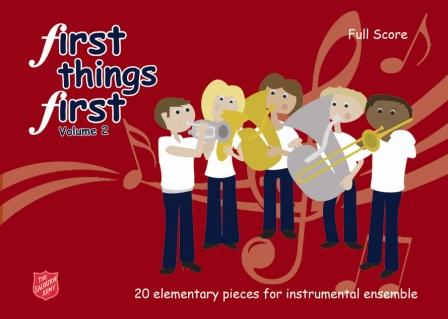
First Things First Vol.2 Full Score
Following the success of Volume 1, here is Volume 2 containing 20 new pieces:Chorus Arrangement - Clap your Hands (Derick Kane)Easter Intrada (Nicholas Samuel)Father, we adore you ((Ralph Pearce)March - Give thanks to the Lord (Trevor Davis)Happy all the time (Martin Cordner)March - Hold On! (Erik Silfverberg)Holy Ground (Trevor Davis)Prelude - In this place (Nicholas Samuel)Marching Saints (Ralph Pearce)New Life (Ray Steadman-Allen)Intrada - O come. all ye faithful (Andrew Blyth)Send the Fire! (Erik Silfverberg)Soon and very soon (Derick Kane)March - Stand up for Jesus (Noel Jones)Song Arrangement - Thank You! ((Andrew Blyth)The Lord's my shepherd (Ray Steadman-Allen)There is a redeemer (Dean Jones)We give thanks (Ralph Pearce)Winter's Rock! (Andrew Blyth)Wonderful Lord (Martin Cordner)
Estimated dispatch 7-14 working days
-
 £45.00
God Put a Smile Upon Your Face
ABOUT THIS PIECE: 'God Put a Smile Upon Your Face' was written by all members of the band Coldplay for their second studio album 'A Rush of Blood to the Head'. Coldplay vocalist Chris Martin said: "The song came out of playing live and wanting to have something with a bit more bounce". The chart was originally released in 2003 to critical acclaim. In 2007 Mark Ronson covered the song on his album 'Version' - it is this version this arrangement is based upon. The following arrangement was devised as a concert opener - written as such to allow different sections of the band to make their way to the stage one at a time. The suggested stage entry directions for this arrangement are: Percussion > Basses > Trombones > Horns & Baritones > Cornets & Euphonium. Kit and percussion parts are written as a guide - please feel free to add and subtract as the MD sees fit. DUE TO COPYRIGHT LAW THIS WORK IS NOT AVAILABLE IN AUSTRALIA OR NEW ZEALAND ENSEMBLE: Standard British Brass Band WHEN YOU BUY THIS PRODUCT, YOU GET: High-quality printed score and parts LEVEL: 2 LISTEN: Click here DURATION: 3-mins 30 secondEXAMPLE SCORE: Click here LEVEL GUIDE: Level 1- Accessible to all Level 2 - c. UK third section and higher Level 3 - c. UK second section and higher Level 4 - c. UK first section and higher Level 5 - c. UK championship section level
Estimated dispatch 5-7 working days
-
 £32.00
Barcelona - Vocal Duet or Cornet & Euphonium - Brass Band Sheet Music Full Score & Parts - LMAM054
COMPOSER: Mike Moran & Freddie MercuryARRANGER: David Beal"Barcelona" is a single released by Queen vocalist Freddie Mercury and operatic soprano Montserrat Caballe. A part of their collaborative album Barcelona, it also appeared on Queen's Greatest Hits III. The song reflects Mercury's love of opera with his high notes and Caballe's operatic vocals, backed by a full orchestra. Originally released in 1987, it was one of the biggest hits of Mercury's solo career, reaching number eight in the UK singles chart. After Mercury's death in 1991, it was featured at the 1992 Summer Olympics. The single was re-issued on 20 July 1992, after which the track climbed even higher, peaking at number two in the UK, the Netherlands and New Zealand. In 2004, BBC Radio 2 listed Barcelona at number 41 in its Sold On Song Top 100.Scored here for British Brass Band.
In Stock: Estimated dispatch 3-5 working days
-
 £30.00
The Sword and the Star
DescriptionThe Sword and the Star was written in 2006 for the Middleton Band at the request of their Musical Director, Carl Whiteoak. The inspiration for the work was the band's badge, which features a medieval archer. The town of Middeton's historical link with the symbol of the Archer came from the English victory at the Battle of Flodden in September 1513, where bowmen from Middleton and Heywood under the command of Sir Richard Assheton played a vital part in crushing the invading Scottish army. Sir Richard captured one of the Scottish commanders and presented the prisoner's sword to the St Leonard's church in Middleton in recognition of the town's contribution. As long time Lords of the Manor, the Assheton family crest was for centuries featured in the coat of arms of Middleton council, and when Middleton became part of the Metropolitan Borough of Rochdale the black star from the Assheton crest was used to represent Middleton in the new borough's coat of arms. Hence the title The Sword and the Star, for a piece which attempts to give an impression of the town as it was then and as it is now.The music is in three short sections - a fanfare, a lament and a bright scherzo - and simply aims to contrast the medieval hamlet of Middleton with the bustling urban centre it has now become. The central lament features a Scottish song called "The Flowers of the Forest", written to mourn the loss of so many of Scotland's young men on the field of Flodden; the song returns in a much more positive form at the end of the piece.
Estimated dispatch 7-14 working days
-
Anyone Who Had A Heart - Burt Bacharach and Hal David - Len Jenkins
"Anyone Who Had A Heart" is a song written by Burt Bacharach (music) and Hal David (lyrics) originally for Dionne Warwick in 1963. However, in the UK, Ireland and New Zealand, the cover version by Cilla Black was, and is still, the best loved. Championed by her friends The Beatles, she began her career as a singer in 1963, and her singles "Anyone Who Had A Heart" and "You're My World" both reached number one in the UK in 1964. From the first line, the song has a certain frisson: "Anyone who ever loved, could look at me, and know that I love you." Sadly, Cilla passed away on 1 August 2015 so this is our tribute to a well-loved lady and singer. Our objective has been to interpret the style of the original performance by Cilla, and whilst the time signatures may not be familiar, experience has shown that these are easier to read and play than the alternative using triplets.

 View Music