
Results
-
 £73.00
Bass Trombone Concerto (Bass Trombone Solo with Brass Band - Score and Parts) - Wood, Gareth
Written in 2006 for Roger Argente, Gareth Wood brings his considerable experience of writing for brass, and brass bands in particular, to an instrument not often blessed with opportunities for solo exposure. It is scored for soloist accompanied by traditional brass band line-up, including timpani and two percussion, and follows the standard three-movement pattern. In the first movement, the soloist launches straight into the musical argument with a low-lying repeated quaver figure punctuated by the band. A lyrical second subject in the high register is also entrusted to the soloist, and the movement comes to a thrilling conclusion. The slow movement opens softly with the percussion, and a mournful bass line sets the mood for a thoughtful long melody. It reaches a powerful climax, which subsides to a return of the opening mood. In the march-like finale, the soloist is pitted against a number of solo instruments from the band and a driving ostinato carries the momentum through to the blazing ending. Duration: 13.00. Suitable for 1st Section Bands and above.
Estimated dispatch 7-14 working days
-
 £60.00
From the Shores of the Mighty Pacific (Cornet Solo with Brass Band - Score and Parts) - Clarke, Herbert L. - Wilkinson, Keith M.
Cornet Solo with Brass BandHerbert L. Clarke (1867 - 1945) is regarded by many as one of the finest cornet players of all time, noted not only for his amazing technique but also for his warm, lyrical tone. He has left a multitude of cornet solos as well as collections of studies which are still very widely used. He was a member of The Sousa Band briefly in 1893 and then from 1898 to 1917 where he was not only the distinguished cornet soloist but also became assistant director.From The Shores Of The Mighty Pacific is an all-time favourite rondo-caprice cornet solo and was first published in 1912. A brass band arrangement was requested by Chris Lichtler, principal cornet of Brass Band of the Western Reserve, musical director Dr. Keith M. Wilkinson. Chris has performed it many times with BBWR and it was recorded by them on the CD, Without Reserve!.
Estimated dispatch 7-14 working days
-
 £34.95
Travelling Along (Euphonium Solo with Brass Band - Score and Parts) - Mallett, Chris
This cheerful and energetic solo includes two Salvation Army songs, 'Travel along in the sunshine' and 'Sunshine', the composer having emigrated from the UK to 'sunny' California. (Look out for musical quotes from 'California, here I come')! The solo was written for himself to play during a return visit to the UK hence the witty quote from 'Raindrops keep falling on my head'.
Estimated dispatch 7-14 working days
-
£17.50
Travelling Along (Euphonium Solo with Brass Band - Score only) - Mallett, Chris
This cheerful and energetic solo includes two Salvation Army songs, 'Travel along in the sunshine' and 'Sunshine', the composer having emigrated from the UK to 'sunny' California. (Look out for musical quotes from 'California, here I come')! The solo was written for himself to play during a return visit to the UK hence the witty quote from 'Raindrops keep falling on my head'.
Estimated dispatch 7-14 working days
-
 £29.95
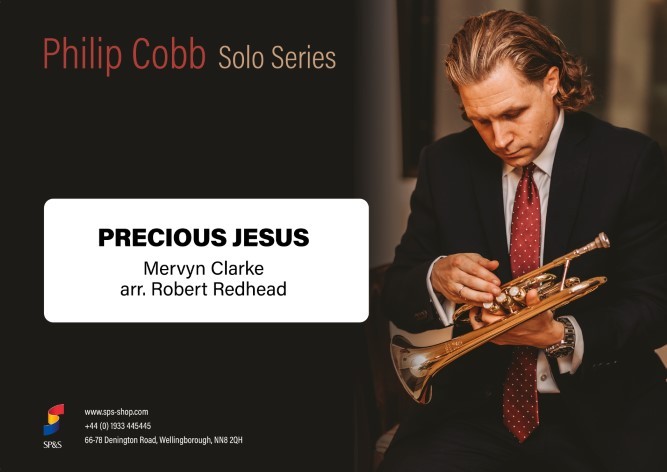
Precious Jesus (Cornet Solo with Brass Band - Score and Parts) - Clarke, Mervyn - Redhead, Robert
Mervyn Clarke composed this musical setting, Precious Jesus, of words by Francis Bottome. The fresh musical interpretation and strong attractive melodic line become a firm favourite with Songsters when it was published in 1976 and has been featured ever since. Duration: 2.45
Estimated dispatch 7-14 working days
-
 £60.00
Fantastic Polka (Trombone Solo with Brass Band - Score and Parts) - Pryor, Arthur - Wilkinson, Keith M.
Arthur Pryor is remembered primarily for his 12 years as the amazing trombone soloist with The Sousa Band. However, he was also a prolific composer and conductor, forming his own band following his years with Sousa. He wrote many trombone solos designed to dazzle audiences with his virtuosity.This brass band version was prepared at the request of The Black Dyke Band, musical director Nicholas J Childs, for a recording project with Ian Bousfield, principal trombone of the Vienna Philharmonic, titled Pryor Engagement. It has also been recorded by Brett Baker with Brass Band of the Western Reserve, musical director Keith M Wilkinson, on the CD Slides Rule!
Estimated dispatch 7-14 working days
-
 £26.95
Paseo (Cornet Solo with Brass Band - Score and Parts) - Wiffin, Rob
A gentle solo for cornet with band accompaniment.Paseo is a Spanish word for a leisurely walk or stroll. The soloist takes the musical line for a walk with no great sense of hurry. There is one moment where the pleasantness of the stroll is threatened but it quickly passes and the good mood is resumed. Technically this needs a good sense of cantabile and control over the range from low D to D two octaves higher. In order to allow the soloist to sing through without fighting the accompaniment, cornets and percussion are omitted.Duration: 4.15
Estimated dispatch 7-14 working days
-
 £102.99
Chameleon (Euphonium Solo with Brass Band - Score and Parts) - Doss, Thomas
Chameleon is a three-part solo piece for euphonium and brass band. The different styles within the piece provide lots of variety, requiring refined technique and a great deal of flexibility from the soloist. This composition was commissioned by Georg Pranger, to whom the piece is also dedicated. As a pioneer of the Austrian euphonium soloist scene, Pranger is committed to the unshackling of this wonderful instrument and the creation of great musical momentum, as achieved by this commission.Duration: 8.30
Estimated dispatch 7-14 working days
-
 £49.95
Caprice (Euphonium Solo with Brass Band - Score and Parts) - Batterham, Andrew
Caprice was written for Matthew can Emmerik, to showcase his virtuosity in an engaging piece of concert music. It is in theme and variation form, with the primary material being the theme from the last of Paganini's Ventiquattro Capricci per violino solo. This theme has been the inspiration for similar works by many composers, including Liszt, Brahms, Rachmaninov, Benny Goodman and Andrew Lloyd Webber.In this work, the famous theme is treated to a more contemporary approach.The first variation, Capricious, relies on motor rhythms and jagged dialogues between the soloist and the accompaniment. It is couched in an organic scale reminiscent of the Phrygian mode.The second variation, Sad, is in direct contrast, acting as a traditional ballad and allowing the soloist to explore the expressive side of the instrument.The third variation, Energetic, is a micro set of variations in itself, designed to display the soloist's innovative technique and stamina. Each section is more challenging than the previous one, until the work concludes with a whirlwind dance at breakneck speed.Like all of Batterham's recent work, the musical language of Caprice draws upon classical, jazz, funk and ska elements to create a unique sound where anything can happen, and probably will!
Estimated dispatch 7-14 working days
-
 £88.00
Bass Trombone Concerto (Bass Trombone Solo with Brass Band - Score and Parts) - Brubeck, Christopher
"As a bass trombonist, I spent many years of my adolescence playing in youth orchestras, engaging in musical daydreams. I would visualize myself jumping up from the back of the orchestra to unleash improvisations much to the conductor's horror. The resultant three-movement, thirteen-minute work has enjoyed a robust life with performances by notable orchestras all around the world. Happily, the concerto works well as a recital piece, with many accomplished college players having won concerto competitions performing it. Jazz elements were inescapable, and realizing my old nightmare/dream, quite a bit of the trombone solo is meant to be improvised. I made a recording of the concerto with the London Symphony Orchestra, which was included on a CD called Bach to Brubeck released on Koch International Classics. Having already become popular as a bass trombone work with orchestra accompaniment, renowned British Bass Trombonist and publisher Roger Argente suggested he release a special Brass Band arrangement of my concerto. Roger knew the piece well because years ago he played the European premiere of the concerto with the Royal Philharmonic Orchestra at the Royal Albert Hall." - Chris Brubeck. Duration: 13.00. Suitable for 1st Section Bands and above.
Estimated dispatch 7-14 working days
 View Music