
Results
-
 £41.09
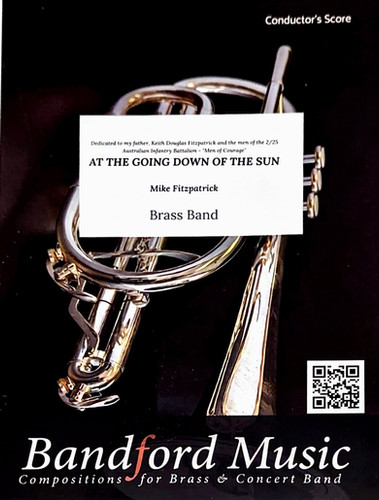
At the Going Down of the Sun (Brass Band) Mike Fitzpatrick
At The Going Down Of The Sun is a deeply moving musical tribute dedicated to the courage, resilience, and ultimate sacrifice of those who have defended the nation of Australia. Inspired by the heroic legacy of the 2/25th Battalion and their storied defense of the Kokoda Track during World War II, this composition serves as a solemn reminder of the immense gratitude owed to its fallen heroes. This piece is born from a legacy of service. It was composed in honor of Keith Fitzpatrick, who enlisted in the AIF on November 28, 1941. Keith served two tours in New Guinea, spending 359 days on the treacherous Kokoda Track. Keith Fitzpatrick lived to celebrate his 100th birthday in 2023, leaving behind a profound legacy through his wife of 67 years, Valda, and three generations of descendants. At The Going Down Of The Sun captures this spirit of endurance and devotion. It is an ideal addition to any program focused on: Anzac Day & Remembrance Day services Military Commemorations Historical Tributes To view a rolling score video of the work please visit www.youtube.com/watch?v=ydO9PKOKTpk Duration: 7.00 minutes Difficulty Level: 3rd Section + This PDF download includes the full score and parts. Sheet music available at www.brassband.co.uk (UK) or https://satradecentral.org (USA) Instrumentation: Soprano Cornet Eb Solo Cornet 1&2 Bb Solo Cornet 3&4 Bb Repiano Cornet Bb 2nd Cornet Bb 3rd Cornet Bb Flugel Horn Bb Solo Horn Eb 1st Horn Eb 2nd Horn Eb 1st Baritone Bb 2nd Baritone Bb 1st Trombone Bb 2nd Trombone Bb Bass Trombone Euphonium Bb Bass Eb Bass Bb Percussion Tubular Bells
In Stock: Estimated dispatch 1-3 working days
-
 £33.62
The Wexford Carol (Brass Band) Irish Trad. arr. Andrew Wainwright
This stunning arrangement for brass band by Andrew Wainwright of the beautiful Irish carol depicts perfectly the wintery moods and landscapes evocative of the Irish countryside. The Wexford Carol is a traditional Irish Christmas carol that originated in County Wexford in the 19th century. The carol tells the story of the birth of Jesus Christ and the journey of the Magi to Bethlehem. It is written in a simple and elegant style, and its melody is both beautiful and haunting. This arrangement is a lush and evocative setting of the traditional carol. The arrangement features a rich tapestry of textures and gradually builds in intensity as the carol progresses, before fading out to a quiet, haunting conclusion. PDF download includes score and parts. Sheet music available from: UK - www.brassband.co.uk USA - www.solidbrassmusic.com Difficulty Level: 3rd Section + Instrumentation: Soprano Cornet Eb Solo Cornet Bb Repiano Cornet Bb 2nd Cornet Bb 3rd Cornet Bb Flugel Horn Bb Solo Horn Eb 1st Horn Eb 2nd Horn Eb 1st Baritone Bb 2nd Baritone Bb 1st Trombone Bb 2nd Trombone Bb Bass Trombone Euphonium Bb Bass Eb Bass Bb Timpani Cymbals Tam-Tam Tuned Percussion
In Stock: Estimated dispatch 1-3 working days
-
£50.00
Fawkes the Phoenix (Score & Parts) - John Williams
From Harry Potter and the Chamber of Secrets, Fawkes the Phoenix was composed by John Williams and arranged for brass band by Andrew Duncan. Brass Band Grade 4: Advanced Youth and 3rd Section Duration: 4 minutes
In Stock: Estimated dispatch 1-3 working days
-
£65.00
The Cowboys (Score & Parts) - John Williams
In a career that's spanned over five decades, composer John Williams has scored fewer than five Westerns which, judging from his exemplary work on this 1972 score The Cowboys, seems something of a shame. Williams offers up a robust, brassy score that the composer hopes 'people will find genuine pleasure in'. Brass Band Grade 5: 1st Section Duration: 6 minutes
In Stock: Estimated dispatch 1-3 working days
-
 £34.95
Descent, The - Christopher Bond
The Descent takes its inspiration from Victorian author Jules Verne; specifically, his work Twenty Thousand Leagues Under the Sea. In Twenty Thousand Leagues Under the Sea, Professor Arronax finds himself a prisoner of the mysterious Captain Nemo, on a remarkable submarine called the Nautilus. Nemo is one of Verne's most memorable characters. He's a man who has turned his back on the world, and his name - Nemo - means 'No Man.' He has vowed never to set foot on dry land ever again. Verne gives his hero's brilliance and benevolence a dark underside - the man's obsessive hate for Empires and Imperialism. Captain Nemo is a genius, an engineer, an artist, an athlete, sometimes a pacifist, sometimes a righter of wrongs, sometimes an out and out villain, and he invented the Nautilus. The Descent is based on the idea of a descent to the depths of the ocean in the Nautilus with Captain Nemo, with the cornet soloist expressing both the anguish and reflective sides of the character. On one hand, a troubled and agitated figure, juxtaposed with the reflective memories of his homeland, children, mother and father. The work was written for and commissioned by Flowers Band as part of their programme of music at Brass in Concert 2019.
Estimated dispatch 10-14 working days
-
 £34.99
I'll be there for you (theme from Friends)
Recommended for - Suitable for all bands An arrangement for brass band by Andrew Duncan of I'll Be There For You' the celebrated theme tune by The Rembrandt's for the ever-popular TV Sitcom, Friends. Includes Score & Parts
-
 £35.00
Money, Money (Makes the World go Round). Arranged for Brass Band
Recommended - Championship to 2nd Section This fun and quirky arrangement of the hit song from Cabaret was premiered in 2011 by Kingdom Brass. Money, Money (makes the World go round) is a show-piece for the band (with added drama and choreography if desired). Includes Score & Parts
-
 £44.95
THE ELEPHANT - Saint-Saens arr. Peter Graham
From Carnival of the Animals, thisarrangement features the tuba section.Available MultiMedia Files
Estimated dispatch 3-7 working days
-
 £34.95
The Cave of Wonders - Jonathan Bates
DIFFICULTY: Champ. DURATION: 3'00". 'The Cave of Wonders' was composed for the Foden's Band's winning performance at the 2023 Brass in Concert Championships, held at The Glasshouse, Gateshead where the band performed a set of music inspired by the Disney classic, 'Aladdin'. Near the start of the film, Aladdin enters the Cave of Wonders to retrieve the golden lamp and is instructed to touch nothing but the lamp. His pet monkey Abu grabs some of the surplus jewels triggering the cave's collapse. Trapped, Aladdin and Abu explore the cave, discovering and releasing a magic carpet. The carpet instructs Aladdin to rub the lamp as their only hope of escape and in doing so releases a mighty Genie from it's captivity.
In Stock: Estimated dispatch 1-3 working days
-
 £19.95
As The World Falls Apart... - Jonathan Bates
DURATION: 4 minutes. DIFFICULTY: Moderate. 'As The World Falls Apart' was composed for David Maxted as part of the programme for his BMus Final Recital at the RNCM in May 2017. The work was composed in a time of real political and social divide, with chaos only ever seeming minutes away, and the base of the piece is one of serenity and traniquility amongst the bedlam which is occurring around us all. Originally, the work was planned to be a totally free unaccompanied work for solo horn, however I wanted to make use of the vast space the RNCM concert hall can offer with the surround-sound speakers and decided to utilise a short sound effect track to enhance the feeling of chaos as the music reaches it's peak in dynamic and intensity. AUDIO FILE AVAILABLE FROM COMPOSER - [email protected]. . . .
In Stock: Estimated dispatch 1-3 working days
 Watch video
 View Music