
Results
-
 £44.83
Following the Star - A Christmas Suite for Brass Band (Ivan Andrews)
This attractive suite for brass band by Ivan Andrews will be accessible to the majority of bands and features several well known carols - Good King Wenceslas (in a slightly unfamiliar form being set in compound time), Here we come a-wassailing, The Three Kings, and We Three Kings of Orient Are in swing time. Set for a slightly smaller band than is traditional, it will be playable by a minimum of 20 players. To view a follow-the-score video of the work please visit: www.youtube.com/watch?v=AYsLf5T144Y PDF download includes score and parts. Sheet music available from: UK - www.brassband.co.uk USA - www.solidbrassmusic.com Difficulty Level: 4th Section + Instrumentation: Soprano Cornet Eb 1st Cornet Bb 2nd Cornet Bb Flugel Horn Bb 1st Horn Eb 2nd Horn Eb 1st Baritone Bb 2nd Baritone Bb 1st Trombone Bb 2nd Trombone Bb Bass Trombone Euphonium Bb Bass Eb Bass Bb Glockenspiel Drum Set
In Stock: Estimated dispatch 1-3 working days
-
 £33.62
For unto us a child is born from 'Messiah'(Brass Band) Handel arr. Kevin Norbury
Ever since the first performance in April 1742 in Dublin, Ireland, Messiah has been the iconic Christian oratorio. It is a work of genius with lyrics skillfully taken from the Bible by Charles Jennens and timeless music by G. F. Handel, and has been at the top of the Western musical canon for close to 300 years. For unto us a child is born comes roughly halfway through Part One of the oratorio and is one of its most popular choruses, being the prophecy of the birth of a Messiah (Jesus) found in Isaiah chapter nine. This excellent setting for brass band is by Kevin Norbury. To view a rolling score video of the work please visit https://www.youtube.com/watch?v=G63Tzi3L07U Duration: Approx. 4.00 minutes Difficulty Level: 2nd Section + PDF download includes parts and score. Sheet music available from www.brassband.co.uk Instrumentation: Soprano Cornet Eb Solo Cornet Bb Repiano Cornet Bb 2nd Cornet Bb 3rd Cornet Bb Flugel Horn Bb Solo Horn Eb 1st Horn Eb 2nd Horn Eb 1st Baritone Bb 2nd Baritone Bb 1st Trombone Bb 2nd Trombone Bb Bass Trombone Euphonium Bb Bass Eb Bass BbTimpani Snare Glockenspiel
In Stock: Estimated dispatch 1-3 working days
-
 £37.35
Great is Thy Faithfulness (Brass Band) Runyan arr. Dan Forrest trs. Wainwright
This marvelous setting by Dan Forrest of the classic hymn Great is thy Faithfulness has quickly become a popular item for choirs around the world. This setting for brass band by English composer Andrew Wainwright was commissioned by the Melbourne Staff Band to commemorate Bandmaster Ken Waterworth's final year as Bandmaster before his retirement. It begins with quiet assurance, a beautiful combination of strength and gentleness which continues to build to a dramatic final statement of truth. For bands looking to combine with a choir, this setting is in the same key and format as the original choral version. To view a rolling score video of Melbourne Staff Band performing the piece please visit www.youtube.com/watch?v=bPtXdxaEPHc Duration: Approx. 5.30 minutes Difficulty Level: 3rd Section + PDF download includes parts and score. Sheet music available from www.brassband.co.uk (UK) or https://satradecentral.org (USA) Instrumentation: Soprano Cornet Eb Solo Cornet Bb Repiano Cornet Bb 2nd Cornet Bb 3rd Cornet Bb Flugel Horn Bb Solo Horn Eb 1st Horn Eb 2nd Horn Eb 1st Baritone Bb 2nd Baritone Bb 1st Trombone Bb 2nd Trombone Bb Bass Trombone Euphonium Bb Bass Eb Bass BbTimpani Percussion 1-2
In Stock: Estimated dispatch 1-3 working days
-
 £59.77
Horizon: The Promise of the Lord (Brass Band) Andrew Wainwright
Horizon: The Promise of the Lord was written at the request of Bandmaster Stephen Cobb for The International Staff Band. It is based on the much loved hymn of the church, Cwm Rhondda (Guide me O thou great Jehovah). The work was recorded on the ISB's CD Manuscripts II (released 2023). This highly descriptive piece will be an excellent addition to concert programs, as well as being appropriate as a test piece. The inspiration for the work comes from the book of Exodus. Whilst the music is not intended to be directly programmatic, like the hymn Cwm Rhondda, the work takes the listener through the Exodus from Egypt to the promised land of Israel as a metaphor of the spiritual pilgrimage of the individual Christian through his or her earthly life. The music aims to evoke a sense of God's guidance through strife and affirm the reality that God provides for us and redeems all the wrong in the world. This God who provided for the Hebrew people wandering amidst 'barren lands' with 'bread of heaven' is still and ever will be a God of provisional grace. Through listening to the music, it is the composer's intention that we are reminded of God's promise of Deliverance as set out in Exodus 6 v7-8: 'I will take you as my own people, and I will be your God. Then you will know that I am the Lord your God, who brought you out from under the yoke of the Egyptians. And I will bring you to the land I swore with uplifted hand to give to Abraham, to Isaac and to Jacob. I will give it to you as a possession. I am the Lord.' Like the hymn, Horizon: The Promise of the Lord is intended as a prayer for guidance. The Christian is a pilgrim through 'this barren land'. The music is often chromatic and in large parts verging on atonality, as a reflection of the strife that the Israelites endured in their 40 years in the wilderness. However, it ends in climactic fashion with the Hebrew people finally reaching their destination after many years of wandering in the desert - as they approach the 'Horizon' promised by the Lord. To view a performance of the work by the National Youth Brass Band of Great Britain please visit www.youtube.com/watch?v=LjOHf7QEw1g PDF download includes score and parts. Sheet music available from: UK - www.brassband.co.uk USA - https://satradecentral.org Difficulty Level: 1st Section + Length: c11.00 minutes Instrumentation: Soprano Cornet Eb Solo Cornet Bb Repiano Cornet Bb 2nd Cornet Bb 3rd Cornet Bb Flugel Horn Bb Solo Horn Eb 1st Horn Eb 2nd Horn Eb 1st Baritone Bb 2nd Baritone Bb 1st Trombone Bb 2nd Trombone Bb Bass Trombone Euphonium Bb Bass Eb Bass Bb Percussion 1-4
In Stock: Estimated dispatch 1-3 working days
-
 £29.88
How Shall I Woo Thee (Cornet Solo with Brass Band) Coleridge-Taylor arr.Bushnell
The 7 African Romances, Op. 17 for voice and piano has words by Paul Laurence Dunbar and music by Samuel Coleridge-Taylor. Published in 1897, it comprises of 7 songs, "An African Love Song", "A Prayer", "A Starry Night", "Dawn", "Ballad", "Over the Hills" and "How Shall I Woo Thee?", of which the last is arranged here.This arrangement was requested by Besses o' th' Barn Band for the The Samuel Coleridge-Taylor Festival held in Liverpool on 11 October 2025. The song is wonderfully lilting with moments to indulge in the music.This arrangement is for the UK-style brass band and either solo B-flat cornet, solo E-flat soprano cornet or soprano singer. It also has alternative parts for horns in F and bass-clef lower brass. A recording of the original song can be found here: https://www.youtube.com/watch?v=tglGpaBsWOo Duration: Approx. 3.10 minutes Difficulty Level: 4th Section + This PDF download includes the full score and parts. Includes alternative parts for soloist in Eb, horns in F and lower brass in bass clef. Sheet music available at www.brassband.co.uk (UK) or https://satradecentral.org (USA) Instrumentation: Cornet Soloist Bb Soprano Cornet Eb Solo Cornet Bb Repiano Cornet Bb 2nd Cornet Bb 3rd Cornet Bb Flugel Horn Bb Solo Horn Eb 1st Horn Eb 2nd Horn Eb 1st Baritone Bb 2nd Baritone Bb 1st Trombone Bb 2nd Trombone Bb Bass Trombone Euphonium Bb Bass Eb Bass Bb Timpani Percussion 1-2
In Stock: Estimated dispatch 1-3 working days
-
 £37.35
I was glad (Brass Band with optional Organ) Hubert Parry trs. Andrew Wainwright
I was glad was originally a choral introit which is a popular piece in the musical repertoire of the Anglican church. It is traditionally sung in the Church of England as an anthem at the coronation of the British monarch, most recently that of King Charles III in May 2023. This transcription for brass band combines the choral and accompaniment parts meaning it is playable as a standalone arrangement. An optional organ part is included to augment the brass. The cornet section is divided into two choirs to create an antiphonal effect. The 'Vivats' are included in this transcription but an optional cut is provided for that section. To view a follow-the-score video please visit https://www.youtube.com/watch?v=Vx95uSp1yU8 PDF download includes score and parts. Sheet music available from: UK - www.brassband.co.uk USA - www.solidbrassmusic.com Difficulty Level: 2nd Section + *Instrumentation: Soprano Cornet Eb Cornets 1-5 Bb (9 players required as a minimum) Flugel Horn Bb Solo Horn Eb 1st Horn Eb 2nd Horn Eb 1st Baritone Bb 2nd Baritone Bb 1st Trombone Bb 2nd Trombone Bb Bass Trombone Euphonium Bb Bass Eb Bass Bb Timpani Percussion *Additional transposed parts are available here for Horns in F, and Baritones, Trombones, Euphoniums and Tubas in Bass Clef.
In Stock: Estimated dispatch 1-3 working days
-
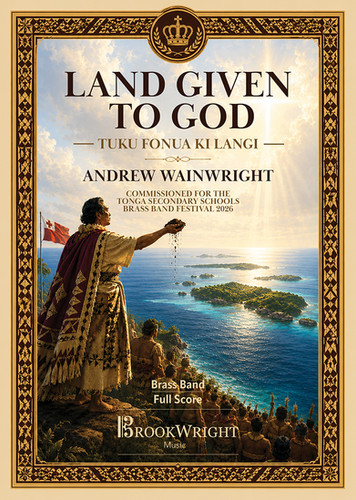 £48.56
Land Given to God (Tuku Fonua ki Langi) (Brass Band) Andrew Wainwright
Land given to God (Tuku Fonua ki Langi) is a landmark major test-piece for brass band celebrating Tongan faith, history, and cultural identity. Commissioned by Sione Malekamu Manu Jr for the Tonga Secondary School Music Festival, Land given to God marks a monumental achievement in Pacific music literature as the first major brass band test-piece written specifically for the Kingdom of Tonga. Commemorating two centuries of Christianity, this compelling four-movement work traces Tonga's journey from ancient traditions to its historic 1839 dedication to divine protection. The piece draws its principal thematic material from the beloved Tongan hymn Oku 'iai ha ki'i fonua 'oku tu'u 'i 'oseni. The work is divided into four through-composed movements: I. Koe Lotu Mu'a (The Old Religion): Grounded and ritualistic, this movement paints the ancient spiritual order of pre-Christian Tonga - a nation anchored in sacred ancestral tradition on the threshold of change. II. Koe Lotu Fo'ou (The New Religion): Captures a nation in transition, depicting the arrival of Wesleyan missionaries, the conversion of Taufa'ahau (King Siaosi Tupou I), and the powerful 1834 spiritual revival (To 'a e 'Ofa). III. Koe Sivi Fakaosi (The Final Test): A dramatic musical confrontation between doubt and conviction. It recounts the story of Christian teacher Pita Vi being cast into shark-infested waters as a test of faith, surviving unharmed to seal the King's devotion. IV. Koe Tuku Fonua ki Langi (Land Given to God): A solemn, declarative finale recounting the historic 1839 act at Pouono, where King Siaosi Tupou I offered the land and people of Tonga to the divine protection of Heaven. Duration: approx. 8.45 minutes Difficulty Level: 4th Section + This PDF download includes the full score and parts. Sheet music available at www.brassband.co.uk (UK) or https://satradecentral.org (USA) Instrumentation: Soprano Cornet Eb Solo Cornet Bb Repiano Cornet Bb 2nd Cornet Bb 3rd Cornet Bb Flugel Horn Bb Solo Horn Eb 1st Horn Eb 2nd Horn Eb 1st Baritone Bb 2nd Baritone Bb 1st Trombone Bb 2nd Trombone Bb Bass Trombone Euphonium Bb Bass Eb Bass Bb Percussion 1-3
In Stock: Estimated dispatch 1-3 working days
-
 £33.62
Love Eternal (Trombone Solo with Brass Band) Jarrod Cooper arr. Gavin Lamplough
Love Eternal was arranged by Gavin Lamplough for trombone virtuoso Isobel Daws to perform in a special concert with the Melbourne Staff Band to honour its Bandmaster Ken Waterworth, on the occasion of his retirement after 30 years of leading the band. The arranger uses Jarod Cooper's popular contemporary worship song King of Kings, Majesty as the basis for the work and the piece seeks to provide a vehicle for the rich timbres of the trombone to be enjoyed by the listener. To view a rolling score video featuring Isobel Daws and the Melbourne Staff Band please visit www.youtube.com/watch?v=AEpbHNFPMxs This title is also available as a tenor horn solo with brass band here. PDF download includes score and parts. Sheet music available from: UK - www.brassband.co.uk USA - https://satradecentral.org Difficulty Level: 4th Section + Length: 5.00 minutes Instrumentation: Trombone Soloist Eb Soprano Cornet Eb 1st Cornet Bb 2nd Cornet Bb Flugel Horn Bb 1st Horn Eb 2nd Horn Eb 1st Baritone Bb 2nd Baritone Bb 1st Trombone Bb 2nd Trombone Bb Bass Trombone Euphonium Bb Bass Eb Bass Bb Percussion 1-3
In Stock: Estimated dispatch 1-3 working days
-
 £37.35
March - New Jerusalem (Brass Band) Kenneth Downie
This sprightly march was the result of a request for a march in traditional style, incorporating a sacred tune that is popular in Holland. It was commissioned by Egbert Scheffer and Brass Band Valerius. The mood is distinctly chirpy and jovial, with a lightness of touch and a generous dose of good humour. This item will be ideal for bands looking for a new modern-day march to freshen up their concert programmes. Sheet music available from: UK - www.brassband.co.uk USA - www.solidbrassmusic.com Difficulty Level: 4th Section + Instrumentation: Soprano Cornet Eb Solo Cornet Bb Repiano Cornet Bb 2nd Cornet Bb 3rd Cornet Bb Flugel Horn Bb Solo Horn Eb 1st Horn Eb 2nd Horn Eb 1st Baritone Bb 2nd Baritone Bb 1st Trombone Bb 2nd Trombone Bb Bass Trombone Euphonium Bb Bass Eb Bass Bb Percussion 1-2
In Stock: Estimated dispatch 1-3 working days
-
 £29.88
March from 'The Love for Three Oranges (Brass Band) Prokofiev arr. Wilkinson
This thrilling brass band arrangement of the March from 'The Love for Three Oranges' by Prokofiev has been skillfully arranged by Keith M. Wilkinson. This setting captures the essence of the original orchestral work, while showcasing the power and brilliance of the brass band. In 1918, Sergei Prokofiev undertook his first visit to the United States. A number of concerts of his works were held in Chicago, which were received very favourably. As a result, the director of the Chicago Opera Association, Cleofonte Campanini, commissioned Prokofiev to write an opera. It just so happened that, during his trip, he had written a draft of a libretto, based on the Italian play by Gozzi, L'amore delle tre melarance, adding some additional surrealism to the text. Given Prokofiev's poor English, and Americans unlikely to accept an opera in Russian, French was his final choice. The result, L'amour des trois oranges (or The Love for Three Oranges), which premiered at the Auditorium Theatre in Chicago on 30 December 1921, conducted by Prokofiev himself. The March from this opera is probably the most familiar part and has been used by CBS in the radio-drama series The FBI in Peace and War. It was also used in films such as The Brink's Job and Prokofiev quoted it in the second act of his ballet Cinderella. To view a rolling score video of the work please visit www.youtube.com/watch?v=I136sf8hxlU Duration: Approx. 2.10 minutes Difficulty Level: 3rd Section + PDF download includes parts and score. Sheet music available from www.brassband.co.uk Instrumentation: Soprano Cornet Eb Solo Cornet Bb Repiano Cornet Bb 2nd Cornet Bb 3rd Cornet Bb Flugel Horn Bb Solo Horn Eb 1st Horn Eb 2nd Horn Eb 1st Baritone Bb 2nd Baritone Bb 1st Trombone Bb 2nd Trombone Bb Bass Trombone Euphonium Bb Bass Eb Bass BbTimpani Percussion 1-2
In Stock: Estimated dispatch 1-3 working days
 Watch video