
Results
-
 £29.88
Carol of the Bells - Brass Band (Traditional arr. Andrew Wainwright)
A colourful arrangement of the carol otherwise known as 'Ukranian Bell Carol'. "Andrew's treatment of 'Carol of the Bells', transforms a rather repetitive and uninspired ditty into a miniature, multi-layered jewell for brass band." Paul Hindmarsh, British Bandsman magazine For a follow-the-score video featuring Virtuosi GUS Band performing the work, please visit: https://www.youtube.com/watch?v=g753_aOqAqE Includes score and full set of parts. Sheet music available exclusively from World of Brass - www.worldofbrass.com Difficulty Level: 2nd Section + Instrumentation: Soprano Cornet Eb Solo Cornet Bb Repiano Cornet Bb 2nd Cornet Bb 3rd Cornet Bb Flugel Horn Bb Solo Horn Eb 1st Horn Eb 2nd Horn Eb 1st Baritone Bb 2nd Baritone Bb 1st Trombone Bb 2nd Trombone Bb Bass Trombone Euphonium Bb Bass Eb Bass Bb Timpani Percussion 1-2
In Stock: Estimated dispatch 1-3 working days
-
 £37.35
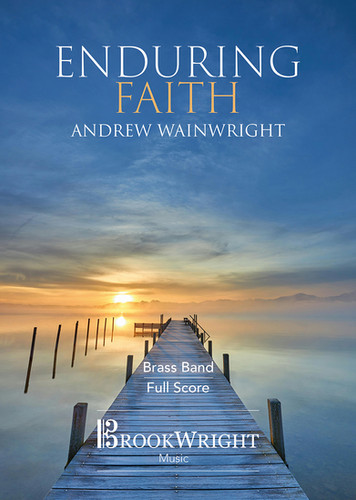
Enduring Faith (Brass Band) Andrew Wainwright
Enduring Faith was commissioned by Christopher Ward and the Five Lakes Silver Band and is a lyrical work for brass band that explores the intersection of hope, resilience, and conviction. Designed with a focus on melodic clarity and expressive phrasing, the composition moves through a series of nuanced emotional shifts - ranging from quiet, reflective passages to moments of expansive lyricism and affirmation. The harmonic structure travels through several keys, serving as a musical metaphor for the changing seasons of life. Throughout the piece, the texture is enriched by featured soloists from across the ensemble, including flugel horn, cornet, euphonium, baritone, and trombone. This work is dedicated to Doug and Stephanie Bayne, long-standing members of the Five Lakes Silver Band, in recognition of their commitment to their community and their steadfast support of the ensemble. It was recorded by the Five Lakes Silver Band on their 2025 album, Legacy. To view a video of the Five Lakes Silver Band performing the work please visit https://youtu.be/84NU_OXMs3Y Duration: Approx. 5.30 minutes Difficulty Level: 3rd Section + This PDF download includes the full score and parts. Sheet music available at www.brassband.co.uk (UK) or https://satradecentral.org (USA) Instrumentation: Soprano Cornet Eb Solo Cornet Bb Repiano Cornet Bb 2nd Cornet Bb 3rd Cornet Bb Flugel Horn Bb Solo Horn Eb 1st Horn Eb 2nd Horn Eb 1st Baritone Bb 2nd Baritone Bb 1st Trombone Bb 2nd Trombone Bb Bass Trombone Euphonium Bb Bass Eb Bass Bb Timpani Percussion 1-2
In Stock: Estimated dispatch 1-3 working days
-
 £33.62
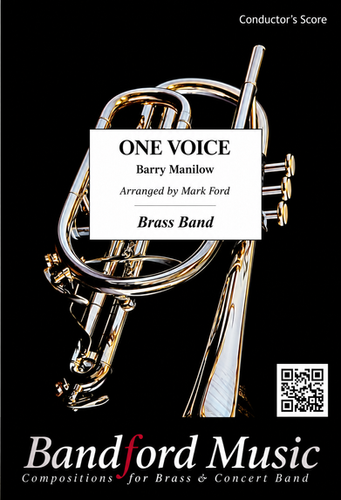
One Voice (Brass Band) Barry Manilow arr. Mark Ford
Originally released in 1979 as the title track of Barry Manilow's sixth studio album, One Voice has become an enduring anthem for unity and social courage. It is a stirring ballad that reminds us how a single, brave voice can ignite a chorus of solidarity and lead the way toward positive change. Expertly crafted for brass band by Mark Ford, this setting captures the intimate, soaring spirit of the original while leveraging the unique textures of the brass band. The piece begins with a delicate, lyrical flugel horn solo, representing the 'single voice' of the title. As the arrangement progresses, the rest of the ensemble joins in, building from a gentle accompaniment into a magnificent, wall-of-sound finale that is sure to leave your audience inspired. To view a rolling score video of the work please visit https://youtu.be/RcQ5xbnyNjs Duration: Approx. 3.15 minutes Difficulty Level: 4th Section + This PDF download includes the full score and parts. Sheet music available at www.brassband.co.uk (UK) or https://satradecentral.org (USA) Instrumentation: Soprano Cornet Eb Solo Cornet Bb Repiano Cornet Bb 2nd Cornet Bb 3rd Cornet Bb Flugel Horn Bb Solo Horn Eb 1st Horn Eb 2nd Horn Eb 1st Baritone Bb 2nd Baritone Bb 1st Trombone Bb 2nd Trombone Bb Bass Trombone Euphonium Bb Bass Eb Bass Bb Timpani Glockenspiel Percussion
In Stock: Estimated dispatch 1-3 working days
-
 £44.83
Symphonic Concert March (Brass Band) Bonelli arr. William Himes
Giouse Bonelli's stirring Symphonic Concert March has here been expertly arranged for brass band by William Himes. As the title implies, the Symphonic Concert March was intended for the concert hall. The compositional style is clearly derived from the Italian school of smooth, flowing melodies, clear contrapuntal lines, and contrasting rhythmic material, leaving no doubt as to Bonelli's traditional classical training. To view a rolling score video of Goteborg Brass Band performing the work please visit www.youtube.com/watch?v=JvUldbuuyIk PDF download includes score and parts. Sheet music available from www.brassband.co.uk Difficulty Level: 1st Section + Length: 6.20 minutes Instrumentation: Soprano Cornet Eb Solo Cornet Bb 1st Cornet Bb 2nd Cornet Bb Flugel Horn Bb Solo Horn Eb 1st Horn Eb 2nd Horn Eb 1st Baritone Bb 2nd Baritone Bb 1st Trombone Bb 2nd Trombone Bb Bass Trombone Euphonium Bb Bass Eb Bass Bb Timpani Percussion
In Stock: Estimated dispatch 1-3 working days
-
 £30.00
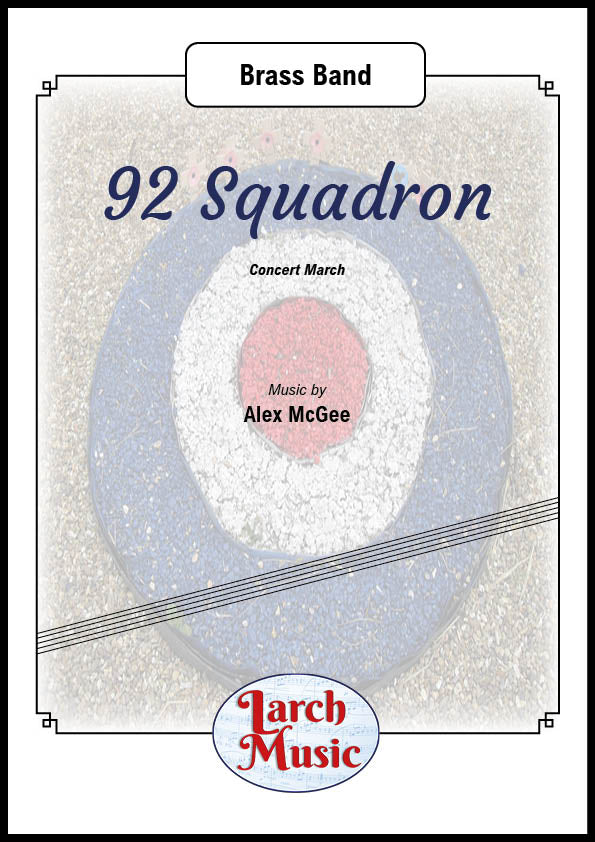
92 Squadron - Brass Band Sheet Music Full Score & Parts - LM372
COMPOSER: Alex McGeeA concert march for brass band dedicated to 92 SquadronNumber 92 Squadron, also known asNo. 92 (East India) Squadronand currently asNo. 92 Tactics and Training Squadron, of theRoyal Air Forceis a test and evaluation squadron based atRAF Waddington,Lincolnshire. It was formed as part of theRoyal Flying CorpsatLondon Colneyas a fighter squadron on 1 September 1917. It deployed to France in July 1918 and saw action for just four months, until the end of the war. During the conflict it flew both air superiority and direct ground support missions. It was disbanded atEilon 7 August 1919. Reformed on 10 October 1939,at Tangmere Airfield, the unit was supposed to be equipped with medium bombers but in the spring of 1940 it became one of the first RAF units to receive theSupermarine Spitfire, going on to fight in theBattle of Britain.LM372 - ISMN : 9790570003723
In Stock: Estimated dispatch 3-5 working days
-
 £30.00
Beguine (Neil Lock) - Brass Band Sheet Music Full Score & Parts - LM455 - Neil Lock
COMPOSER: Neil LockA delightful dance for brass band from the pen of Neil LockSuitable for most bandsLM455ISMN : 9790570004553
In Stock: Estimated dispatch 3-5 working days
-
 £10.00
Fanfare for Christmas - Tim Paton
A short fanfare created by Tim Paton for brass band, to begin your Christmas Concert, start the Carol Service, or welcome a special guest. Based on the well known carol "Good Christian Men Rejoice", this little number is a short and sweet, festive attention grabber.
In Stock: Estimated dispatch 3-5 working days
-
 £25.00
Folk Dance and Carol (brass band) - Tim Paton
A festive, musical cocktail by Tim Paton for brass band, bringing together a folk-feel dance motif and a familiar carol, to create the atmosphere of a village celebration.Opening with a lively Jig, where the music joyfully dances around the band, the piece then settles to offer the tranquility of Gustav Holst's beautiful melody In the Bleak Mid-Winter.This peacefulness is soon overtaken by the reintroduction of the dance motif, finishing off the musical celebration with the dance and the carol mingling together.A very nice addition to Christmas repertoire, presenting a little bit of tradition amidst some lovely, imaginative scoring.Also available for concert band.
In Stock: Estimated dispatch 3-5 working days
-
 £44.95
Clapp!!! (Brass Band - Score and Parts)
'Clapp!!!!' was originally written in 2006 whilst studying at the Royal Welsh College of Music and Drama and was written for two players at one piano. The music uses rhythmic phasing with each rhythm assigned it's own tone cluster - as each shift in rhythm occurs the harmonic structure is altered too. Melodic passages are created through the shifts in rhythm and harmony, but these only occur within the given rhythmic parameters. The music can very much be viewed as a study in momentum, with its unrelenting pulse driving us through the music.The Brass Band version of 'Clapp!!!!' was written for Manger Musikklag and Torstein Aagaard-Nilsen, receiving its premiere at the 2010 BrassWind Festival in Bergen, Norway. The Whitburn Band featured Clapp!!!! at their 2012 Brass in Concert programme and the piece was featured by the Grimethorpe Colliery Brass Band on their 'Grimethorpe Entertain' CD.
Estimated dispatch 7-14 working days
-
 £59.77
Diversions on Sine Nomine (Brass Band) Vaughan Williams arr. Mark Ford
Diversions on Sine Nomine is a substantial concert work for brass band, derived entirely from Ralph Vaughan Williams' celebrated hymn tune For All the Saints. Rather than a conventional set of variations, the work unfolds as a sequence of contrasting diversions, each reimagining aspects of the melody's character, harmony, and rhythmic potential. The opening establishes the noble and timeless quality of Sine Nomine before leading into episodes that explore a wide expressive range - from reflective and lyrical writing to passages of rhythmic energy and grandeur. Fragments of the hymn are continually transformed and re-contextualised, allowing the music to progress with clarity and purpose while maintaining a strong sense of structural coherence. Scored specifically with 3rd and 4th Section bands in mind, the work combines musical substance with practical playability. Idiomatic brass writing, transparent textures, and effective use of traditional band colours ensure musical impact without excessive technical demand. The final section brings the work to a broad and affirmative conclusion, reaffirming the dignity and enduring strength of Vaughan Williams' original melody. To view a rolling score video of the work please visit www.youtube.com/watch?v=Sth69ate-Cs Duration: 11.00 minutes Difficulty Level: 4th Section + This PDF download includes the full score and parts. Sheet music available at www.brassband.co.uk (UK) or https://satradecentral.org(USA) Instrumentation: Soprano Cornet Eb Solo Cornet 1&2 Bb Solo Cornet 3&4 Bb Repiano Cornet Bb 2nd Cornet Bb 3rd Cornet Bb Flugel Horn Bb Solo Horn Eb 1st Horn Eb 2nd Horn Eb 1st Baritone Bb 2nd Baritone Bb 1st Trombone Bb 2nd Trombone Bb Bass Trombone Euphonium Bb Bass Eb Bass Bb Timpani Percussion 1-2 Tuned Percussion
In Stock: Estimated dispatch 1-3 working days
